
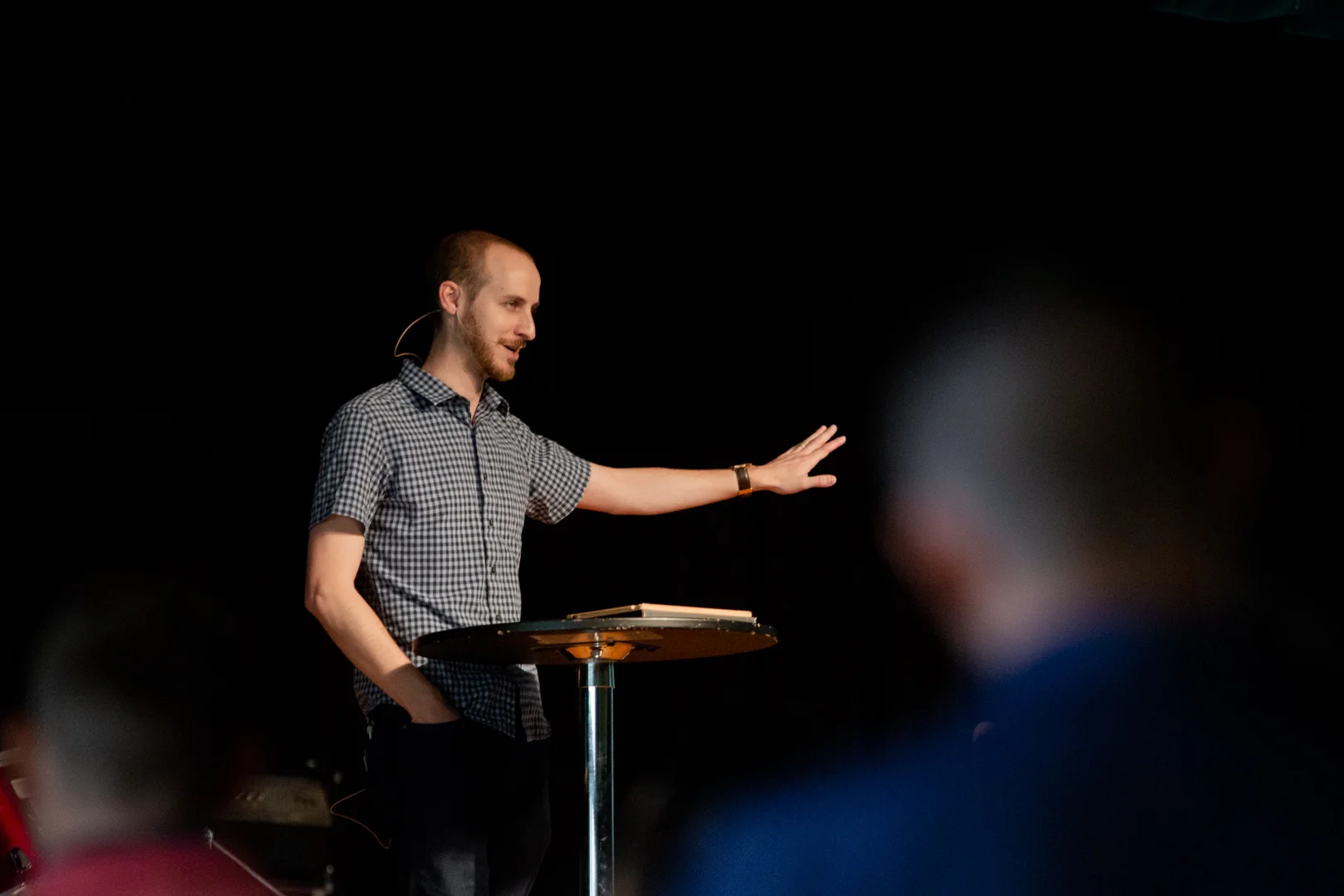
True Righteousness
Matthew 5:17-20
Jesus upholds and fulfills the Scriptures and welcomes us into the life of true righteousness
Matthew 5:17-20
February 17th, 2019 (*Note: No audio available)
Main Idea: Jesus upholds and fulfills the Scriptures and welcomes us into the life of true righteousness
I. Christ & The Bible (5:17-18)
Jesus begins by clarifying his relationship to the Scriptures and the OT Law; he has come not to “abolish” them (to destroy or to overthrow), but instead he came to “fulfill” them.
This means you can’t understand the Scriptures without understanding Jesus, and you can’t understand Jesus without rightly reading the Scriptures.
“When we start with Christ in the gospel and go back from there into the Old Testament, we find that the Old Testament eventually leads us back again to Christ.” ~ Graeme Goldsworthy
If Jesus is the fulfillment of the Scriptures, then the Scriptures must be upheld in their totality, even down to an “iota” (smallest letter in the Greek alphabet) and the “dots” (strokes that make up a letter).
Jesus’ coming and what he accomplishes does change our relationship to certain types of laws in the OT (ceremonial & civil), but the spirit of the Law is to be upheld in its deepest meaning.
Application: Are we reading the Bible as if it’s all about Jesus? Or are we reading the Bible like it is all about us?
“The Bible, then, is not a collection of Aesop-like fables, fictional stories that give us insights on how to find God and live right. Rather, it is both true history and a unified story about how God came to find us in the person of Jesus Christ, who lived and died in our place so we could be saved by grace through faith and live with him forever in a remade world, the Garden-City of God. From this basic plot there emerges profound insights, principles, and directives on how to live. But the Bible is not primarily about us and what we should do. It is first and foremost about Jesus and what he has done.” ~ Tim Keller
II. Christians & True Righteousness (5:19-20)
Since Jesus has come to fulfill the Law and since he upholds the entirety of the Scriptures, we should not seek to relax or work our way around them. To relax them will result in being the “least” of the Kingdom, because it will cause us to miss the King.
Verse 20 is a startling statement, since the Scribes and the Pharisees were the standard of righteous and faithful living in this time period. They were upheld as the great moral examples of their day and taught the people what God’s word says and what it requires.
However, Matthew 23 condemns the scribes & Pharisees for “cleaning the outside of the cup” but being filthy inside. He calls them “whitewashed tombs” who look good externally, but are actually dead inside.
The “righteousness” of the Scribes & Pharisees is only skin-deep; it is only focused on the externals rather than the whole person.
“The Sermon (on the Mount) in many ways is an epitome of a moral philosophy on what righteousness is…All the while, there is a subtle and powerful redefinition of what true righteousness is- it is not merely external piety but is the faithful purity and integrity of the inner person, the heart, as opposed to the Pharisees, whose righteousness is only skin deep… The ‘righteous’ person, according to Matthew, is the “whole” person, who does not only do the will of God externally but, most importantly, from the heart. This is both radically continuous with the ethics of the Jewish Scriptures and radically in conflict with Jesus’s debaters, the Pharisees” ~ Jonathan Pennington
There are two types of “righteousness” set up here:
Outside-In Righteousness (Pharisees)
Inside-Out Righteousness (Christians)
This “exceeding righteousness” is not a new set of behaviors or swapping out old actions for new ones. This is about becoming a new kind of person altogether. This exceeding righteousness is not about “being better” but rather about “becoming new.” The only way we can have this true righteousness is to receive it as a gift.
“The Pharisees and scribes were denounced by our Lord as being hypocrites. But they were unconscious hypocrites. They did not realize it, they really thought all was well. You cannot read your Bible without constantly being reminded of that terrible danger. There is the possibility of our relying upon the wrong thing, of resting upon things that relate to true worship rather than being in the position of true worship.” ~ Martyn Lloyd-Jones
Salt and Light
Matthew 5:13-16
Disciples of Jesus are salt and light, called to live distinct and compelling lives in the world.
NO AUDIO AVAILABLE
Matthew 5:13-16
February 10th 2019
“Christians are to live in such a way that as men and women look at us we become a problem to them. They will ask ‘What is it? Why are these people so different in every way, different in their conduct and behavior, and different in their reactions? There is something about them which we do not understand, which we cannot explain.’ And they will be driven to the only real explanation, which is that we are the people of God, the children of God.” ~ D. Martyn Lloyd-Jones
Main Idea: Disciples of Jesus are salt and light, called to live distinct and compelling lives in the world.
I. The Salt of the Earth (5:13)
Identity: Salt had over 10 uses in the ancient world, but it was primarily used as a preservative. You would rub salt into meat or fish and it would slow down the spoiling process.
Disciples of Jesus are to have an enduring, lasting, purifying effect on the world around them. God’s people alone are salt in this way. This is their identity as followers of Christ.
Implication: The world (the “earth”) is dying, decaying, and deteriorating. It cannot stop itself from this process of going bad. Something from the outside must prevent this spilling that will inevitably occur.
“Disciples of Jesus are called to be a moral disinfectant in a world where moral standards are low, constantly changing, or non-existent.” ~ R.V.G. Tasker
Warning: Salt can’t lose its “saltiness” strictly speaking, but it can be adulterated, contaminated, and diluted. The warning here is to fight against the temptation to simply assimilate into the world and the culture.
“The glory of the gospel is that when the Church is absolutely different from the world, she invariably attracts it. It is then that the world is made to listen to her message, though it may hate it at first” ~ D. Martyn Lloyd-Jones
We are called to be distinct from the world but we still must be in contact with it. Salt does nothing if it does not come into contact with the food.
“The world does not thirst for a religious imitation of itself, nor does it thirst for an “us against them” moral turf war with its zealous religious neighbors. The world thirsts for a different kind of neighbor- not the kind who deny their fellow man, take up their comforts, and follow their dreams- but the kind who deny themselves, take up their crosses, and follow Jesus in his mission of loving a weary world to life.” ~ Scott Sauls
II. The Light of the World (5:14-16)
Identity: Jesus gives imagery to his disciples being the “light of the world” in 2 ways. They are like:
1. A City Set on a Hill
2. A Lamp in a House
Disciples are the “light of the world” in a borrowed or a derivative sense from Jesus, who is himself the “light of the world” (cf. John 812). We must be “charged up” from the true light of the world, as we are conduits of this light to the world around us.
Implication: The world is a dark place. It needs something from the outside to shine a light into its own darkness.
Warning: We must fight the temptation to “conceal” the light (‘putting it under a basket”). We must avoid isolation from the world. Covering & concealing defeats the whole purpose of the light.
Light is inherently compelling. We are to “shine as lights” in the world (Phil. 2:15) the glories of the gospel as people who have been fundamentally changed by it.
“A Christianity that is without friction in the culture is a Christianity that dies… a Christianity that is walled off from the culture around it is a Christianity that dies… Our call is to a Christianity that preserves the distinctness of our gospel while not retreating from our calling as neighbors, friends, and citizens.” ~ Russell Moore
What happens as we live out this identity? People will see and encounter Jesus through his disciples. As God’s people declare the King and display the Kingdom, they will “give glory” to the Father in worship.
Practical Considerations:
We must remain in close proximity to Jesus
We are called to do this together
Start with the opportunities right in front of us
The Kingdom of Heaven
Matthew 5:1 (Sermon on the Mount)
Jesus is the fulfillment of the entire Biblical story, who declares and displays the Kingdom of Heaven in the Sermon on the Mount.
January 27th, 2019
Text: Matthew 5:1 (Introducing the Sermon on the Mount)
Introduction:
“The Sermon on the Mount is probably the best-known part of the teaching of Jesus, though arguably it is the least understood, and certainly it is the least obeyed.” ~ John Stott.
Main Idea: Jesus is the fulfillment of the entire Biblical story, who declares and displays the Kingdom of Heaven in the Sermon on the Mount.
I. A Greater Prophet (1:1-4:16)
The Gospel of Matthew serves as a perfect “bridge” between the Old & New Testament. He is concerned about how Jesus has come to “fulfill” all that has come before in the story.
Matthew 1:1: “The book of the genealogy (lit. “genesis’)” that connects Jesus into the promised royal lineage of David and the Father of the Israelites (Abraham) who was to be a blessing to all of the families of the earth (cf. Gen. 12:3).
Matthew’s greater concern in chapters 1-5 seems to connect Jesus’ story to Moses. There was messianic expectation concerning a prophet and redeemer who would come in the same way as Moses had (cf. Deuteronomy 18:15-19).
Similarities between Moses & Jesus:
Birth stories (Matt. 2:16-18/Ex. 1:15-2:10)
Traveling to Egypt (Matt. 2:13-15/Ex. 4:18-20)
Baptism & “passing through” the waters (Matt. 3:13-17/Ex. 14)
Led by the Spirit into the wilderness to face temptation (Matt. 4:1-11/Ex. 16)
“Like Israel, Jesus has a lengthy period of wandering in the desert. The Spirit leads him into a dry and barren place, in which he has to trust God for the provision of bread, resist evil, and stand on the testimony of Scripture. The specific temptations echo those that unraveled Israel: grumbling about the lack of food, testing God by demanding a miracle, bowing down to false gods, and seizing his inheritance before it was time. It is no coincidence that in all three of his temptations Jesus quotes Deuteronomy, the sermon Moses preached to remind Israel of their need for obedience. But Jesus succeeds where Israel failed. For all our familiarities with the exodus story in Scripture, we have never seen this before. The all-too-familiar biblical melody of failures has been transformed and turning into a song of hope.” ~ Andrew Wilson & Alastair Roberts
Going into a land that was promised (Matt. 4:13-16)
Jesus going up the mountain to teach from God’s Word (Matt. 5:1/Ex. 19)
What’s the point of all of this? Jesus is the continuation and the fulfillment of the whole Biblical story up to this point.
Jesus, as the greater Moses, is leading the captives into freedom. Moses came to rescue Israel from the bondage of physical slavery in Egypt, but Jesus comes to rescue his people from their bondage to sin & Satan (cf. Matt. 1:21). We are in need of this redeemer and this rescue if we are to live out The Sermon on the Mount.
II. A Greater Kingdom (4:17-5:1)
The summary of Jesus’ mission and ministry is found in 4:17: “Repent, for the Kingdom of Heaven is at hand.” Jesus announces that at his coming, the Kingdom of Heaven has broken in; the first step for us is to recognize that we are unfit to enter it.
“The life of heaven - the life of the realm where God is already king - is to become the life of the world, transforming the present earth into the place of beauty and delight that God always intended. And those who follow Jesus are to begin to live by this rule here and now. That's the point of the Sermon on the Mount… [it is] a summons to live in the present in the way that will make sense in God's promised future, because that future has arrived in the present in Jesus of Nazareth. It may seem upside down, but we are called to believe, with great daring, that it is in fact the right way up” ~ N.T. Wright
The Sermon on the Mount presents a holistic picture of what life in the Kingdom looks like as we await its arrival in fullness. The Sermon focuses on:
True Flourishing
True Righteousness
Practical Concerns
The Lord’s Prayer (6:9-13) sits at the center of the sermon intentionally. “The Lord’s Prayer stretches from the Father at the beginning to the devil at the end, from heaven to hell, and in between in six brief petitions everything important in life.” ~ Jonathan Pennington
The invitation extended to all of us is to move from being a part of the “crowd” to being a “disciple.” In this, we must acknowledge the feeling of condemnation the Sermon can bring, while simultaneously recognizing that it points to the source of power as we are drawn further into this life in the Kingdom.
“After nineteen hundred years the Sermon on the Mount still haunts men. They may praise it, as Gandhi did; or like Nietzsche, they may curse it. They cannot ignore it. Its words are winged words, quick and powerful to rebuke, to challenge, to inspire. And though some turn from it in despair, it continues, like some mighty magnetic mountain, to attract to itself the greatest spirits of our race, so that if some world-wide vote were taken, there is little doubt that men would account it ‘the most searching and powerful utterance we possess on what concerns the moral life.”~A.M. Hunter

The Spirit of Adoption
Romans 8:12-17
Though we were orphans, we have been adopted by God through Christ, making us fully and completely children of God.
Romans 8:12-17
January 20th, 2019
What is a Christian? The question can be answered in many ways, but the richest answer I know is that a Christian is one who has God as Father… If you want to judge how well a person understands Christianity, find out how much he makes of the thought of being God’s child, and having God as his Father. If this is not the thought that prompts and control his worship and prayers and his whole outlook on life, it means that he does not understand Christianity very well at all. - J.I Packer
Main Idea: Though we were orphans, we have been adopted by God through Christ, making us fully and completely children of God.
I. TRULY BROTHERS AND SISTERS (8:12-13)
To address the church in Rome as “brothers and sisters” was revolutionary in this context. The constant threat of division between Jews & Gentiles within the church is the single biggest issue of the New Testament outside of the gospel itself.
The question that looms over the early church and the New Testament: Are we really brothers? Are we really sisters? Is this really our family?
Paul urges the church to no longer live “according to the flesh” which always leads to tribalism. This looks like an “us” vs. “them” mentality that only ever goes skin-deep. And it leads to “death.”
We are a family not formed by the blood of biology but by the blood of the cross. Caring for orphans makes perfect sense when we grasp this. We are not the sum of our biological background or our biological family, no matter what that may look like.
John 20:17 Do not cling to me, for I have not yet ascended to the Father; but go to my brothers and say to them, ‘I am ascending to my Father and your Father, to my God and your God.
II. TRULY SONS (8:14-15)
Paul strikes at the heart of what it means to be “spiritual” here. The primary work of the indwelling Holy Spirit is to instill a deep sense within us that God is indeed our Father. The Spirit works to confirm this identity in us.
Adoption is a choice, not an obligation. This should confirm to us that God does not merely “tolerate” or “put up” with us, but he views us as beloved sons and daughters.
The Spirit here leads our souls to cry out “Abba! Father!” Abba is a term of intimacy, but this is more intense than a childish babble. It is a cry (or a scream or “groan” cf. 8:26) of desperation toward our Father, realizing he is the only hope that we have in this face of brokenness.
The only way that we are given this identity and this privilege is because Jesus himself became an orphan for us. He was adopted into an earthly family, cries out in the garden of Gethsemane “Abba!” and on the cross “My God, my God, why have you forsaken me?”
…But all they knew was the orphanage. It was filthy, but they had no other reference point. It was home. They are now thoroughly Americanized, perhaps too much so, able to recognize the sound of a microwave ding from forty yards away. I still remember, though, those little hands reaching for the orphanage. And I see myself there. - Russell Moore
Growing in Christ means leaving behind what we know as “home” and what is comfortable, which is always scary. But when we leave behind what is “comfortable” for what God is calling us to, we leave behind the spirit of slavery to fear and instead move toward our eternal family and the true Kingdom. This is where our true identity is found.
III. TRULY HEIRS (8:16-17)
The issue of inheritance was far more than receiving a lump sum of money when a relative died in the 1st century; inheritance was tied up to your livelihood and lineage far more than we can imagine today.
Paul assures us that we are “heirs” of God and “co-heirs” with Christ. This means that we are going to inherit the whole world alongside Jesus, receiving the very same blessing that is given to him from God the Father. But this is all in the context of family.
The picture that Paul is painting: though we were orphans- though we were not the “natural-born” children- God has made us truly brothers and sisters; we truly have God as our Father; we are truly heirs of God. This should be hard for us to believe.
The picture we get of the Kingdom of God is a bunch of adopted children.
It is not a matter of “if” God has called us to orphan care but rather “how” he has called us to this.
This mission of the church is to declare and display the gospel to the “least” of these, because Jesus is there with them (Matt. 25:40).
More important than your name, however, is hearing it called out by the One you’ve come to know, or rather who has come to know you. When you see him for the first time face-to-face, when your legal adoption is fully realized, the Spirit within you will cry out, “Abba! Father!” And you’ll hear another voice, louder than all the others, cry out the same thing. You’ll turn to see him, the Messiah of Israel, the Emperor of the universe, Jesus of Nazareth. And you’ll call him “Brother" - Russell Moore

Holding Fast Together
Hebrews 10:19-25
God’s faithfulness toward us in Christ bonds us into a family that is called to hold fast together.
Hebrews 10:19-25
January 13th, 2019
What happens to the church in this environment? It’s not that suddenly all the sanctuaries are emptied and the church gets rejected. Instead, the people who continue to attend church do so because they believe the church can help them find and express themselves. Religiosity doesn’t disappear; it morphs into something adaptable, something you embrace on your own terms. Faith is no longer focused on reality or something true; it’s a therapeutic choice intended to aid you in your pursuit of self-exaltation and self-fulfillment. - Trevin Wax
Main idea: God’s faithfulness toward us in Christ bonds us into a family that is called to hold fast together.
I. THE BASIS OF OUR FAMILY (10:19-21)
The “holy places” here is a reference to the innermost part of the tabernacle/temple, that was only accessible to the High Priest once a year on the Day of Atonement. It was unaccessible and dangerous.
But now, the author urges this community that they have “confidence to enter” this place. How is that possible?
They have confidence through the blood of Jesus, who, through his death, has torn the curtain that separated mankind from the presence of God
Because of this work, Jesus now serves as our High Priest, interceding and pleading on our behalf before God.
Application:
These verses push back on a rugged individualism in 2 ways:
1. This pushes us to define our identity upward, not inward. (Cf. Colossians 3:1-4)
2. Jesus as our High Priest is connecting us to the community of the Trinity. Community is not merely a good suggestion: it’s at the center of God Himself.
II. THE BEHAVIOR OF OUR FAMILY (10:22-25)
How do we actually access the presence of God? How do we take advantage of our confidence to enter this holy place? The author makes it clear that it is only through one another. The family of the church is where the presence of God is seen and experienced.
This section is framed by 3 exhortations to the community:
1. We draw near (10:22).
We do so with “true’ (sincere, genuine) hearts, with full confidence, because our hearts have been sprinkled clean & made new. But we must draw near together.
In friendship, we think we have chosen our peers. In reality, a few years difference in the dates of our births, a few more miles between certain houses, the choice of one university instead of another...the accident of a topic being raised or not raised at a first meeting--any of these chances might have kept us apart. But, for a Christian, there are, strictly speaking, no chances. A secret master of ceremonies has been at work. Christ, who said to the disciples, "You have not chosen me, but I have chosen you," can truly say to every group of Christian friends, "You have not chosen one another but I have chosen you for one another." The friendship is not a reward for our discriminating and good taste in finding one another out. It is the instrument by which God reveals to each of us the beauties of others. - C.S Lewis
2. We hold fast (10:23)
We don’t do this very well on our own, however. We need one another to remind us that God is faithful and that He will bring to completion the good work that has begun in us (Cf. Phil. 1:6).
3. We consider one another (10:24-25)
To “stir up” literally means “to irritate” or “agitate.” We need people in our lives who can have the hard conversation with us, and to speak the truth in love
In all of this, we cannot neglect meeting together. We must fight to show up. There were some in this community who were neglecting this. Do we have margin for one another?
So then, what if the Church became the first place, instead of the last place, that people went looking for family? What if the Church was filled with unmarried people but had no “single” people, because unmarried people were as family to each other, and surrogate brothers and sisters and mothers and fathers and sons and daughters to the rest of the Church? What if the Church was the place where no parent felt the burden of having to raise children alone, and where every child had hundreds of mothers and fathers and grandmas and grandpas and aunts and uncles and big sisters and brothers? What if it were true that God sets the lonely in families? What if the Church was the place where anyone in the world could find refuge and solace from the age-old curse—first uttered into Paradise—that it is not good to be alone? - Scott Sauls

A Greater Worship
Psalm 103
We are called to worship with our all because of who God is and what God has done.
Psalm 103
January 6th, 2019
Here's something else that's weird but true: in the day-to day trenches of adult life, there is actually no such thing as atheism. There is no such thing as not worshipping. Everybody worships... And the compelling reason for maybe choosing some sort of god or spiritual-type thing to worship is that pretty much anything else you worship will eat you alive. If you worship money and things, if they are where you tap real meaning in life, then you will never feel like you have enough. It's the truth. Worship your own body and beauty and sexual allure and you will always feel ugly, and when time and age start showing, you will die a million deaths before they finally plant you. On one level, we all know this stuff already... The trick is keeping the truth up front in daily consciousness… The insidious thing about these forms of worship is not that they are evil or sinful; it is that they are unconscious. They are default settings. They’re the kind of worship you just gradually slip into, day after day, getting more and more selective about what you see & how you measure value without ever being fully aware that’s what you’re doing. - David Foster Wallace
Main Idea: We are called to worship with our all because of who God is and what God has done.
I. What is Worship? (103:1-2)
This Psalm opens in a strange way for 2 reasons:
1. The Psalmist is talking to himself.
2. The Psalmist is asking us to “bless” the Lord instead of the other way around.
Worship is ascribing ultimate value to an object and engaging your mind, your heart, and your will- your whole being, as you do it. It is using your entire person to ascribe ultimate value to some object - Tim Keller
When we consider all who God is and all he has done, it is an invitation for all that I am to respond. Worship engages our entire being: our head, heart, and hands.
The first act of worship is to “forget not” (to remember). We are a people prone to forget and are in constant need to remember the Lord (cf. 2 Peter 1:3-9)
Application: Do we have this proactive posture toward worship? Do we recognize that worship is a battle?
II. Why Should We Worship God? (103:3-18)
The Psalmist gives three overarching categories here:
1. We remember the works of the Lord (103:3-5)
He forgives, heals, redeems, crowns, satisfies, and renews us. We find all of these benefits and works supremely in Jesus Christ.
2. We remember the character and nature of the Lord (103:6-13)
The Lord is a righteous and gracious Father toward his children.
David is remembering the scene at Mount Sinai after the Exodus from Egypt, where the Lord “made known his ways to Moses” (v. 7), but also where the Israelites sin in creating & worshipping a golden calf.
Despite our sin, the Lord in his steadfast love removes our transgressions as “far as the east is from the west,” separating them infinitely far from one another.
3. We remember who we are in light of who the Lord is (103:14-18)
Pride and an elevated view of the self will wage war against a proper worship of God.
We are merely dust, grass, and flowers when compared to God, which should produce the “fear of the Lord” within us.
Application: Habits, rhythms, and remembering.
Meditation is listening to your heart, then arguing with your heart with the truth, and then praying it hot in the presence of God. - Tim Keller
III. Who is Called to Worship? (103:19-22)
The Psalmist moves from his own soul to progressing to a collective “our,” to ending with a vision of all of creation joining in on this worship of God. Since the Lord has established his throne and his kingdom rules over all, nothing short of of the worship of all of creation will suffice.
Application: Are we participating and pointing others to this worship through declaring and displaying the gospel?

The First Christmas
Luke 1:46-55
Christmas is good news of great joy for all people and is an invitation to respond in worship
Luke 2:8-20
December 24th, 2018
Main Idea: Christmas is good news of great joy for all people and is an invitation to respond in worship
I. THE CONTENT OF CHRISTMAS (2:8-12)
The response to an experience with God’s “glory” in Scripture is always the same: fear (Cf. Isaiah 6). When we are confronted with God’s holiness and majesty, we realize that we, as humans, are neither of these things.
The message of Christmas is that “mega-fear” will give way to “mega-joy,” because a Savior, Christ the Lord, is born.
Christmas is not simply about a birth, but about a coming - Tim Keller
This good news of great joy is truly for all people. Shepherds, the first to hear of this good news, were viewed with great disdain and suspicion in this society. God purposely comes to the lowly and downcast in society, rather than to royalty or the elite.
II. THE BATTLE-CRY OF CHRISTMAS (2:13-14)
When the Scriptures describe the heavenly “host,” it is in reference to a military unity or an army, not a heavenly choir. The Shepherds are now witnessing a battle-cry of a multitude of the heavenly army.
These angels are making a declaration of war on evil, sin, and death. The coming of the Savior means that peace is coming to a world that desperately needs it.
Christmas means peace on earth, but this peace comes at a cost. The battle here will not be won with swords and ancient warfare but through the perfect life and suffering of the very son of God.
III. THE CALL OF CHRISTMAS (2:15-20)
Christmas is an invitation for all of us to “go and see this thing which the Lord has made known to us.”
Christmas calls together a group of imperfect people gathered around a perfect savior, and the same thing is still happening today.
This first gospel community responds to the message of the shepherds in 3 ways:
1. Wonder & Amazement (2:18)
2. Treasuring & Pondering (2:19)
The more we look at [the incarnation], the more we are astonished; the more we become accustomed to it, the more have we a sense of its surpassing splendor of love and grace. There is more of God’s glory and majesty to be seen in the manger and the cross, than in the sparkling stars above, the rolling deep below, the towering mountain, the teeming valleys, the abodes of life, or the abyss of death. Let us then give ourselves up to holy wonder, such as will produce gratitude, worship, love, and confidence, as we think of that great “mystery of godliness, God manifest in the flesh
3. Glorifying & Praising (2:20)
All of this adds up to worship. The good news of Christmas is an invitation to let this good news of great joy permeate all of life.

The Ancient, Present, and Future King
Micah 5:1-5a
Jesus is the promised King whose peaceful reign is ancient, present, and future
Micah 5:1-5a
December 16th, 2018
In a very real sense, the Christian community lives in Advent all the time. It can well be called the Time Between, because the people of God live in the time between the first coming of Christ, incognito in the stable in Bethlehem, and his second coming, in glory, to judge the living and the dead… Advent contains within itself the crucial balance of the now and the not-yet that our faith requires…. The disappointment, brokenness, and pain that characterizes life in this present world is held in dynamic tension with the promise of future glory that is yet to come. In that Advent tension, the church lives its life. - Fleming Rutledge
Main Idea: Jesus is the promised King whose peaceful reign is ancient, present, and future
I. THE PROMISED ANCIENT KING (5:1-2)
Micah describes a scene where troops have surrounded Jerusalem and their King is being humiliated by the enemy. This ought to humble the people of Israel, but they continually ignore gracious warnings from God.
The King described in verse 2 stands in stark contrast to the weak & humiliated King of Israel. 3 things we learn about this coming Ruler & Messiah:
1. He will be born in Bethlehem
2. He will serve God faithfully
3. He is from “old, from ancient days”
Though this King is “born,” he is actually “ancient.” This is what we celebrate at Christmas: the incarnation of Christ is God himself coming in the flesh. Strikingly, he comes not in strength but in weakness, born as a baby, born in a small, meager town, and born into a poor family.
“Christ is always born in Bethlehem among the little ones. Big hearts never get Christ inside of them; Christ lives not in great hearts, but in little ones. Mighty and proud spirits never have Jesus Christ, for he comes in at low doors, but he will not come in at high ones. He who has a broken heart, and a low spirit, shall have the Savior, but none else
— Charles Spurgeon
The message of Christmas forces us to life our eyes from the cradle to the cross.
“There has never been a gift offered that makes you swallow your pride to the depths that the gift of Jesus Christ requires us to do. Christmas means that we are so lost, so unable to save ourselves, that nothing less than the death of the Son of God himself could save us. That means you are not somebody who can pull yourself together and live a moral and good life. To accept the true Christmas gift, you have to admit you’re a sinner. You need to be saved by grace. You need to give up control of your life
— Tim Keller
II. THE ALREADY & NOT YET KINGDOM (5:3-5A)
The reign and rule of this Messiah here can be difficult to locate temporally; some of the descriptions seem like past events, some present, and some in the future. This tension captures the “already” but “not yet” of the Kingdom of God.
Three aspects of the rule and reign of the Messiah are seen in these verses:
1.The Nature of His Rule (5:4a)
He will rule like a shepherd (cf. John 10:11), caring for his flock in toughness & tenderness.
2. The Extent of His Rule (5:4b)
He will be great “to the ends of the earth,” the vision that is realized fully at the end of the Scriptures (cf. Rev. 7:9ff)
3. The Results of His Rule (5:5a)
His people will “dwell secure” because “he shall be their peace.”
Are you at peace this Christmas season? Is your soul at rest? True peace will not be found in temporary things or in better circumstances; it can only be found in him. Christmas forces us to ask: Is Jesus your King? Is Jesus your peace?

The Son Born and Begotten
Matthew 1:18-25
The Son Born and Begotten.
Matthew 1:18-25
December 9th, 2018