
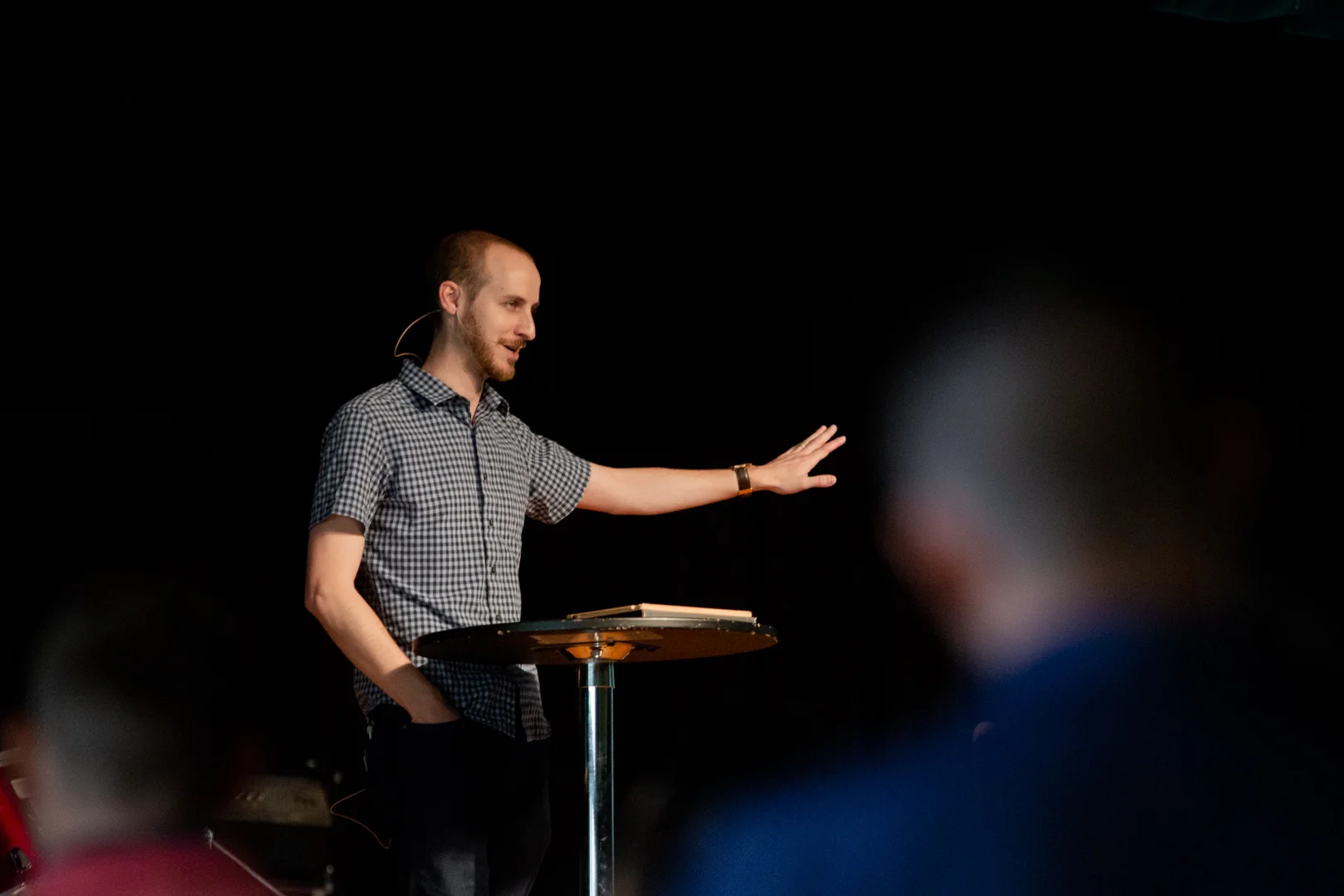

The Invitation of the Kingdom
Matthew 22:1-14
Only those who respond appropriately to the invitation of the king will enter the Kingdom.
Matthew 22:1-14
October 6th, 2019
Main Idea: Only those who respond appropriately to the invitation of the king will enter the Kingdom.
I. Rejecting the Invitation (22:1-7)
This is the third consecutive parable Jesus tells in response to the chief priests, elders, and religious leaders (cf. 21:23). Theses stories seem to be purposely escalating:
A father asks his two sons to work (21:28-32)
A landowner asks his tenants to gather what is rightfully his own (21:33-46)
A king is inviting guests to a royal wedding for his son
Jesus is clearly comparing the Kingdom of Heaven to a wedding feast; ancient weddings were a multi-day party and celebration, and a royal wedding would have been a national event and the finest of all occassions.
When the king sends his servants to call those who had been invited, they shockingly “would not come.” The king is extremely patient and sends out another round of servants, but they “paid no attention.” They were preoccupied with their own interests (farming and business) and turned down the invitation of a lifetime.
Others respond with extreme hostility and treat the servants “shamefully and killed them.” The religious leaders (those who are the first guests invited in the parable) are going to do this very thing toward Jesus in a mere 3 days from the telling of this story.
“It is not as if God is offering some piddling meal in exchange for all. That would certainly be worth making excuses to avoid. The feast God offers in Christ is not the lentil stew, good for a temporary quelling of a hunger pang, but all the attendant honors of the birthright, good for an eternity of unassailable joy. When people reject the gospel, it is precisely because they do not perceive the reality of the kingdom it proclaims.” ~ Jared Wilson
Have you responded to the invitation of the King? The banquet feast is set before us because of the finished work of Christ, and we are invited to join the party. Have you delayed and made other priorities more important?
Acts 17:30–31: “The times of ignorance God overlooked, but now he commands all people everywhere to repent, because he has fixed a day on which he will judge the world in righteousness by a man whom he has appointed; and of this he has given assurance to all by raising him from the dead.”
II. Receiving the Invitation (22:8-10)
In the face of this rejection, the king now sends his servants out to the “main roads” to invite others. The king is now inviting the non-elites of society; they would be the ordinary, poor, and outcasts (Lk. 14:21), all unlikely recipients of an invitation to a royal wedding.
This is precisely what was happening as Jesus brought the message of the Kingdom: the religious elites continually rejected his message but those who knew their desperate need for mercy and forgiveness responded with joy.
Matt. 21:31: … Jesus said to them, “Truly, I say to you, the tax collectors and the prostitutes go into the kingdom of God before you.”
Matthew 9:11–13: And when the Pharisees saw this, they said to his disciples, “Why does your teacher eat with tax collectors and sinners?” But when he heard it, he said, “Those who are well have no need of a physician, but those who are sick. Go and learn what this means: ‘I desire mercy, and not sacrifice.’ For I came not to call the righteous, but sinners.”
Those who are “worthy” were the people who saw this invitation from the king as an undeserved honor and a privilege, and who joyfully drop everything to join the party. The Kingdom of Heaven will be full of people who can’t believe they are in the party.
“Those ladies and gentlemen who were first invited, if they had come to the wedding, would have seated themselves there in a very stiff and proper manner… Did you ever attend a breakfast or a dinner of beggars? Did you ever see a company of very hungry people feeding to their heart’s content? They make a merry clatter; they are not muzzled by propriety; they are glad at the sight of every dish... The dull monotony of respectability knows no joy like that which comes to poverty when it feasts to the full at the table of bounty.” ~ Charles Spurgeon
Do you have this kind of joy?
Who are the people around you who need this kind of joy and an invitation to the wedding feast?
III. Robed in Righteousness (22:11-14)
In the ancient world, a wedding garment would have been very expensive, often upwards of 2-3 month’s wages. The assumption of the story is that the king himself provided the garments for these guests who came right away to the prepared feast.
The gospel in the parable of the wedding feast is this: Jesus invites us to come as we are, but the king must clothe you at the door. You have to enter wearing his robes, not your own.
There is a seemingly throwaway comment made earlier that helps emphasize and explain this ending. As the servants go out to the main roads and gather all they could find, they invited “both bad and good” (22:10). It is not your moralism or religion that gets you in, and it is not your immorality or your irreligion that keeps you out. The gospel is something else altogether!
The imagery of “clothing” throughout the Bible helps us see the beauty of this:
Genesis 3:7, 21: Adam & Eve cover themselves inadequately with fig leaves, but the Lord provides a better garment through the death of another to cover their shame
Isaiah 61:10, 64:6: Though our own good deeds are a “polluted garment,” the Lord clothes with “the garments of salvation” and with the “robe of righteousness”
Revelation 7:9, 19:13: A great multitude is gathered before the throne of God in white (pure) robes, because the kingly robe of Jesus has been dipped in blood.
The entrance to the feast and the continuing enjoyment of it is not about being “good” or “bad” but instead about being robed with the righteousness of Christ, evidenced by a changed life full of repentance and faith.
This man who is caught without the appropriate garment makes no defense for his actions. He insulted the king by presuming upon his kindness; he assumed he could come and stay just as he was. But this confuses the true nature of the invitation (cf. Rom. 2:4-5).
“There is a difference between this wide-open invitation and the message so many want to hear today. We want to hear that everyone is all right exactly as they are; that God loves us as we are and doesn’t want us to change. People often say this when they want to justify particular types of behavior, but the argument doesn’t work. When the blind and lame came to Jesus, he didn’t say, ‘You’re all right as you are’. He healed them. They wouldn’t have been satisfied with anything less. When the prostitutes and extortioners came to Jesus he didn’t say, ‘You’re all right as you are’. His love reached them where they were, but his love refused to let them stay as they were. Love wants the best for the beloved. Their lives were transformed, healed, changed.” ~ N.T. Wright
Many are called, but only a few accept the invitation and respond appropriately; the wedding feast is laid before us: Have we accepted the invitation? Are we dressed in his righteousness alone? Are we wearing and trusting something else?

The Sons, the Servants, and the Stone
Matthew 21:23-46
Whoever you are, you will not be rid of Jesus. He will eventually expose you for who and what you truly are. And that will either be the worst thing or the best thing that ever happens to you.
Matthew 21:23-46
Main Idea: Whoever you are, you will not be rid of Jesus. He will eventually expose you for who and what you truly are. And that will either be the worst thing or the best thing that ever happens to you.

The Parable of the Laborers
Matthew 20:1-16
The Parable of the Laborers
*For more information on Pastor Winston Miller & Grace Life Church, visit their website here: www.gracelifefl.com
Matthew 20:1-16
September 22nd, 2019

Forgiveness in the Kingdom
Matthew 18:21-35
Those who grasp the enormity of their own forgiveness in Christ will then offer forgiveness to others.
Text: Matthew 18:21-35
Main Idea: Those who grasp the enormity of their own forgiveness in Christ will then offer forgiveness to others.
I. The Forgiveness of the King (18:21-27)
As the King is settling accounts, a servant is called before him who owes 10,000 talents. A “talent” is the largest denomination of currency in the Roman Empire, worth an estimated 20 years of wages. 10,000 talents would have been an insurmountable debt.
Since the servant can’t settle his debt, he and his family are ordered to be sold into slavery, a common practice in the ancient world for those who could not pay back a debt. This man does not seem to grasp the severity of the situation, however. He didn’t need patience, he needed forgiveness.
As the servant pleads his case, the King does the unthinkable and forgives him of this massive, insurmountable debt. He does so in 3 steps (18:27):
He has pity (a deep compassion felt on the “inside”)
He cancels the debt (he absorbs the cost himself)
He releases him (he lets him go free)
Just like the servant, we have an insurmountable debt before God because of our sin. The King’s actions toward this servant are a picture of God’s posture toward us in the gospel. Jesus has “pity” on an undeserving humanity, he absorbs the cost of our debt himself on the cross, and he sets us free to love and serve him as citizens of the Kingdom of Heaven.
Colossians 2:13–14: And you, who were dead in your trespasses… God made alive together with him, having forgiven us all our trespasses, by canceling the record of debt that stood against us with its legal demands. This he set aside, nailing it to the cross.
Is this your story? Or are we, like the servant, begging for “more time” and trying to resolve our spiritual bankruptcy ourselves rather than asking for forgiveness?
II. The Unforgiveness of the Servant (18:28-34)
This turn in the parable is meant to stir up outrage in the hearer. It was unthinkable for this servant to act this way toward a “fellow servant” after he had just been forgiven himself. A “denarius” was a day’s wage, so this fellow servant owed him roughly 3-months of wages. Though this was not an insignificant amount of money, it was nothing compared to the 10,000 talents that had just been forgiven.
Paul Tripp describes some of the reasons why we are drawn to the posture of unforgiveness in our relationships:
Debt gives us a perceived power
Debt gives us a sense of superior identity
Debt gives us a feeling of entitlement
Debt puts us in God’s position
The problem is that these perceived “benefits” cannot deliver on their promises. The longer that we refuse to forgive and we harbor resentment, the more we are becoming like the evil that was wrongly done to us.
Romans 2:4: Or do you presume on the riches of his kindness and forbearance and patience, not knowing that God’s kindness is meant to lead you to repentance? But because of your hard and impenitent heart you are storing up wrath for yourself on the day of wrath when God’s righteous judgment will be revealed.
There are consequences for presuming upon the kindness of the king in this way. “Jailers” is literally “torturers” in the Greek. The intensity of this description points to the end of unforgiveness. All unrepentant sin eventually leads to torment as it disrupts and fights against God’s good design.
We have two choices when we are sinned against:
We can choose not to forgive and demand full restitution. The problem here is that it is usually impossible when the “debt” can’t be easily measured or calculated.
We can choose to forgive and absorb the cost of the debt against us. We can do this knowing that God does not overlook sin, as it will be dealt with either on the cross or on the last day.
Both forgiveness and unforgiveness hurt and are a form of suffering, but only one of them leads to a resurrection as we are empowered by Christ. “Unforgiveness is a relief that brings lasting hurt, but forgiveness is a hurt that brings lasting relief.” ~ John Onwuchekwa
The question that is posed to all of us: “Shouldn’t you have had mercy on your fellow servant just as I had on you?” (18:33) The only way to truly and fully forgive others is to be moved and empowered by the mercy we’ve received in Jesus Christ.
III. The Life of Forgiveness in the Kingdom (18:35, 21-22)
There is an assumption here that the Kingdom of Heaven is marked by a life of forgiveness amongst its citizens. Forgiveness is the entrance to the Kingdom and it is the ethic that sustains the relationships within it.
True forgiveness must be “from your heart” (18:35), not partially or begrudgingly. This whole-hearted forgiveness is necessary because Jesus indicates that we will be judged on the basis of our forgiveness or lack of forgiveness of others.
“Jesus is not saying that God’s forgiveness is conditional upon our forgiving others. What He is saying is that the pride which keeps us from forgiving is the same pride which keeps us from accepting forgiveness.” - Frederick Buechner
Forgiveness does not mean “forgiving and forgetting” nor does it mean enabling harmful or abusive behavior. The passage immediately before this reminds the church of the importance of accountability and church discipline (Mt. 18:15-20). Forgiveness often deals more with you than the other person, and wisdom sometimes dictates that a fully restored relationship may not be possible (cf. Rom. 12:18).
Jesus’ response to Peter (18:21-22) is an indication that God’s people need to be ready and eager to forgive. This should be our default as we have experienced the grace of God. Jesus is warning that if you are counting, you’re not really forgiving. You’ve missed the point.
Colossians 3:12–13: Put on then, as God’s chosen ones, holy and beloved, compassionate hearts, kindness, humility, meekness, and patience, bearing with one another and, if one has a complaint against another, forgiving each other; as the Lord has forgiven you, so you also must forgive.

The Free but Costly Pursuit
Matthew 13:44-46
The Kingdom of Heaven is free, but it’s not cheap.
“When we hear a parable, we nod in agreement because the story is true to life and readily understood. Although the application of the parable may be heard, it is not always grasped. We see the story unfold before our eyes, but we do not perceive the significance of it. The truth remains hidden until our eyes are opened and we see clearly. Then the new lesson of the parable becomes meaningful.”
-Simon J. Kistemaker
Main Idea: The Kingdom of Heaven is Free, but it’s Not Cheap
Matthew 13:44-46
“The kingdom of heaven is like treasure hidden in a field, which a man found and covered up. Then in his joy he goes and sells all that he has and buys that field. “Again, the kingdom of heaven is like a merchant in search of fine pearls, who, on finding one pearl of great value, went and sold all that he had and bought it.
I. The Goods
“The phrasing tells us something else important, however, It is not personal fulfillment or individual salvation that is like a treasure or a pearl of great price - it is ‘the kingdom’. The kingdom is certainly not less than personal fulfillment and individual salvation, but it is most definitely more. And understanding this is essential to understanding what makes the treasure of Christ so surpassingly valuable. It is not simply forgiveness of sins and assurance of heaven that trusting in Christ brings - as wonderful and generous as those gifts are! It is so much more. ‘He who did not spare his own Son but gave him up for us all, how will he not also with him graciously give us all things? (Rom. 8:32). What we receive in receiving Christ is his kingdom. The manifest reign of God takes dominion in our hearts as it goes about subduing the entire earth.” -Jared C. Wilson
II. The Encounters
III. Implication for us
1. How do you see the kingdom?
2. Are there competing treasures?
3. Are you hedging your bets?
“…if it costs you everything you have, it’s worth it. Notice two things: The man sold everything he had, and he did it with joy. ‘In his joy he goes and sells all that he has and buys that field.’ The kingdom of God is so valuable that losing everything on earth, but getting the kingdom, is a happy trade-off. That’s the main point.” -John Piper
Philippians 3:7-8
But whatever gain I had, I counted as loss for the sake of Christ. Indeed, I count everything as loss because of the surpassing worth of knowing Christ Jesus my Lord. For his sake I have suffered the loss of all things and count them as rubbish, in order that I may gain Christ
Mark 10:28-30
Peter began to say to him, “See, we have left everything and followed you.” Jesus said, “Truly, I say to you, there is no one who has left house or brothers or sisters or mother or father or children or lands, for my sake and for the gospel, who will not receive a hundredfold now in this time, houses and brothers and sisters and mothers and children and lands, with persecutions, and in the age to come eternal life.
“He is no fool who gives what he cannot keep to gain what he cannot lose.” - Jim Elliot
“Doing God’s work doesn’t mean that you’re promised complete safety or guaranteed you’ll see immediate results. But there is immense assurance that you’re following the Lord God Almighty whose plans are far greater than anything you could imagine. Even though my father and his fellow missionaries’ lives were taken, their work among the Auca Indians was far from over. My mother (and other missionaries) picked up where they left off, living and working among her husband’s murderers. God used her obedience and faithfulness to ultimately reach and transform the tribe for Jesus Christ.” -Valerie Elliot Shepard, daughter of Jim Elliot
Philippians 1:21-24
For to me to live is Christ, and to die is gain. If I am to live in the flesh, that means fruitful labor for me. Yet which I shall choose I cannot tell. I am hard pressed between the two. My desire is to depart and be with Christ, for that is far better. But to remain in the flesh is more necessary on your account.
Will you buy that field? Will you go all in?

The Unlikely and Unstoppable Kingdom
Matthew 13:31-35
Though it begins in obscurity, God will expand his Kingdom far and wide through ordinary, unlikely means.
Matthew 13:31-35
August 25th, 2019
Main idea: Though it begins in obscurity, God will expand his Kingdom far and wide through ordinary, unlikely means.
I. The Unimpressive Beginning of the Kingdom (13:31-32a, 33a,)
Jesus compares the Kingdom of Heaven to:
A grain of a mustard seed (13:31-32), “the smallest of all seeds” that is planted in the ground.
Leaven (13:33), which is mixed into dough in order to make bread rise.
These two illustrations are teaching the same truth: the Kingdom of Heaven is initially not much to look at. It is seemingly insignificant. It is not impressive and many will not pay any attention to it.
Luke 17:20–21: Being asked by the Pharisees when the kingdom of God would come, he answered them, “The kingdom of God is not coming in ways that can be observed, nor will they say, ‘Look, here it is!’ or ‘There!’ for behold, the kingdom of God is in the midst of you.”
This seemingly obscure and insignificant beginning to the Kingdom fits the picture we have of:
Jesus (Isa. 53:2-3): Jesus’ ordinary life, humble appearance, and unlikely crowning moment of glory (crucifixion & resurrection) were unexpected by those hearing about the Kingdom.
The Disciples & God’s People (Acts 4:13; Deut. 7:7): They were “uneducated” and “common men” who had no pedigree to lead a revolution.
Us (1 Cor. 1:26-29): God purposely chooses what is small & insignificant in the world to make his glory & kingdom known.
II. The Unstoppable Growth of the Kingdom (13:32b, 33b)
Revisiting the two images in the parables reveals that despite small and insignificant starting points, massive growth occurs.
The mustard seed grows into a tree that is taller than all the other garden plants so that the birds find shelter in its branches.
The leaven mixes in with “three measures” of flour (~50 pounds) and yields enough bread to feed close to 100 people.
Jesus says this is exactly how the Kingdom of Heaven works; although it is unimpressive to begin with, God will cause it to grow far and wide and it will be a pervasive influence in all the world. The “birds” in the Old Testament represent the nations being welcomed into God’s people, while the massive yield of bread points to provision made available for many.
Ultimately, all of this growth really has nothing to do with us. Jesus has promised that he will build his church (Matt. 16:18), and that nothing will prevail against it. This is precisely what has happened since the resurrection and even into our world today (cf. Acts 1:6-8). Do we trust him to carry out his promise?
“If we were designing a movement to take over the world and claim dominion over the universe, you would not come up with Christianity.” ~ Jared Wilson
III. The Upside-Down Life of the Kingdom (13:34-35)
How do we live within this unlikely and unstoppable kingdom? 3 implications for us to consider:
1. Embrace Obscurity
This is not about hiding the gospel but rather the posture of our own souls. We crave big, fast, and famous, all of which can pull us away from the Kingdom described in these parables which grows slowly and steadily.
We should not “despise the small things” (Zech. 4:10), but instead realize that we tap into the true power of the gospel when we are “small” (John 3:30).
2. Find Beauty in the Ordinary
The work of planting seed and baking bread is incredibly ordinary. Farming and baking were some of the most common tasks for men and women respectively in this time period. Jesus is intentionally using the ordinary to draw our attention to the beauty that is found there.
"A sign hangs on the wall in a New Monastic Christian community house: 'Everyone wants a revolution. No one wants to do the dishes.’ I was, & remain, a Christian who longs for revolution, for things to be made new & whole in beautiful and big ways. But what I am slowly seeing is that you can't get to the revolution without learning to do the dishes. The kind of spiritual life & disciplines needed to sustain the Christian life are quiet, repetitive, and ordinary. I often want to skip the boring, daily stuff to get to the thrill of an edgy faith. But it's in the dailiness of the Christian faith - the making the bed, the doing the dishes, the praying for our enemies, the reading the Bible, the quiet, the small --that God's transformation takes root and grows.” ~ Tish Warren
Finding beauty in the ordinary means a commitment to the means of grace that the Lord has given us, including reading Scripture, praying, corporate worship, and living in community. Though these are “quiet, repetitive, and ordinary,” God uses them to reveal himself and to transform us.
3. Live with Gospel Intentionality
While there are moments of revival throughout church history (and it is not inappropriate to pray for this to occur), the normative way the Kingdom grows is through God changing the world one person at a time.
“The bedrock of gospel ministry is low-key, ordinary, day-to-day work that often goes unseen. Most gospel ministry involves ordinary people doing ordinary things with gospel intentionality.” ~ Tim Chester & Steve Timmis
How would our lives look if we really lived as if Jesus was king over it all - the big and the small? Would anything change if we viewed all of life as an opportunity to declare and display the gospel?
Jesus taught in parables in order to reveal what has been “hidden since the foundation of the world” (Ps. 78:2). Though the Kingdom began in obscurity, it has expanded far and wide. What had been “hidden” was Christ, and he now has been revealed and invites us to trust him and to turn to him as the King who was and is to come.

The Expectations of the Kingdom
Matthew 13:24-30, 36-43
Jesus calls us to be patient and realistic while we await the hope of his return.
Matthew 13:24-30, 36-43
August 18th, 2019
Main idea: Jesus calls us to be patient and realistic while we await the hope of his return
I. The Adversity of the Kingdom (13:24-28a, 36-39a)
This parable also includes a “sower” (farmer) who plants good seed in his field. However, an “enemy” comes and plants weeds amongst the wheat in an attempt to sabotage the harvest. Jesus helpfully explains what each of these components represents:
The Farmer/Sower = Jesus (The Son of Man)
The field = the world
The good seed (wheat) = the sons of the Kingdom (Christians)
The weeds = the sons of the evil one
The enemy = the Devil
The parable indicates that the Kingdom Jesus is bringing will face adversity almost immediately from a real enemy. There is someone at work to actively try and thwart the plans of the farmer.
Ephesians 6:12: For we do not wrestle against flesh and blood, but against the rulers, against the authorities, against the cosmic powers over this present darkness, against the spiritual forces of evil in the heavenly places.
“There are two equal and opposite errors into which our race can fall about the devils. One is to disbelieve in their existence. The other is to believe, and to feel an excessive and unhealthy interest in them. They themselves are equally pleased by both errors and hail a materialist or a magician with the same delight.” ~ C.S. Lewis
Do we really believe that there is a real enemy out there? How would that change our day-to-day lives? How would it affect our friendships? How would it change our prayers?
"Prayer is a wartime walkie talkie for spiritual warfare, not a domestic intercom to increase the comforts of the saints.” ~ John Piper
Despite this adversity, it does not overcome the farmer or jeopardize his work. He calmly recognizes the reality of the enemy without panicking. This is because in the Kingdom of God, evil is turned upside-down and used for God’s purposes. The kingdom itself is inaugurated through the crucifixion of Christ.
All of this means that we should not be surprised by evil; this does not mean that we become hardened or numb to evil, but we should recognize that this world is not the way it is supposed to be.
II. The Waiting of the Kingdom (13:28b-30a)
The workers ask the reasonable question: “Do you want us to go and gather them (the weeds)?” The answer from the farmer would have been a surprise: he says that they should be left alone until the harvest.
Jesus is confronting a misunderstanding about the Kingdom of God. Many of the Jewish people in the 1st century were awaiting a Messiah who would come and overthrow the Romans and all enemies who stood opposed to God’s people. Jesus indicates that the Kingdom of God is not going to be that simple.
The question being asked by the workers is the same question that runs deep within all of us: Why does God allow evil to continue? Why doesn’t he just put an end to it all?
The parable hints at a few answers:
The Farmer does not want to harm the wheat (13:29). The weeds are “darnel” which look almost indistinguishable from the wheat at first.
The Farmer himself will separate the wheat from the weeds at the end (13:30). It is not our role to take the place of God in making eternal judgments of others.
Why does the Lord seemingly delay the harvest at the “end of the age”?
2 Peter 3:8-9: But do not overlook this one fact, beloved, that with the Lord one day is as a thousand years, and a thousand years as one day. The Lord is not slow to fulfill his promise as some count slowness, but is patient toward you, not wishing that any should perish, but that all should reach repentance.
Jesus is calling his people to a patient waiting for the Kingdom to come in its fullness. But this is not an endless or eternal waiting; there is a day coming where all will be made clear
III. The Hope of the Kingdom (13:30b, 39b-43)
Jesus’ explanation of the parable of the weeds is overwhelmingly focused on what will happen at the end. He is reminding the citizens of the Kingdom that their hope is not in present circumstances but in the sure promise of what is to come.
The ultimate hope is that one day God will deal with “all causes of sin and all law-breakers.” All the effects of the curse of sin will be wiped away as Jesus makes all things new.
This hopeful day is also a sober day for those who have rejected the King and his gospel message, as their decision will be affirmed for eternity. Jesus speaks symbolically to describe a very real place, where there will be sorrow, suffering, and despair.
For God’s people, they will be gathered into the barn (the Father’s house), and they will “shine like the sun,” a picture of being gloriously distinct. What has been hidden will now be made gloriously clear for all to see.
“It may be possible for each to think too much of his own potential glory hereafter; it is hardly possible for him to think too often or too deeply about that of his neighbor. The load, or weight, or burden of my neighbor’s glory should be laid daily on my back, a load so heavy that only humility can carry it, and the backs of the proud will be broken It is a serious thing to live in a society of possible gods and goddesses, to remember that the dullest and most uninteresting person you talk to may one day be a creature which, if you saw it now, you would be strongly tempted to worship, or else a horror and a corruption such as you now meet, if at all, only in a nightmare. All day long we are, in some degree, helping each other to one or other of these destinations.” ~ C.S. Lewis
Jesus ends by saying “he who has ears, let him hear.” The only way to have a patient, enduring, realism in this kingdom is if we trust the Farmer. Do you listen to his words?Do you trust the Farmer?

Rightly Hearing Jesus
Matthew 13:1-23
We must consider if we have truly heard and understood the gospel or if we have not really heard it at all.
Matthew 13:1-23
August 11th, 2019
Main idea: We must consider if we have truly heard and understood the gospel or if we have not really heard it at all.
“The stories Jesus told are insertions of powerful truth meant to shake people awake. They are smart bombs, full of explosive life to those who would embrace the power behind them. The way these stories upend life as we know it is spiritually discombobulating, but for those with the eyes to see and ears to hear, the parables give great comfort. They are snapshots of the blessed hope, visions of the now-dawning future. The way they turn life inside out shows us in fact how life was ill-fitting all along. The parables show us the glory of the Lord who was and is to come.” ~ Jared Wilson
I. The Parable of the Sower (13:1-9)
By this point in the gospel of Matthew there is increasing opposition toward Jesus, his message of the Kingdom, and his teaching about what it really means to be a disciple. Great crowds continue to gather around him, but Jesus wants to make sure they are following him for the right reasons.
With this great crowd gathered on the beach, Jesus tells a parable about a farmer who went out to sow seeds. He is describing a practice that would have been familiar to most in the crowd (“broadcast farming”). As the seed is tossed out by hand, it lands in different places:
Some seeds fell “along the path” (13:4), and is immediately eaten by the birds with no chance to grow.
Some seeds fell “on rocky ground” (13:5-6), and though it immediately sprung up, it had no root and quickly withered in the sun.
Some seeds fell “among thorns” (13:7) which eventually “choke” out the seed as they compete for soil, water, and sunlight.
Some seeds fell “on good soil” (13:8), finding rich, fertile grounds for the seeds to take root and to produce a crop.
II. The Purpose of the Parables (13:10-17)
The disciples sense that the way Jesus is teaching is “cryptic” to some, including his puzzling statement in verse 9: (“He who has ears, let him hear.”) Jesus’ response to their question indicates that his parables have a mysterious way of simultaneously concealing and revealing.
Jesus warns here that there is a way to “see” without really seeing, and a way to “hear” without really hearing. To truly listen means to be focused, attentive, and fully engaged. He quotes Isaiah 6:9-10 to show that for those who are already set against Jesus and his Kingdom, the parables serve to blind, deafen, and harden “dull” hearts.
1 Corinthians 1:18: For the word of the cross is folly to those who are perishing, but to us who are being saved it is the power of God.
So how do we actually get this understanding? How can we rightly see, rightly hear, and actually understand? There are two hints here that will be more fully developed as he explains the Parable of the Sower
1. It must be given (13:11a). This is all the grace of God; it cannot be earned or assumed.
1 Corinthians 2:12-14: Now we have received not the spirit of the world, but the Spirit who is from God, that we might understand the things freely given us by God. And we impart this in words not taught by human wisdom but taught by the Spirit, interpreting spiritual truths to those who are spiritual. The natural person does not accept the things of the Spirit of God, for they are folly to him, and he is not able to understand them because they are spiritually discerned.
The Holy Spirit takes our ears and our hearts which are tone-deaf to the things of God, and “tunes” them so that we might actually understand its meaning and significance.
2. It must come from recognizing the King and his Kingdom (13:11b)
The parables of Jesus are overwhelmingly focused on the Kingdom of God/Heaven, and are meant to describe what life looks like within this kingdom that came in surprising and unexpected ways. The “secrets” of the kingdom are not mysteries to crack with a special code, but ultimately are revealed in Jesus Christ.
III. Proper and Improper Hearing (13:18-23)
Having explained the purpose behind the parables, Jesus now turns to his disciples to explain the Parable of the Sower. In doing so, he is providing a map which invites us to consider our current response and to move toward the “good soil.”
In the parable, there are three improper ways to “hear,” none of which lead to true understanding.
1. The Careless Hearer (13:19): The way a “path” is forged is through people constantly walking on it. There is a warning of familiarity here; there is a way to “hear” the gospel over and over again but harden your heart against it.
"There is such a thing as being 'gospel-hardened': it is possible to sit under sermons till your heart becomes dead, and callous. ... never startled, never astonished. ... you come (to church) but yet the tear does not trickle down your cheek, your soul never seems to mount up to heaven on the wings of praise, nor deep mourning over sin. Your heart is iron…unless God himself shall be pleased to crack it in sunder with an earthquake, or with a heart-quake, there will never be room for the seed of heaven to lodge there." ~ Charles Spurgeon
2. The Superficial Hearer (13:20-21): What appears to be a genuine response to the gospel here is actually “hollow” and “empty,” as there is no root. Tribulations and persecutions quickly reveal that the hearer has allegiance elsewhere, and only followed when it was convenient.
3. The Distracted Hearer (13:22): Just as the thorns will choke out the seed, competing loves and values in our lives can prevent the gospel from taking root. If we have distracted and divided priorities that compete with Jesus, he will be left out.
The danger of the superficial & distracted hearer is that they initially seem to spring up in true faith, but they will not last. Jesus is warning that it is not the profession of faith that matters, but perseverance in faith.
4. The Right Hearer (13:23): The one who hears the word, understands the word, and bears fruit. This is the disciple who has been transformed from the inside out because the gospel has taken root in their heart and is now bearing fruit.
Ultimately, this parable should make us consider: Have I really heard Jesus? Have I rightly responded to the word of the kingdom? Is there evidence of fruit in my life?
In all of this we must remember that Jesus is the farmer and we are the soil. It is his work that brings about spiritual life from this seed. If we really “understand with our hearts,” then we will turn to him (13:15), allowing him to break up the rocky soil, crush all competing desires, and to transform our lives to bear fruit.

The Compassion of God
Jonah 4:1-11
We are called to have the same concern as God does for the lost and for the nations
Jonah 4:1-11
August 4th, 2019
We are called to have the same concern as God does for the lost and for the nations
I. Jonah’s Pouting (4:1-5)
Jonah should have been exceeding glad for what happened in Nineveh, but instead he is “exceedingly angry.” Jonah’s prayer reveals that his frustration is with God’s grace, mercy, and steadfast love (cf. Exodus 34:6) being offered to Nineveh, Israel’s enemy. He does not think they are worthy of this treatment.
Jonah’s prayer reveals he has a heart full of self-righteousness, which is the primary barrier the Scriptures to understanding and receiving the grace offered in the gospel. “Self-righteousness” can be defined as a trust in either who you are or what you do for salvation and right-standing before God.
Self-righteousness is dangerous in at least 3 ways:
It makes us fragile (4:3)
It makes us blind to our own sin & idolatry (4:3-4)
“If love for your country’s interests leads you to exploit people or, in this case, to root for an entire class of people to be spiritually lost, then you love your nation more than God. That is idolatry, by any definition... Jonah’s rightful love for his country and people had become inordinate, too great, rivaling God.”~ Tim Keller
It makes us feel superior to others (4:5)
Luke 5:31–32: Jesus answered them, “Those who are well have no need of a physician, but those who are sick. I have not come to call the righteous but sinners to repentance.”
II. God’s Pity (4:6-11)
The Lord is not yet done with his prophet; he sovereignly “appoints” a plant, and then subsequently a worm and a scorching east wind to counsel Jonah to the place where he can see his own sin laid bare.
After God has Jonah’s attention, he delivers a power-packed point of rebuke to his prophet (4:10-11). God is asking Jonah: Do you really care more about the plant than the people who make up the city of Nineveh?
“By contrasting Jonah’s attitude to the [plant] with his attitude towards the Ninevites, God highlights where the real absurdity lies. Jonah is filled with compassion regarding a mere plant, yet remains hard-hearted towards the entire population of a city. He shows concern for one small item of God’s creation, yet fails to care for a large mass of people, who, like Jonah himself, were made in the divine image. The inconsistency rests not with God but with Jonah.” ~ T. Desmond Alexander
Jonah looks at the Nineveh from a place of anger and judgment, but God looks at the city and has pity on their ignorance (“who do not know their right hand from their left”). Though they are not innocent (God has called them to repent), they are lost, and God’s posture toward the city and its well-being (down to the cattle) is one of compassion.
The Hebrew for “pity” is loaded with emotion; it means to have a deep compassion, even to the point of weeping. God looks upon Nineveh and is moved to the point of grief over their lostness; his heart is drawn toward the city and its inhabitants.
“The basis for mission is that “Christ Jesus came into the world to save sinners.” (1 Tim. 1:15). Jonah is told to leave his world of comfort to bring God’s message to people he hated, and he ran the other way (Jon. 1:1-3). Jesus left the beauty and glory of heaven for people who hated him, to love them to himself (Rom. 5:8). Jonah tucked himself under the shade of a tree to protect and comfort himself. Jesus was hung on a tree to protect and shelter us from the judgment to come. Jonah stood outside the populated city to condemn it. Jesus was dragged outside the city to be condemned so we would never taste condemnation (Rom. 8:1-2).” ~ Scott Saul
III. Our Priority (4:11)
The cliffhanger ending of Jonah confronts us to answer the very same question: Is our heart for the lost and for the nations more like God’s or Jonah’s?
If we zoom out from Jonah, we see that this story fits within the broader story of Scripture. The Bible consistently tells us that God is going to make his glory and salvation known among all the nations.
Genesis 12:3: “...and in you [Abraham] all the families of the earth shall be blessed.”
Isaiah 42:6, 49:6: “I will give you as a covenant for the people, a light for the nations... that my salvation may reach to the end of the earth”
John 10:16: “And I have other sheep that are not of this fold. I must bring them also, and they will listen to my voice. So there will be one flock, one shepherd.”
Matthew 28:18-20: And Jesus came and said to them, “All authority in heaven and on earth has been given to me. Go therefore and make disciples of all nations…”
Acts 1:8: “But you will receive power when the Holy Spirit has come upon you, and you will be my witnesses in Jerusalem and in all Judea and Samaria, and to the end of the earth.”
Revelation 7:9-10: “After this I looked, and behold, a great multitude that no one could number, from every nation, from all tribes and peoples and languages, standing before the throne and before the Lamb, clothed in white robes, with palm branches in their hands, and crying out with a loud voice, “Salvation belongs to our God who sits on the throne, and to the Lamb!”
Our future is an eternity with saints from every nation, tribe, people, and languages worshipping the Lamb who was slain who is now the King of all kings. And we get to participate in this! Our priority as the church is to declare and display the good news of Jesus to the ends of the earth as we are compelled by Christ.
What is our posture toward the lost and toward the nations? We live in a day and age where nationalism is on the rise and cultural and racial tensions are high; we must be careful that we are informed by and faithful to the Word of God and the commissioning of Christ above everything else.
“It may be that in the years to come this warning note from Jonah’s experience will be an urgent one for us to hear. Churches must never be conditioned by national environment rather than by the word of the gospel. But the kind of prejudices, which come to the surface in waves of nationalism, lie in the heart at all times. Prejudices – that is for the Christian, judgments and opinions which are formed without knowledge of the circumstances, and not from the standpoint of God’s Word – can daily drive us from the love of our fellows, and from the service of God. Our prejudices need to be exposed, just as they were in Jonah’s life. Once exposed, they must be destroyed by grace.” ~ Sinclair Ferguson
The cliffhanger ending of Jonah does beg the question: does Jonah ever get it? Does he ever repent? The biggest evidence of Jonah’s repentance is the very existence of this book. Jonah, in raw honesty, revealed to us what was going on in his heart as he wrestles with God. His repentance is hope for our repentance.

The Greater Miracle of Mercy
Jonah 3:1-10
1. Jonah announced the message God gave him
2. The people of Nineveh believed God and repented
3. God saw what the people did and relented on His plans to destroy them
Jonah 3:1-10
July 28th, 2019
What happened at Nineveh?
1. Jonah announced the message God gave him
2. The people of Nineveh believed God and repented
3. God saw what the people did and relented on His plans to destroy them
Jonah preaches
Then the word of the Lord came to Jonah the second time, saying, “Arise, go to Nineveh, that great city, and call out against it the message that I tell you.” So Jonah arose and went to Nineveh, according to the word of the Lord. Now Nineveh was an exceedingly great city, three days' journey in breadth. Jonah began to go into the city, going a day's journey. And he called out, “Yet forty days, and Nineveh shall be overthrown!” (Jonah 3:1-4)
The people of Nineveh believe God
And the people of Nineveh believed God. They called for a fast and put on sackcloth, from the greatest of them to the least of them. The word reached the king of Nineveh, and he arose from his throne, removed his robe, covered himself with sackcloth, and sat in ashes. And he issued a proclamation and published through Nineveh, “By the decree of the king and his nobles: Let neither man nor beast, herd nor flock, taste anything. Let them not feed or drink water, but let man and beast be covered with sackcloth, and let them call out mightily to God. Let everyone turn from his evil way and from the violence that is in his hands. Who knows? God may turn and relent and turn from his fierce anger, so that we may not perish.” (Jonah 3:5-9)
God relents on His plans to destroy
When God saw what they did, how they turned from their evil way, God relented of the disaster that he had said he would do to them, and he did not do it. (Jonah 3:10)
Then some of the scribes and Pharisees answered him, saying, “Teacher, we wish to see a sign from you.” But he answered them, “An evil and adulterous generation seeks for a sign, but no sign will be given to it except the sign of the prophet Jonah. For just as Jonah was three days and three nights in the belly of the great fish, so will the Son of Man be three days and three nights in the heart of the earth. The men of Nineveh will rise up at the judgment with this generation and condemn it, for they repented at the preaching of Jonah, and behold, something greater than Jonah is here. (Matthew 12:38-41)
Jesus confronts a GREATER DOOM
Jesus is a GREATER RESCUER
Jesus delivers a GREATER SIGN
Jesus offers a GREATER INVITATION