
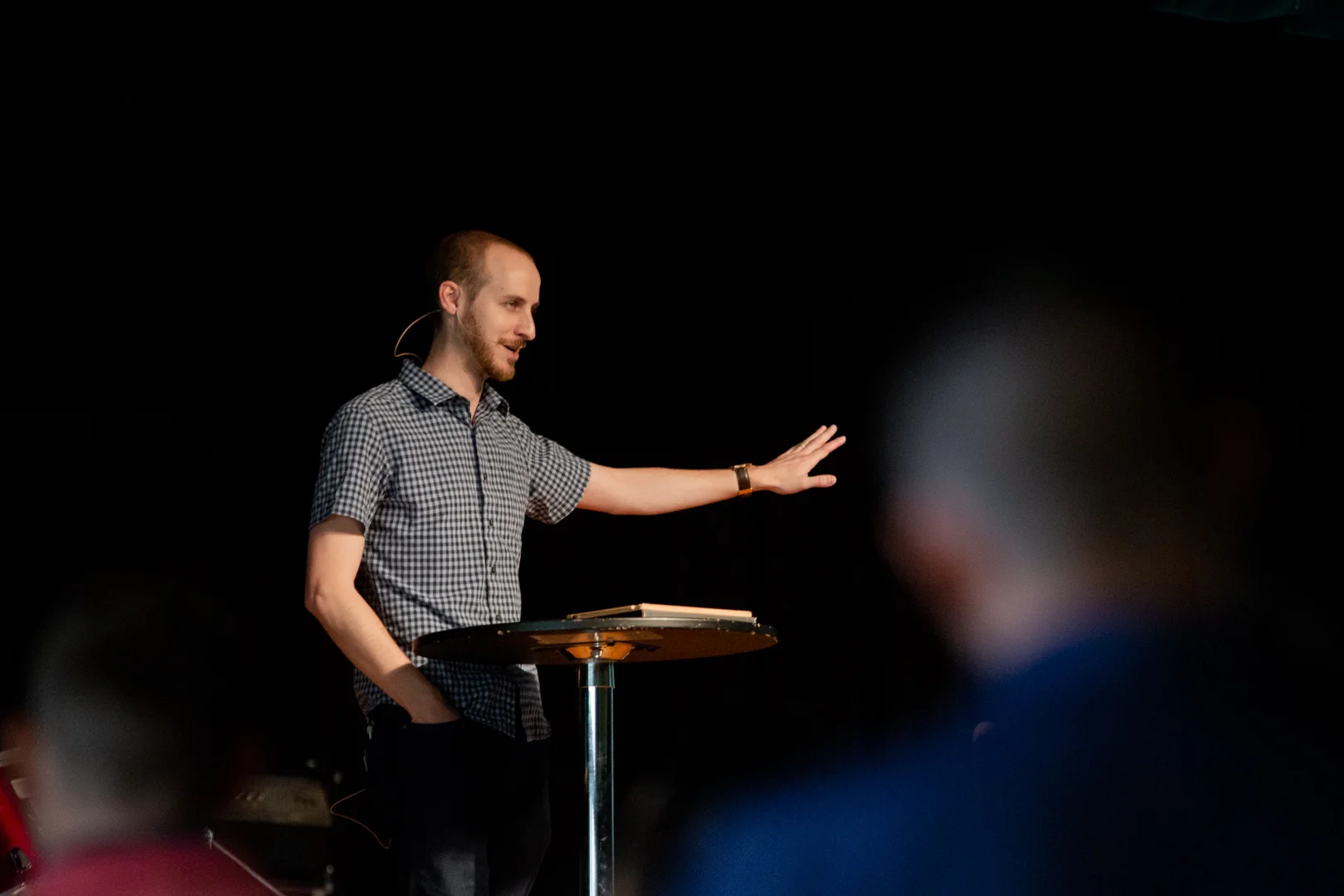

Wisdom From Above
James 3:13-18 | True wisdom is a gift from heaven above, shown by a life of personal humility & relational peace.
Wisdom From Above
James 3:13-18
“Knowledge these days is very easy to come by – almost too easy, given the flood of search results for almost any word or phrase you can imagine. But you can’t search for wisdom – at least not online. And it’s as rare and precious as ever… Wisdom is not just knowledge – mastering information about particular aspects of the world. Wisdom is understanding. It’s the kind of understanding, specifically, that guides action. It’s knowing, in a tremendously complex world, what the right thing to do is – what will be most honoring of our Creator and our fellow creatures.” ~ Andy Crouch
Main Idea: True wisdom is a gift from heaven above, shown by a life of personal humility & relational peace.
I. Wisdom & Her Deeds (3:13)
Wisdom is not seen in intellect or knowledge alone, but through a life of “good conduct” shown in the “meekness of humility.” As Jesus taught, “wisdom is justified by her deeds” (Mt. 11:19), not in talk or knowledge alone.
“Good conduct” can also be translated as “good life.” The truly wise will live in such a way that iit showcases the true “good life” of the Kingdom of God.
1 Pet. 2:12: Keep your conduct among the Gentiles honorable, so that when they speak against you as evildoers, they may see your good deeds and glorify God on the day of visitation.
The good life of wisdom in the gospel is marked by “meekness” (or humility). The way of wisdom is the way of meekness because this is at the very heart of Jesus himself, who is wisdom revealed in the flesh (Matt. 11:29).
“Meek. Humble. Gentle. Jesus is not trigger-happy. Not harsh, reactionary, easily exasperated. He is the most understanding person in the universe. The posture most natural to him is not a pointed finger but open arms…‘Gentle and lowly.’ This, according to his own testimony, is Christ’s very heart. This is who he is. Tender. Open. Welcoming. Accommodating. Understanding. Willing. If we are asked to say only one thing about who Jesus is, we would be honoring Jesus’ own teaching if our answer is, gentle and lowly... lowly gentleness is not one way Jesus occasionally acts toward others. Gentleness is who he is. It is his heart. He can’t un-gentle himself toward his own any more than you or I can change the color of our eyes.” ~ Dane Ortlund
‘Meekness’ is not being timid or a pushover; it’s the idea of “strength or power under control,” used to describe ancient war horses in Greece. Meekness is harnessing strength in the right time and in the right way.
II. False Wisdom (3:14-16)
Origin: “Earthly, unspiritual, demonic” that takes root in the “heart”
Marks: “Bitter jealousy, selfish ambition, boastful pride”
“In its (selfish ambition) only pre-New Testament occurrence (in Aristotle), the word refers to the selfish ambition and the narrow partisan zeal of factional, greedy politicians.” ~ Douglas Moo
Fruit: “Disorder and every vile practice”
III. True Wisdom (3:17-18)
Origin: “From above” (cf. Prov. 2:6)
Marks: “Pure, peaceful, gentle, open to reason, full of mercy & good fruits, impartial, and sincere.”
The marks of true wisdom are the marks of the beatitudes (Matt. 5:2-12) and the fruit of the Spirit (Gal. 5:22-23). The marks of true wisdom are the polar opposites of what James has described in false, earthly “wisdom,” because they are the marks of Jesus himself.
Fruit: “A harvest of righteousness and a community of peacemakers”
“Peacemakers are people who breathe grace. They draw continually on the goodness and power of Jesus Christ, and then they bring his love, mercy, forgiveness, strength, and wisdom to the conflicts of daily life. God delights to breathe his grace through peacemakers and use them to dissipate anger, improve understanding, promote justice, and encourage repentance & reconciliation.” ~ Ken Sande
James 1:5: If any of you lacks wisdom, let him ask God, who gives generously to all without reproach, and it will be given him.

True Religion & The Tongue
James 3:1-12 | The tongue is powerful, dangerous, and impossible to tame without a new heart transformed by the gospel.
True Religion & The Tongue
James 3:1-12
Main Idea: The tongue is powerful, dangerous, and impossible to tame without a new heart transformed by the gospel.
I. The Power of the Tongue (3:1-5a)
What is a particular issue for teachers is also a general warning for all believers: the more words we speak, the more we will be judged by our speech.
Proverbs 10:19: When words are many, transgression is not lacking,
But whoever restrains his lips is prudent.
Though small, the tongue is incredibly powerful, just like a ‘bit’ for a horse, or a ‘rudder’ for a ship. The tongue has incredible power to either build up or to tear down, powerfully expressing the will of each human.
Proverbs 18:21: Death and life are in the power of the tongue,
And those who love it will eat its fruits.
II. The Danger of the Tongue (3:5b-10)
The tongue is like a small spark that can set an entire forest on fire; it can reach & stain the whole body & all of its members, and it has the power to do so for the entirety of life. This is the inevitable end of the tongue when it is “set on fire by hell” (3:6).
The tongue is a “world of unrighteousness” because it can be responsible for any number of sins: deceit, slander, lies, half-truths, boasting, gossiping, tearing down, manipulation, stirring up dissension, etc.
“Social media simply is another way of exercising our tongues, either for good or for ill. Social media amplifies the reach of our tongues. It lets our private thoughts circle the globe and brings into public discussion conversations and statements that once would have been contained in a small circle of friends bantering in a coffee shop. That means it has huge potential for evil, because we are sinners, and as James reminds us, the tongue is hard to tame.” ~ Ligon Duncan
Matthew 12:36–37: “I tell you, on the day of judgment people will give account for every careless word they speak, for by your words you will be justified, and by your words you will be condemned.”
James indicates a mark of “true religion” is the ability to “bridle” (tame) the tongue (1:26), while simultaneously making it clear that no human being can do this. Humans can tame every kind of animal, but we can’t tame ourselves. We need divine intervention to accomplish what is impossible on our own.
III. The Source of the Tongue (3:11-12)
The problem with the tongue is actually a problem in the heart, the “source” of the tongue. Our hearts are either dead in sin or alive in Christ. A product is always consistent with its source (whether fresh or salt water or fruit that comes from the corresponding seed).
Luke 6:43–45: “For no good tree bears bad fruit, nor again does a bad tree bear good fruit, for each tree is known by its own fruit. For figs are not gathered from thornbushes, nor are grapes picked from a bramble bush. The good person out of the good treasure of his heart produces good, and the evil person out of his evil treasure produces evil, for out of the abundance of the heart his mouth speaks.”
The remedy for the tongue is a heart that is transformed and made new by the gospel. In Acts 2, the tongues of the first Christians were “tongues as of fire” from heaven above, not from hell below. They were set ablaze “telling of the mighty works of God” (Acts 2:11).
“[Pentecost] is James 3 in reverse. The effects of the tongue are no less widespread, but now the great forest is ablaze with the Spirit of God. The small spark of gospel living is able to change the course of a whole life and even whole communities and nations. Such godly fire only comes from heaven by the Spirit of God. If we have come to Christ, this new kind of speech is now our native tongue.” ~ Sam Allberry

Living Faith
James 2:14-26 | A faith without works is dead, while a living faith is evidenced by the fruit of good works.
Living Faith
James 2:14-26
MIM: A faith without works is dead, while a living faith is evidenced by the fruit of good works
I. Dead Faith (2:14-20)
Example 1: “Faith” that fails to help a brother or sister in need (2:14-17). This kind of “faith” is really no faith at all; it is dead.
Interlude: Separating faith & works (2:18); James warns that we cannot drive a wedge between “faith” people & “works” people. Faith will always be “shown” (made visible) by good works.
Example 2: “Faith” that is mental assent alone (2:19)
“If we are ever tempted to congratulate ourselves about our orthodoxy – about having our theology right – we need to remember who we share it with. The demons have sound doctrine. This should not surprise us. They came from heaven, after all. They know who God is. They know he is One. There are no atheists in the demonic realm. Affirming certain right things about God is clearly not enough. Hell is full of good theology.” ~ Sam Allberry
“Any theology that does not lead to song is, at a fundamental level, a flawed theology.” ~ J.I. Packer
Matthew 23:27: “Woe to you, scribes and Pharisees, hypocrites! For you are like whitewashed tombs, which outwardly appear beautiful, but within are full of dead people’s bones and all uncleanness.”
II. Living Faith (2:21-26)
Example 1: The Faith of the Patriarch (2:21-23)
Genesis 12:1-3: Now the LORD said to Abram, “Go from your country and your kindred and your father’s house to the land that I will show you. And I will make of you a great nation, and I will bless you and make your name great, so that you will be a blessing. I will bless those who bless you, and him who dishonors you I will curse, and in you all the families of the earth shall be blessed.”
Genesis 15:6: And [Abraham] believed the LORD, and he counted it to him as righteousness.
Hebrews 11:19: He considered that God was able even to raise him from the dead, from which, figuratively speaking, he did receive him back.
Example 2: The Faith of the Prostitute (2:25)
“The contrast is neat: Abraham, a major Bible figure; Rahab, a minor participant. Abraham the father of the faithful; Rahab a foreigner. Abraham the respected; Rahab the disreputable. Abraham a man; Rahab a woman… the contrast is intended to alert us to the fact that a fully comprehensive statement is being made — the primary works of faith are the works of Abraham and Rahab and they apply to all without exception.” ~ Alec Motyer
Joshua 2:9–11: [She] said to the men, “I know that the LORD has given you the land, and that the fear of you has fallen upon us, and that all the inhabitants of the land melt away before you. For we have heard how the LORD dried up the water of the Red Sea before you when you came out of Egypt… And as soon as we heard it, our hearts melted, and there was no spirit left in any man because of you, for the LORD your God, he is God in the heavens above and on the earth beneath.
If your faith is dead, Jesus is in the business of making dead people alive by his grace & mercy (Eph. 2:4). Although faith is shown to be alive by good works, faith is made alive by grace.
For those with a living faith, we’ve been made alive by the grace and mercy of God to be “his workmanship, created in Christ Jesus for good works, which God prepared beforehand, that we should walk in them.” (Eph. 2:10)

Evidences of True Religion
James 1:26-2:13 | True religion is evidenced by caring for the needy, while refusing to show partiality like the world.
Evidences of True Religion | Compassion Sunday
James 1:26-2:13
“Gospel doctrine creates a gospel culture. The doctrine of grace creates a culture of grace. When a doctrine is clear and the culture is beautiful, that church will be powerful.” ~ Ray Ortlund
Main Idea: True religion is evidenced by caring for the needy, while refusing to show partiality like the world.
I. True Religion & Compassion for the Needy (1:26-27)
James compares and contrasts “worthless” religion (lit. ‘empty’) with “pure” & “undefiled” religion. True religion is evidenced by caring for orphans & widows, the most vulnerable & needy of society in the 1st century.
This is “pure” and “true” religion because:
1. It imitates the character & nature of God Himself
Psalm 68:5: Father of the fatherless and protector of widows is God in his holy habitation.
Deuteronomy 10:17–18: For the LORD your God is God of gods and Lord of lords, the great, the mighty, and the awesome God, who is not partial and takes no bribe. He executes justice for the fatherless and the widow, and loves the sojourner, giving him food and clothing.
2. It reflects the very heart of the gospel
Ephesians 2:4–5: But God, being rich in mercy, because of the great love with which he loved us, even when we were dead in our trespasses, made us alive together with Christ—by grace you have been saved
II. True Religion & Love for Neighbor (2:1-13)
“James’ point is a simple one: favoritism (or partiality) is profoundly un-Christian. It says, in effect, that someone who is worth more to the world is worth more to the church, and, correspondingly, that someone who is worth less to the world is worth less to the church. Favoritism ends up judging one person’s soul as being of greater value than another’s, and it does all this on the basis of superficial, worldly criteria. James will have none of it.” ~ Sam Allberry
Partiality (2:1) is a sin because it contradicts:
1. God’s Choice (2:2-7)
1 Corinthians 1:26–27: For consider your calling, brothers: not many of you were wise according to worldly standards, not many were powerful, not many were of noble birth. But God chose what is foolish in the world to shame the wise; God chose what is weak in the world to shame the strong;
2. God’s Law (2:8-11)
3. God’s Mercy (2:12-13)
“The very heart of what Christ has come to do is showing mercy. We demonstrate that we have received mercy from Christ when we show it to others. Mercy defines the gospel. Christ loved us even when we were unlovely in his sight; he gave promises to us that we did not deserve; and he showered us with blessings we could never have earned. Having been treated in this way, we will instinctively start to treat others in the same way. There is no other way to make a human being merciful than for them to be gripped and defined by the mercy of God toward them.” ~ Sam Allberry
2 Corinthians 8:9: For you know the grace of our Lord Jesus Christ, that though he was rich, yet for your sake he became poor, so that you by his poverty might become rich.


The Life Cycle of Sin & Salvation
James 1:13-18 | We can withstand temptations by understanding the nature of sin & treasuring the goodness of God.
The Life Cycle of Sin & Salvation
James 1:13-18
“Nearly all wisdom we possess, that is to say, true and sound wisdom, consists of two parts: the knowledge of God and of ourselves.” ~ John Calvin
Main Idea: We can withstand temptations by understanding the nature of sin & treasuring the goodness of God.
I. Rightly Understanding Sin (1:13-15)
James shifts his attention from trials (external circumstances) to temptations (internal conflict). Every trial presents a temptation to either trust & obey God or to be drawn away from God toward sin.
The “life cycle” of sin according to James:
Our own desires within us
Mark 7:20–23: And he said, “What comes out of a person is what defiles him. For from within, out of the heart of man, come evil thoughts, sexual immorality, theft, murder, adultery, coveting, wickedness, deceit, sensuality, envy, slander, pride, foolishness. All these evil things come from within, and they defile a person.”
“James is showing us something deeply profound about our human nature, for we are both agent & victim of our desires. The desires are our own, from our own hearts – yet it is us that they entice & attack. Within each of us there is this deep tension. We really are our own worst enemies.” ~ Sam Allberry
These desires conceive & give birth to sin
Sin conceives & gives birth to death
James is echoing the ancient temptation & fall of man from the Garden of Eden in Genesis 3. Adam & Eve questioned God’s Word, questioned His goodness, had their desires twisted, blame-shifted, and death entered into creation.
“The awful truth is that we are fallen creatures, and as such are in constant danger of being ‘lured.’ Temptation starts with a question of identity, moves to a confusion of the desires, and ultimately heads to a contest of futures.” ~ Russell Moore
II. Rightly Understanding Salvation (1:16-18)
We are prone to lose sight of the goodness of God & his tangible grace in our lives in the face of temptations. James reminds his readers that “every good and every perfect gift” comes from God.
“Never forget that when we are dealing with pleasure in its healthy and normal and satisfying form, we are, in a sense, on [God’s] ground. I know we have won many a soul through pleasure. All the same, it is His invention, not ours, He made the pleasures: all our research has not enabled us to produce one. All we can do is to encourage the humans to take the pleasures which [God] has produced, at times, or in ways, or in degrees, which He has forbidden… An ever increasing craving for an ever diminishing pleasure is the formula.” ~ C.S. Lewis
Just as sin has a “life cycle,” so too does salvation:
The “Father” of lights, of his own will, causes us to be “brought forth” (born again)
This new birth comes about by the “word of truth” (the gospel)
For those who receive this new birth, we become the “firstfruits” of his creation
What does all of this mean for the temptations we face right now?
We need to acknowledge temptations are normal part of the Christian life
1 Corinthians 10:12-13: Therefore let anyone who thinks that he stands take heed lest he fall. No temptation has overtaken you that is not common to man. God is faithful, and he will not let you be tempted beyond your ability, but with the temptation he will also provide the way of escape, that you may be able to endure it.
The way of escape in our temptations is the way of Christ
Hebrews 4:14–16: Since then we have a great high priest who has passed through the heavens, Jesus, the Son of God, let us hold fast our confession. For we do not have a high priest who is unable to sympathize with our weaknesses, but one who in every respect has been tempted as we are, yet without sin. Let us then with confidence draw near to the throne of grace, that we may receive mercy and find grace to help in time of need.

Steadfast in Trials
James 1:1-12 | Christians can joyfully endure hardships by looking beyond their trials with a gospel perspective.
Steadfast in Trials
James 1:1-12
Main Idea: Christians can joyfully endure hardships by looking beyond their trials with a gospel perspective.
I. Trials & Joy (1:1-4)
To “count it all joy” in the face of trials (of various kinds) means to adopt a mental posture that fights to see hardships as an opportunity for growth in the gospel.
We can have joy in the face of trials by looking beyond the trial itself, while recognizing two things:
1. Trials test & refine our faith
1 Peter 1:6–7: In this you rejoice, though now for a little while, if necessary, you have been grieved by various trials, so that the tested genuineness of your faith—more precious than gold that perishes though it is tested by fire—may be found to result in praise and glory and honor at the revelation of Jesus Christ.
“You don’t really know Jesus is all you need until Jesus is all you have.” ~ Tim Keller
2. Trials form Christ-like character within us
2 Corinthians 4:16: So we do not lose heart. Though our outer self is wasting away, our inner self is being renewed day by day.
II. Trials & Wisdom (1:5-8)
In order to approach trials with joy, we must have wisdom. James invites us to pray for wisdom by reminding us of God’s character and nature:
God gives generously
God gives to all
God gives without finding fault (“without reproach”)
To ask without “doubting” is to ask without being “double-minded” or having split loyalties; we can’t ask for wisdom from God while also looking for worldly wisdom. This leads to “instability” and being tossed to & fro like a wave in the ocean.
“I used to think the waves came from far away, making a journey from a distant land. When I got older, I found out that’s of course, not what happens. Waves are what happens when wind and tide take hold of the waters that are there all the time and make them dance to their tune. The waves seem to have character and energy of their own, but they don’t. They are the products of other forces upon them. The challenge of faith is the challenge to not be a wave.” ~ N.T. Wright
III. Trials & Eternal Perspective (1:9-12)
“One of the subtlest hindrances to prayer is probably the most pervasive. In the broader culture and in our churches, we prize intellect, competency, and wealth. Because we can do life without God, praying seems nice but unnecessary. Money can do what prayer does, and it is quicker and less time-consuming. Our trust in ourselves and in our talents makes us structurally independent of God. As a result, exhortations to pray don’t stick.” ~ Paul Miller
The gospel prevents our socio-economic status from being the primary factor in how we handle trials:
The poor (“lowly”) are not to fall into the trap of assuming better status will solve all of their problems, but instead boast in their “exalted” position in Christ
The rich are not to trust in their riches but instead boast in their “humiliation” in Christ; they have been saved by grace & mercy, not their own accomplishments
James is trying to move us from verse 2 to verse 12; in order to joyfully endure in trials, God’s people must look to the “crown of life” that is promised because of the finished work of Christ on our behalf.
“Jesus lost all his glory so that we could be clothed in it. He was shut out so we could get access. He was bound, nailed, so that we could be free. He was cast out so we could approach. And Jesus took away the only kind of suffering that can really destroy you: that is being cast away from God. He took that so that now all suffering that comes into your life will only make you great… Jesus Christ suffered, not so that we would never suffer but so that when we suffer we would be like him. His suffering led to glory… And if you know that glory is coming, you can handle suffering too.” ~ Tim Keller

Adorn the Gospel
Titus 2:9-3:11 | The citizens of Jesus’ kingdom are to adorn the gospel by practicing “gospel civility” in all situations.
Adorn the Gospel
Titus 2:9-3:11
Main idea: The citizens of Jesus’ kingdom are to adorn the gospel by practicing “gospel civility” in all situations
In Titus 2:9-3:11, Paul explains WHAT gospel civility looks like, WHY it matters, and HOW FAR it extends.
First, what does “GOSPEL CIVILITY” look like?
“Gospel civility” speaks to our demeanor as well as our behavior. It gets at the attitude, or spirit, behind our actions that makes them align with the gospel. It is not enough to hold the right positions, but hold them with a wrong posture. What we adhere to doctrinally loses its power and appeal when we fail to practice Jesus’ central command to love our neighbor.
As such, “Gospel civility” compels us to be HUMBLE, to be REFRESHING, and to be WISE as we live out the specific behaviors the gospel calls us into.
It is safe for us to assume that wherever Paul went to establish the gospel, he established the priority of the mindset he spells out in Philippians 2. It is a citizen mindset built on HUMILITY.
Do nothing from selfish ambition or conceit, but in humility count others more significant than yourselves. Let each of you look not only to his own interests, but also to the interests of others. Have this mind among yourselves, which is yours in Christ Jesus, who, though he was in the form of God, did not count equality with God a thing to be grasped, but emptied himself, by taking the form of a servant, being born in the likeness of men. And being found in human form, he humbled himself by becoming obedient to the point of death, even death on a cross. (Php 2:3-8)
“Gospel civility” also calls us to be REFRESHING to those amongst whom God has placed us.
This is exactly the same ethic Peter endorses in his first letter. To people suffering under the cruel hand of Roman persecution, he writes:
Do not repay evil for evil or reviling for reviling, but on the contrary, bless, for to this you were called, that you may obtain a blessing. For“Whoever desires to love life and see good days,let him keep his tongue from evil and his lips from speaking deceit;
let him turn away from evil and do good; let him seek peace and pursue it.
For the eyes of the Lord are on the righteous, and his ears are open to their prayer.
But the face of the Lord is against those who do evil.”
Now who is there to harm you if you are zealous for what is good? (1 Pet 3:9-13)
“Gospel civility” approaches life’s realities with WISDOM. Throughout Scripture, the WISE person is that one who understands and does the best thing in any given situation. In things governed by clear and accepted rules, they follow the rules. In that larger domain of life where there are no clear and accepted rules, they know how to choose the better options, the options that bless and build up, and they choose them consistently.
Paul may actually be thinking of Jesus' words to His disciple in Matthew 10, when He sent them out to announce the good news of the Kingdom in the Israeli villages.
Behold, I am sending you out as sheep in the midst of wolves, so be wise as serpents and innocent as doves. (Matt 10:16)
Gospel civility is that gospel-driven demeanor that inspires gospel-aligned behavior in the presence of the watching world. It aspires to the HUMILITY of Christ, seeking to REFRESH as He did, and adapts to situational realites with WISDOM.
WHY is Paul so urgent to have Titus promote “gospel civility” among the believers in Crete?
The answer rests in one word that appears twice in the passage we read. Since the word is so easily read right over, it is important to highlight it. It's the word “for” which appears as the first word in Titus 2:11 and then again in Titus 3:3.
In both cases, Paul has just outlined the set of behaviors that arise out of “gospel civility”.
In both cases, the rationale upon which Paul builds his case for “gospel civility” is something that happened in the past, not something that might happen in the future.
The reason we are to display “gospel civility” in every situation is not so that we can bring in the kingdom of God by building a better system than the rest, but rather so that we might adorn the gospel that announces that the kingdom has already arrived in Jesus.
The people of Jesus are to display “gospel civility” because the gospel is the truest truth there is. Adorning the gospel with our lives is the best possible thing we can do. It is how we serve as “salt” and “light” in the world. Whether we live or die for doing it is simply irrelevant. Whether we make a difference for the better or whether we vanish into the vast number of saints who lived and died hoping in Jesus, such things are not ours to decide. It is the gospel that must be adorned, not us.
HOW FAR does gospel civility extend in our lives as Christ followers?
There is no situation or circumstance that exempts us from the gospel civility mandate.
There are no durational limits either. There is no point in the distress of our situation at which we are allowed to set aside gospel civility in favor of any other alternatives.
Conclusion
In the first sermon of this series, Ian reminded us that “Christ has commissioned us as his ambassadors, bearing witness to the Kingdom of God in a hyper-politicized world.”
That means as we come into what will no doubt be a white hot national election season and as we stand up for racial reconciliation, the sanctity of human life, social justice, and sexual integrity that we do so in a way that adorns the gospel, with gospel civility. Remember, we exist to see a greater worship of Jesus through declaring and displaying the gospel.

A Biblical Sexual Ethic & The Beauty of the Gospel
1 Thessalonians 4:1-8 | God cares about who we sleep with because sex is not just about sex, but a signpost to the gospel.
A Biblical Sexual Ethic & The Beauty of the Gospel
1 Thessalonians 4:1-8
Main Idea: God cares about who we sleep with because sex is not just about sex, but a signpost to the gospel
I. The Beautiful Design of Sex
Wrong approaches toward sex:
Discount
Demonize
Deify
Instead of these approaches, sex is God’s good gift to his creation to be enjoyed in the context he created it for: a man & a woman within the covenant of marriage. God’s beautiful design for sex within this context includes:
1. Oneness: Unity & Diversity (Gen. 2:18; 2:24)
2. Intimacy: Joyful Self-Giving (Gen. 2:24-25. 1 Cor. 7:3-5)
1 Cor. 7:3-5: The husband should fulfill his marital duty to his wife, and likewise the wife to her husband. 4 The wife does not have authority over her own body but yields it to her husband. In the same way, the husband does not have authority over his own body but yields it to his wife. 5 Do not deprive each other except perhaps by mutual consent and for a time, so that you may devote yourselves to prayer. Then come together again so that Satan will not tempt you because of your lack of self-control.
3. Fruitfulness: Potential for Procreation (Gen. 1:26-28)
II. The Brokenness of Sexual Immorality
Sexual immorality distorts this beautiful design for sex:
It detaches sex from the covenant of marriage
“Sex is perhaps the most powerful God-created way to help you give your entire self to another human being. Sex is God’s appointed way for two people to reciprocally say to one another ‘I belong completely, permanently, and exclusively to you.’ You must not use sex to say anything less.” ~ Tim Keller
It uses sex as “self-serving” rather than “self-giving”
“Lust is a cheap thrill at the expense of another human being, but without any personal accountability or commitment to that human being.” ~ Scott Sauls
Matthew 5:27–28: “You have heard that it was said, ‘You shall not commit adultery.’ But I say to you that everyone who looks at a woman with lustful intent has already committed adultery with her in his heart.
“Jesus is saying that sexual integrity is so precious that it must not be violated, even in the privacy of someone else’s mind. Even if [the other person] were to never find out about it, [they] would have been greatly wronged by being thought about lustfully.” ~ Sam Allberry
1 Corinthians 6:18–19: Flee from sexual immorality. Every other sin a person commits is outside the body, but the sexually immoral person sins against his own body. Or do you not know that your body is a temple of the Holy Spirit within you, whom you have from God? You are not your own,
Paul reminds the church in Thessalonica that the Lord is an “avenger” in these things, which ought to comfort those who have been victims & humble all of us who are guilty of sexual sin.
Hebrews 13:4: Let marriage be held in honor among all, and let the marriage bed be undefiled, for God will judge the sexually immoral and adulterous.
III. The Power Beyond Sex
For those who “know God” (4:5), they know:
1. There is grace, healing, and hope for our sexual sin & brokenness
“... and such were some of you” (1 Cor. 6:11)
“It’s not just that I’m hooked and need a fix, or that I’m overly dependent on external stimuli to try and achieve happiness. That can all be true yet still an inadequate diagnosis of what’s really going on if it doesn’t recognize the insatiability of my hunger isn’t a bug but a feature – a signal that I long for something infinite. Wanting more isn’t the problem; it’s where I keep looking for it.” ~ James K.A. Smith
2. The reason sex is so powerful is because it points to something far greater than itself
“The search for sexual excitement is not really men & women looking for biochemical sensations. We are not, ultimately, even looking for each other. We are looking for that to which sex points- something we know exists but just can’t identify. We are looking to be part of a love that is as strong a death (Song of Sol. 8:6), stronger in fact. We are looking, whether we know it or not, for a Christ and for a church.” ~ Russell Moore

Justice & The Weightier Matters
Micah 6:6-8 & Matthew 23:23-26 | Christians are called to do justice as a reflection of God’s character & an expression of his grace.
Justice & The Weightier Matters
Micah 6:6-8 & Matthew 23:23-26
Main Idea: Christians are called to do justice as a reflection of God’s character & an expression of his grace.
I. Justice & God’s Character
“Justice” is central to God’s self-disclosure of himself in his Word to his people. A few examples:
Ps. 89:14: “Righteousness and justice are the foundation of your throne; Steadfast love and faithfulness go before you.”
Deut. 32:4: “The Rock, his work is perfect, For all his ways are justice. A God of faithfulness and without iniquity, Just and upright is he.”
Ps. 146:7-9: [He] executes justice for the oppressed,
Who gives food to the hungry.
The Lord sets the prisoners free;
the Lord opens the eyes of the blind.
The Lord lifts up those who are bowed down;
The Lord loves the righteous.
The Lord watches over the sojourners;
He upholds the widow and the fatherless,
But the way of the wicked he brings to ruin.
Deut. 10:17-18: For the LORD your God is God of gods and Lord of lords, the great, the mighty, and the awesome God, who is not partial and takes no bribe. He executes justice for the fatherless and the widow, and loves the sojourner, giving him food and clothing.
“More than half of the books in the Old Testament speak of justice as an attribute of God & a responsibility of His people. We can’t know God without understanding His heart for justice… He is a just God. He is the source of all true justice… seeing God in this way helps define & root justice in the Lord. To ignore justice is to ignore God. Justice isn’t God (we don’t worship justice), but His justice is one of his key attributes.” ~ Eric Mason
II. Justice & God’s People
The people of Israel were to showcase this attribute of God by having a society that embraced a “holistic” justice. This included:
Punitive Justice: Punishing wrongdoers & protecting victims of wrongdoing (ex: Lev. 24:19-20)
Structural Justice: Treating others fairly in the context of right relationships; not showing partiality, creating just societal structures (ex: Lev. 19:15-18; 24:22)
Restorative Justice: Speaking up & advocating for the vulnerable, oppressed, overlooked (ex: Prov. 31:8-9)
“The righteous are willing to disadvantage themselves to advantage the community; the wicked are willing to disadvantage the community to advantage themselves.” ~ Bruce Waltke
Generous Justice: Practices such as “gleaning” (Lev. 19:9-10), Sabbath years (Deut. 15:1-18), & the Year of Jubilee (Lev. 25:8ff)
“If you are trying to lie a life in accordance with the Bible, the concept and call to justice are inescapable. We do justice when we give all human beings their due as creations of God. Doing justice includes not only the righting of wrongs, but generosity and social concern, especially toward the poor & vulnerable. This kind of life reflects the character of God. It consists of a broad range of activities, from simple fair and honest dealings with people in daily life, to regular, radically generous giving of your time & resources, to activism that seeks to end particular forms of injustice, violence, and oppression.” ~ Tim Keller
This vision and expectation of “justice” from God helps us to appreciate why Jesus is so confrontational with the Pharisees in Matthew 23. They were “hypocrites” (actors with a mask) because they gave the impression they were righteous while neglecting the “weightier” matters of the law.
III. Justice & God’s Son
Luke 4:18-19: “The Spirit of the Lord is upon me,
Because he has anointed me
To proclaim good news to the poor.
He has sent me to proclaim liberty to the captives
And recovering of sight to the blind,
To set at liberty those who are oppressed,
to proclaim the year of the Lord’s favor.”
Any conversation about justice & mercy in the Bible has to find its center at the cross. At the cross, every form of biblical “justice” meets the mercy of God toward the undeserving.
“By becoming one of the poor who was deprived of his rights, by dying as one of those robbed of justice, God’s Son submitted to the utmost extremity of humiliation, entering into total solidarity with those who are without help… even more astonishingly, however, he underwent helplessness & humiliation not only for the victimized but also for the perpetrators… Who would have thought that the same God who passed judgment, calling down woe upon the religious establishment, would come under his own judgment and woe?... Perfect justice is wrought in the self-offering of the Son, who alone of all human beings was perfectly righteous.” ~ Fleming Rutledge
There is an intrinsic link between our “justification” at the cross of Christ & our call to “do justice.” When we begin to grasp the depth of God’s mercy toward us in Jesus Christ, we will keep him at the center of justice. Because we are changed we will want to do justice as we follow King Jesus.