
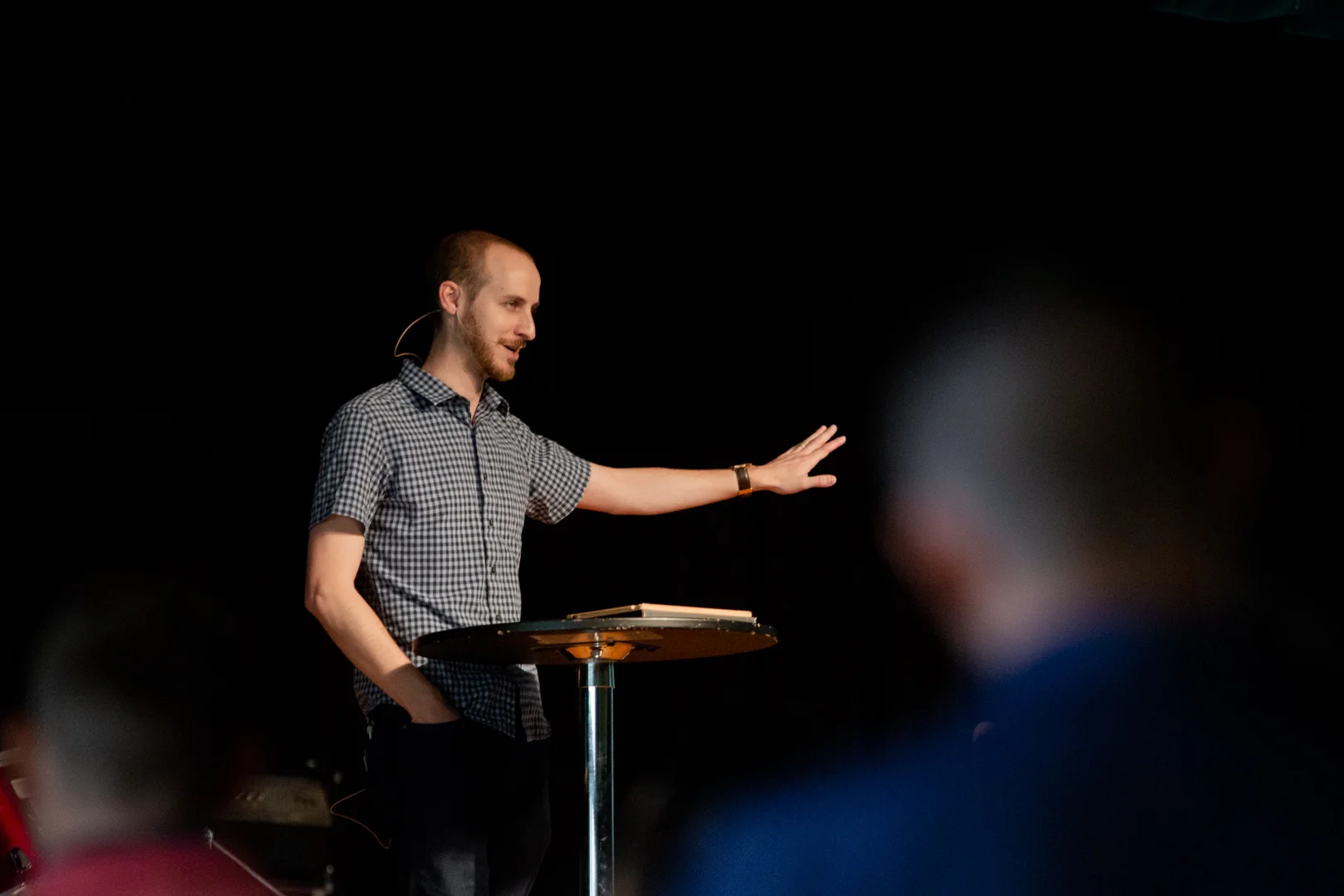

Faith & The Bigger Story
Heb. 11:22, Gen. 50:15-26 | Faith fights to see the bigger story God is writing while trusting his promises for the future.
Faith & The Bigger Story
Hebrews 11:22 | Genesis 50:15-26
Main Idea: Faith fights to see the bigger story God is writing while trusting his promises for the future
I. Faith & Forgiveness (Heb. 11:22a | Gen. 50:15-21)
Joseph’s brothers, motivated by their own guilt, ask for his forgiveness (again) after the death of their father Jacob. Joseph’s words & posture toward his undeserving brothers are a living picture of enduring faith.
His faith is seen in this offer of forgiveness in 4 ways:
1. He humbly refuses to take the place of God (50:19)
Romans 12:19: Beloved, never avenge yourselves, but leave it to the wrath of God, for it is written, “Vengeance is mine, I will repay, says the Lord.”
2. He honestly identifies sin as sin (50:20a)
3. He honors God’s sovereignty & faithfulness in the big story (50:20b)
Acts 2:22–23: “Men of Israel, hear these words: Jesus of Nazareth, a man attested to you by God with mighty works and wonders and signs that God did through him in your midst, as you yourselves know— this Jesus, delivered up according to the definite plan and foreknowledge of God, you crucified and killed by the hands of lawless men.
“God is always doing 10,000 things in your life, and you may be aware of three of them.” ~ John Piper
4. He exhibits the heart of Christ (50:21)
Joseph uses his position of power & privilege to care for his brothers who are undeserving. It is better to view Joseph as a signpost to a greater reality rather than an example to follow.
“Each sentence of his threefold reply is a pinnacle of faith. To leave all the righting of one’s wrongs to God, to see his providence in man’s malice, and to repay evil not only with forgiveness but also with practical affection, are attitudes which [are] Christlike” ~ Derek Kidner
Ephesians 4:32: “Be kind to one another, tenderhearted, forgiving one another as God in Christ forgave you.”
II. Faith & The Future (Heb. 11:22b | Gen. 50:22-26)
Joseph had many moments throughout his life that showcased his enduring faith, but the author of Hebrews emphasizes this end of life scene. This is a moment of defining faith for a few reasons:
He looks in faith to his true home & identity
Joseph had spent nearly his entire life in Egypt; he was second in command at the right hand of Pharaoh, saved their country from famine, took an Egyptain wife and had Egyptian children. Despite being fully immersed in Egyptian culture, Joseph knew this wasn’t his true home nor his true identity.
Hebrews 11:13–14, 16a: These all died in faith, not having received the things promised, but having seen them and greeted them from afar, and having acknowledged that they were strangers and exiles on the earth. For people who speak thus make it clear that they are seeking a homeland... But as it is, they desire a better country, that is, a heavenly one.
He trusts the promises of God in faith
Joseph confidently spoke of the Exodus because he had full confidence that God would keep his promises that he made to Abraham, Isaac, and Jacob.
Hebrews 11:1: Now faith is the assurance of things hoped for, the conviction of things not seen.
“[Joseph’s] coffin was going to point subsequent generations forward, allowing them to recognize that the reason the coffin was being kept was not on account of some morbid interest in bones, but it was being kept in order that it may stand as a vital symbol to the provision of God in the past and to the prospect of a glorious deliverance in the future.” ~ Alistair Begg
He looks in faith to God’s coming
“God will surely visit you” (50:25) is the storyline of the Bible. Some 400 years after this moment, God does indeed visit his people in the Exodus from Egypt; some 1,500 years later, he visited his people in the incarnation of Jesus Christ; this creed is the same thing that those of faith still cling to today as we await the restoration of all things at the return of Christ.

Faith in the Face of Death
Hebrews 11:21 | We can face death full of faith by resting in the grace of God.
Faith in the Face of Death
Hebrews 11:21
MIS: We can face death full of faith by resting in the grace of God.
I. Dying by Faith (Hebrews 11:21, Genesis 47:29-30, 48:3,15)
Cropping God into His Past (48:3,15)
Recognizes God in the Present (47:29-30)
Cropping God into His Future (47:30, 48:21)
2. Blessing by Faith (Genesis 48:8-20)
1. Jacob’s Low Position (47:3-6)
2. Joseph’s High Position (48:1)
“Faith prefers grace to talent, and piety to cleverness; she lays her right hand where God lays it, and not where beauty of person or quickness of intellect would suggest. Our best child is that which God calls best; faith corrects reason and accepts the divine verdict.” Charles H. Spurgeon
“Let the lowly brother boast in his exultation, and the rich in his humiliation.” (James 1:9)
3. God’s Riches (48:15-16)
“Blessed be the God and Father of our Lord Jesus Christ, who has blessed us in Christ with every spiritual blessing in the heavenly places.” (Ephesians 1:3)
3. Worshipping by Faith
Jacob’s Gratitude (48:11)
Jacob’s Dependence (48:15)
Jacob’s Testimony (48:3-4)
Jacob’s Posture (48:12)
How does the heal grabbing, selfish, lying, manipulating, hollow, cowardly, shallow, vain, hedonistic, calculating … man Jacob die, bless, and worship by faith?
By grace, through faith. (Ephesians 2:8, Romans 9:11-23)
“By faith Jacob, when dying, blessed each of the sons of Joseph, bowing in worship over the head of his staff.” Hebrews 11:21
“24 And Jacob was left alone. And a man wrestled with him until the breaking of the day. 25 When the man saw that he did not prevail against Jacob, he touched his hip socket, and Jacob’s hip was put out of joint as he wrestled with him. 26 Then he said, “Let me go, for the day has broken.” But Jacob said, “I will not let you go unless you bless me.” 27 And he said to him, “What is your name?” And he said, “Jacob.” 28 Then he said, “Your name shall no longer be called Jacob, but Israel, for you have striven with God and with men, and have prevailed.” 29 Then Jacob asked him, “Please tell me your name.” But he said, “Why is it that you ask my name?” And there he blessed him. 30 So Jacob called the name of the place Peniel, saying, “For I have seen God face to face, and yet my life has been delivered.” (Genesis 32:24–30)
“He who did not spare his own Son but gave him up for us all, how will he not also with him graciously give us all things?” (Romans 8:32)

Faith & The Ultimate Blessing
Heb. 11:20; Gen. 27:1-13, 18-29 | The life of faith embraces God’s sovereign work of blessing the undeserving and redeeming the unlikely.
Faith & The Ultimate Blessing
Hebrews 11:20 | Genesis 27:1-13, 18-29
Main Idea: The life of faith embraces God’s sovereign work of blessing the undeserving and redeeming the unlikely.
I. The Unlikely Blessing
Isaac & Rebekah experienced infertility just like Abraham & Sarah, but after 20 years the Lord grants them their desire for children. The promises given to Abraham (Genesis 12:3) run through the line of Isaac, the promised child.
Genesis 25:23: And the Lord said to her,
“Two nations are in your womb,
and two peoples from within you shall be divided;
the one shall be stronger than the other,
the older shall serve the younger.”
God is breaking the customary pattern and privileges of the firstborn son in this society. God often works in unlikely ways with unlikely people, turning upside down the values and standards of the world.
1 Corinthians 1:26–29: For consider your calling, brothers: not many of you were wise according to worldly standards, not many were powerful, not many were of noble birth. But God chose what is foolish in the world to shame the wise; God chose what is weak in the world to shame the strong; God chose what is low and despised in the world, even things that are not, to bring to nothing things that are, so that no human being might boast in the presence of God.
“If we were designing a movement to take over the world and claim dominion over the universe, you would not come up with Christianity… the beauty of the gospel is that you don't have to be great to wield its power… It actually helps if you’re not great. Because the gospel’s greatness is enough.” ~ Jared Wilson
II. The Undeserved Blessing
God’s choosing & working in this family was not only unlikely; they are also completely undeserving. Every figure in this dysfunctional family has their own contribution to this story:
Isaac: shows favoritism toward Esau (Gen. 25:27-28), is driven by his cravings, desiring to give Esau the blessing instead of Jacob
Esau: flippantly already “sold” his birthright for stew (Gen. 25:29-34), shirking responsibility to lead his people
Rebekah: shows favoritism toward Jacob & is the mastermind behind this deceptive plan
Jacob: name literally means “heel-grabber” & deceiver; his life is marked by behavior just like this story
“Fulfilling God’s plans is a family of faith and failure: Isaac who depends on his fallible senses and lacks resoluteness, Rebekah who acts by domination and deception, and Jacob who deceives and blasphemously lies. This is a message of hope for the church, for the irruption of the kingdom of God ultimately depends on God’s sovereign grace, not on human faithfulness. God’s promise of hope overrides all of this failure, ultimately using these fallible people to accomplish his good work.” ~ Bruce Waltke
The ‘blessing’ at the center of this story is more than just “well-wishes;” this fatherly blessing (lit. ‘eulogize’) had to do with the trajectory and destiny of their future. Isaac’s actions here are ultimately “by faith” (Heb. 11:20) because he trusts & yields to the promises of God for the future (Gen. 27:33).
III. The Ultimate Blessing
What does this story of faith in “future blessings” mean for us today as we seek to endure by faith? Two implications:
1. Our deepest desire for blessing has been offered to us in Jesus Christ, to be received by faith
We all crave the blessing and approval that is sought after in this story, but we often go about it in the wrong way. We either presume upon it (Esau), or we dress up like someone else, manipulate, and try to take control of what God has already promised (Rebekah & Jacob).
The life of faith comes just as we are to Jesus, the “firstborn” of all creation, who took on the curse of sin in our place (Gal. 3:13) so we might be blessed by his grace & mercy.
Romans 8:15–17: For you did not receive the spirit of slavery to fall back into fear, but you have received the Spirit of adoption as sons, by whom we cry, “Abba! Father!” The Spirit himself bears witness with our spirit that we are children of God, and if children, then heirs—heirs of God and fellow heirs with Christ, provided we suffer with him in order that we may also be glorified with him.
2. Our future blessings in Christ ought to produce present faithfulness and endurance
The content of the “future blessing” to Jacob (Gen. 27:27-29) included provision, power, and honor. The banquet table of the lamb awaits us in the future, where there will be no more sin, death, suffering, and we will commune with the Lord “face to face” (1 Cor. 13:12).


Faith & The Faithful Promise-Maker
Heb. 11:11-12, Gen. 15:1-12, 17 | Faith waits patiently on the Lord, trusting He is faithful to do what he has promised.
Faith & The Faithful Promise-Maker
Hebrews 11:11-12 | Genesis 15:1-12, 17
Main Idea: Faith waits patiently on the Lord, trusting He is faithful to do what he has promised
I. Faith in the Waiting
Abraham is 75 years old and childless when God appears to him in Genesis 12. His name (lit. ‘father of many / multitude’) and his situation would have been shameful and painful for Abraham.
Sarah is feeling pressure in at least 3 ways:
Culturally: infertility was often assumed to be the women’s fault in this culture
Pscyhologically: her situation would have brought a monthly reminder of her suffering & unfulfilled longings
Theologically: God has promised this would happen, but they still remain childless
As we seek to live by faith, we are confronted with the same tension facing Abraham & Sarah: Am I going to continue to trust God & his promises even when I don’t see any way they will be fulfilled?
“If God is answering your prayers with no, wait, or silence, that is when the relationship gets real. You have to trust, wait and surrender because he's not a cosmic vendor.” ~ J.R. Vassar
Abraham & Sarah stumble their way through this period of waiting. God assures them in Genesis 17-18 (24 years after his initial call in Genesis 12), that they will still have this promised son. In the face of this tension, we see two different kinds of “laughs”
Abraham (Gen. 17:15-17): incredulous, awkward, nervous laugh
Sarah (Gen. 18:9-15): scoffing, unbelief
II. Faith in the Promise-Maker (11:11)
Sarah seems like an unlikely candidate to show up in Hebrews 11, but the reason provided by the author is that she ultimately “considered him faithful who had promised.” It wasn’t merely the promise that Sarah considered; it was the character and nature of the God behind his Word.
Genesis 15 helps us see how they could trust God to be faithful to his word. Abraham, after believing God (15:6), asks him how this was all going to come about (15:8). Biblical faith is not about complete certainty around every corner and it is not without its questions. Abraham is asking from a posture of faith seeking understanding.
God instructs Abraham to set up a covenant ceremony (“blood path covenant”), meant to symbolize that if either party broke their end of the deal they would become like these animals. But, surprisingly, God obligates himself to both ends of the covenant by his presence passing through the “blood path.” God is indicating: even if you are unfaithful, I will be faithful. I will suffer the consequences on your behalf & I will pay the price in blood.
Hebrews 6:13–16: “For when God made a promise to Abraham, since he had no one greater by whom to swear, he swore by himself, saying, “Surely I will bless you and multiply you.” And thus Abraham, having patiently waited, obtained the promise. For people swear by something greater than themselves, and in all their disputes an oath is final for confirmation.”
We can trust that God is faithful to his promises because this picture is ultimately seen in the cross of Christ, where God suffers the consequences of our lack of faith, in our place. All the promises of God find their “yes and amen” in Jesus Christ (2 Cor. 1:20)
III. Faith in the Impossible (11:12)
The faith of Sarah & Abraham is an invitation to “hope against hope” (Rom. 4:18) because “nothing is too hard for the Lord” (Gen. 18:14). God will often lead us to a place that feels “barren” and “dead” in our lives so that we might completely and wholly trust him, the one who brings life from death.
“You don't really know Jesus is all you need until Jesus is all you have.” ~ Tim Keller
Romans 4:18–21: In hope he believed against hope, that he should become the father of many nations, as he had been told, “So shall your offspring be.” He did not weaken in faith when he considered his own body, which was as good as dead (since he was about a hundred years old), or when he considered the barrenness of Sarah’s womb. No unbelief made him waver concerning the promise of God, but he grew strong in his faith as he gave glory to God, fully convinced that God was able to do what he had promised.
God takes their precise place of pain, shame, and unbelief, and gives them a memorial of his power & grace. They are instructed to name their child Isaac, which means ‘he laughs.’ God is faithful even when we are not, and he views us in light of his grace, not our failures.
Hebrews 10:23: Let us hold fast the confession of our hope without wavering, for he who promised is faithful.

Faith & Our True Home
Heb. 11:8-10, 13-16, Gen. 12:1-4 | Faith embraces the call of God as we long for our true home in the city of God.
Faith & Our True Home
Hebrews 11:8-10, 13-16 | Genesis 12:1-4
Main Idea: Faith embraces the call of God as we long for our true home in the city of God.
I. Embracing the Call (11:8)
God appears to Abraham (Abram) in Genesis 12 and asks him to leave his “country, kindred, and father’s house;” God asks him to leave the primary things that would mark his identity, security, comfort, and future.
By faith, Abraham obeys this call from the Lord. He embraces an uncertain future & a painful leaving in faith because he trusted:
God’s Promise: He is promised and inheritance and blessing, even though this would have made no earthly sense.
God’s Presence: God is ultimately calling Abraham to himself more than a place.
The call of God on Abraham’s life is a paradigm for the Christian life. ‘The church’ literally means ‘the called out ones.’ We are all called, in repentance and faith, to leave behind the world & our own priorities to follow the Lord who has called us to himself.
Philippians 3:7–8: But whatever gain I had, I counted as loss for the sake of Christ. Indeed, I count everything as loss because of the surpassing worth of knowing Christ Jesus my Lord. For his sake I have suffered the loss of all things and count them as rubbish, in order that I may gain Christ
II. Living in Exile (11:9, 13)
By obeying the Lord in faith, Abraham and his family live the rest of their lives as “strangers and exiles” (11:13). They live in ‘tents,’ the ultimate picture of a temporary dwelling place.
It is not only in Canaan (the Promised Land) that Abraham is a sojourner: he & his family acknowledged they were strangers and exiles “on the earth.” Nowhere on earth was truly ‘home’ and the same is true of us today in the church (cf. 1 Peter 1:1)
Hebrews 13:14: For here we have no lasting city, but we seek the city that is to come.
Philippians 3:20: But our citizenship is in heaven, and from it we await a Savior, the Lord Jesus Christ
Two temptations while we live as sojourners & exiles:
Arrival: Assimilating & making our home in the world
Escapism: Disengaging from the world & withdrawing back into our own silos
1 Peter 2:11–12: Beloved, I urge you as sojourners and exiles to abstain from the passions of the flesh, which wage war against your soul. Keep your conduct among the Gentiles honorable, so that when they speak against you as evildoers, they may see your good deeds and glorify God on the day of visitation.
“The question of the tension of the between becomes a catalyst for pilgrimage – prompting me, like Abraham, to answer the call and “go” – or whether I try to decamp in that distant country, turning my exile into arrival, suppressing my sense that there must be something more, that another shore is calling… So much of our restlessness and disappointment is the result of trying to convince ourselves that we’re already home. The alternative is not escapism; it is a refugee spiritually – unsettled yet hopeful, tenuous but searching, eager to find the hometown we’ve never been to.” ~ James K. A. Smith
III. Longing for Home (11:10, 14-16)
The ‘homeland’ Abraham was seeking was not the palace he was born (11:15); instead, it is a place he has never been before. His true home is:
A City with Foundations (11:10)
Designed & Built by God (11:10)
A Better & Heavenly Country (11:16)
Prepared for God’s People (11:16)
Just as Abraham refused to go back to what might have been comfortable in Ur (cf. Gen. 24:6-8), the author of Hebrews is urging his recipients not to turn back to their former life. The Christian life is a call to live by faith as we keep our eyes fixed on our true home that is still in our future.
Colossians 3:1–4: If then you have been raised with Christ, seek the things that are above, where Christ is, seated at the right hand of God. Set your minds on things that are above, not on things that are on earth. For you have died, and your life is hidden with Christ in God. When Christ who is your life appears, then you also will appear with him in glory.
“Most people, if they had really learned to look into their own hearts, would know that what they do want, and want acutely, is something that cannot be had in this world. There are all sorts of things in this world that offer to give it to you, but they never quite keep their promise… if I find in myself a desire which no experience in this world can satisfy, the most probable explanation is that I was made for another world… I must keep alive in myself the desire for my true country, which I shall not find till after death; I must never let it get snowed under or turned aside; I must make it the main object of life to press on to that other country & to help others to do the same.” ~ C.S. Lewis
Jesus has gone before us in this journey of faith; he knows what it means to leave home & to leave his Father to walk into an uncertain future. Jesus left home to bring us home; until we arrive and are welcomed to this place, we live by faith and not by sight.

Faith Enduring Judgment
Heb. 11:7, Gen. 6:8-14, 17-22 | Faith believes God while living in a sinful world, so we are saved from the coming judgment.
Faith Enduring Judgment
Hebrews 11:7 | Genesis 6:8-14, 17-22
Main Idea: Faith believes God while living in a sinful world, so we are saved from the coming judgment.
I. Faith That Believes (11:7a)
Noah had faith in “events as yet unseen” because:
He had found “favor” (lit. ‘grace’) with God (Gen. 6:8)
He “walked with God” (Gen. 6:9) in daily communion & relationship
He had a “reverent fear” of the Lord, an “inner faith” that led to obedience
“Notice, first, that Noah believed in God in his ordinary life. Before the great test came, before he heard the oracle from the secret place, Noah believed in God. We know that he did, for we read that he walked with God… It is a great thing to have faith in the presence of a terrible trial; but the first essential is to have faith for ordinary every-day consumption… Faith will not come to you all of a sudden, in the dark night, if you have shut it out through all the bright days. Faith must be a constant tenant, not an occasional guest.” ~ Charles Spurgeon
Romans 10:17: “So faith comes from hearing, and hearing through the word of Christ.”
II. Faith That Condemns (11:7b)
Noah’s faith, seen in constructing the ark, “condemned the world” because it set him against the status-quo, pronouncing judgment upon it. Noah is a “herald of righteousness” (cf. 2 Pet. 2:5) in building the ark, pointing people to their hope to survive the judgment to come.
We struggle with this “condemning” for a few reasons:
Fear of man (cf. Gal. 1:10)
“The people of the world did not tremble till the waters began to rise, but Noah trembled when God did but speak.” ~ Thomas Manton
We downplay and minimize sin & sinfulness (cf. Gen. 6:5); The flood was an act of God to simultaneously bring about death & cleansing (renewal) of the entire created order due to the wickedness of humanity
Judgment is often delayed
Matthew 24:37–39: For as were the days of Noah, so will be the coming of the Son of Man. For as in those days before the flood they were eating and drinking, marrying and giving in marriage, until the day when Noah entered the ark, and they were unaware until the flood came and swept them all away, so will be the coming of the Son of Man.
2 Peter 3:3–9:“ ... knowing this first of all, that scoffers will come in the last days with scoffing, following their own sinful desires. They will say, “Where is the promise of his coming? For ever since the fathers fell asleep, all things are continuing as they were from the beginning of creation.” For they deliberately overlook this fact, that the heavens existed long ago, and the earth was formed out of water and through water by the word of God, and that by means of these the world that then existed was deluged with water and perished. But by the same word the heavens and earth that now exist are stored up for fire, being kept until the day of judgment and destruction of the ungodly. But do not overlook this one fact, beloved, that with the Lord one day is as a thousand years, and a thousand years as one day. The Lord is not slow to fulfill his promise as some count slowness, but is patient toward you, not wishing that any should perish, but that all should reach repentance.”
III. Faith That Saves (11:7c)
Hebrews 11:7 gives us two pictures from Noah’s story of what it means to be saved by faith:
1. The Ark: Just as Noah was saved from the waters of judgment by finding refuge in the ark, we too are called to find refuge in Jesus, who bears the judgment of God in our place
The NT frequently connects the flood to baptism (cf. 1 Pet. 3:18-22), because it pictures this same pattern of death and cleansing. Jesus’ baptism was not for his own sin (since he is sinless), but instead an identification with the judgment of the world, his victory over the grave offering new life.
Colossians 2:12: “… having been buried with him in baptism, in which you were also raised with him through faith in the powerful working of God, who raised him from the dead.”
2. “Heir of Righteousness”
An “heir” is in this position not because of their own abilities but because of their relationship to the one guaranteeing the inheritance. Being in Christ makes you an “heir of righteousness,” a gift that comes from the accomplished work of Jesus on our behalf to be received by faith.

Faith And The Most Acceptable Sacrifice
Hebrews 11:4; Gen 4:1-16 | Because Christ is the most acceptable sacrifice, we are approved and can by faith exclusively seek his glory.
Faith And The Most Acceptable Sacrifice
Hebrews 11:4; Gen 4:1-16
“Because God loves me and accepts me, I do not have to do things just to build up my résumé.” - Tim Keller
Big Idea: Because Christ is the most acceptable sacrifice, we are approved and can by faith exclusively seek his glory.
When We Know We’re Fully Accepted
“By faith Abel offered to God a more acceptable sacrifice than Cain, through which he was commended as righteous, God commending him by accepting his gifts.” v4a
There is a sad reality and subsequent tragic consequence of religiosity as a means of earning the approval of God.
Cain and Abel narrative from Genesis 4:1-16
Out of all that happens in the narrative of Genesis, Hebrews 11:4 keys in on the sacrifice.
Genesis 4 doesn’t outright indicate how Abel’s sacrifice was in fact better.
They both offered sacrifices according to their vocations. Cain from the ground; Abel from the flock.
The sacrifice itself can’t be the object of our attention.
“By faith...” or further, “because he trusted God…”
There was a faith that preceded the sacrifice given.
The focus turns to Abel; (“the Lord had regard for Abel and his offering.” Gen 4:4).
Why did the Lord have regard for Abel, and not for Cain (Gen 4:5)? Because Abel’s sacrifice was preceded by faith.
But there’s more: “he was commended as righteous”.
His faith in fact made him righteous, not the act of sacrifice itself.
Rom 4:6 “Abraham believed God and it was counted to him as righteousness.”
The commendation or testimony was this: God had declared to Abel “You are righteous! so therefore I can accept your gift.”
Jesus highlights this in Matt 23:35 “righteous Abel” as opposed to John’s words about Cain “he was of the evil one” and “his deeds were evil” 1 Jo 3:12).
This doesn’t devalue or diminish the obedience of Abel. It gives it more meaning.
“Grace isn’t opposed to effort. It is opposed to earning.” - Dallas Willard
When We Know We Are Untouchable
“And through his faith, though he died, he still speaks.” (4b)
By faith, we are untouchable! There isn’t a trial, circumstance, person, (not even death), that can touch us.
Because of Abel’s “faith”, he was untouchable.
Even though he suffered injustice of the greatest kind, losing his life by the hands of his own brother, “he still speaks”.
Glimpses of this thought were given in the original narrative; Gen 4:10: “The voice of your brother’s blood is crying to me from the ground.” But what does this mean exactly?
How could Abel still speak if he was dead? How can his voice still be crying out?
Because the faith that he had still resonates throughout history.
God is a God of justice who cares about those of his who lose their lives unjustly because of their faith (Abel was the first according to Scripture).
Abel didn’t have a dead religiosity like Cain.
Cain was a Pharisee of sorts whose religious activity was birthed out of self-righteousness rather than the righteousness that comes by faith.
Abel had a living faith because of a living God, and therefore he wouldn’t ever be offering dead sacrifices.
Our obedience to God never falls flat.
The faith Abel had wasn’t revealed in the efficacy of his sacrifice.
However, it was validated!
And it pointed to an even greater offering; the most acceptable sacrifice by Christ on Calvary!
Think about it: If I am fully accepted by Christ because of his sacrifice on the cross, in what ways can this fuel a faith-filled obedience in my life?

Enduring By Faith
Hebrews 10:32-11:3, 6, 12:1-3 | Faith is trusting God & his promises so that we might endure with Jesus.
Enduring By Faith
Hebrews 10:32-11:3, 6, 12:1-3
“In modern Western speech ‘faith’ has become a vague term, a warm fuzzy slipping and sliding from one area of meaning to another all the time.” ~ J.I. Packer
Main Idea: Faith is trusting God & his promises so that we might endure with Jesus.
I. The Nature of Faith (11:1-3, 6)
The character and nature of ‘faith’ involves a few components:
Knowing God (11:3a, 6b): Intellectual Component
Christianity is not a ‘blind faith;’ you cannot place your faith in something that you do not truly know.
“The heart cannot love what the mind does not know.” ~ Jen Wilkin
We are able to know God in two primary ways:
Creation (cf. Rom. 1:19-20; Ps. 19:1; Lk. 19:40)
The Word of God
Trusting God (11:1): Volitional/Relational Component
Christianity is not a “wishful thinking, hope for the best” kind of faith; it is worked out in a relationship of trust. Biblical faith is not merely believing in God, it is believing God; faith is not just knowing about God, it is knowing God.
We have “assurance of things hoped for” because of the one who has made promises about our future. We can have “the conviction of things unseen” because we know there is more to life than what we might see.
Living For God (11:2. 6a): Moral Component.
Christianity is not a passive “let go and let God” kind of faith; it is an active pursuit of the Lord, realizing that trusting the Lord in faith is what brings him pleasure.
“God is not tapping his foot judgmentally inside the door as you sneak in, crawling over the threshold in shame. He’s the father running toward you, losing his sandals on the way, his robes spilling off his shoulders with a laughing smile whose joy says, “I can’t believe you came home!” This is what grace looks like.” ~ James K.A. Smith
II. The Necessity of Faith (10:32-39)
Hebrews is written to struggling Jewish Christians who are facing difficult hardships in two ways:
Suffering (10:32)
Persecution (10:33-34)
While being tempted to “throw away their confidence” (faith), the author exhorts them to ‘endure’ (lit. ‘to stay under & remain), rather than “shrink back.” Faith is a fight to remember that God is greater than our circumstances & our feelings at any given moment.
“Faith is the art of holding on to things in spite of your changing moods and circumstances.” ~ C.S. Lewis
Faith reminds us that we are living toward hope, until the ‘coming one’ (10:37) returns. Until that day comes, God’s will for us is to endure by faith, not to shrink back.
III. The Source of Faith (12:1-3)
The life of faith is presented as a marathon “race” that requires endurance. We are not alone in this race, however: we are surrounded by a “great cloud of witnesses” who have gone before us & we must look to Jesus, who is the “founder” and “perfecter” of our faith who has completed his journey.
It is the object of our faith that saves, not the strength of our faith. But the more we look to the object (Jesus), the stronger our faith will become.

The Church & Her Mission
Matthew 28:16-20 | Mission for the church is everything that the church is sent into the world to do. Embraces the double vocation of service, “the salt of the earth” and “the light of the world”.
“First thing, all mission that we have as individuals or the church must flow from God himself. It is God himself that has a plan and purpose for the world. So our mission must flow from His mission.”~ John Stott
Main Idea: Mission for the church is everything that the church is sent into the world to do. Embraces the double vocation of service, “the salt of the earth” and “the light of the world.”
The gospel is the good news that Jesus has come to save sinners and to usher in the Kingdom of God. Until Jesus returns, the local church is to be an outpost and an embassy of this Kingdom, which has already arrived with the coming of Christ and will one day be fully realized at his return. We exist to declare the King and to display the Kingdom to a world that is in desperate need of this good news.
"..the scattered people of God from all ages and places will finally be gathered. Our real spiritual connection will be made completely visible, and we will live together in the same time and space. On that day, the local church will cease to exist. In it’s place will be a single congregation of all the redeemed. And we will worship. The praise that we sing so feebly now in our own congregations will become the thunderous shot of all God’s people." ~Megan Hill