
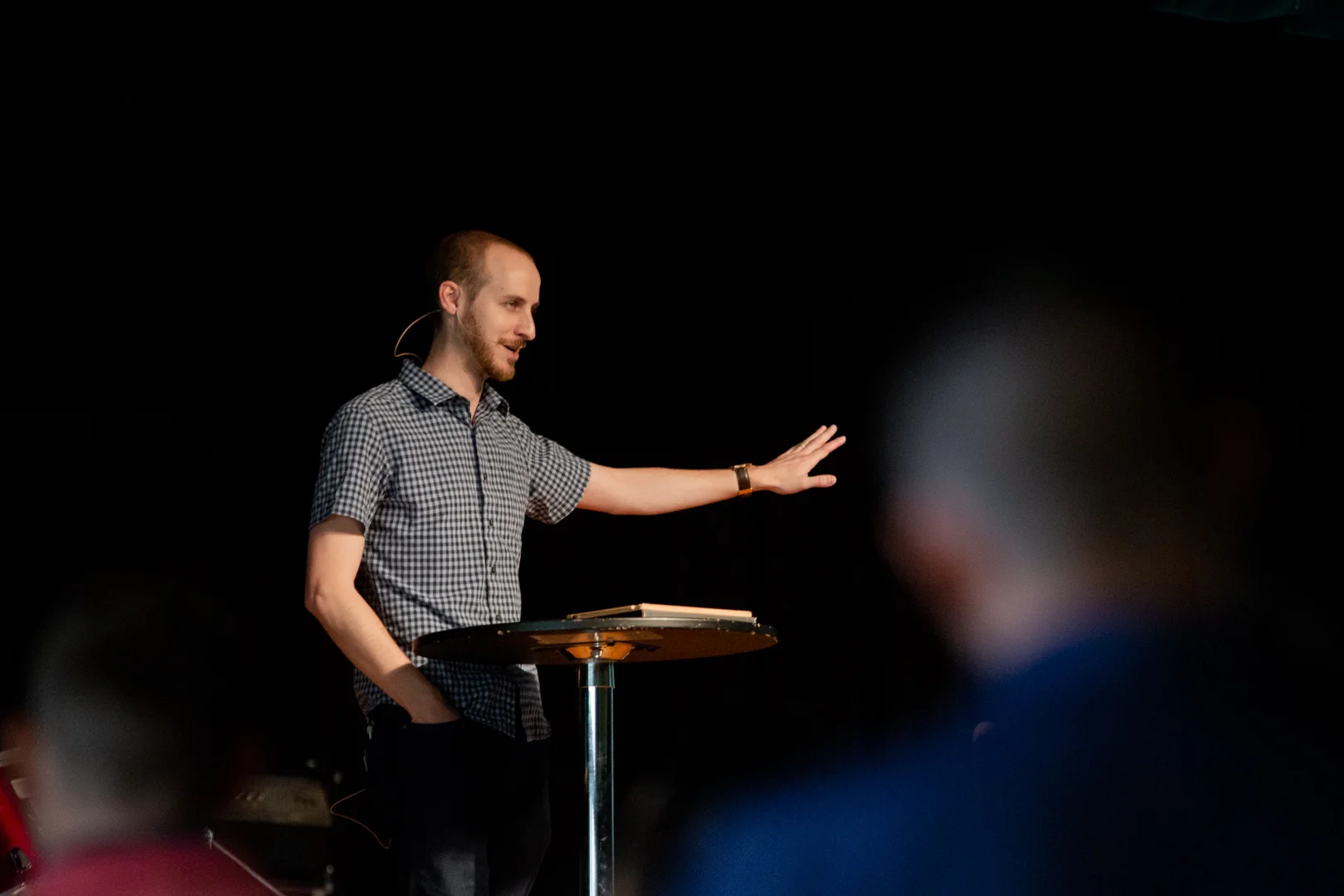

Family in Light of the End
1 Thessalonians 5:12-28
Family in Light of the End
1 Thessalonians 5:12-28
Main Idea: Living in light of the end dramatically impacts how we act as a church family.
I. Instructions for Relationships within the Church (5:12-22)
A. To their pastors (v. 12-13
Labor among you
Are over you
Admonish you
B. To one another (v. 14-22)
“For it is God’s will, he taught, that every local church should enjoy pastoral oversight, but not his will that pastors should dominate and organize everything. They are not meant to monopolize ministries, but rather to multiply them.”
- John Stott
Admonish the idle
Encourage the fainthearted
Help the weak
Be patient with them all
Seek to do good not evil to one another
“Every Christian community must realize that not only do the weak need the strong, but also that the strong cannot exist without the weak. The elimination of the weak is the death of fellowship.”
- Dietrich Bonhoeffer
1 Thessalonians 5:16-18: “Rejoice always, pray without ceasing, give thanks in all circumstances; for this is the will of God in Christ Jesus for you.”
“In that darkness God’s truth shines most clear.”
- Corrie Ten Boom (The Hiding Place)
II. Benediction (5:23-28)
A. Holy conduct (v. 23-24)
B. Wholly conduct (v. 25-28)
1 Thessalonians 5:28: “The grace of our Lord Jesus be with you.”
Preparing for the End
1 Thessalonians 5:1-11
Preparing for the End
1 Thessalonians 5:1-11
“Whatever your position on eschatology is (or isn’t), if it doesn’t foster encouragement of other Christians or empower you to live an eternity-driven life, you haven’t understood your eschatology. In fact, the end of all things is the greatest hope the world has. If eschatology is not encouraging and life-re-directing, it’s not biblical.” ~ J.A. Medders & Brandon Smith
Main Idea: We must prepare for the sudden return of Christ by living spiritually alert & awake.
I. The Nature of Christ’s Return (5:1-3)
In their confusion about various things related to the second coming of Christ, the Thessaonians desired to know the “times and the seasons” surrounding his coming. Their curiosity about the “Day of the Lord” was not unwarranted or uncommon, as it appears frequently in the prophets & in Jesus’ teaching.
Acts 1:6–7: So when they had come together, they asked him, “Lord, will you at this time restore the kingdom to Israel?” He said to them, “It is not for you to know times or seasons that the Father has fixed by his own authority.
Though the Thessalonians did not have exhaustive knowledge, they did have sufficient information about Christ’s return. Paul reminds them with two analogies:
A Thief in the Night (2:2b; cf. Matt. 24:43-44, 2 Pet. 3:10)
Labor Pains (2:3)
Christ’s return will be sudden, surprising, and disruptive. While most people carry on with their lives with no awareness of the return of Christ (“peace and security”), the promised “Day of the Lord” will come unexpectedly & with judgment.
II. Preparing for Christ’s Return (5:4-8)
For those who are in Christ, however, we have no reason to be “surprised” on the day of his return. In Christ, our status & our lifestyle have been transformed by God’s grace to prepare us for the end.
Our Status in Christ (5:4-5): we are now “children of light.” Light represents illumination and life while death represents disorder and death; Christ comes as the “light of the world” (Jn. 8:12; Lk. 1:78-79) to call us out of darkness.
Colossians 1:13–14: He has delivered us from the domain of darkness and transferred us to the kingdom of his beloved Son, in whom we have redemption, the forgiveness of sins.
Our Lifestyle in Christ (5:6-8):
Stay Awake
Stay Sober
“To be drunk spiritually is to imbibe too much of the world’s way of looking at things and not enough of the way God views reality. To be intoxicated with the world’s wine is to be numbed to feeling any fear in the present of a coming judgment” ~ G.K. Beale
Take up the armor of God & the weapons of the Kingdom: faith, love, and hope
III. The Hope of Christ’s Return (5:9-11)
We can have hope on the day of Christ’s return because the judgment of the “day of the Lord” has already been poured out on Jesus at the cross. Jesus’ death on the cross was for us so that we might live with him. Jesus is not a means to an end; whether we are awake or asleep (alive or dead), we will live forever with him.
“When we are united to Christ, we are no longer to cringe before the thought of Judgment Day. That’s because we no longer have the pressure to make the case for our own innocence. Our case is thoroughly debunked. At the cross, God has already revealed our guilt. In our repentance from sin, we have already agreed with his verdict, and our ongoing confession of sin reaffirms that agreement. Judgment Day happened for us, in a very real sense, already, at the Place of the Skull outside the gates of Jerusalem 2,000 years ago.” ~ Russell Moore
Hebrews 9:27–28: And just as it is appointed for man to die once, and after that comes judgment, so Christ, having been offered once to bear the sins of many, will appear a second time, not to deal with sin but to save those who are eagerly waiting for him.
Together as an end-time community of God, the church ought to be constantly “encouraging one another & building one another up” in the hope of Christ’s return.
Gospel Grief in Light of the End
1 Thessalonians 4:13-18
Gospel Grief in Light of the End
1 Thessalonians 4:13-18
Main Idea: The gospel provides us hope in the midst of grief and death in light of the finished work of Christ and His promised return.
I. Gospel Grief (v. 13-14)
Paul reintroduces the problem facing the Thessalonians in verse 13, namely that many in Thessaloniki were “uninformed” about the return of Christ and about those “who were asleep”
“Uninformed” or in some translations “ignorant” implies something in their faith was lacking and that knowledge could affect their understanding and thus drive down into their hearts and transform their actions and attitudes as a whole.
Asleep was a common analogy for those who had died. This was a known expression and would not have caused much confusion on what Paul was talking about. There were debates about the end times and what would happen to those who had already died. Would they miss out on the return of Christ?
“Grieve as others do who have no hope” (v.13)
Paul gives a double negative which is essentially telling us he wants us to grieve hopefully. Balance of these extremes is key to proper Gospel Grief. Two potential extreme pitfalls:
Detached stoicism
Complete despair
Detached stoicism
Lazarus died and “Jesus wept” (John 11:35) and “snorted with rage” (John 11:38) and this was still knowing that he would resurrect him. How could the creator of all things weep and be angry over something in His created world unless it was an intruder distorting the original good design He had envisioned. So if Jesus wept over this we ought to weep as well.
“Grieving over someone’s death is biblical, Christ-like (John 11:35). We often say, “Death is a natural part of life.” It’s actually the opposite-death is entirely unnatural. We weren’t created to die, and we aren’t destined to stay dead.”
~ J. Medders + Brandon Smith (Rooted: Theology for Growing Christians)
Complete despair
We often hold that grief and hope are two mutually exclusive things and cannot coexist. Paul is encouraging us that they can, but only in a uniquely Christian way. Our despair is seasoned with hope. Again Jesus is our perfect example. Jesus did not just weep over Lazarus but pointed us to our ultimate hope… himself.
Jesus knew raising him from the grave would be the final straw that would push the Pharisees to condemn him. Yet, he raised him knowing in a short while he would be going to the tomb on his behalf.
“There is a difference between sorrow and despair. Sorrow is pain for which there are sources of consolation. Sorrow comes from losing one good thing among others, so that, if you experience a career reversal, you can find comfort in your family to get you through it. Despair, however, is inconsolable, because it comes from losing an ultimate thing. When you lose the ultimate source of your meaning or hope, there are no alternative sources to turn to. It breaks your spirit.”
~ Tim Keller (Counterfeit Gods)
“For since we believe that Jesus died and rose again, even so, through Jesus, God will bring with him those who have fallen asleep.” (V. 14)
What is the Gospel? The good news that Jesus Christ, the son of God incarnate, came to earth in human flesh lived a sinless perfect life and died a substitutionary sacrificial death on the cross to atone for our sins and wrong doings, and then three days later He rose up out of that grave and ascended into heaven and is sitting at the right hand of the father ruling and reigning over the whole world. Our assurance then comes from this finished work.
II. Gospel Promise (v. 15-17)
4 eschatological events which John Stott has helpfully identified as four R’s.
Return - “coming of the Lord” (v. 15)
Resurrection - “the dead in Christ will rise first” (v. 16)
Rapture - “we who are alive … will be caught up together … meet the Lord in the air” (v.17)
Reunion - “together with them … we will always be with the Lord” (v.17)
Return of Christ is assured even if all the details are unknown … Revelation 6:14 refers to the end of the present cosmos as “a scroll that has been split and each of the two halves is rolled up.”
The resurrection is a transformation of not just our world but our bodies rising from the grave but creating bodies designed and perfected to inhabit this new world.
“Now if we died with Christ, we believe that we shall also live with Him. - Romans 6:8
“There is now no condemnation for those who are in Christ Jesus” - Romans 8:1
Rapture comes from the Latin word rapere meaning to seize and the Greek word harpazo. It’s emphasis here is on a suddenness as we will not know the day or time that it will happen (1 Thessalonians 5), but what is certain is that we will be together with the Lord. That believers will experience a corporate continuity.
The ultimate goal of the resurrection and the final return is that we will be with the Lord forever.
“We must resist temptations to embroider, dismiss, or take total literalism.” ~ John Stott
Gospel Encouragement (v.18)
Paul’s concluding argument is our concluding argument as well: “Therefore encourage one another with these words.” (V. 18)
Paul’s plea was pastoral in nature. He didn’t pen this letter to cause debates and disagreement on the end times and when final tribulation was coming. Paul wrote this letter to provide counsel for a hurting and grieving church. To provide hope and encouragement found only in the gospel for those who had lost loved ones and were in pain.
In this context, hope in the face of death will enhance the witness of the Christian community.
Kingdom Ethics
1 Thessalonians 4:1-12
Kingdom Ethics
1 Thessalonians 4:1-12
Main Idea: We should strive to please God in all of life as a compelling witness to the gospel.
“The glory of the gospel is that when the Church is absolutely different from the world, she invariably attracts it. It is then that the world is made to listen to her message, though it may hate it at first” ~ Martyn Lloyd-Jones
The Foundational Kingdom Ethic (4:1-3a)
Paul reminds the church in Thessalonica that the will of God for them (and for all Christians) is “your sanctification.” The guiding ethic behind all of the Christian life & our sanctification should be a desire to “please God.”
This foundational ethic for the Chrsitian life entails:
A life deeply impacted by a relationship with the Lord Jesus & his Church
A radical “reorienting” of our lives
“Whether in the ancient world or today, the chief end of humanity has often been to take pleasure in this life. In contrast, our passage begins by affirming the opposite: humanity’s chief goal ought to be to take pleasure in pleasing God.” ~ G.K. Beale
John 8:29: “And he who sent me is with me. He has not left me alone, for I always do the things that are pleasing to him.”
Progressive growth (“that you do so more and more”). The power for sanctification comes from the Holy Spirit who has been given to us (4:8). It is the Spirit who transforms us into the image of Christ “from one degree of glory to another” (cf. 2 Cor. 3:18).
The Kingdom Sexual Ethic (4:3b-8)
Paul first applies the principle of sanctification and pleasing God to the issue of sexality. The Graeco-Roman world was full of sexual immorality; sex was viewed as a “commodity” and there was little to no expectation of sexual restraint, particularly for men.
Paul indicates there are two basic ways to approach sex:
Lust (4:3b, 5-6): “exploits” & objectifies another in order to please yourself. Paul says that the Lord is an “avenger” in these things to remind them of the seriousness of sexual sin (cf. 1 Cor. 6:18-19, Matt. 5:27-28)
Love (4:4): exercises self-control and treats sex with “holiness and honor” in order to please God
For those who “know God” and have the Holy Spirit, we have been empowered to live holy lives in this regard. We can acknowledge the good gift of sex while also not making it the ultimate thing, embracing that it points to the mystery of Christ’s love for the Church (cf. Eph. 5:31-32).
As the early church lived out this radically different sexual ethic, they promoted:
Mutuality & Self-Control (cf. 1 Cor. 7:3-5)
Consent
The opportunity for faithful singleness & celibacy
“Sex as a commodity was a pillar of the Roman Empire. Christian sexual ethics developed as a rebuke of that world. Christians claimed that Christ gave us the kind of freedom that allows us to choose sexual holiness. Truly consensual sex was a rarity in the world in which Christianity got its start. Christianity, we might say, invented consensual sex.” ~ Beth Felker Jones
The Kingdom Work Ethic (4:9-12)
Though the church in Thessalonica had a track record for contagious love for one another, they failed to connect this to the realm of work. For some reason (either cultural practice or a misunderstanding of Christ’s return), many in the church had stopped working altogether & were meddling & disturbing the lives of others.
Paul exhorts them in 3 ways (4:11):
“Live Quietly” (Lit. ‘ambition to have no ambition”)
“Mind your own affairs,” and do not meddle unnecessarily in the lives of others.
“Work with your hands,” something the Greeks looked down upon as the work of slaves.
The church is to live this way so they might gain a good reputation before outsiders and not be unnecessarily dependent on the church. This all pleases God and showcases the love of Christ to others as they are faithful to God in the ordinary, everyday stuff of life.
* NOTE: For a further in depth look at “A Biblical Sexual Ethic & The Beauty of the Gospel” ( 1 Thessalonians 4:1-8) you can reference our sermon archives from August 30th, 2020 HERE.

How Do You Feel About the Church?
1 Thessalonians 2:17-3:13 | If I don’t love the church the way that Paul did, I am not properly preparing for the Lord’s return.
How Do You Feel About the Church?
1 Thessalonians 2:17-3:13
Main Point: If I don’t love the church the way that Paul did, I am not properly preparing for the Lord’s return.
How did Paul come to love the church the way he did?
“In this connection I journeyed to Damascus with the authority and commission of the chief priests. At midday, O king, I saw on the way a light from heaven, brighter than the sun, that shone around me and those who journeyed with me. And when we had all fallen to the ground, I heard a voice saying to me in the Hebrew language, ‘Saul, Saul, why are you persecuting me? It is hard for you to kick against the goads.’ And I said, ‘Who are you, Lord?’ And the Lord said, ‘I am Jesus whom you are persecuting. But rise and stand upon your feet, for I have appeared to you for this purpose, to appoint you as a servant and witness to the things in which you have seen me and to those in which I will appear to you, delivering you from your people and from the Gentiles—to whom I am sending you to open their eyes, so that they may turn from darkness to light and from the power of Satan to God, that they may receive forgiveness of sins and a place among those who are sanctified by faith in me.” (Acts 26:12-18)
Here is the important takeaway: NOTHING about the church has changed one bit since the Damascus Road and Paul’s day. NOTHING. Her people are still as fumbling and frail as they have ever been. She totters along through history with fits and starts that leave us cringing and scratching our heads. She is socially awkward and stupidly blunt most of the time. But Jesus loves her and He is perfecting her and protecting her and preserving her for Himself. The day is coming when the Church shall be dazzling, second only to Jesus and the Godhead in her glory.
What did Paul’s love for the church prompt him to do?
He longed to be with them in person - 1 Thes 2:17; 3:10
He gave his best to secure their best - 1 Thes 3:2ff
He found his joy in their advancement -1 Thes 2:19, 3:8
How do we train ourselves to love the church like Paul did?
Fight to show up - stay connected.
Focus on promoting one another’s faith - stay engaged.
Pray for one another in full awareness of the coming of Christ - stay invested.
We are properly preparing for the Lord’s return when we are meaningfully connected with what matters most to Him, actively engaged in establishing and encouraging one another’s faith in Him, and deeply invested in what He gave Himself to secure as His own.

Gospel Ministry
1 Thessalonians 2:1-16 | Faithful gospel ministry is a stewardship of the Word of God & a commitment to the people of God.
Gospel Ministry
1 Thessalonians 2:1-16
Main Idea: Faithful gospel ministry is a stewardship of the Word of God & a commitment to the people of God.
I. The Motivation for Ministry (2:1-6)
Paul defends his ministry when he was in Thessalonica by reminding them that he was not:
Deterred by suffering & conflict (2:2)
Acting in “impurity” nor attempting to deceive (2:3)
Seeking glory from man nor greedy (2:5-6)
Instead, Paul has a clean conscience and pure motives because he knew he was a steward of what ultimately belongs to God. He has been “approved by God” and “entrusted with the gospel.” This stewardship is both liberating and sobering, inviting the minister of the gospel to a posture of humble confidence.
1 Corinthians 4:2–4: It is required of stewards that they be found faithful. But with me it is a very small thing that I should be judged by you or by any human court. In fact, I do not even judge myself. For I am not aware of anything against myself, but I am not thereby acquitted. It is the Lord who judges me.
II. The Manner of Ministry (2:7-12)
Paul gives 2 images of his manner of ministry in Thessalonica:
1. A Mother (2:7-8)
A different set of traits is needed for pastors than for the business world’s management culture. Paul writes, ‘But we were gentle among you, like a nursing mother taking care of her own children’ (1 Thess. 2:7). This is not exactly the pastoral image that is most popular today. In an age when machismo and ‘catalytic, visionary’ life-coaching dominate the evangelical leadership ranks, the ministerial role of a breastfeeding mom is alien. There is a patience, a parental affection, a tender giving of one’s self that Scripture envisions for the pastor’s leadership role.” ~ Jared Wilson
This image is meant to reveal:
Ministry is an overflow of love (cf. Mt. 9:36)
Ministry is an act of self-giving
2. A Father (2:9-12)
Just as a father would be responsible for training up his children to follow in their work, inheritance, and trade, Paul acted as a “spiritual father” in this way, both his words and his actions.
He “proclaimed the gospel of God” while he also “exhorted, encouraged, and charged” his children to “walk in a manner worthy of the calling.”
He worked hard to not be a burden, and his conduct was “holy, righteous, and blameless toward them.” Paul was setting an example to the church (cf. 1 Pet. 5:3), urging them to “follow him as he followed Christ” (1 Cor. 11:1)
“In America, credentials qualify a person to lead. In Jesus, the chief qualification is character. In America, what matters most are the results we produce. In Jesus, what matters most is the kind of people we are becoming. In America, success is measured by material accumulation, power, and the positions that we hold. In Jesus, success is measured by material generosity, humility, and the people whom we serve… In America, leaders crave recognition and credit. In Jesus, leaders think less of themselves and give credit to others. In America, leaders compare and compete so they will flourish. In Jesus, leaders sacrifice and serve so others will flourish. In America, the strong and powerful rise to the top. In Jesus, the meek inherit the earth.” ~ Scott Sauls
III. The Message of Ministry (2:13-16)
The nature of the Bible: it is the very word of God communicated through the words of men as inspired by the Holy Spirit
2 Peter 1:21: For no prophecy was ever produced by the will of man, but men spoke from God as they were carried along by the Holy Spirit.
2 Timothy 4:1–5: I charge you in the presence of God and of Christ Jesus, who is to judge the living and the dead, and by his appearing and his kingdom: 2 preach the word; be ready in season and out of season; reprove, rebuke, and exhort, with complete patience and teaching. 3 For the time is coming when people will not endure sound teaching, but having itching ears they will accumulate for themselves teachers to suit their own passions, 4 and will turn away from listening to the truth and wander off into myths. 5 As for you, always be sober-minded, endure suffering, do the work of an evangelist, fulfill your ministry.
The activity of the Bible: it is “at work” producing fruit in the life of a believer (cf. 1:3-5) and a faithful perseverance in the midst of suffering (2:14-16)
We must “receive” & “accept” the word of God in the same way as the church in Thessalonica.

An Upside-Down Life
1 Thessalonians 1:1-10 | The gospel empowers us to live an upside-down life that bears witness to Jesus as King.
An Upside-Down Life
1 Thessalonians 1:1-10
Acts 17:6b–7: “These men who have turned the world upside down have come here also, and Jason has received them, and they are all acting against the decrees of Caesar, saying that there is another king, Jesus.”
Main Idea: The gospel empowers us to live an upside-down life that bears witness to Jesus as King.
I. Faith That Works (1:1-5a)
Paul encourages the church in Thessalonica that they should be commended for their “faith, love, and hope.” These often ‘abstract’ qualities are actually tangible evidences of the gospel at work: it is their work of faith, their labor of love, and their steadfastness of hope
None of these come naturally, however. Faith, love, and hope are the fruit of being “loved by God” & “chosen by him” (1:4). This occurs because the Holy Spirit takes the words of the gospel and turns them into eternal power that results in a “full conviction” of faith.
Ephesians 1:4b-5: In love he predestined us for adoption to himself as sons through Jesus Christ
Deuteronomy 7:7-8a: It was not because you were more in number than any other people that the Lord set his love on you and chose you, for you were the fewest of all peoples, but it is because the Lord loves you and is keeping the oath that he swore to your fathers…
There are two errors & dangers when we consider “faith that works”:
We can too heavily focus on what we are supposed to “do” in the Christian life
We can fail to be moved by grace toward action
“One of the most striking evidences of sinful human nature lies in the universal propensity for downward drift. In other words, it takes thought, resolve, energy, and effort to bring about reform… People do not drift toward holiness. Apart from grace-driven effort, people do not gravitate toward godliness, prayer and obedience to Scripture, faith and delight in the Lord.” ~ D.A. Carson
II. Joy In Affliction (1:5b-8)
The church in Thessalonica was planted in the midst of suffering, affliction, & adversity (cf. Acts 17:1-6) which has continued. The Scriptures over and over again tell us to expect suffering, persecution, and affliction (cf. Jn 16:33; 1 Pet. 4:12-13; 1 Thess. 3:3).
Joy in suffering produces an “imitation” (lit. “a mold”) of Paul and the apostles, but most importantly, “of the Lord '' himself, as the Holy Spirit conforms us to the image of Christ.
Joy in the face of suffering, persecution, and affliction is a powerful & undeniable witness to the hope of the gospel. As this church had joy in their affliction, the “word of the Lord sounded forth from them” throughout the surrounding region. Ordinary Christians facing suffering yet filled with joy of the Holy Spirit is a powerful witness to the extraordinary gospel.
III. Serving While Waiting (1:9-10)
The Thessalonians had a reputation for having “turned to God from idols to serve the living and true God.” By implication, this means that idols are “dead” and “false.” Idolatry is not just a 1st century issue; an idol is something you’ll either sin to get or you’ll sin if you don’t get it.
As we continually turn from idols, we are to “serve” while we “wait” for Jesus to return. In this paradox of “serving” and “waiting,” we must realize that this is not a “passive” waiting. Because Jesus has been raised from the dead & one day will return, we actively wait & look forward to the hope of his return.
“Christians are to live in such a way that, as men and women look at us, we become a problem to them. They will ask ‘What is it? Why are these people so different in every way, different in their conduct and behavior, and different in their reactions? There is something about them which we do not understand, which we cannot explain.’ And they will be driven to the only real explanation, which is that we are the people of God, the children of God.” ~ D. Martyn Lloyd-Jones

The Faithful God
2 Samuel 7:1-29 | We can endure faithfully by clinging to the character and promises of our perfectly faithful God.
The Faithful God
2 Samuel 7:1-29
We can endure faithfully by clinging to the character and promises of our perfectly faithful God.
I. God’s Word
1. Presence (2 Samuel 7:4-7)
2. Promise (2 Samuel 7:8-17)
II. David’s Response
1. Praise (2 Samuel 7:18-24)
2. Prayer (2 Samuel 7:25-29)
We can endure faithfully by clinging to the character and promises of our perfectly faithful God.

Faith & The Victorious Defeat
Hebrews 11:32-34 & Judges 16:4-6, 18-30 | God has faithfully provided salvation for us through one man’s victorious defeat.
Faith & The Victorious Defeat
Hebrews 11:32-34 & Judges 16:4-6, 18-30
Main Idea: God has faithfully provided salvation for us through one man’s victorious defeat.
I. A Problematic Judge (16:4-6, 18-21)
Samson, the final judge of Israel, was to be a Nazirite “from the womb to the day of his death” (Jdg. 13:7). A Nazarite vow (Num. 6) meant an individual was consecrated & set apart for the Lord & included:
Abstaining from drinks from the “vine”
Avoiding contact with the dead
Growing out hair for the length of the vow
Samson was as weak morally as he was as strong physically. When he is not saving Israel, he is being Israel; he constantly does “what is right in his own eyes,” is driven by the “lust of the flesh and the pride of life” (cf. 1 Jn. 2:16), and continually disregards his Nazirite vow.
Samson foolishly leads Delilah closer and closer to the secret of his strength until it is too late; he has been so seduced in his sin that “he did not know that the Lord had left him” (16:20). His sin ends up blinding and binding him, which is always the trajectory of sin unchecked.
The life of enduring faith acknowledges the seductive nature of sin, sees the end result, & turns away in repentance from it’s devastating consequences.
II. A Promise-Keeping God (16:22-27)
Despite the sin of Samson, his presumption of strength & God’s favor, and his disregard for his Nazarite vow - “the hair of his head began to grow again” (16:22). This important for 2 reasons:
1. The Philistines are Foolish
They assume that they have conquered Israel’s mighty champion & that Dagon, their ‘god,’ has delivered him into their hands. They do not consider what Samson’s hair represents about his relationship with God
Isaiah 42:8: “I am the Lord; that is my name;
my glory I give to no other,
nor my praise to carved idols.”
2. The Lord is Faithful
Samson’s hair growing back is a reminder of God’s grace that always runs deeper than we can imagine. Underneath all of the rebellion of Israel & the sin of Samson, the Lord remains faithful at every turn to his promises and his people.
“[The Philistines] knew nothing of the God who does the unexpected, whose strength is made perfect in weakness, and who never breaks his word. [They did not know] that God had said years before that Samson would be a Nazirite ‘to the day of his death’ (13:7). His abandonment of his servant at the time of his capture could not but be temporary. The promise was bound to hold, however Samson might despise it. There is grace abounding to the chief of sinners.” ~ Michael Wilcock
God’s faithful plans are not thwarted by the sinful actions of his judge nor the sinful contentment of his people. He will “never break his covenant” (Jdg. 2:1) and even “if we are faithless, he remains faithful” (2 Tim. 2:13).
III. A Prophetic Death (16:28-30)
The mighty Samson has been humbled and humiliated in this final scene of his life; he is doing the work of a woman or a slave (grinding flour), is blinded, and is being brought out for mockery & entertainment. But in this state of weakness, Samson exercises faith for maybe the first time.
“The Samson narrative begins with a strong man who is revealed to be weak, but it ends with a weak man who is stronger than he ever was before” ~ David Jackman
Despite his massive flaws, perhaps no other single OT figure sets the stage for Christ as Samson does. Consider their striking similarities:
Births are announced by angels & miraculous
They are both rejected & handed over by their own people
Experienced betrayal by someone they loved
Were put on display for entertainment & asked to perform
Acted as saviors alone
They both up crushing their enemies in a victorious defeat

Faith & Weakness
Hebrews 11:32-34 & Judges 6:1-16 | The way of enduring faith is the way of weakness.
Faith & Weakness
Hebrews 11:32-34 & Judges 6:1-16
Main Idea: The way of enduring faith is the way of weakness
I. Asking the Wrong Question (6:1-10)
The “Judges Cycle” begins again with the people of Israel sinning & undergoing oppression from the Midianites. They devoured their crops and livestock and left them “with no sustenance” (6:4) to eat or sell for economic gain. They are starving and forced to hide out in caves, being brought “very low” (6:6).
The people of Israel cry out for a deliverer, but God sends them a prophet; they want a savior, but he sends them a sermon. This prophet is a rebuke to the Isrealites that before they cry out for deliverance from their circumstances, they ought to be asking: “Why are we here in the first place?”
There are two issues that the people of Israel are missing:
They have regret, but not repentance (cf. 2 Cor. 7:10)
They see no issue with their “worship” of God combined with idolatry
II. Assuming the Wrong Reality (6:11-13)
Before the people “listen” (6:10) or truly repent, God sends an “Angel of the Lord” to Gideon. Even though he is hiding out in a hole in fear, he greets him as “O mighty man of valor.” This is how the Lord works: he names us & then he conforms us to that name
Abram & Sarai become Abraham (father of a multitude) & Sarah (princess)
Jacob (liar & deceiver) becomes Israel (he strives with God)
Simon becomes Peter (rock)
We become “citizens and saints,” adopted sons & daughters, & “co-heirs” with Christ
Gideon assumes that the circumstance & the situation that the Israelites find themselves in means that God is not with them. He is assuming that they are forsaken since they are suffering & facing hardship. Likewise, we often believe a sort of “pseudo-prosperity gospel.”
We often cry out “Lord, please remove this problem” rather than praying: “Lord, please make me the kind of person of character who can handle this problem.”
III. Accepting Our Weakness (6:14-16)
Gideon assumes his weakness & his “smallness” are an obstacle for God’s work in his life, failing to realize that his weakness is actually a conduit for the Lord’s grace and power.
“Everything that Gideon needs is supplied in this brief statement: ‘But I will be with you’… Basically, God has nothing else or more to offer you. You can go through a lot with that promise. It does not answer your questions about details. It only provides the essential. Nothing about when or how or where or why. Only the what, or, better, the Who. ‘But I will be with you.’ And that is enough.” ~ Dale Ralph Davis
2 Corinthians 12:7-10: So to keep me from becoming conceited because of the surpassing greatness of the revelations, a thorn was given me in the flesh, a messenger of Satan to harass me, to keep me from becoming conceited. Three times I pleaded with the Lord about this, that it should leave me. But he said to me, “My grace is sufficient for you, for my power is made perfect in weakness.” Therefore I will boast all the more gladly of my weaknesses, so that the power of Christ may rest upon me. For the sake of Christ, then, I am content with weaknesses, insults, hardships, persecutions, and calamities. For when I am weak, then I am strong.
By the end of his life, Gideon is a mixed bag of faithful moments along with devastating sin. Gideon is ultimately an imperfect, broken, picture of what we all really need in Christ. Jesus came to us in weakness and embraced our weakness as his own on the cross “for the joy that was set before him” (Heb. 12:2).