
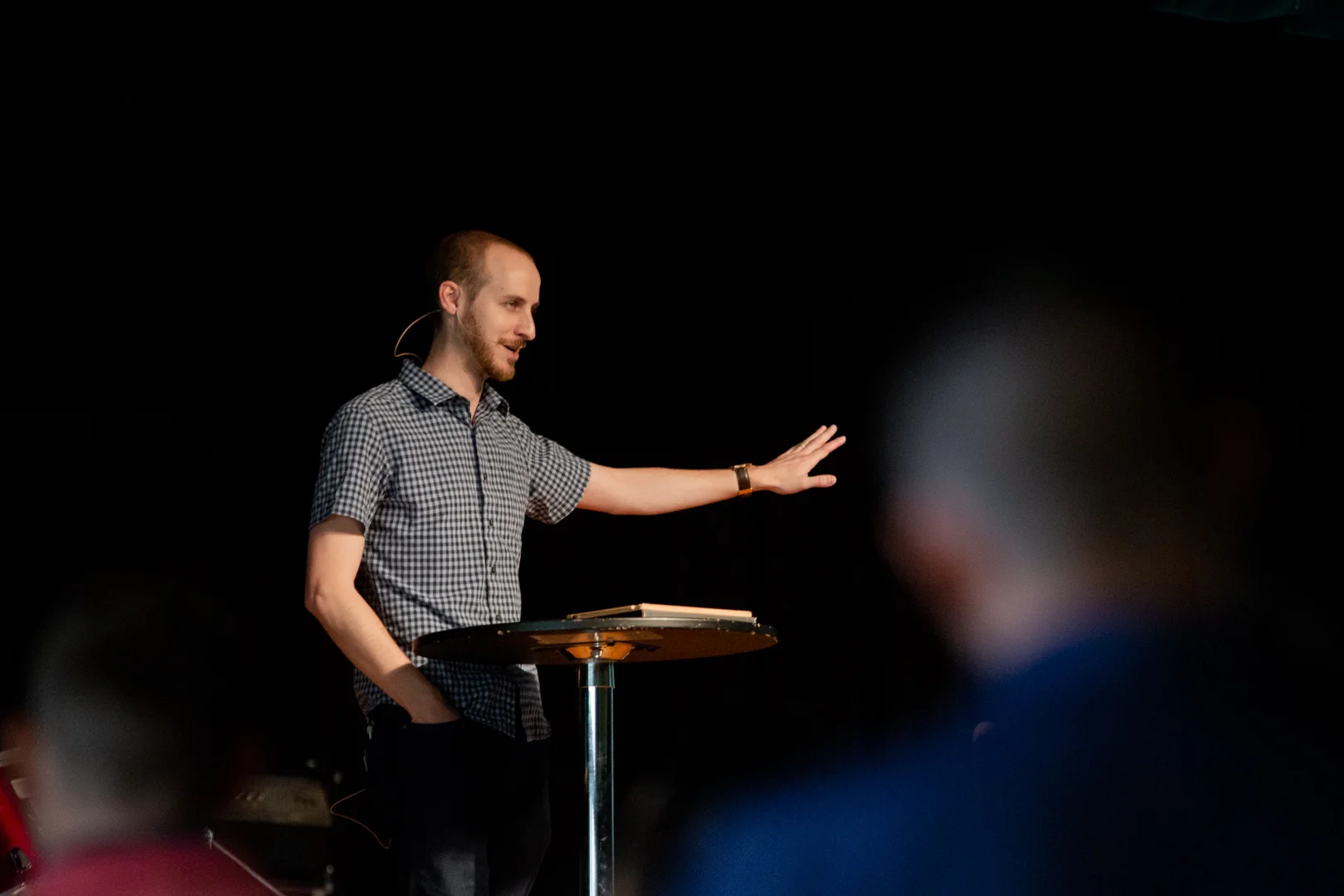

Lent Prayer & Worship Gathering | Ash Wednesday
Matthew 4:1-11
The Temptation of Christ
Matthew 4:1-11
Main Idea: Jesus overcomes the temptations common to us all by trusting his Father & listening to his voice.
I. The Challenge of Identity: Provide For Yourself (4:1-4)
The first temptation from Satan is less about bread and more about trust. He frames the temptation by attacking Jesus’ identity: “If you are the Son of God…” Satan’s temptation to doubt the goodness of God is as old as the Garden of Eden with Eve. He is tempting Jesus to view his circumstances as a definitive statement of who he is before his Father.
Jesus quotes Deuteronomy 8:3; the Israelites failed in their wilderness test by storing up more manna than the Lord commanded, believing that their effort was more sure than God’s promises. Jesus refuses the route of self-provision and trusts his Father’s word is for the best despite his circumstances.
II. The Craving of Validation: Prove Yourself (4:5-7)
Satan now throws Scripture back at Jesus by quoting Psalm 91:11-12, tempting Jesus to prove himself in spectacular fashion for all to see. He is tempting Jesus to prove all who doubt him wrong and to show himself to be the Son of God using the most significant place in Judaism, the temple.
We all deep down have a craving to be proven right and to validate ourselves before others. But we often result in devilish tactics rather than seeking validation from our Heavenly Father, the only opinion that ultimately matters.
Jesus quotes Deuteronomy 6:16, knowing that following Satan’s offer would be a manipulation of God for a self-directed vindication. He was already validated by his Father and he was carrying out his mission, even if most people assumed he was wrong. His validation would come at the resurrection three days after his crucifixion.
III. The Contest of Futures: Promote Yourself (4:8-11)
Satan now shows Jesus “all the kingdoms of the world and their glory” and offers them to him in exchange for his worship. Satan is tempting Jesus to take hold of his inheritance immediately in this moment by offering him the crown without the cross. The temptation is to get the right thing the wrong way, by promoting and exalting himself rather than submitting to his Father’s plan.
Everytime we grasp for power and control to ensure that everything is going to work out in the end, we are following the pattern of the Enemy who pridefully desired the place of God & fell from heaven like lighting (Isa. 14:13-14, Lk. 10:18).
“Satan showed here explicitly what he’d been trying to do all along. Satan was not just trying to tempt Jesus; he was attempting to adopt Jesus. Satan, in all three temptations, is assuming the role of a father – first in provision, then in protection, and now in the granting of an inheritance. Satan didn’t just want to be Jesus’ lord; he wanted to be his father.” ~ Russell Moore
What is the hope for a tempted people like us? This passage forces us to consider whose voice we are listening to. We only have two options:
The voice from hell who (often subtly) tells us to provide for ourselves, prove ourselves, and promote ourselves.
The voice from heaven that ensures us we are beloved sons and daughters, that we have a Father whose grip on us is tight, and who has promised us a future inheritance in Christ. The way out of temptation is the way of Christ & tuning our ears to hear the voice of our Father.

Jesus Our Peace
Ephesians 2:11-18
Jesus Our Peace
Ephesians 2:11-18
Main Idea: Jesus has made peace in the church through the cross, reconciling us to God and to one another.
I. A Hopeless Past (2:11-12)
The “once… but now” pattern of 2:1-10 is mirrored in this section, moving from individual salvation to the corporate nature of the church. Paul reminds the Gentile believers of their spiritual biography, begining with their life before Christ, and the deep division that existed between Jews & Gentiles.
The Gentiles had 5 spiritual disadvantages compared to Jewish believers (2:12):
Separated from Christ (and the expectations of a ‘Messiah’)
Alienated from Israel
Strangers to the Covenants
Romans 9:4-5: They are Israelites, and to them belong the adoption, the glory, the covenants, the giving of the law, the worship, and the promises. To them belong the patriarchs, and from their race, according to the flesh, is the Christ, who is God over all, blessed forever.
Hopeless
Godless (cf. Eph. 4:18)
Paul is drawing a connection between our worship and our hope; though the Gentiles worshiped many gods and placed their hope in many things, they did not know the true God, which ultimately left them hopeless.
“Why does Paul tell us twice to “remember?” There can be only one answer: we too easily forget. Either because we do not want to face the pain of what we were, or because our pride tempts us to erase the shame of what we were, or because we do not want to confess that we are no better than those we judge… We forget the grace that God designed to bind our hearts to his truths and to the hearts of others also claimed by his grace. It is too easy to forget, too easy to be proud of our differences, too easy to embrace our prejudices, too easy to nurse our offenses — and so the apostle says, ‘Remember.’” ~ Bryan Chapell
II. A Reconciled Present (2:13-18)
“But now” Christ has brought near the Gentiles who were “far off” through the shedding of his own blood. Jesus himself is our peace (2:14), who is reconciling & setting all things right, beginning in the church. This peace is only accomplished through the violent and hostile act of crucifixion (cf. Col. 1:20).
Paul explains how Jesus himself is our peace and how he has accomplished reconciliation in 4 ways. Christ has:
1. Broke down the dividing wall of hostility (2:14b)
There was a literal wall in the temple in Jerusalem at the “Court of the Gentiles” that barred them access to the inner areas. There was a sign posted threatening death for any Gentiles who dared cross this wall. Because of the crucifixion of Christ, the dividing wall is broken down and stripped of its power.
2. Abolished the law of commandments (2:15a)
“Jesus abolished both the regulations of the ceremonial law and the condemnation of the moral law. Both were divisive. Both were put aside by the cross.” ~ John Stott
3. Created in himself one new humanity (2:15b)
In the body of Christ, God is creating a new humanity (Gentiles are not becoming Jews, nor are Jews becoming Gentiles). This “oneness” in the church is precisely what Jesus prayed for (John 17:22-23) and is not “sameness” (cf. Gal. 3:28, Col. 3:11).
4. Reconciled both Jews & Gentiles to God (2:16-18)
The ground is level at the foot of the cross between Jews (those “who were near”) & Gentiles (those “who were far off”), who both need reconciliation with God. The “double reconciliation” that takes place at the cross of Christ kills the hostility, gives us access to the life of God, and brings us peace.
“Our community with one another consists solely in what Christ has done to both of us... I have community with others and I shall continue to have it only through Jesus Christ. The more genuine and the deeper our community becomes, the more will everything else between us recede, the more clearly and purely will Jesus Christ and his work become the one and only thing that is vital between us. We have one another only through Christ, but through Christ we do have one another, wholly, for eternity.” ~ Dietrich Bonhoeffer
Implications of this reconciliation we have in Christ for the church:
We should lament when division, exclusion, and walls remain in place in the church.
We should listen and pursue meaningful conversations.
We should declare and display the gospel of peace to a broken and hostile world.
Ephesians 3:10: “… that through the church the manifold wisdom of God might now be made known to the rulers and authorities in the heavenly places.”
Prayer of Lament
(Prayer from Isaac Adams in the book "Weep With Me")
Pastor: Father it often seems like we’re far from that Revelation vision where every tribe is united around your throne. Instead, it feels like we’re at Babel: we’re together, but we’re fighting; we’re talking, but we’re speaking different languages past one another. O Lord, with the frustration among us, it seems your churches are under your judgment still.
Congregation: But Lord, we now look away from the division behind us and in front of us. We turn to you with our grief by your grace. O God, would you give us grace to cherish Christ more deeply, and to remember how your judgment has fallen on him instead of us!
Pastor: Help us to sincerely live as what you’ve made us in Christ: one new man – a chosen race- that the world may believe you sent your Son.
Congregation: Until Babel is completely undone, we beg for your help in Jesus’ name. Amen.
Made Alive
Ephesians 2:1-10
Made Alive
Ephesians 2:1-10
Main Idea: By grace, God makes dead sinners alive through faith in Christ for His glory.
I. Dead in Sin (2:1-3)
Ephesians 2:1–3: “And you were dead in the trespasses and sins in which you once walked, following the course of this world, following the prince of the power of the air, the spirit that is now at work in the sons of disobedience— among whom we all once lived in the passions of our flesh, carrying out the desires of the body and the mind, and were by nature children of wrath, like the rest of mankind”
3 enemies or causes of this deadness of soul:
The World
The Devil (Prince of Power of the Air)
The Flesh
“Consider the overall impact of these three verses. Paul is not speaking of sin the way we often do: “I messed up,” “I made a mistake,” “I’m struggling with … “; Paul identifies sin as the comprehensive, enveloping, inexorable flow of our lives. Our sins are less like an otherwise healthy man occasionally tripping up and more like a man who is disease ridden head to foot–or, if we take the language of Ephesians 2 seriously, dead.”
~ Dane Ortland, Gently & Lowly (pg. 175)
II. Alive in Christ (2:4-7)
Ephesians 2:4–7: “But God, being rich in mercy, because of the great love with which he loved us, even when we were dead in our trespasses, made us alive together with Christ—by grace you have been saved— and raised us up with him and seated us with him in the heavenly places in Christ Jesus, so that in the coming ages he might show the immeasurable riches of his grace in kindness toward us in Christ Jesus”
Who He Is - “mercy, love, grace, and kindness”
“Because mercy is who he is. If mercy was something he simply had, while his deepest nature was something different, there would be a limit on how much mercy he could dole out. But if he is essentially merciful, then for him to pour out mercy is for him to act in accord with who he is. It is simply for him to be God. When God shows mercy, he is acting in a way that is true to himself. Once again, this does not mean that he is only merciful. He is also perfectly just and holy. He is rightly wrathful against sin and sinners. Following Scripture’s lead in how it talks about God, however, these attributes of moral standard do not reflect his deepest heart.”
~Dane Ortland, Gentle and Lowly (pg. 173)
What He Has Done - “made us alive, saved us from death, raised us up, seated us with Him”
2 Corinthians 5:17: “Therefore, if anyone is in Christ, he is a new creation”
Romans 2:4: “Or do you presume on the riches of his kindness and forbearance and patience, not knowing that God’s kindness is meant to lead you to repentance?”
III. All For His Glory (2:8-10)
Ephesians 2:8–10: “For by grace you have been saved through faith. And this is not your own doing; it is the gift of God, not a result of works, so that no one may boast. For we are his workmanship, created in Christ Jesus for good works, which God prepared beforehand, that we should walk in them.”
John 6:28-29: “This is the work of God, that you believe in him whom he has sent.”
“The work we are called to do is to rest from our own work to make ourselves right with God and believe in the work of Jesus on our behalf. We are saved by faith in Jesus’s work, not our own. We all live by faith in someone or something. And everything that we are and do is a result of what we believe. Our behaviors are the tangible expression of our beliefs.”
~ Jeff Vanderstelt (Gospel Fluency, pg. 78)
“Good works are indispensable to salvation–not as its ground or means, however, but as its consequence and evidence... Thus the paragraph ends as it began, with our human ‘walk’, a Hebrew idiom for our manner of life. Formerly we walked in trespasses and sins in which the devil has trapped us; now we walk in good works which God has eternally planned for us to do.”
~ John Stott
Romans 7:15–16: “For I do not understand my own actions. For I do not do what I want, but I do the very thing I hate.
“Amazing Grace, how sweet the sound
That saved a wretch like me
I once was lost, but now am found
Was blind but now I see
Was Grace that taught my heart to fear
And Grace, my fears relieved
How precious did that Grace appear
The hour I first believed
Through many dangers, toils and snares
We have already come
T'was Grace that brought us safe thus far
And Grace will lead us home
And Grace will lead us home”
Praying With Paul
Ephesians 1:15-23
Praying With Paul
Ephesians 1:15-23
Main Idea: We should pray for divine illumination to know more of God and Christ’s power at work in his church.
I. Praying in Thanksgiving (1:15-16)
Paul begins his prayer with thanksgiving, recognizing that the Ephesians “bear a telltale cross-shaped birthmark of God’s true children” (Richard Coekin).
Faith in the Lord Jesus (vertical dimension)
Ephesus was a major city of influence in the Roman Empire and it was steeped in idolatry. The city participated in worship of the Roman emperor cult and famously was the headquarters for the worship of the Roman goddess, Diana (Greek: Artemis). When the gospel began to take root in Ephesus, it caused a riot because the silversmiths were losing customers buying idolatrous statues (Acts 19).
Love toward all the saints (horizontal dimension)
The glorious gospel doctrine of Eph. 1:3-14 embraced by their faith in Jesus produced in them a gospel culture held together by the ethic of love.
John 13:35: By this all people will know that you are my disciples, if you have love for one another.
II. Praying for Illumination (1:17-19)
Paul’s prayer is not for additional blessings from God or a circumstantial change, but rather that the church in Ephesus would know God better. This “knowing” is not merely intellectual knowledge but an experience of increasingly realizing “every spiritual blessing” (1:3) already belongs to them in Christ.
The only way to gain this “knowledge” is by the power of the Holy Spirit “enlightening the eyes of our hearts” (cf. Lk. 24:45, Acts 16:14), illuminating to us what had been “darkened” in our understanding (4:18).
2 Corinthians 4:6: For God, who said, “Let light shine out of darkness,” has shone in our hearts to give the light of the knowledge of the glory of God in the face of Jesus Christ.
“The Spirit makes the heart of Christ real to us: not just heard, but seen; not just seen, but felt; not just felt, but enjoyed. The Spirit takes what we read in the Bible and believe on paper about Jesus’ heart and moves it from theory to reality, from doctrine to experience.”
~ Dane Ortlund
As Paul prays for the Spirit’s illumination that we might know the Triune God more fully, he prays for specific knowledge of:
The hope of our calling (1:18b). God’s calling is “effective;” all who God has called will be justified and glorified (Rom. 8:29-30), which gives us an unshakeable hope.
The riches of his glorious inheritance in the saints (1:18c). God has claimed us (the church) as his glorious possession and inheritance. “To the degree you understand this phrase, you will receive strength not to sin.” ~ D. Martyn Lloyd-Jones
The immeasurable greatness of his power toward us (1:19).
III. Praying for Power (1:20-23)
The church in Ephesus would have likely felt “powerless” in the culture they inhabited. Paul prays they would realize the power (lit. dynamic) that is at “work” (lit. energy) in them, given to the church because of Christ. The work of Christ is the most definitive and dramatic display of true power the world has ever seen.
Paul draws attention to three powerful realities about Jesus:
Christ’s Resurrection (1:20a): It was “not possible” for Christ to be held by death (Acts 2:24), and the same spirit that powerfully raised Jesus now dwells in us (Rom. 8:11)
Christ’s Ascension (1:20b): Christ is now seated at the right hand of the Father, the place of authority and honor as he rules and reigns as King.
Christ’s Exaltation (1:21-23): ‘All things’ have been put under his feet; there is no power, realm, or authority that rivals Jesus. Christ is the head of the cosmos in an ultimate sense, and the head of the church in an intimate sense.
“Jesus is changing the world for the good of the church by means of the church… He who is head over all things and gives the universe its full purpose also fills the church that gathers in his name. The church, the body of Christ, is the present instrument of his filling the universe with his purpose. The eternal, universe-conforming power of God is present in the world through the church, and this power is working in the world for the church.”
~ Bryan Chapell
The Spirit Seals
Ephesians 1:11-14
The Spirit Seals
Ephesians 1:11-14
Main Idea: In Christ, we are given the Spirit of God as the seal and guarantee of our present and future hope.
I. The Problem and the Promise (V13)
A) The Problem
(Ephesians 1:13) - “In him you also, when you heard the word of truth, the gospel of your salvation, and believed in him,”
We need set apart hearts. (Deuteronomy 30:6)
We need new hearts. (Jeremiah 31:31-34)
We need clean hearts. (Psalm 51:10)
B) The Promise (v13)
(John 3:5–7)- “Jesus answered, “Truly, truly, I say to you, unless one is born of water and the Spirit, he cannot enter the kingdom of God. That which is born of the flesh is flesh, and that which is born of the Spirit is spirit. Do not marvel that I said to you, ‘You must be born again.’”
(Ezekiel 36:25–27) - “I will sprinkle clean water on you, and you shall be clean from all your uncleannesses, and from all your idols I will cleanse you. And I will give you a new heart, and a new spirit I will put within you. And I will remove the heart of stone from your flesh and give you a heart of flesh. And I will put my Spirit within you, and cause you to walk in my statutes and be careful to obey my rules.”
II. The Seal and the Guarantee
A) The Spirit Seals (V13b)
(Ephesians 1:13) - “In him you also, when you heard the word of truth, the gospel of your salvation, and believed in him, were sealed with the promised Holy Spirit,”
(John 16:6–7) - “Nevertheless, I tell you the truth: it is to your advantage that I go away, for if I do not go away, the Helper will not come to you. But if I go, I will send him to you.”
1. Ongoing Conviction of Sin
(John 16:8–9) - And when he comes, he will convict the world concerning sin and righteousness and judgment: concerning sin, because they do not believe in me;
(Romans 7:14–15) - For I do not understand my own actions. For I do not do what I want, but I do the very thing I hate.
2. Greater Worship of Christ
(John 15:26) - “But when the Helper comes, whom I will send to you from the Father, the Spirit of truth, who proceeds from the Father, he will bear witness about me.
3. Dependance on the Father
(Galatians 4:6) “And because you are sons, God has sent the Spirit of his Son into are hearts, crying “Abba! Father!””
4. Fruit of the Spirit
(Galatians 5:22–23) - “But the fruit of the Spirit is love, joy, peace, patience, kindness, goodness, faithfulness, gentleness, self-control; against such things, there is no law.”
“Blessed assurance, Jesus is mine
Oh, what a foretaste of glory divine!
Heir of salvation, purchase of God
Born of His Spirit, washed in His blood
This is my story, this is my song
Praising my Savior all the day long.”
B. The Spirit Guarantees (V14)
(Ephesians 1:14) - “who is the guarantee of our inheritance until we acquire possession of it, to the praise of his glory.”
The Son Saves
Ephesians 1:7-10
The Son Saves
Ephesians 1:7-10
Main Idea: Christ reveals to us the mystery of God’s plan to redeem sinners and reconcile all things.
I. The Son Redeems (1:7-8)
Paul continues his list of “every spiritual blessing” we have by focusing on the work of the Son. In Christ, we have “redemption,” which is the idea of liberating those enslaved or in bondage. Biblically, the backdrop for “redemption” comes in the Israelite’s exodus from Egypt where they were “redeemed” by the mighty hand of God.
John 8:31–34: So Jesus said to the Jews who had believed him, “If you abide in my word, you are truly my disciples, and you will know the truth, and the truth will set you free.” They answered him, “We are offspring of Abraham and have never been enslaved to anyone. How is it that you say, ‘You will become free’?” Jesus answered them, “Truly, truly, I say to you, everyone who practices sin is a slave to sin.
This redemption has three realities:
Redemption is through the blood of Christ. The blood of the lamb in the Exodus story that saves guilty sinners foreshadows the blood of the cross shed by the “Lamb of God” (Jn. 1:29)
1 Peter 1:18–19: “… you were ransomed from the futile ways inherited from your forefathers, not with perishable things such as silver or gold, but with the precious blood of Christ, like that of a lamb without blemish or spot.”Redemption is for the forgiveness of our sins.
Redemption is according to the riches of his grace, which he lavished upon us.“In matters of God’s grace, hyperboles are understatements.” ~ Eugene Peterson
In Christ, we have true freedom from guilt, bondage, and condemnation. He has “paid our bill” in full, we owe him nothing, and we have been welcomed in. John 8:35-36: The slave does not remain in the house forever; the son remains forever. So if the Son sets you free, you will be free indeed.
II. The Son Reveals (1:9)
Through Christ, God has made known the ‘mystery’ of God’s will. ‘Mystery’ is not the idea of intrigue or secretive information but rather something previously hidden but now revealed. Christ’s coming, person, and work are the “hinge” point of history & redemption.
Luke 24:25–27: And he said to them, “O foolish ones, and slow of heart to believe all that the prophets have spoken! Was it not necessary that the Christ should suffer these things and enter into his glory?” And beginning with Moses and all the Prophets, he interpreted to them in all the Scriptures the things concerning himself.
The way the mystery is revealed to us is not through cryptic religious practices (like many religious cults of Paul’s day) or to the religious elite, but to “us” in the church who have humbly placed our faith in Jesus Christ. He opens our eyes to see what has been there all along, but we were blinded to because of our sin.
III. The Son Reconciles (1:10)
The cosmic plan of God the Father centered on Jesus Christ does not just involve the salvation of individual sinners; one day “all things” will be “united in him” (lit. ‘under one head’). Jesus will “sum up” all things (spiritual & physical) in himself, reconciling what had been fractured under his rule & reign.
“In the fullness of time, God’s two creations, his whole universe, and his whole church, will be unified under the cosmic Christ who is the supreme head of both.”
~ John Stott
Though this world is marked by death, sin, suffering, sickness, and the mundane, we can live with hope because of the plan and the promise that one day Jesus will set right all that has gone wrong. We can live with an infectious hope that Jesus is ruling right now as King and history itself will culminate with his rightful exaltation.
Acts 17:6b–7: “These men who have turned the world upside down have come here also… saying that there is another king, Jesus.”
The Father Blesses
Ephesians 1:1-6
The Father Blesses
Ephesians 1:1-6
Main Idea: In Christ, we have been blessed, chosen, and adopted by the Father to the praise of his glory.
I. Blessed by The Father (1:3)
Paul begins Ephesians with an explosion of blessing directed toward “the God and Father of our Lord Jesus Christ.” Before we think of God as a Creator, Ruler, or Law-Giver, we must begin with the Trinitarian reality of God as Father.
“Since God is, before all things, a Father, and not primarily a Creator or Ruler, all his ways are beautifully fatherly. It is not that this God ‘does’ being Father as his day job, only to kick back in the evenings as plain old ‘God.’ It is not that he has a nice blob of fatherly icing on top. He is Father. All the way down. Thus, all that he does, he does as Father. That is who he is.” ~ Michael Reeves
As an eternal Father, God’s love for the Son overflows into all of creation and to his children. For those of us “in Christ” (used 40x in Ephesians), we have received “every spiritual blessing in the heavenly places.” As we live simultaneously “in Ephesus” and “in Christ” (1:1), God the Father is not holding back anything from us, which is an invitation to bless him.
II. Chosen by the Father (1:4)
Though the doctrine of ‘election’ is the source of many debates and questions, it is presented as a praiseworthy reality by Paul. Election is not cold and impersonal; it shows us the glorious reality of God’s divine initiative from before the foundation of the world to save through Jesus Christ.
There is divine mystery in election (Deut. 29:29), but it is meant to warm our hearts toward our Heavenly Father, who is not improvising, but planned from eternity past to save us in Christ by his grace. “Election sets the soul on fire with enthusiastic delight in God.” ~ Charles Spurgeon
The doctrine of election ought to produce in us:
Humility (Deut. 7:6-8, 1 Cor. 1:27-29)
Holiness (1:4b, Rom. 8:29)
Security
“Nothing about the biblical doctrine of election is meant to cast doubt on whether you’re welcome in God’s household. God is not some metaphorical airport security screener, waving through the secretly preapproved and sending the rest into a holding tank for questioning. God isn’t treating us like puppets made of meat, forcing us along by his capricious whim. Instead, the doctrine of election tells us that all of us who have come to know Christ are here on purpose.” ~ Russell Moore
III. Adopted by the Father (1:5-6)
Adoption is the primary picture of our salvation throughout the NT. This passage points us to 4 realities of our adoption:
Planned
Personal
Permanent
Praiseworthy
“What is a Christian? The question can be answered in many ways, but the richest answer I know is that a Christian is one who has God as Father… If you want to judge how well a person understands Christianity, find out how much he makes of the thought of being God’s child, and having God as his Father. If this is not the thought that prompts and controls his worship and prayers and his whole outlook on life, it means that he does not understand Christianity very well at all” ~ J.I. Packer

A Greater Worship
Psalm 103
A Greater Worship
Psalm 103
“In the day-to-day trenches of adult life, there is actually no such thing as atheism. There is no such thing as not worshipping. Everybody worships... And the compelling reason for maybe choosing some sort of god or spiritual-type thing to worship is that pretty much anything else you worship will eat you alive.” David Foster Wallace
Main Idea: We are all called to worship God for who he is and what he has done in Christ.
I. What is Worship? (103:1-2)
The Psalmist (David) begins by talking to himself, urging his soul and “all that is within me” to bless the Lord. This posture gets to the very heart of worship. “Worship is ascribing ultimate value to an object and engaging your mind, your heart, and your will - your whole being, as you do it.” ~ Tim Keller
In response to the worship “drift” that we all experience, Psalm 103 is instructive for us. David is fighting for proper worship by remembering the “benefits” of the Lord. “Worship is the strategy by which we interrupt our preoccupation with ourselves and attend to the presence of God.” ~ Eugene Peterson
David is preaching the gospel to himself and urging his entire being to re-center on God as the object of his worship. Worship is an act of proactively remembering what is true about God so that our mind, heart, and will are re-engaged with the Lord, especially when we are being drawn elsewhere.
II. Why Should We Worship? (103:3-18)
We “forget not” the benefits of God by meditating on two categories:
We remember the works of the Lord (103:3-5)
The Lord forgives, heals, redeems, crowns, satisfies, and renews us. He has dealt with the barrier of our sin and given us meaning in our suffering, inviting us to see his glorious work toward the undeserving. “You have made us for yourself, O Lord, and our heart is restless until it rests in you.” ~ Augustine
We remember the character of the Lord (103:6-18)
David here quotes from Exodus 34, when Moses asks to see the glory of God on Mt. Sinai. The Lord responds not by showing his greatness but his goodness (Ex. 33:19), which we are constantly tempted to doubt. When he passes in front of Moses (Ex. 34:6-7) he emphasizes that his glory is seen through his mercy and his grace.
“God does not reveal his glory as ‘The Lord, the Lord, exacting and precise,’ or, ‘the Lord, the Lord, disappointed and frustrated.’ His highest priority and deepest delight and first reaction – his heart – is merciful and gracious. He gently accommodates himself to our terms rather than overwhelming us with his.” ~ Dane Ortlund
As an extension of this, God “does not deal with us according to our sins” but removes them from us an infinite distance (‘as far as the east is from the west’). As a gracious Father, he shows compassion on us in our weakness, patience with our besetting sins, and invites us to humbly fear him.
We have even more reason to worship God than David because we know the substance of Jesus Christ, which he could only see from afar as a shadow. When we remember the benefits of the Lord, we are specifically remembering Christ, who “from his fullness we have all received grace upon grace” (Jn. 1:16)
III. Who Should Worship? (103:19-22)
The Psalmist now realizes that the worship in his own soul has joined a greater song; he is joining with the chorus of the angels, mighty ones, the heavenly hosts, ministers, and all of creation in worship of God. Jesus declared that even the “stones would cry out” (Lk. 19:40) in worship, and Isaiah (55:12) envisions a day where the hills, mountains, and trees sing & clap to the Lord.
Since the Lord has established his throne and his kingdom rules over all, nothing short of the worship of all of creation and all that is within us will suffice. Everytime we worship Jesus through declaring and displaying the gospel, we are turning up the music for others to join in.

The Church
Romans 12:1-16
The Church
Romans 12:1-16
“We are often eager to see extraordinary events – growth in numbers or financial abundance or credibility in the larger community – that we fail to delight in the ordinary breath and heartbeat of the body. When people in the church encourage one another, teach one another, serve one another, and pray for one another in dozens of small and large ways, we ought to rejoice.” ~ Megan Hill
Main Idea: The church is a worshipping people, a serving body, and a welcoming family because of God’s mercies.
I. A Worshipping People (12:1-2)
Because of the mercies (plural) of God, we are to present our bodies as a living sacrifice, which is our ‘spiritual worship.’ In every age, season, and location, the church is a worshipping people. We have no greater incentive or power to worship than the mercies of God toward us in Jesus Christ.
This worship is not just inward or abstract; it is an offering of our entire being. This includes:
Head: ‘spiritual’ worship = rational or logical. We are invited to fill our minds with the pure, lovely, commendable, and excellent things of God (Phil. 4:8)
Heart: ‘All that is within us’ (Ps. 103:1) is summoned to worship God
Hands: we are to offer our very bodies as a “living sacrifice”
As we engage in worship, we are resisting being “conformed” (lit. molded) by the world, and are rather transformed into the image of Christ. This occurs both individually (2 Cor. 3:18) and corporately (Eph. 4:15-16) in the church.
II. A Serving Body (12:3-8)
The imagery of the “body” of Christ (cf. 1 Cor. 12, Eph. 4:12-16) signifies:
Unity: Just as the members of our physical body must be unified and work together, so too must the members of the body of Christ. We operate from unity, not toward unity (Eph. 4:3).
Diversity: The members do not all have the same function; there is unity but not uniformity in the body of Christ. There are no unimportant parts and we are dependent upon one another for the health of the body.
This imagery primarily implies in the Scriptures a humble service (12:3) that builds up the body of Christ. Whatever gifts we have been given by the Spirit, we are to employ them in the body of Christ as servants and contributors, not spectators or consumers.
“This truth should give you confidence: your particular gifts have a valuable, God-appointed place. It should also humble you: your particular gifts are simply one part of the body, and you desperately need other people with their particular gifts… this truth should increase your love for the local church: the gifts in the body are exactly what God knows your congregation needs. Because of God’s sovereign choosing, no part is missing, and every part is valuable.” ~ Megan Hill
The various “lists” of spiritual gifts in the NT can be categorized broadly into Speaking Gifts, Leading Gifts, and Serving Gifts. Regardless of gifts or categories, the exhortation is “having gifts that differ according to the grace given to us, let us use them” (12:6). We are called to joyfully & sacrificially invest our time, treasure, and talents as an act of worship out of love for God and love for one another.
III. A Welcoming Family (12:9-16)
The church is primarily described in the NT as the family of God or the “household of faith” (Gal. 6:10; 1 Tim. 3:15); the early church was subversive to the Greco-Roman world around because they related to one another as brothers and sisters in Christ, united not by the blood of biology but the blood of the cross.
The church as a family ought to be marked by hospitality. Hospitality is not “entertaining” but instead a powerful picture of the invitation of the gospel itself. Romans 15:7: Therefore welcome one another as Christ has welcomed you, for the glory of God. As we love one another in this way, we are to welcome the outsider and the stranger in the very same way each of us have been welcomed into God’s family.
“Churches are not Victorian parlors where everything is always picked up and ready for guests. They are messy family rooms… Things are out of order, to be sure, but that is what happens to churches that are lived in. They are not show rooms. They are living rooms, and if the persons living in them are sinners, they are going to be clothes scattered about, handprints on the woodwork, and mud on the carpet. For as long as Jesus insists on calling sinners and not the righteous to repentance – and there is no indication as yet that he has changed his policy in this regard – churches are going to be an embarrassment to the fastidious and an affront to the upright.” ~ Eugene Peterson
Our experience & the world’s view of the church is often unremarkable, but God has willed that “through the church the manifold wisdom of God might now be made known to the rulers & authorities in the heavenly places” (Eph. 3:10). The church is God’s “Plan A” to make known the glories of Jesus Christ to the cosmos.

Rage & Refuge
Psalm 2
Rage & Refuge
Psalm 2
Main Idea: The gospel invites us to turn from our rage against God and take refuge in Him.
I. Our sin is great (v.1-3)
All nations and people are naturally bent away from God (v. 1)
Our own actions follow and we disobey and actively work against the Lord (v. 2)
We foolishly think this is good (v. 3)
James 1:13-15 tells us “Let no one say when he is tempted, “I am being tempted by God,” for God cannot be tempted with evil, and he himself tempts no one. But each person is tempted when he is lured and enticed by his own desire. Then desire when it has conceived gives birth to sin, and sin when it is fully grown brings forth death.”
“It is not just the political powers of this world which have no desire to be ruled by him. There is scarcely a commercial or intellectual or cultural interest anywhere on earth which would not resent his claims on it.” ~ Michael Wilcock
II. The Lord is greater (v. 4-6)
The Lord is infinitely more powerful than us (v. 4)
He has authority (v. 5)
He has ability (v. 6)
He is both YAHWEH which we see with all capitals in the translated word for LORD and Adonai which we see with only a capital L (Lord). These names point to his reality. He is the Creator or all powerful One and personal Master or King.
III. He has a plan (v. 7-9)
His plan was Jesus (v. 6-7)
His plan is at work (v. 8)
His plan is just (v. 9)
Hebrews 5:5 “So also Christ did not exalt himself to be made a high priest, but was appointed by him who said to him, “You are my Son, today I have begotten you”;”
Acts 13:33 “this he has fulfilled to us their children by raising Jesus, as also it is written in the second Psalm, “‘You are my Son, today I have begotten you.’”
Romans 1:4 “concerning his Son, who was descended from David according to the flesh and was declared to be the Son of God in power according to the Spirit of holiness by his resurrection from the dead, Jesus Christ our Lord, through whom we have received grace and apostleship to bring about the obedience of faith for the sake of his name among all the nations, including you who are called to belong to Jesus Christ,”
Romans 9:21-24 “But who are you, O man, to answer back to God? Will what is molded say to its molder, “Why have you made me like this?” Has the potter no right over the clay, to make out of the same lump one vessel for honorable use and another for dishonorable use? What if God, desiring to show his wrath and to make known his power, has endured with much patience vessels of wrath prepared for destruction, in order to make known the riches of his glory for vessels of mercy, which he has prepared beforehand for glory— even us whom he has called, not from the Jews only but also from the Gentiles?”
IV. He is inviting us in (v. 10-12)
Through our actions (v. 10)
Through our understanding (v. 11)
Through our identity (v. 12)
Distinct Christian Identity
Distinct Christian Community
Distinct Christian Lifestyle
Phil 2:12-13 “Therefore, my beloved, as you have always obeyed, so now, not only as in my presence but much more in my absence, work out your own salvation with fear and trembling, for it is God who works in you, both to will and to work for his good pleasure.”
Phil 4:4 “Rejoice in the Lord always; again I will say, rejoice. Let your reasonableness be known to everyone. The Lord is at hand; do not be anxious about anything, but in everything by prayer and supplication with thanksgiving let your requests be made known to God. And the peace of God, which surpasses all understanding, will guard your hearts and your minds in Christ Jesus.”
John 14:6, he says “I am the way, and the truth, and the life. No one comes to the Father except through me.”
“God's response to human pride and power is to install his "son” on Zion. This points beyond Israel's king to Jesus, God's true Son. One day he will put everything right; but he will do this by going first to Zion - to Jerusalem - to die for our sins. To "kiss his son"is to rest in and live for him. If we do this, we have assurance that no matter what happens to us, ultimately everything will be all right. If we don't live for him, we end up fighting God himself. So "there is no refuge from him only in him."” ~ Tim Keller
Our Sin is great. Our Lord is greater. He has a plan. And he is inviting us in.