
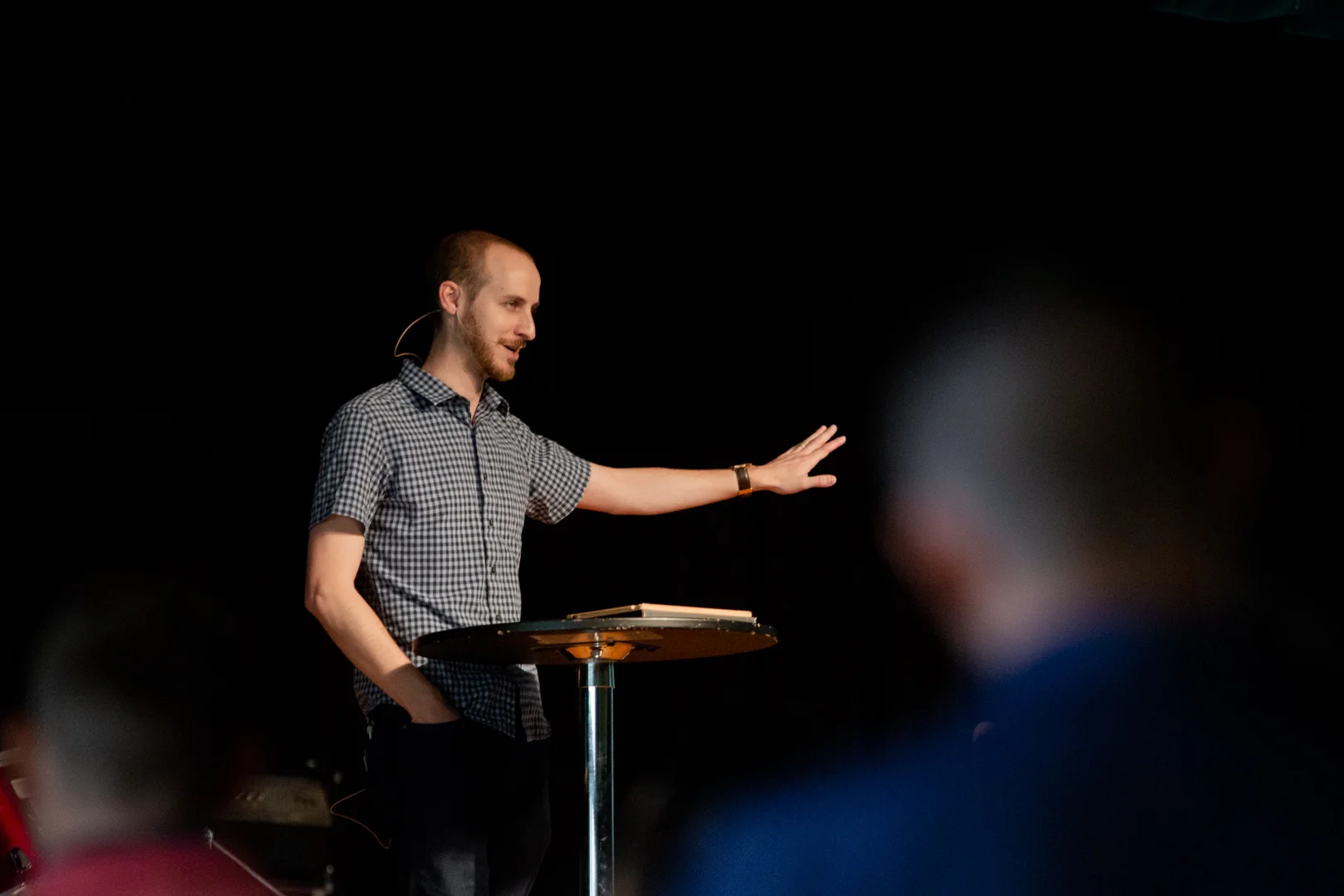

The Cross of Christ | Good Friday
John 19:16b-37
The Cross of Christ
John 19:16b-37
Luke 9:23-24: And he said to all, “If anyone would come after me, let him deny himself and take up his cross daily and follow me. For whoever would save his life will lose it, but whoever loses his life for my sake will save it.”
I. A Forsaken King (19:16b-22)
It was customary for the charge against the crucified one to be displayed above them. For Christ: “Jesus of Nazareth, the King of the Jews.” The haunting, divine irony of the situation is that they are indeed crucifying the true King of all kings. Pilate’s stubbornness communicates this truth in three different languages, symbolic for the universal, world-wide reign of Christ.
“The Crucified One is the true king, the kingliest king of all; because it is He who is stretched on the cross, He turns an obscene instrument of torture into a throne of glory and reigns from the tree.” ~ F.F. Bruce
II. A Forceful Shame (19:23-24)
Though the physical pain of crucifixion would have been unthinkable, the emphasis in the gospel accounts is on the shame, disgrace, and forsakenness of the cross. Jesus’ death was a “curse-bearing” death:
His nakedness echos the nakedness of the Garden of Eden (Gen. 3:7)
He is mockingly given a crown of thorns (Gen. 3:18)
Jewish Law stated that everyone who was “hanged on a tree” was cursed by God (Deut. 21:22-23)
John indicates that there is more going on than we might realize in this scene; he sees the fulfillment of Psalm 22, which Jesus directly quotes in other gospel accounts. The Holy Spirit spoke through David in this Psalm to transcend his own experience and point us to the cross of Christ.
III. A Family Crisis (19:25-27)
Mary’s presence at the cross is a fulfillment of Simeon’s words in Luke 2:34-35 and a reminder of the faithfulness of God from Psalm 22:9-11.
“Even as Jesus’ disciples fled from him in shame, he could cite Psalm 22 while looking out from the cross at his mother. In the moment of his greatest desolation, Jesus could see the invisible outline of God’s mercy and presence there in the one whom, in his human nature, he learned to trust a fathering, nurturing God. He learned that from his mother. And there she stood.” ~ Russell Moore
John (the beloved disciple) is also there with Mary, even though he does not yet believe or understand. Jesus gives them to one another in this moment and this “adoption” is the beginning of the church, a new family joined together by the blood of the cross.
IV. A Finished Work (19:28-30)
John does not present Jesus as a helpless victim who is powerless on the cross; Jesus knows that a greater story is being written. His physical “thirst” (Ps. 22:15; Ps. 69:21) is part of the larger story of God’s plan for redemption that has led to this climactic moment.
Jesus’ cry of “it is finished” is not a cry of defeat or a comment on his impending death. It is a phrase meaning “mission accomplished” and the completion of a task. His death was the fulfillment of his introduction as “the Lamb of God who takes away the sin of the world!” (John 1:29, 1 Cor. 5:7)
“Jesus is not on the cross by mistake… The crucifixion was not just an unfortunate thing that happened to Jesus on his way to the resurrection. It is not a momentary blip on the arc of his ascent to the Father. It is precisely on the cross that the work of Jesus is carried through to its completion.” ~ Fleming Rutledge
V. A Fulfilled Promise (19:31-37)
The ‘blood and the water’ from Jesus’ side was to show that he really was dead. But even in the aftermath of this horrific scene, John reminds us of the faithfulness of God. His faithfulness and his promises were still true even at the place of the skull.
“The lack of broken bones there at the cross was a sign to Jesus that whatever happened could not go any further than God’s purposes, and that God’s purposes were good… God might seem absent at the cross, but he was not. He was there providentially ruling, even through the most wicked actions imaginable… Jesus could count all his bones because of the mystery of God’s providence, which works behind, and through, even the most awful things that happen to us. Jesus’ intact skeleton was a sign that no matter how much it seemed that he had been abandoned, the steadfast love of God would not depart. God was still there.”~ Russell Moore

Body Building in the Local Church
Ephesians 4:7-16
Body Building in the Local Church
Ephesians 4:7-16
Main Point: A local church grows into its mature, functioning reality as each of us speaks the Truth to one another in love.
In this passage we see:
What does a mature, functioning local church look like?
Where do the resources for becoming such a church come from?
Where does the responsibility lie for becoming such a church?
How does a local church become more mature and functional?
I. What does a mature, functioning local church look like?
It looks like a healthy, active adult human being.
A healthy, active adult human being is one that can be fully engaged with what it was made to do without giving a thought to itself. In a similar way, the maturing, functional local church is one that can be fully engaged in the work of ministry to which Jesus called it without tripping over itself, getting in its own way.
II. Where do the resources for becoming this kind of local church come from?
They come from Jesus as expressions of His kingly rule over the right-now world as foretold in the Scriptures.
The two basic resources Jesus provides for His people to become mature functional local church communities are GRACE and “GOSPELIZERS.”
GRACE here is the embarrassment of riches Jesus gives to the local church through the skills and capabilities inherent in the believers who are its members.
In addition to this, He has given a cohort of gifted individuals I have lumped under the label “GOSPELIZERS.”
III. Where does responsibility lie for becoming this kind of local church?
The responsibility for becoming this kind of local church lies with each of us. We are “the saints” who need to be equipped for the work of ministry so that we can build up the body of Christ, which, in this usage, is obviously the local church in Ephesus. (4:12)
Our responsibility is two-fold. We are to:
Arrive at mature adulthood in Christ.
So that we can stop being like immature children.
IV. How does a local church become more mature and functional?
The answer is simple and straightforward: By speaking the Truth to one another in love.
In context, the Truth Paul has been talking about is the gospel as revealed in Jesus. In other words, the local church’s growth into healthy maturity is directly correlated to the gospel fluency of each and every member of that local church.

The Least of These
Matthew 25:31-46
The Least of These
Matthew 25:31-46
Main Idea: True disciples of Jesus are so transformed by the gospel that the King’s interests joyfully become their own.
I. The Sheep
The ‘sheep’ are sorted from the ‘goats’ at the coming judgment, evaluated by their care & concern for the “least of these.” The sheep provided the basic necessities for human life to those in need: food, water, clothing, shelter, and companionship.
Jesus indicates that the ‘least of these’ are ‘my brothers,’ having in mind needy Christians. If we can’t begin with caring for the ‘least of these’ within the church, we will be unable to move outward to those in need in the world. Galatians 6:10: So then, as we have opportunity, let us do good to everyone, and especially to those who are of the household of faith.
On the surface, the sheep and the goats seem to contradict the message of salvation by grace. A few important observations from the passage that push against this:
The surprise of the sheep (25:37-39) reveals their actions were evidence of their citizenship in God’s kingdom, not the cause. Their tangible care was the fruit of salvation, not the root (cf. James 2:14-17).
The sheep are rewarded their ‘inheritance’ from the Father (25:34), which is not earned but received.
“A man does not fear to lose that which he wins by descent from his parent. If heaven had been the subject of earning, we might have feared that our merits had not really deserved it… but we do know whose sons we are; we know whose love it is that makes glad our spirits, and when we “inherit” the kingdom we shall enter it not as strangers or as foreigners, but as sons coming to their birthright.” ~ Charles Spurgeon
The Kingdom is prepared “from the foundation of the world” (25:34)
II. The Goats
On the other hand, the “goats” failed to act when they had an opportunity to do so, and are equally as surprised as the “sheep” at the judgment from the King. Their lack of concern for the least of these shows their misunderstanding of the gospel of the Kingdom.
In Jesus’ final teaching in Matt. 25, a common theme develops in his parables:
The foolish bridesmaids failed to prepare for the groom (25:1-13)
The wicked servant failed to increase the talent entrusted to him (25:14-30)
The goats failed to act when they saw those in need (25:41-43)
Each group is guilty of sins of omission (cf. James 4:17). Indifference to the needs of fellow brothers, sisters, and neighbors (cf. Parable of the Good Samaritan) is ultimately an indifference toward the interests of Jesus himself.
“Hell is real and eternal because God’s holiness is real and eternal… the frightening thing is that, to enter hell, all one has to do is nothing… all you have to do to go to hell is not rock the boat. Accept the status quo. Hell is quite easy to enter. Because outside of Christ we stand condemned already (Jn. 3:18), we need simply do nothing.” ~ Jared Wilson
III. The King
Though Jesus is “hidden” right now to most, a promised day is coming where all will recognize his universal kingship as he sits on his “glorious throne” to judge the nations.
To be transformed by the gospel we must first look at the King. This passage shows us that Jesus identifies profoundly with his people (cf. Matt. 12:46-50, Acts 9:4). For the King to identify with the “least of these” in his Kingdom is an incredible picture of his character and nature.
In order to be transformed in this way, we must recognize ourselves in the least of these. When we are swept up in the reality that Jesus has met us at our worst and in our place of need with his grace, the interests of our King will joyfully become our own. Have you recognized yourself in this place of need?
The Unity of the Church
Ephesians 4:1-6
The Unity of the Church
Ephesians 4:1-6
Main Idea: We must diligently maintain unity by walking in Christlikeness and remembering our common confession of faith.
I. The Attitudes of Unity (4:1-2a)
As Paul hits the “hinge” point of his letter to the Ephesians, he exhorts the church in Ephesus to pursue four attitudes necessary for unity:
1. Urgency
Paul exhorts the Ephesians to “walk” in a manner consistent with their calling in Christ. Our walking in unity will not happen accidentally or nonchalantly, but takes urgency and intentionality.
Colossians 2:6: “Therefore, as you received Christ Jesus the Lord, so walk in him…”
2. Humility
Humility is an essential attitude to unity, but in Roman culture this concept was used in a derogatory way. Jesus entered this world in the “form of a servant” in ultimate humility, and we are to take up this same mindset in the church, considering others more significant than ourselves (Phil. 2:1-11).
“The truth is this: pride must die in you or nothing of heaven can live in you. Under the banner of the truth, give yourself up to the meek and humble spirit of the holy Jesus. Humility must sow the seed or there can be no reaping in heaven. Look not at pride only as an unbecoming temper, nor at humility only as a decent virtue: for the one is death and the other is life; the one is hell and the other is heaven. So much as you have of pride within you, you have of the fallen angel alive in you; so much as you have of true humility, so much you have of the Lamb of God within you…Humility is the only soil in which graces root” ~ Andrew Murray
3. Gentleness
Gentleness is not timidity or weakness; it is “meekness” (cf. Mt. 5:5) which has the idea of strength under control. It means dealing with others kindly rather than harshly, and with compassion rather than demanding. This is following after Christ who himself is “gentle and lowly in heart” (Mt. 11:28-29).
4. Patience
This is the posture of being ‘longsuffering’ with the people around us in endurance and steadfastness, just as Christ has been patient with each one of us.
II. The Actions of Unity (4:2b-3)
Forbearance in love
Ephesians 4:15–16: Rather, speaking the truth in love, we are to grow up in every way into him who is the head, into Christ, from whom the whole body, joined and held together by every joint with which it is equipped, when each part is working properly, makes the body grow so that it builds itself up in love.Eager to maintain the unity of the Spirit in the bond of peace
We are not called to create unity in the church but instead to maintain unity. We are already united in the Spirit as Jesus has made peace (2:15). The church must do this “eagerly,” making every effort to continue on in this work.
“Those who love their dream of a Christian community more than the Christian community itself become destroyers of that Christian community even though their personal intentions may be ever so honest, earnest, and sacrificial.” ~ Dietrich Bonhoeffer
III. The Anchor of Unity (4:4-6)
Paul appears to be quoting an early “Christian” creed modeled after the OT ‘Shema’ from Deuteronomy 6:4. This creed has a trinitarian structure:
We are one in God the Spirit (4:4): Despite all of our differences, as one body we share the same Spirit and the same hope of our calling.
We are one in God The Son (4:5): In the Lord, we have one faith and one baptism.
John 17:20–23: “I do not ask for these only, but also for those who will believe in me through their word, 21 that they may all be one, just as you, Father, are in me, and I in you, that they also may be in us, so that the world may believe that you have sent me. 22 The glory that you have given me I have given to them, that they may be one even as we are one, 23 I in them and you in me, that they may become perfectly one, so that the world may know that you sent me and loved them even as you loved me.We are one in God the Father (4:6)
“The unity of the church is as indestructible as the unity of God himself. It is no more possible to split the church than it is possible to split the Godhead.” ~ John Stott
Prayer’s Power to Form and Fill
Ephesians 3:14-21
Prayer’s Power to Form and Fill
Ephesians 3:14-21
Main Point: Attending to God in prayer is how he takes you from here to there.
In prayer we attend to the care of the Triune God
In prayer we access the cache of the Father’s riches
In prayer we acquire the capacity of the Spirit’s power
In prayer we ask for comprehension of Christ’s love
A Mystery, a Purpose, and a Paradox
Ephesians 3:1-13
A Mystery, a Purpose, and a Paradox
Ephesians 3:1-13
Paul’s main point: The Church is the most important thing happening in the world right now.
Two Bold Theological Claims about the Church
1. The Church is the crowning achievement of Christ’s purposes in the World. (Eph 3:1-6)
The Church is the “mystery” now revealed and confirmed in Christ. The culmination of everything the Scriptures foretold about the Messiah blessing all the nations of the earth.
The Church is the Inheritance promised by the Father to the Son. (Ps 2:7-9)
The Church is the Prize that Jesus purchased with His own blood. (Acts 20:28)
The Church is the Gathering being carried out by the Spirit, through the proclaimed gospel. (Eph 2:22)
The Church is that general assembly of the First Born, the writer of Hebrews mentions and that John saw in Revelation.
2. The Church is the crowning achievement of Christ’s preeminence in the Heavenly Places. (Eph 3:7-12)
The Church is “the eternal purpose” that “God who created all things” “realized in Christ Jesus our Lord,” the means by which His manifold wisdom is made known to “rulers and authorities in the heavenly places.” It is the definitive proof point of Jesus’ triumph over “all the cosmic powers over this present darkness, against the spiritual forces of evil in the heavenly places.” (Eph 6:12)
The Church is the means by which His manifold wisdom is made known to “rulers and authorities in the heavenly places.”
It is the definitive proof point of Jesus’ triumph over all the efforts of organized Evil.
Paul and the Ephesians were among “the first to hope in Christ” with the end result that they “might be to the praise of his glory.” (Eph 1:12)
Like us, they “were sealed with the promised Holy Spirit, who is the guarantee of our inheritance until we acquire possession of it, to the praise of his glory.” (Eph 1:13)
One Paradoxical Risk for members of the Church right now: “Losing heart” by becoming more focused on our current situation than on our ultimate reality. (Eph 3:13)
At the time Paul is writing and right up to today, the full and complete story of the Church in the world is still unfolding.
Equally obvious, the marvel of King Jesus enthroned in the heavenly places is hidden from our eyes. For now.
This is the paradox. One would like to think that in the glare of such glory as Paul has just described, it would be virtually impossible to lose heart. But it is not.
The Church Together
Ephesians 2:11-18
The Church Together
Ephesians 2:19-22
Main Idea: The church has been brought together as citizens and family and built together as God’s new temple.
I. Citizens in God’s Kingdom (2:19a)
The Gentiles, who were ‘strangers’ and ‘aliens’ in Christ are now fellow citizens and saints. Citizenship in the Roman Empire was a big deal, as only citizens experienced full protection, right, and privileges.
We do not live on a passport in the Kingdom of God but on a birth certificate (Martyn Lloyd-Jones); we have a born-again birth certificate with all the rights & privileges that come with it. There are no “second-class” citizens in this Kingdom, and it is the only one Kingdom that has no end (Luke 1:33) and whose citizenship is eternal (Phil. 3:20).
Implication: Our highest allegiance in the church of Jesus Christ must be to King Jesus & the Kingdom of God. We are to live as ambassadors of our King, with local churches being embassies and outposts of this Kingdom.
II. Members in God’s Family (2:19b)
The church is primarily described in the New Testament as the family of God or the “household of faith” (Gal. 6:10; 1 Tim. 3:15). Christians are called ‘brothers and sisters’ more than any other designation. This familial relationship between Jews and Gentiles in the church was simultaneously challenging and revolutionary.
Both Jews and Gentiles have been welcomed into the life of the Trinitarian God in the church; they have both been adopted by God the Father (1:5), both are brothers with Jesus (Heb. 2:11), and both have access to God through the indwelling Spirit (2:18). The church is a family not bonded by the blood of biology but by the blood of the cross.
“By their simple and repeated use of the term brothers and sisters, the writers of the Epistles underscore that the people in the pews around us are in, in fact, our family. Like the members of our biological family, we haven’t chosen them for ourselves, but they have been chosen for us, and we are therefore inseparably bound to them. Because we are allied with Christ, we are allied with his family.” ~ Megan Hill
Implication: We are called to live together as a true family, opening up our lives and our homes to one another. We are to bear one another’s burdens (Gal. 6:2) and seek to know and to be known in the household of faith.
III. Stones in God’s Temple (2:20-22)
Each picture Paul uses builds in intimacy & intensity both vertically with God and horizontally with one another.
Vertically: Jesus is our King (citizens), God is our Father (family members), and the Holy Spirit indwells within us as God’s temple.
Horizontally:
“You are united to other citizens through a social contract. You’re united to other brothers and sisters in a family even more tightly than you are to your neighbor or your fellow citizen, because genetics and shared historical [and] lived experience attach you to your brothers and sisters. But when it comes to the idea of the building, if Christians are like the blocks in a building, they’re cemented together. I don’t know how much closer you could get than that.” ~ Tim Keller
This ‘new temple’ is described in great detail in these verses:
The Foundation (2:20a): The ‘apostles and prophets’ are shorthand for Scripture; their authoritative teaching and writing is the basis for the Word of God.
The Cornerstone (2:20b): Christ himself is the ‘cornerstone.’ This was the most important ‘stone’ in the building, as it dictates the shape of the entire structure. The rest of the foundation and walls are oriented to the cornerstone, not the other way around.
“Our community with one another consists solely in what Christ has done to both of us... I have community with others and I shall continue to have it only through Jesus Christ. The more genuine and the deeper our community becomes, the more will everything else between us recede, the more clearly and purely will Jesus Christ and his work become the one and only thing that is vital between us. We have one another only through Christ, but through Christ we do have one another, wholly, for eternity.” ~ Dietrich Bonhoeffer
The Building (2:21-22): We are individual stones in this building, being built together and formed to the cornerstone. We are to be a ‘holy temple’ as we are sanctified by Christ.
1 Peter 2:4–5: As you come to him, a living stone rejected by men but in the sight of God chosen and precious, you yourselves like living stones are being built up as a spiritual house, to be a holy priesthood, to offer spiritual sacrifices acceptable to God through Jesus Christ.
Implication: The church is to be the meeting place between God and man, being built up in love and holiness.
“It would be hard to exaggerate the grandeur of this vision. The new society God has brought into being is nothing short of a new creation, a new human race, whose characteristic is no longer alienation but reconciliation, no longer division and hostility but unity and peace. This new society God rules and loves and lives in.” ~ John Stott

Lent Prayer & Worship Gathering | Ash Wednesday
Matthew 4:1-11
The Temptation of Christ
Matthew 4:1-11
Main Idea: Jesus overcomes the temptations common to us all by trusting his Father & listening to his voice.
I. The Challenge of Identity: Provide For Yourself (4:1-4)
The first temptation from Satan is less about bread and more about trust. He frames the temptation by attacking Jesus’ identity: “If you are the Son of God…” Satan’s temptation to doubt the goodness of God is as old as the Garden of Eden with Eve. He is tempting Jesus to view his circumstances as a definitive statement of who he is before his Father.
Jesus quotes Deuteronomy 8:3; the Israelites failed in their wilderness test by storing up more manna than the Lord commanded, believing that their effort was more sure than God’s promises. Jesus refuses the route of self-provision and trusts his Father’s word is for the best despite his circumstances.
II. The Craving of Validation: Prove Yourself (4:5-7)
Satan now throws Scripture back at Jesus by quoting Psalm 91:11-12, tempting Jesus to prove himself in spectacular fashion for all to see. He is tempting Jesus to prove all who doubt him wrong and to show himself to be the Son of God using the most significant place in Judaism, the temple.
We all deep down have a craving to be proven right and to validate ourselves before others. But we often result in devilish tactics rather than seeking validation from our Heavenly Father, the only opinion that ultimately matters.
Jesus quotes Deuteronomy 6:16, knowing that following Satan’s offer would be a manipulation of God for a self-directed vindication. He was already validated by his Father and he was carrying out his mission, even if most people assumed he was wrong. His validation would come at the resurrection three days after his crucifixion.
III. The Contest of Futures: Promote Yourself (4:8-11)
Satan now shows Jesus “all the kingdoms of the world and their glory” and offers them to him in exchange for his worship. Satan is tempting Jesus to take hold of his inheritance immediately in this moment by offering him the crown without the cross. The temptation is to get the right thing the wrong way, by promoting and exalting himself rather than submitting to his Father’s plan.
Everytime we grasp for power and control to ensure that everything is going to work out in the end, we are following the pattern of the Enemy who pridefully desired the place of God & fell from heaven like lighting (Isa. 14:13-14, Lk. 10:18).
“Satan showed here explicitly what he’d been trying to do all along. Satan was not just trying to tempt Jesus; he was attempting to adopt Jesus. Satan, in all three temptations, is assuming the role of a father – first in provision, then in protection, and now in the granting of an inheritance. Satan didn’t just want to be Jesus’ lord; he wanted to be his father.” ~ Russell Moore
What is the hope for a tempted people like us? This passage forces us to consider whose voice we are listening to. We only have two options:
The voice from hell who (often subtly) tells us to provide for ourselves, prove ourselves, and promote ourselves.
The voice from heaven that ensures us we are beloved sons and daughters, that we have a Father whose grip on us is tight, and who has promised us a future inheritance in Christ. The way out of temptation is the way of Christ & tuning our ears to hear the voice of our Father.
Jesus Our Peace
Ephesians 2:11-18
Jesus Our Peace
Ephesians 2:11-18
Main Idea: Jesus has made peace in the church through the cross, reconciling us to God and to one another.
I. A Hopeless Past (2:11-12)
The “once… but now” pattern of 2:1-10 is mirrored in this section, moving from individual salvation to the corporate nature of the church. Paul reminds the Gentile believers of their spiritual biography, begining with their life before Christ, and the deep division that existed between Jews & Gentiles.
The Gentiles had 5 spiritual disadvantages compared to Jewish believers (2:12):
Separated from Christ (and the expectations of a ‘Messiah’)
Alienated from Israel
Strangers to the Covenants
Romans 9:4-5: They are Israelites, and to them belong the adoption, the glory, the covenants, the giving of the law, the worship, and the promises. To them belong the patriarchs, and from their race, according to the flesh, is the Christ, who is God over all, blessed forever.
Hopeless
Godless (cf. Eph. 4:18)
Paul is drawing a connection between our worship and our hope; though the Gentiles worshiped many gods and placed their hope in many things, they did not know the true God, which ultimately left them hopeless.
“Why does Paul tell us twice to “remember?” There can be only one answer: we too easily forget. Either because we do not want to face the pain of what we were, or because our pride tempts us to erase the shame of what we were, or because we do not want to confess that we are no better than those we judge… We forget the grace that God designed to bind our hearts to his truths and to the hearts of others also claimed by his grace. It is too easy to forget, too easy to be proud of our differences, too easy to embrace our prejudices, too easy to nurse our offenses — and so the apostle says, ‘Remember.’” ~ Bryan Chapell
II. A Reconciled Present (2:13-18)
“But now” Christ has brought near the Gentiles who were “far off” through the shedding of his own blood. Jesus himself is our peace (2:14), who is reconciling & setting all things right, beginning in the church. This peace is only accomplished through the violent and hostile act of crucifixion (cf. Col. 1:20).
Paul explains how Jesus himself is our peace and how he has accomplished reconciliation in 4 ways. Christ has:
1. Broke down the dividing wall of hostility (2:14b)
There was a literal wall in the temple in Jerusalem at the “Court of the Gentiles” that barred them access to the inner areas. There was a sign posted threatening death for any Gentiles who dared cross this wall. Because of the crucifixion of Christ, the dividing wall is broken down and stripped of its power.
2. Abolished the law of commandments (2:15a)
“Jesus abolished both the regulations of the ceremonial law and the condemnation of the moral law. Both were divisive. Both were put aside by the cross.” ~ John Stott
3. Created in himself one new humanity (2:15b)
In the body of Christ, God is creating a new humanity (Gentiles are not becoming Jews, nor are Jews becoming Gentiles). This “oneness” in the church is precisely what Jesus prayed for (John 17:22-23) and is not “sameness” (cf. Gal. 3:28, Col. 3:11).
4. Reconciled both Jews & Gentiles to God (2:16-18)
The ground is level at the foot of the cross between Jews (those “who were near”) & Gentiles (those “who were far off”), who both need reconciliation with God. The “double reconciliation” that takes place at the cross of Christ kills the hostility, gives us access to the life of God, and brings us peace.
“Our community with one another consists solely in what Christ has done to both of us... I have community with others and I shall continue to have it only through Jesus Christ. The more genuine and the deeper our community becomes, the more will everything else between us recede, the more clearly and purely will Jesus Christ and his work become the one and only thing that is vital between us. We have one another only through Christ, but through Christ we do have one another, wholly, for eternity.” ~ Dietrich Bonhoeffer
Implications of this reconciliation we have in Christ for the church:
We should lament when division, exclusion, and walls remain in place in the church.
We should listen and pursue meaningful conversations.
We should declare and display the gospel of peace to a broken and hostile world.
Ephesians 3:10: “… that through the church the manifold wisdom of God might now be made known to the rulers and authorities in the heavenly places.”
Prayer of Lament
(Prayer from Isaac Adams in the book "Weep With Me")
Pastor: Father it often seems like we’re far from that Revelation vision where every tribe is united around your throne. Instead, it feels like we’re at Babel: we’re together, but we’re fighting; we’re talking, but we’re speaking different languages past one another. O Lord, with the frustration among us, it seems your churches are under your judgment still.
Congregation: But Lord, we now look away from the division behind us and in front of us. We turn to you with our grief by your grace. O God, would you give us grace to cherish Christ more deeply, and to remember how your judgment has fallen on him instead of us!
Pastor: Help us to sincerely live as what you’ve made us in Christ: one new man – a chosen race- that the world may believe you sent your Son.
Congregation: Until Babel is completely undone, we beg for your help in Jesus’ name. Amen.
Made Alive
Ephesians 2:1-10
Made Alive
Ephesians 2:1-10
Main Idea: By grace, God makes dead sinners alive through faith in Christ for His glory.
I. Dead in Sin (2:1-3)
Ephesians 2:1–3: “And you were dead in the trespasses and sins in which you once walked, following the course of this world, following the prince of the power of the air, the spirit that is now at work in the sons of disobedience— among whom we all once lived in the passions of our flesh, carrying out the desires of the body and the mind, and were by nature children of wrath, like the rest of mankind”
3 enemies or causes of this deadness of soul:
The World
The Devil (Prince of Power of the Air)
The Flesh
“Consider the overall impact of these three verses. Paul is not speaking of sin the way we often do: “I messed up,” “I made a mistake,” “I’m struggling with … “; Paul identifies sin as the comprehensive, enveloping, inexorable flow of our lives. Our sins are less like an otherwise healthy man occasionally tripping up and more like a man who is disease ridden head to foot–or, if we take the language of Ephesians 2 seriously, dead.”
~ Dane Ortland, Gently & Lowly (pg. 175)
II. Alive in Christ (2:4-7)
Ephesians 2:4–7: “But God, being rich in mercy, because of the great love with which he loved us, even when we were dead in our trespasses, made us alive together with Christ—by grace you have been saved— and raised us up with him and seated us with him in the heavenly places in Christ Jesus, so that in the coming ages he might show the immeasurable riches of his grace in kindness toward us in Christ Jesus”
Who He Is - “mercy, love, grace, and kindness”
“Because mercy is who he is. If mercy was something he simply had, while his deepest nature was something different, there would be a limit on how much mercy he could dole out. But if he is essentially merciful, then for him to pour out mercy is for him to act in accord with who he is. It is simply for him to be God. When God shows mercy, he is acting in a way that is true to himself. Once again, this does not mean that he is only merciful. He is also perfectly just and holy. He is rightly wrathful against sin and sinners. Following Scripture’s lead in how it talks about God, however, these attributes of moral standard do not reflect his deepest heart.”
~Dane Ortland, Gentle and Lowly (pg. 173)
What He Has Done - “made us alive, saved us from death, raised us up, seated us with Him”
2 Corinthians 5:17: “Therefore, if anyone is in Christ, he is a new creation”
Romans 2:4: “Or do you presume on the riches of his kindness and forbearance and patience, not knowing that God’s kindness is meant to lead you to repentance?”
III. All For His Glory (2:8-10)
Ephesians 2:8–10: “For by grace you have been saved through faith. And this is not your own doing; it is the gift of God, not a result of works, so that no one may boast. For we are his workmanship, created in Christ Jesus for good works, which God prepared beforehand, that we should walk in them.”
John 6:28-29: “This is the work of God, that you believe in him whom he has sent.”
“The work we are called to do is to rest from our own work to make ourselves right with God and believe in the work of Jesus on our behalf. We are saved by faith in Jesus’s work, not our own. We all live by faith in someone or something. And everything that we are and do is a result of what we believe. Our behaviors are the tangible expression of our beliefs.”
~ Jeff Vanderstelt (Gospel Fluency, pg. 78)
“Good works are indispensable to salvation–not as its ground or means, however, but as its consequence and evidence... Thus the paragraph ends as it began, with our human ‘walk’, a Hebrew idiom for our manner of life. Formerly we walked in trespasses and sins in which the devil has trapped us; now we walk in good works which God has eternally planned for us to do.”
~ John Stott
Romans 7:15–16: “For I do not understand my own actions. For I do not do what I want, but I do the very thing I hate.
“Amazing Grace, how sweet the sound
That saved a wretch like me
I once was lost, but now am found
Was blind but now I see
Was Grace that taught my heart to fear
And Grace, my fears relieved
How precious did that Grace appear
The hour I first believed
Through many dangers, toils and snares
We have already come
T'was Grace that brought us safe thus far
And Grace will lead us home
And Grace will lead us home”