
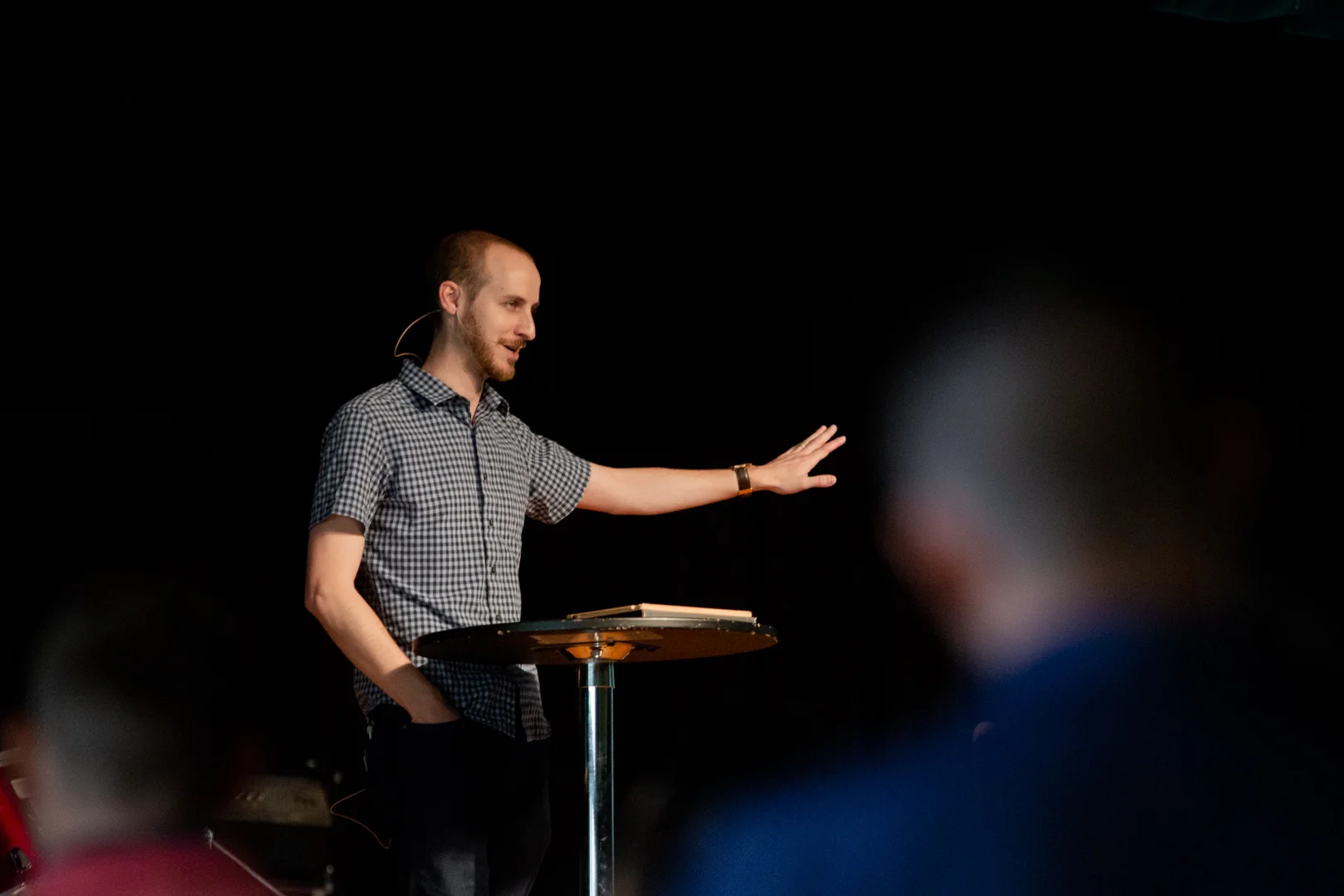

Walking in Step with the Gospel
Galatians 2:11-16
Walking in Step with the Gospel
galatians 2:11-16
Main Idea: We must strive to uphold the truth of the gospel both in doctrine and in conduct.
I. Eating & Drinking
This apostolic confrontation was a monumental moment in the early church because of both the people and the place involved:
People: The Apostle Peter received a direct revelation from the Lord (Acts 10:9-16), indicating that God has made all foods clean, the ceremonial distinctions between Jews and Gentiles have been broken down (10:28; Mk. 7:18-19; Eph. 2:14-17), and that God “shows no partiality” (10:34). He preaches the gospel to the Gentiles who then receive the Holy Spirit and are baptized.
Place: The church in Antioch began when Gentiles heard the gospel, turned in faith to Christ, and then were taught by Barnabas and Paul (Acts 11). Antioch is the first place where followers of Jesus were called “Christians” (11:26) and later became the home-base for Paul’s missionary journeys to the “ends of the earth.”
In Antioch, Peter freely shared “table fellowship” with the Gentiles, despite criticism (Acts 11:2), knowing that the gospel of God’s grace overcame deep cultural division and animosity between Jews and Gentiles.
We used to hate and destroy one another and refused to associate with people of another race or country. Now, because of Christ, we live together with such people and pray for our enemies.
~ Justin Martyr
II. Hypocrisy & Fear
When “certain men from James” came to Antioch from Jerusalem (presumably Jewish Chrsitians), Peter “drew back and separated himself” from the Gentiles, acting in hypocrisy.
There was nothing intrinsically wrong with Peter's Jewish customs. But there was something very wrong with requiring adherence to them after Christ had fulfilled them, which Peter did by distancing himself from the unkosher Gentile believers. In effect, Peter was saying that Gentiles had to believe the gospel and adapt to Jewish culture for them to be good enough for Christ - and good enough for Peter! They were not his equals, because they weren't like him. In doing this, Peter obscured the all-sufficiency of Jesus and exalted something of himself in the Lord's place. What an insult to the finished work of Christ on the cross! How demeaning to those blood-bought Gentiles!... What a violation of justification by faith alone!
~ Ray Ortlund, The Gospel: How the Church Portrays the Beauty of Christ
‘Hypocrisy’ is not simply failing to live up to what you believe; it is to be a “play-actor” and wear a “mask,” hiding your true self. Peter’s hypocrisy led him to live out his gospel convictions in one situation, but then cover them up in another.
Peter’s hypocrisy in Antioch is driven by his “fear” of the circumcision party. His desire for the approval of this group allowed cultural differences to become more important than gospel unity, and risked creating a church in which there was “one Lord, but two Lord’s tables” (~ Stephen Neill).
Like all of us, Peter had a history of fear. When he denied Jesus on the night of his Lord’s arrest, he feared physical harm. In Antioch, he effectively denied Jesus because he feared social harm. Driven by the primitive fear, he falsified the gospel. In other words, the problem entered in not at the level of doctrine but at the level of culture. It started with personal fear, not with reading a book of bad theology.
~ Ray Ortlund, The Gospel: How the Church Portrays the Beauty of Christ
Peter’s fear of the “circumcision party” caused his conduct to be “not in step with the truth of the gospel.” This had serious consequences: he “stood condemned” before the Lord and he also led the other Jewish Christians - “even Barnabas” - astray.
III. The Equalizer of Grace
Paul, knowing what was at stake by Peter’s actions, courageously confronted Peter “to his face” and “before them all.” His confrontation highlights two theological realities that were inconsistent in their hypocritical behavior.
There is no distinction between Jews and Gentiles in their sin, since no one will be justified by “works of the law” (cf. Rom. 10:3; Ps. 143:2)
There is no distinction between Jews and Gentiles in their salvation, since we are only justified by faith in Christ alone
Romans 3:21–24: But now the righteousness of God has been manifested apart from the law, although the Law and the Prophets bear witness to it— the righteousness of God through faith in Jesus Christ for all who believe. For there is no distinction: for all have sinned and fall short of the glory of God, and are justified by his grace as a gift, through the redemption that is in Christ Jesus.
Romans 15:7: Therefore welcome one another as Christ has welcomed you, for the glory of God.
A Little Steel for Your Spine
Galatians 2:1-10
A Little Steel for Your Spine
galatians 2:1-10
Main Idea: We must resist false gospels because of our submission to Christ and love of our neighbor.
I. Submit to the Revelation (2:1-2)
t was not, we may be sure, that he had any personal doubts or misgivings about his gospel and needed the reassurance of the other Jerusalem apostles, for he had been preaching it for fourteen years; but rather lest his ministry, past and present, should be rendered fruitless by the Judaizers. It was to overthrow their influence, not to strengthen his own conviction, that he laud his gospel before the Jerusalem apostles.”
~ John Stott The Message of Galatians
His fear is not that his gospel will be voided of its power if the decision in Jerusalem should go against him; what he fears, rather, is that a negative verdict will create a fissure in the church between its Jewish and Gentile wings.
~ Douglas Moo
II. Unyielding in the Confrontation (2:3-5)
Such people were no doubt genuinely shocked by the carefree attitude of Gentile Christians to the law of Moses, their own most treasured possession. It is highly likely that they thought themselves to be enriching the spiritual lives of Gentile converts immeasurably. But from his own experience Paul knew that this action was but a return to slavery. True, the Galatians had not been slaves to this particular Jewish system before: as pagans, they had had their own system of religion and morals. But a change of masters is not an escape from slavery: that is Paul’s whole point.
~ Alan Cole
Let this be then the conclusion of all together, that we will suffer our goods to be taken away, our name, our life, and all that we have; but the Gospel, our faith, Jesus Christ, we will never suffer to be wrested from us. And cursed be that humility which here abaseth and submitteth itself.
~ Martin Luther
Three Reasons Why We Are Vulnerable to False Teaching
Ignorance
Idolatry
Indifference
III. Impartial to the Confirmation (2:6-10)
Gospel Transformation
Galatians 1:10-24
Gospel Transformation
galatians 1:10-24
Main Idea: The gospel completely transforms us so that we now live for God’s glory and approval alone.
I. The Necessity of Grace (1:11-14)
His gospel, which was being called in question by the Judaizers and deserted by the Galatians, was neither an invention (as if his own brain had fabricated it), nor a tradition (as if the church had handed it down to him), but a revelation (for God had made it known to him)... The magnitude of his claim is remarkable. He is affirming that his message is not his message but God’s message, that his gospel is not his gospel but God’s gospel, that his words are not his words but God’s words.
~ John Stott, The Message of Galatians
In order to back up this claim, Paul reminds the Galatians of his unlikely conversion story. His former life looked like a fanatical commitment to:
Persecuting the church of God “violently” trying to “destroy” it (cf. Acts 8:1-3, 22:4-5, 26:9-11)
Advancing quickly in Judaism as a Pharisee, “zealous” for the tradition of his fathers (cf. Phil. 3:3-6; Acts 22:3, 26:5)
II. The Experience of the Gospel (1:15-16a)
As Paul recounts his incredible conversion experience (cf. Acts 9:1-6), he emphasizes the Lord’s work of:
Setting him apart before he was born (Jer. 1:5; Isa. 49:1; Lk. 1:13-17; Eph. 1:3ff)
Calling him by his grace (2 Tim. 1:9; 1 Thess. 5:23-24)
Revealing Christ to him externally (Acts 9:4-5) and internally (2 Cor. 4:6)
In the story of freedom, God is always the subject; humans, always the object. If we’re to live free, it will be because of God’s actions, not because of our own will or disposition or politics or intelligence…. Something is done to us or for us before we do anything. We are acted on before we act. Life isn’t naturally produced by us; it’s supernaturally provided for us.
~ Eugene Peterson, Traveling Light: Galatians and the Free Life in Christ
Christianity is not something you take up. Christianity is something that takes you up. Christianity is not so much something you decide on. Christianity is something that happens to you.
~ Tim Keller, “Why They Glorified God”
1 Timothy 1:15–16: The saying is trustworthy and deserving of full acceptance, that Christ Jesus came into the world to save sinners, of whom I am the foremost. But I received mercy for this reason, that in me, as the foremost, Jesus Christ might display his perfect patience as an example to those who were to believe in him for eternal life.
III. The Approval of God (1:16b-24, 10)
The next season of Paul’s life confirmed God’s divine calling and commissioning “in order that he might preach [Christ] among the Gentiles.” This is seen as Paul traveled to:
Arabia for 3 years (Acts 9:23-25; 2 Cor. 11:32-33)
Jerusalem for 15 days, meeting with Peter & James (Acts 9:26)
Syria and Cilicia, remaining “unknown” to the churches in Judea (Acts 9:30)
Paul is contending that his gospel ministry was independent from but not in contradiction to the Jerusalem Apostles. Jesus was building his church and communicating his gospel of grace through both Paul and the other Apostles.
Paul’s testimony and our testimony ought to produce the same response:
Within us: “For am I now seeking the approval of man, or of God? Or am I trying to please man? If I were still trying to please man, I would not be a servant of Christ.” (1:10)
In others: “They glorified God because of me.” (1:24)
The primary reality of which we have to take account in seeking for a Christian impact on public life is the Christian congregation. How is it possible that the gospel should be credible that people should come to believe that the power which has the last word in human affairs is represented by a man hanging on a cross? . . . The only answer, the only hermeneutic of the gospel, is a congregation of men and women who believe it and live by it.
~ Lesslie Newbigin, The Gospel in a Pluralistic Society
No Other Gospel
Galatians 1:1-9
No Other Gospel
galatians 1:1-9
Paul is not tolerant when people he loves are being told lies about God, because he knows that such lies will reduce their lives, impair the vitality of their spirits, imprison them in old guilts, and cripple them with anxieties and fears.
~ Eugene Peterson, Traveling Light: Galatians and the Free Life in Christ
Main Idea: We must hold fast to the gospel of Christ, who alone secures grace and peace for us.
I. The Messenger of the Gospel (1:1-2)
Paul begins his letter to the churches in Galatia by asserting his apostleship; the “apostles” were a special group (including the Twelve plus a few others) commissioned personally by the risen Lord Jesus to serve a foundational role in the church.
Eph. 2:20: [the church is] “built on the foundation of the apostles and prophets, Christ Jesus himself being the cornerstone.”
Why did Paul thus assert and defend his apostleship?... It was because the gospel that he preached was at stake. If Paul were not an apostle of Jesus Christ, then men could, and no doubt would, reject his gospel. This he could not bear. For what Paul spoke was Christ’s message on Christ’s authority.
~ John Stott, The Message of Galatians: Only One Way
II. The Message of the Gospel (1:3-5)
Paul “bookends” his letter (1:3, 6:18) to the Galatians with a reminder of grace. God’s grace toward the undeserving is at the heart of the message of the gospel (John 1:14, 16), and is the only basis for ‘peace’ with God.
The bridge from grace (1:3) to glory (1:5) is the finished work of Jesus Christ through the cross and resurrection (1:1), who “gave himself for our sins to deliver us from the present evil age.” All of this was “according to the will of our God and Father,” foretold in the OT Scriptures.
III. The Matchlessness of the Gospel (1:6-9)
Paul is astonished that the Galatians were so quickly at risk of ‘deserting:’
What Paul had taught them (the gospel)
Who had saved them (God himself)
How he had saved them (in the grace of Christ)
The rest of Galatians indicates that these false teachers were “distorting [lit. ‘reversing’] the gospel of Christ” by contending that Gentile Christians must accept circumcision (5:11-12, 6:12-13; cf. Acts 15:1), become culturally Jewish (4:9-10), and observe the Mosaic Law (3:10-11) in order to truly be a part of the people of God.
If the Galatians accepted this teaching, they would actually be “reversing” the gospel, because ‘another gospel’ is not another gospel; to “add” to the gospel is actually to subtract, and an ‘almost gospel’ is no gospel at all.
There is a clear and present danger that the devil may take away from us the pure doctrine of faith and may substitute for it the doctrines of works and of human traditions. It is very necessary, therefore, that this doctrine of faith be continually read and heard in public… There is no middle ground between Christian righteousness and works-righteousness. There is no other alternative to Christian righteousness but works righteousness; if you do not build your confidence on the work of Christ you must build your confidence on your own work.
~ Martin Luther, Commentary on the Epistle to the Galatians
Cling tightly [to the gospel] with both your hands; when they fail, catch hold with your teeth; and if they give way, hang on by your eyelashes!
~ Charles Spurgeon

Taste and See
Psalm 34
Taste and see
Psalm 34
Main Idea: We can taste and see the Lord’s goodness by looking to Christ in every circumstance.
I. Recounting the Lord’s Praise (34:1-3)
David’s first impulse after experiencing divine deliverance (cf. 1 Sam. 21:10ff) is to call God’s people to worship the Lord together. This corporate worship involves blessing, praising, boasting, hearing, magnifying, and exalting the Lord.
I think we delight to praise what we enjoy because the praise not merely expresses but completes the enjoyment; it is its appointed consummation. It is not out of compliment that lovers keep on telling one another how beautiful they are; the delight is incomplete till it is expressed. It is frustrating to have discovered a new author and not to be able to tell anyone how good he is; to come suddenly, at the turn of the road, upon some mountain valley of unexpected grandeur and then to have to keep silent because the people with you care for it no more than for a tin can in the ditch; to hear a good joke and find no one to share it with.
~ C.S. Lewis, Reflections on the Psalms
The key to enjoying the Lord through corporate worship is humility (34:2); the humble are easily edified and make their boast and exaltation in the Lord, not themselves. “Who can make God great but those who feel themselves to be little?” (Charles Spurgeon)
Hebrews 10:23–25: Let us hold fast the confession of our hope without wavering, for he who promised is faithful. And let us consider how to stir up one another to love and good works, not neglecting to meet together, as is the habit of some, but encouraging one another, and all the more as you see the Day drawing near.
II. Remembering the Lord’s Provision (34:4-14)
Rather than trying to provide for himself or take credit for his own deliverance, David acknowledges the Lord’s provision. He tells us the Lord provides for his people through:
1. Saving (34:4-7)
Rather than carrying the weight of our suffering, anxieties, and fears ourselves, those who look to God are made “radiant” (cf. 2 Cor. 3:18) as He protects us on all sides (2 Kings 6:15-17).
2. Satisfying (34:8-10)
Those who “taste and see” the goodness of the Lord and humbly take “refuge” in him will “lack no good thing” (cf. Matt. 5:6). “You have made us for yourself, O Lord, and our heart is restless until it rests in you.” ~ Augustine, Confessions
3. Sustaining (34:11-14; cf. 1 Pet. 3:8-17)
The Bible isn’t interested in whether we believe in God or not. It assumes that everyone more or less does. What it is interested in is the response we have to him: Will we let God be as he is, majestic and holy, vast and wondrous, or will we always be trying to whittle him down to the size of our small minds, insist on confining him within the boundaries we are comfortable with, and refuse to think of him other than in images that are convenient to our lifestyle?... To guard against such blasphemous chumminess with the Almighty, the Bible talks about the fear of the Lord – not to scare us but to bring us to awesome attention before the overwhelming grandeur of God, to shut up our whining and chattering and stop our running and fidgeting so that we can really see him as he is and listen to him as he speaks.
~ Eugene Peterson, A Long Obedience in the Same Direction
III. Recognizing the Lord’s Presence (34:15-22)
Though affliction will come upon both the righteous and the wicked, the Lord has promised to be near His people, especially when they are “brokenhearted” over life’s circumstances or “crushed in spirit” over their own sin (cf. Matt. 5:3.).
When pain and suffering come upon us, we finally see not only that we are not in control of our lives but that we never were. Over the years, I have come to realize that adversity… pulled those who already believed into a deeper experience of God’s reality, love, and grace. One of the main ways we move from abstract knowledge about God to a personal encounter with him as a living reality is through the furnace of affliction… Believers understand many doctrinal truths in the mind, but those truths seldom make the journey down into the heart except through disappointment, failure, and loss... the great theme of the Bible itself is how God brings fullness of joy not just despite but through suffering, just as Jesus saved us not in spite of but because of what he endured on the cross. There is a peculiar, rich, and poignant joy that seems to come to us only through and in suffering.
~ Tim Keller, Walking with God through Pain and Suffering
When these promises feel too good to be true or out of reach, we must look to the finished work of Christ. Though it appeared God the Father was absent as Christ was crucified, his intact bones (John 19:36) are a reminder of God’s steadfast love and deliverance, so that “none of those who take refuge in him will be condemned.”
How God Shepherds His Flock
Psalm 23
HOW god shepherds his flock
Psalm 23
I. God’s Flock Has All of God for Every Need
Psalm 23:1: The Lord is my shepherd; I shall not want.
II. God Restores His Anxious and Drained Flock
Psalm 23:2-3a: He makes me lie down in green pastures. He leads me beside still waters. He restores my soul.
III. God Grows His Flock on Unnatural Paths
Psalm 23:3b: He leads me in paths of righteousness for his name's sake.
IV. God Secures His Frightened Flock
Psalm 23:4: Even though I walk through the valley of the shadow of death, I will fear no evil, for you are with me; your rod and your staff, they comfort me.
V. God Comforts His Flock with His Table
Psalm 23:5: You prepare a table before me in the presence of my enemies; you anoint my head with oil; my cup overflows.
VI. God Comforts His Flock with His Table
Psalm 23:6: Surely goodness and mercy shall follow me all the days of my life, and I shall dwell in the house of the Lord forever.
Our Gracious God
Psalm 41
OUr gracious God
Psalm 41
Main Idea: In Jesus, we can look to the Lord’s promises and make them our own.
I. The Position of Promise (v. 1-3)
Psalm 41:1-3: Blessed is the one who considers the poor!
In the day of trouble the Lord delivers him;
the Lord protects him and keeps him alive;
he is called blessed in the land;
you do not give him up to the will of his enemies.
The Lord sustains him on his sickbed;
in his illness you restore him to full health.
The Psalms are not trite, superficial answers to life's deepest problems. The Psalms take us deep down into the pain of this life, and then they take us up again into divine renewal and true hope. We see this when verse 10 begins by saying "But ..." David's pains are not the sum total of his life. The deepest reality of his life is the promises of God.
~Dane Ortlund, In The Lord I Take Refuge
Psalm 41 is the last psalm in book one of the Psalter (Psalms 1-41). While it is similar in content to Psalm 6 and Psalm 38 with cries of deliverance from illness or sickness, its opening line is clearly a call back to the first Psalm. They both open with the phrase “Blessed is…”
Psalm 1:1-2: Blessed is the man
who walks not in the counsel of the wicked,
nor stands in the way of sinners,
nor sits in the seat of scoffers;
but his delight is in the law of the Lord,
and on his law he meditates day and night.
While Psalm 1 pronounces blessing in those who obey God’s law, keeping them from trouble, Psalm 41 pronounces blessing on the weak who are in trouble by assuring them of rescue.
~ John Goldingay, Baker Commentary
We see David's position of declaring the LORD’s promises in his time of need in 5 distinct ways. These are all “theological truths” that David believes about the LORD. He says that the LORD:
Delivers (v. 1)
Protects (v. 2)
Keeps (v. 2)
Sustains (v. 3)
Restores (v. 3)
Hebrew 5:12-14: For though by this time you ought to be teachers, you need someone to teach you again the basic principles of the oracles of God. You need milk, not solid food, for everyone who lives on milk is unskilled in the word of righteousness, since he is a child. But solid food is for the mature, for those who have their powers of discernment trained by constant practice to distinguish good from evil.
1 Thessalonians 4:3: For this is the will of God, your sanctification.
II. A Personal Prayer (v. 4-10)
The power of verse 4 in this psalm cannot be understated. David turns impersonal principles about God, into personal prayer and applies the theological principles to his own life. His prayer echoes Psalm 32 where he turns to the Lord in prayer and acknowledges his sin to the Lord and confesses it. It is this confession of guilt that paradoxically and mysteriously turns him, and us, from betrayer to benefactor.
Your accuser goes on scoring points off you, as long as you insist on making your own excuses. So do you want to ensure that your accuser—the devil, that is—suffers and groans? Do what you have heard, do what you have learned, and say to your God, “I myself have said it, Lord. Have mercy on me, heal my soul, since I have sinned against you.” “I myself,” he says, “I myself have said it; not the devil, not luck, not fate. I myself have said it. I’m not making excuses, on the contrary, I accuse myself. I have said it. Have mercy on me, heal my soul.
~ Augustine
While David is the author of this Psalm, we can read it in light of the hope and truth of the Gospel as Jesus has revealed. Therefore, we have two pictures in mind. The type and their fulfillment (antitype). David was a type of Christ. David’s enemies, in particular Ahithophel (2 Samuel 15:12), were a type of the betrayer who would come (Judas). We can be confident of this because Jesus quotes this verse (41:9) in reference to Judas’ betrayal of him (John 13:18-26; Matthew 26:21-30).
It may seem too rudimentary, too simple, but what better plea can one bring in all our own guilt or in the face of the malice, hatred, and betrayal of others to a God who already has a grace-bent to His nature?
~ Dale Ralph Davis, My Exceeding Joy
III. The Power of Grace (v. 11-13)
Psalm 41:11-13: By this I know that you delight in me:
my enemy will not shout in triumph over me.
But you have upheld me because of my integrity,
and set me in your presence forever.
Blessed be the Lord, the God of Israel,
from everlasting to everlasting!
Amen and Amen.
The 'integrity' bothers some readers. After all, didn't David confess sin in verse 4? But 'integrity' is not sinlessness nor perfection; he only claims that this is the overall bent of his life-that he has not turned away from his devotion to Yahweh. And what has he found? That Yahweh has 'held on to' His servant. How much more secure can one be?
~ Dale Ralph Davis, My Exceeding Joy
John 10: 27-28: My sheep hear my voice, and I know them, and they follow me. I give them eternal life, and they will never perish, and no one will snatch them out of my hand.
The Good News of a Short Life
Psalm 39
The Good News of a Short Life
Psalm 39
Main Idea: Jesus turns our laments over this life’s fragility into hope in our eternal citizenship.
I. Silence to Lament (v. 1-6)
David turns from keeping his tongue silent in the midst of his distress to avoid sin to speaking out with his tongue to the Lord in prayer to avoid despair.
Psalm 37:3-15: Trust in the Lord, and do good; dwell in the land and befriend faithfulness. Delight yourself in the Lord, and he will give you the desires of your heart. Commit your way to the Lord; trust in him, and he will act. He will bring forth your righteousness as the light, and your justice as the noonday. Be still before the Lord and wait patiently for him; fret not yourself over the one who prospers in his way, over the man who carries out evil devices! Refrain from anger, and forsake wrath! Fret not yourself; it tends only to evil. For the evildoers shall be cut off, but those who wait for the Lord shall inherit the land. In just a little while, the wicked will be no more; though you look carefully at his place, he will not be there. But the meek shall inherit the land and delight themselves in abundant peace. The wicked plots against the righteous and gnashes his teeth at him, but the Lord laughs at the wicked, for he sees that his day is coming. The wicked draw the sword and bend their bows to bring down the poor and needy, to slay those whose way is upright; their sword shall enter their own heart, and their bows shall be broken.
I wonder how many believers stop speaking to God about their pain. Disappointed by unanswered prayers or frustrated by out-of-control circumstances, these people wind up in a spiritual desert unable—or refusing—to talk to God. This silence is a soul killer.
- Mark Vroegop
Lament is a prayer in pain that leads to trust.”
- Mark Vroegop.
Psalm 77:2-4: My soul refuses to be comforted. When I remember God, I moan; when I meditate, my spirit faints. You hold my eyelids open; I am so troubled that I cannot speak.
Lament does not give you an excuse to wallow in your questions or frustrations. It is a means to another end. In the same way a surgeon’s cut is meant to heal, so complaint is designed to move us along in our lament. You are not meant to linger in complaint. If you never move beyond complaint, lament loses its purpose and its power. Complaint is central to lament. But Christians never complain just to complain. Instead, we bring our complaints to the Lord for the purpose of moving us toward him. We allow the honest opening of our souls to become a doorway to the other elements of lament.
- Mark Vroegop.
Luke 12:13-21: Someone in the crowd said to him, “Teacher, tell my brother to divide the inheritance with me.” But he said to him, “Man, who made me a judge or arbitrator over you?” And he said to them, “Take care, and be on your guard against all covetousness, for one’s life does not consist in the abundance of his possessions.” And he told them a parable, saying, “The land of a rich man produced plentifully, and he thought to himself, ‘What shall I do, for I have nowhere to store my crops?’ And he said, ‘I will do this: I will tear down my barns and build larger ones, and there I will store all my grain and my goods. And I will say to my soul, “Soul, you have ample goods laid up for many years; relax, eat, drink, be merry.” But God said to him, ‘Fool! This night your soul is required of you, and the things you have prepared, whose will they be?’ So is the one who lays up treasure for himself and is not rich toward God.
II. Lament to Confession (v. 7-11)
David’s lament over the fragility of this life turns into a confession of hope that the Lord is the only one able to deliver and rescue him.
Luke 12:13-21: I have seen a wicked, ruthless man,
spreading himself like a green laurel tree.
But he passed away, and behold, he was no more;
though I sought him, he could not be found.
Mark the blameless and behold the upright,
for there is a future for the man of peace.
But transgressors shall be altogether destroyed;
the future of the wicked shall be cut off.
For the Christian, the exodus event—the place where we find ultimate deliverance—is the cross of Christ. This is where all our questions—our heartaches and pain—should be taken. The cross shows us that God has already proven himself to be for us and not against us.
- Mark Vroegop.
III. Confession to Appeal (v. 12-13)
David’s confession of hope turns into an appeal to his shared identity with the Lord as an exile in this world, longing for something beyond it.
Hebrews 11:13-16: These all died in faith, not having received the things promised, but having seen them and greeted them from afar, and having acknowledged that they were strangers and exiles on the earth. For people who speak thus make it clear that they are seeking a homeland. If they had been thinking of that land from which they had gone out, they would have had opportunity to return. But as it is, they desire a better country, that is, a heavenly one. Therefore God is not ashamed to be called their God, for he has prepared for them a city.
Ephesians 2:19: So then you are no longer strangers and aliens, but you are fellow citizens with the saints and members of the household of God.
The brevity of life and the sadness of death run throughout the Bible and the full revelation of the immortal world does dot remove them. This life is precious. Its joys and loves may be transcended but they cannot be replaced.
- Alec Motyer
There is a Hiding Place
Psalm 32
There is a hiding place
Psalm 32
I. The Blessings of Confessed Sin
II. The Burdens of Concealed Sin
III. The Beauty of Mercy and Grace
What We Love
Psalm 30
What WE love
Psalm 30
Main Idea: What we love drives what we do and affirms what we believe.
I. What Did David Love?
The plain and simple answer is “the LORD” and David tells us why. He describes a double deliverance in the two main stanzas of this psalm.
First, the LORD delivered David from external threats. (v.1-3)
Second, the LORD delivered David from internal despair. (v. 6-10)
C.S. Lewis calls this God’s “intolerable compliment” to those He loves. Having set His love upon us, the LORD will not let us remain who we were when He found us. He will scrub and clean, and break and mend, and squeeze and mold all our life long, relentlessly striving to make us just a little more like Jesus than we ever were and that much more like we shall be when we see him at last.
II. What Did David’s Love Drive Him to Do?
Again, the answer is simple and straight-forward. It drove him to build the Temple. We get a sense of what the Temple meant to him by looking at how he talks about it in his own words.
Psalm 27, the one thing David asks of the Lord and seeks after is to “dwell in the house of the LORD all the days of my life, to gaze upon the beauty of the LORD and to inquire in his temple.”
Psalm 122 indicates that visiting the Temple was David’s “happy place.” “I was glad when they said to him, “Let us go to the house of the LORD!”
According to Psalm 11, “The LORD is in His holy Temple.” It is from there that He sends help (Ps 20:4). It is there that He hears the cries of those who cry to Him. (Ps. 18:6) Those who will worship the LORD do so by “bowing down toward His holy Temple” (Ps. 5:7) and in His Temple, everyone cries, “Glory!” (Ps 29:9) In a life that David describes as being shepherded by goodness and mercy, his highest hope is to “dwell in the house of the LORD forever.” (Ps 23:6)
David’s passion for the Temple is not just exaggerated “religious language” poetically expressed. David literally put his money where his mouth was!
Along with cutting all of the stones that would be needed for the Temple, “David also provided great quantities of iron for nails for the doors of the gates and for clamps, as well as bronze in quantities beyond weighing, and cedar timbers without number... (1 Chron 22:3-5) A little later in that same chapter he says to Solomon: “With great pains I have provided for the house of the LORD 100,000 talents of gold, a million talents of silver, and bronze and iron beyond weighing, for there is so much of it; timber and stone, too, I have provided. To these you must add.” (1 Chron 22:14)
The rest of the chapters talk about how David organized the Levites for the maintenance of the Temple, how he organized the priests for the work of the Temple, how he arranged musicians to rotate through on monthly rhythms to fill the Temple with praise and music, how he structured the administrative infrastructure for guarding and supplying the Temple, and how he drew up the architectural renderings for the Temple.
III. What Did David Believe That Affirmed Such Love?
That there is something more than the current moment that matters most of all. That there is something beyond the Temple that is even better yet.
Psalm 2:10-12: Now therefore, O kings, be wise;
be warned, O rulers of the earth.
Serve the Lord with fear,
and rejoice with trembling.
Kiss the Son,
lest he be angry, and you perish in the way,
for his wrath is quickly kindled.
Blessed are all who take refuge in him.