
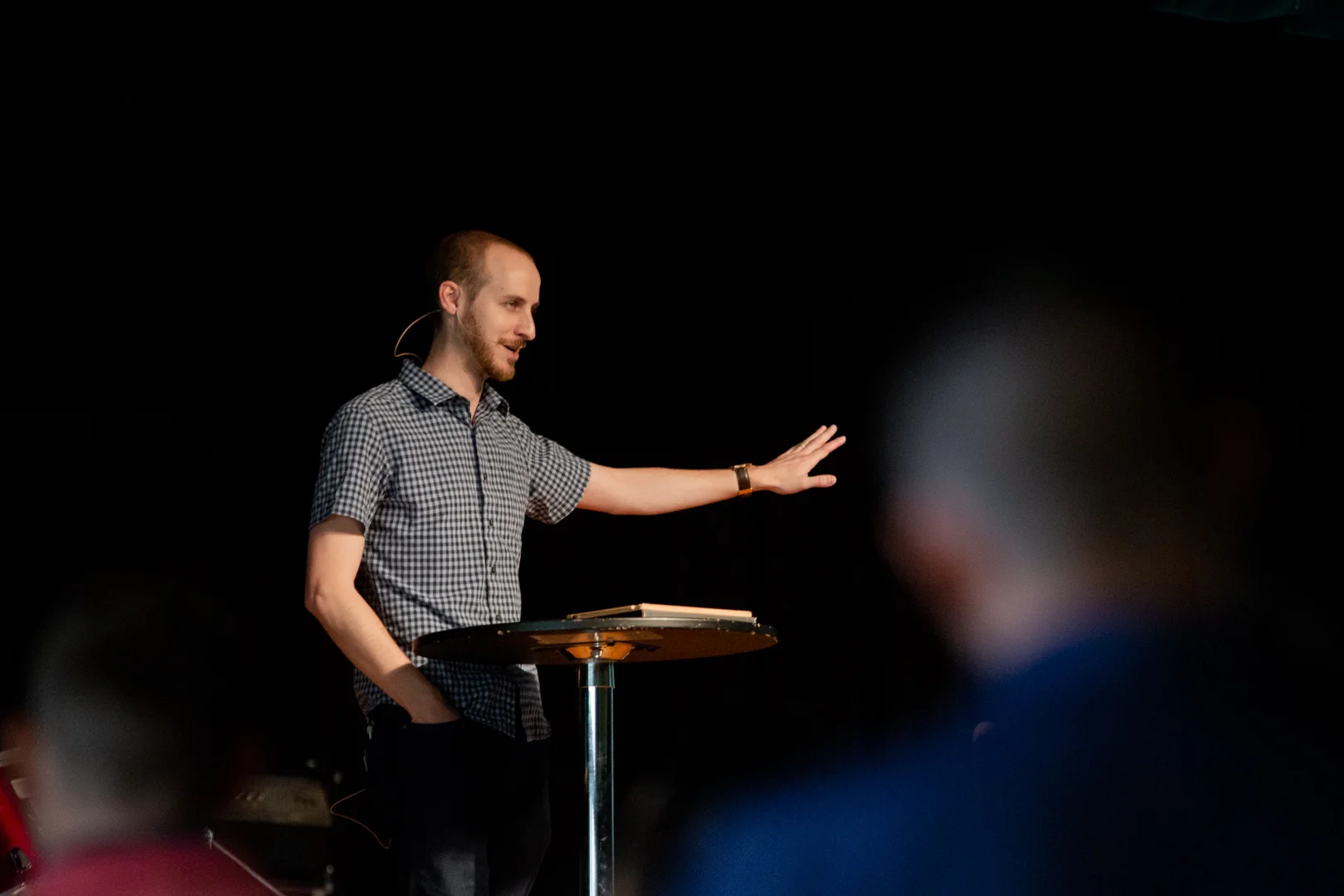

The Kingdom of the Lord
Obadiah
*Unfortunately, we were unable to record the sermon from Sunday, February 9, 2025. We sincerely apologize for any inconvenience.
The Kingdom of the Lord
obadiah
Your patient has become humble; have you drawn his attention to the fact? All virtues are less formidable to us once the man is aware he has them, but this is especially true of humility. Catch him at the moment when he is really poor in spirit and smuggle into his mind the gratifying reflection, ‘By jove! I’m being humble,’ and almost immediately pride - pride at his own humility - will appear.
~ C.S. Lewis, The Screwtape Letters
Main Idea: As the sovereign King, the Lord will humble the exalted and exalt the humble.
I. The Pride of Edom (1-14)
The sibling rivalry between Jacob and Esau (Gen. 25:19-34) evolves into a long-standing fraternal struggle between the nations of Israel and Edom. These two ‘brothers’ had near constant strife and animosity toward one another, often resulting in violence and warfare.
Obadiah indicts Edom for the “pride of their heart” that has “deceived” them (3). The Lord hints of numerous points of pride for the nation:
They presumed their topography meant they were invulnerable to attack (3-4)
They had relative wealth (5-6)
They had friends and allies (7-8)
They perceived to have worldly wisdom (8) and mighty strength (9)
The evidence of their deceptive pride became obvious in the way they treated others, particularly after Judah was defeated by Babylon:
They “stood aloof” as Judah was destroyed (11; cf. Prov. 3:27)
They boasted and delighted in their downfall (12; cf. Prov. 24:17-18)
They exploited and looted their ‘brother’ (13)
They assisted Babylon in capturing those fleeing (14)
1 Peter 5:5b-6: Clothe yourselves, all of you, with humility toward one another, for “God opposes the proud but gives grace to the humble.” Humble yourselves, therefore, under the mighty hand of God so that at the proper time he may exalt you
II. The Cup of Judgment (15-18)
Obadiah then expands the humbling, justified judgment on Edom to a picture of what will happen on the “Day of the Lord’ to all nations who follow in their prideful path (cf. Mt. 25:31-32). The nations will drink the “cup” of God’s wrath, a frequent theme of the OT (cf. Ps. 75:8; Isa. 51:17; Jer. 25:15, Eze. 23:33; Hab. 2:15–16).
God has provided a way of “escape” (17) from his righteous judgment on the prideful who oppose the Lord, his anointed (cf. Ps. 2:2), and his people. The incarnation of Christ was an act of ‘humiliation,’ leading to crucifixion, the supreme picture of humility (Phil. 2:5-8). On the cross, Jesus drinks the full cup of God’s wrath against pride and sin until it is dry (Mk. 14:32-42).
See him there, amid the olives in Gethsemane’s garden, prostrate in prayer, and covered with a bloody sweat as he pleads with his Father on his people’s behalf. Do you see that cup, filled with wormwood and gall, of which he must drink if you are to be saved? Can you bear the sight? Are you not overwhelmed with penitent sorrow as you see the Lord of life and glory lying there covered with his own blood, and know that all his agony was on your account? It is that poverty of his which has made you rich; for he has taken from your hand the cup of his Father’s just wrath against sin, and he has drained it himself; and, instead, he has set before you the cup of salvation, from which he bids you to drink the new wine of the kingdom full of joy and delight... Yet you never could have had that cup of blessing in your hand if he had not first emptied that other cup, which his Father gave him to drink—that cup of awful bitterness which he resolved that you should never taste.
~ Charles Spurgeon, “Christ’s Poverty, Our Riches”
For those of humble faith, the Day of the Lord will be a refining fire (17; cf. 1 Cor. 3:13-14); for those of prideful rebellion (like Edom), they will be like ‘stubble’ consumed by judgment (18).
III. The Kingdom of God (19-21)
Obadiah ends his book with a vision of the people of God expanding into and beyond the Promised Land, taking possession of an increasing portion of the earth. Ultimately, this is a “telescopic” vision of the restoration of all things, when “the kingdom of the world has become the kingdom of our Lord and of his Christ, and he shall reign forever and ever” (Rev. 11:15).
Dominion belongs to the Lord after the great reversal that comes on his day (Obad. 15). The Day of the Lord brings the Kingdom of God. God’s ultimate aim is not just a reversal of his people’s fortunes… not simply the defeat of enemies or the restoration of Israel, but his kingship over the whole world.
~ Craig Bartholomew & Heath Thomas, The Minor Prophets
Matthew 5:3: “Blessed are the poor in spirit, for theirs is the kingdom of heaven.”
Hebrews 12:28-29: Therefore let us be grateful for receiving a kingdom that cannot be shaken, and thus let us offer to God acceptable worship, with reverence and awe, for our God is a consuming fire.
Preparing to Meet God
Amos
PReparing to meet god
Amos
Main Idea: We prepare to meet God through whole-hearted, whole-life worship.
I. The Sovereignty of God (4:6-11)
In response to the injustice happening throughout N. Israel (cf. 2:6-7; 4:1; 5:11-12; 8:5), the Lord sovereignly sent judgment upon their land in the form of:
Famine (4:6)
Drought (4:7-8)
Destruction of Vegetation (4:9)
Plagues & Pestilence (4:10)
Overthrow & Defeat (4:11)
Despite God’s sovereign intervention in these dramatic ways, the people failed to respond appropriately to the Lord’s discipline (cf. 3:1-2; Ps. 94:12; Heb. 12:5ff): “yet you did not return to me” (5x).
Five times in Amos 4 God says that he had done specific things in the lives of his people to turn them back to himself. And five times it says, ‘Yet you did not return to me.’ Each of these things God had done to get their attention could be explained as natural events with no divine cause. But God holds Israel accountable to listen and respond… In not hearing the voice of God, or seeing the hand of God, Israel failed to prepare to meet him. That is what we must not do. We must wake up and stop looking at our lives like secular, scientific, western naturalists. God is doing things in your life which are gracious providential messages to return to him and trust him.”
~ John Piper, “Prepare to Meet Your God”
II. The Sureness of Judgment (4:12-13; 5:18-20)
Because of Israel’s gross injustice and their failure to repent, the Lord will bring an inevitable judgment as a consequence of their sin. This judgment is multifaceted:
A. The Visitation of the Lord (4:12-13)
Israel is urged to prepare for the arrival of the Lord himself, to whom they must give an account. Amos reminds the people through a ‘creation hymn’ (4:13, 5:8, 9:5-6) that the Lord they will meet is the creator of all, omniscient in his discernment, and omnipotent in his reign.
B. The Day of the Lord (5:18-20)
The inevitability of judgment is described in a parable; a man escapes a sudden encounter with a lion (cf. 1:2) and a bear, only to be bitten by a snake while thinking he is safe in his own home. All of this was meant to stir up awe, reverence, and fear within God’s people (cf. Heb. 10:31).
The day of the Lord is the advent of God into the world in judgment and salvation to usher in his kingdom.
~ Craig G. Bartholomew and Heath A. Thomas, The Minor Prophets: A Theological Introduction
III. The Substance of Worship (5:21-24)
The haunting irony of Israel’s situation is that they assumed God’s favor and approval due to their religious fervor and practice (cf. 4:4-5). However, their worship had become an end to itself, and they were unaware of the fact that God had left them a long time ago.
The Lord indicts Israel for “honoring me with their lips, while their hearts are far from me” (Isa. 29:13; Matt. 15:8-9a). They treated their religious assemblies, feasts, and offerings as a “den” of protection from the rest of their lives which were marked by iniquity and injustice (Jer. 7:11; Matt. 21:13).
Israel had failed to give attention to the “weightier matters of the law: justice and mercy and faithfulness” (5:24; Mt. 23:23). Repentance would mean replacing their outward, hypocritical, compartmentalized religiosity with true and proper worship that would permeate all of society and all of life as an ever-flowing stream.
The marks of true, substantive worship:
True worship is about God
True worship is in spirit and in truth (Jn. 4:23-24)
True worship is whole-hearted and whole-life (Rom. 12:1; Heb. 12:28)
You may have very sweet voices, but God does not regard your voice, he hears your heart, and if your heart does not sing you have not sung at all. When we stand up to pray it may be that the preacher’s words may happen to be suitable to your case, but it is not prayer so far as you are concerned … unless you join in it. Recollect that if you do not put your hearts into the worship of God, you might for that matter as well be at home as here; you are better here than at home for other reasons, because you are in the way where good may come to you; but for worship’s sake you might as well have been in bed as here… It is not your worshipping God by words in hymns and prayers, or sitting in a certain place, or covering your faces at certain times that is acceptable to him; true worship lies in your heart paying reverence to him, your soul obeying him, and your inner nature coming into conformity to his own nature, by the work of his Spirit in your soul.
~ Charles Spurgeon, “An Axe at the Root”
Anytime, Anyone, Anywhere
Joel 2:28-32
Anytime, anyone, anywhere
joel 2:28-32
Main Idea: Anytime anyone, anywhere calls upon the name of the Lord, they will be saved
I. The Spirit (2:28-29)
Passages where the Lord bestows His Spirit:
Kings – 1 Sam 16:13 – 14; Isa 1:2
Prophets – 1 Sam 10:6; 19:20 – 24; Isa 61:1; Mic 3:8
Other Leaders – Ex 31:3; 35:31; Judges 3:10; 6:34; 14:6
The gift of the Spirit was not to be for personal satisfaction, or even for national recovery and stability. It was to strengthen the people of God to take up a position of prophetic leadership among the nations in a world heading for an apocalyptic day of final reckoning. If individual prophets had the task of taking God’s word to a nation at risk of God’s judgment, a prophetically inspired people would have the task of taking God’s word to a world on the brink of Ultimate judgment.
~ David Prior, The Message of Joel, Micah, and Habakkuk
II. The Day (2:30–31)
The Day of the Lord:*
Is a time and event, not just a singular day (Joel 3:1)
Emerges in more than one historic moment in the history of God’s people
Emerges with/after momentous cosmological events
Is a time of restoration and salvation and it is followed by peace and harmony
Is a time of judgment and punishment
Anticipates a coming vindication of the righteous and punishment of the wicked
Correlates with the coming reign of God, which can also be identified as the coming kingdom of God
Is a day of refuge and restoration for those who, in humility and fidelity, call on the Lord and wait for him
Reveals the just and restorative character of Yahweh
*Adapted from The Minor Prophets: A Theological Introduction, Craig G. Bartholomew and Heath A. Thomas
The day of the Lord is the advent of God into the world in judgment and salvation to usher in his kingdom.
~ Craig G. Bartholomew and Heath A. Thomas, The Minor Prophets: A Theological Introduction
III. The Call (2:32)
I believe the doctrine of election, because I am quite certain that, if God had not chosen me, I should never have chosen Him; and I am sure He chose me before I was born, or else He never would have chosen me afterwards; and He must have elected me for reasons unknown to me, for I never could find in myself why He should have looked upon me with special love. So I am forced to accept that great Biblical doctrine.
~ Charles Spurgeon, C. H. Spurgeon's Autobiography
We are invited to rejoice in a God who is still pouring out his Spirit on those who, in glad and humble response to his call, turn to him to be saved — from the grip of sin and the powers of death, but supremely from the day of judgment. They then become part of the people of God, a ‘remnant’ called and equipped to speak his word to their generation and, by such ministry, to provide godly leadership in society at every level.
~ David Prior, The Message of Joel, Micah, and Habakkuk
God's Wayward Bride
Hosea 1-3
God’s wayward bride
hosea 1-3
Main Idea: Despite our spiritual adultery, the Lord graciously calls us back to himself as our husband.
I. Marriage & Our Husband (1:2)
Hosea’s marriage to Gomer was to be a prophetic picture of the Lord’s marriage to his covenant people, Israel (cf. Jer. 2-4, Ezek. 16, Isa. 54:5, 62:4-5). Throughout Hosea’s prophetic message, he emphasizes the Lord’s special, covenant relationship with Israel (cf. 11:1; 13:4), reflecting the larger OT story of God “setting his love upon them and choosing them” in keeping with his covenant promises (cf. Deut. 7:7-8).
[The prophets] retell the whole story of Israel in a new way – as a tragic romance. The Lord gave himself to Israel in a pure and holy marriage. He pledged himself to her to be her God, for all that that means, and she consented to be his, for all that that means. He promised to guide her infallibly, protect her fiercely, and fulfill her satisfyingly. She promised to love him, obey him, honor him. But this most sacred marriage relationship failed miserably. Though the divine husband was faithful, true, and generous, the bride sold out. She gave herself away to many lovers many times. And she was not shy about it. She hurled herself with abandon into her pattern of open and even compulsive adultery.
~ Ray Ortlund, Marriage and the Mystery of the Gospel
II. Adultery & Her Children (1:4-11)
Hosea’s marriage to unfaithful Gomer is clearly communicating that sin is not merely the breaking of the law or the transgression of a commandment; at its deeper level all sin is spiritual adultery against the Lord, our husband. The prophets use the language of ‘whore’ or ‘whoredom’ more than 60x to describe this spiritual adultery.
This sin and spiritual adultery has consequences. The children of Gomer represent different aspects of this:
‘Jezreel’ represents the “scattering” and judgment on Israel that is to come, like the massacre of the house of Ahab in the past
‘Lo-Ruhama’ means “no mercy,” as the Lord will “carry them away” into exile (cf. 3:4)
‘Lo-Ammi’ which means ‘not my people,” as the Lord will initiate a kind of divorce with Israel
Despite the Lord’s righteous response of judgment to Israel’s sin, there is a tension that runs throughout the book. Despite the unfaithfulness of his “bride,” the Lord still graciously promises to keep his covenant promises (1:10-2:1); Hosea oscillates back and forth between his righteous judgment and his steadfast mercy and love.
III. Redemption & Our Savior (2:14-3:5)
Despite Israel’s spiritual adultery, the Lord is a jealous God (cf. Ex. 34:14) who will show unbelievable grace and mercy by:
Tenderly wooing and ‘alluring’ his people back to himself (2:14-15)
Saving and securing them (2:16-18)
Redeeming them in a renewed covenant relationship (2:19-23)
The mystery of grace revealed here is a promise of covenant renewal—although even the word renewal is weak, for this oracle promises not merely the reinvigoration of the old marriage but the creation of a new one. A fresh betrothal, as if Israel were starting out again as a pure virgin, is set before the corrupted nation as their future hope. The declaration ‘I will betroth you to me’ appears three times with emphatic force... It is striking that a premarital term is exploited by the prophet to portray Israel’s future. The positive function of this is not to suggest that God intends to stop short of a full marriage with Israel but rather to suggest the unspoiled newness of their union on that day. The ugly past will be forgotten and they will start over again, as if nothing had ever gone wrong. And unlike the first marriage, which was such a disaster that it could not be salvaged, this new marriage will last forever, strengthened by the moral qualities of righteousness and justice, steadfast love and mercy—all of which translate into a marriage secured by faithfulness.
~ Ray Ortlund, God’s Unfaithful Wife: A Biblical Theology of Spiritual Adultery
However, in order for the Lord to act in this way toward his people, it would come at a cost (3:1ff). Hosea is commanded to “go again” and “buy back” Gomer, who is loved and owned by another man in her adulterous affairs and idolatrous worship. Symbolically, though exile is coming (3:4), there is a day when the people of God will return to him through the promised offspring of David (3:5).
This picture of redemption sets the stage for our ultimate redemption in Jesus, who entered the marketplace of sin and bought us back “not by silver or gold, but by the precious blood of Christ” (1 Pet. 1:18-19). The mystery of marriage is the profound reality of Christ’s love for his bride, the church (Eph. 5:32) which will be fully consummated at the marriage supper of Lamb that awaits us in the future (Rev. 19:6ff).
1 Peter 2:9–10: But you are a chosen race, a royal priesthood, a holy nation, a people for his own possession, that you may proclaim the excellencies of him who called you out of darkness into his marvelous light. Once you were not a people, but now you are God’s people; once you had not received mercy, but now you have received mercy.

Sheep-Side Economics
Matthew 26:6-13
Sheep-side Economics
Matthew 26:6-13
Main Idea: Blessed are those who see that Jesus matters most and who do something about it.
I. The Woman Who Got It
Just about every woman in the room today understands what Mary did and why it made such overwhelming sense to her. She was behaving toward her maker exactly as He had made her to behave. She was, in that moment, “woman” in her fullest and strongest sense. And it was beautiful.
The blessedness this woman illustrates is based in her grasp of the surpassing value of Jesus. Here is the blessedness of the “Woman Who Got It” — she saw that Jesus is worth any and every sacrifice.
II. The Men Who Missed It
Matthew 26:8-9: “When the disciples saw it, they were indignant, saying ‘Why this waste?! For this could have been sold for a large sum and given to the poor.’”
For Judas - and for all the others who more or less agreed with him - the most valuable thing in the room was the money bag. To make matters worse, the men who missed it thought they got it!
If Jesus had not stepped in, who knows what levels of verbal abuse and shaming this woman would have been forced to endure. Matthew 26:10-13: “(Leave her alone.) Why do you trouble the woman? For she has done a beautiful thing to me. For you always have the poor with you, (and whenever you want, you can do good for them.) But you will not always have me. In pouring this ointment on my body, she has done it to prepare me for burial. Truly, I say to you, wherever this gospel is proclaimed in the whole world, what she has done will also be told in memory of her.”
The men who missed it did nothing beautiful that night.
III. The Poor Who Need It
Jesus frequently says more in an aside comment than we say in books and volumes. That is certainly the case here. In Mark’s version of this story, Jesus rebukes Judas’s pretended concern for the poor with a more complete statement about the poor: “For you always have the poor with you, and whenever you want, you can do good for them. But you will not always have me.” (Mark 14:7)
There are a couple really important implications for us to notice here:
Jesus chooses not to end poverty…
Theologically, we cannot support the idea that Jesus is not capable of solving the poverty problem. With God, all things are possible. The reality is that He chooses not to fix this one.
…so that we can have occasion to serve the poor.
The only given reason He gives for not ending poverty is so that we can do good for them whenever we want! Jesus is giving us a gift and an opportunity.. In the same way that this woman, Mary, had done a beautiful thing to Him, Jesus is giving us opportunities to do beautiful things for “the poor.”
Matthew 25:31-46: “When the Son of Man comes in his glory, and all the angels with him, then he will sit on his glorious throne. Before him will be gathered all the nations, and he will separate people one from another as a shepherd separates the sheep from the goats. And he will place the sheep on his right, but the goats on the left. Then the King will say to those on his right, ‘Come, you who are blessed by my Father, inherit the kingdom prepared for you from the foundation of the world. For I was hungry and you gave me food, I was thirsty and you gave me drink, I was a stranger and you welcomed me, I was naked and you clothed me, I was sick and you visited me, I was in prison and you came to me…’
Matthew 25:31-46 (continued): “… Then the righteous will answer him, saying, ‘Lord, when did we see you hungry and feed you, or thirsty and give you drink? And when did we see you a stranger and welcome you, or naked and clothe you? And when did we see you sick or in prison and visit you?’ And the King will answer them, ‘Truly, I say to you, as you did it to one of the least of these my brothers, you did it to me.’ “Then he will say to those on his left, ‘Depart from me, you cursed, into the eternal fire prepared for the devil and his angels. For I was hungry and you gave me no food, I was thirsty and you gave me no drink, I was a stranger and you did not welcome me, naked and you did not clothe me, sick and in prison and you did not visit me…’
Matthew 25:31-46 (continued): “…Then they also will answer, saying, ‘Lord, when did we see you hungry or thirsty or a stranger or naked or sick or in prison, and did not minister to you?’
Then he will answer them, saying, ‘Truly, I say to you, as you did not do it to one of the least of these, you did not do it to me.’ And these will go away into eternal punishment, but the righteous into eternal life.
Doing something for the poor is equivalent to doing something for Jesus.
Notable in Jesus’ story about the final judgment is His identification with the poor in their various expressions. Jesus leaves the “poor” among us in order that, if we will, we might demonstrate our regard for Him in our obedience to Him by pouring out our treasures on “the least of His brothers and sisters,” the same way that Mary poured out her ointment on Jesus.
Loving the “poor” is what it looks like to be “the righteous” in real life
Twice in this passage, those whose real lives are characterized by recurring acts of service to the poor are called “the righteous.”
Mt. 25:37 - Then the righteous will answer, “Lord, when did we…”
Mt. 25:46 - “…the righteous will [go away] into eternal life.”
The beauty of their righteousness is in that they were not trying to be perceived as beautiful. They were just doing what flowed properly from their regard for Jesus. Just like the woman who got it… three verses later in Matthew’s Gospel.
This is “Sheep-Side Economics”: It is the economy of “the righteous” who value Jesus above all and who, consequently, value all that Jesus values, especially “the poor,” whom He has left with us as a gift and with whom He identifies as “the least of these his brothers and sisters.”
Blessed are those who see that Jesus matters most and who do something about it.
How to Spiritually Thrive in 2025
Exodus 3:1-14
How to Spiritually thrive in 2025
Exodus 3:1-14
Main Idea: Knowing God as the I AM is the foundation of Christian salvation and Christian growth.
What I think about God determines what I think of myself. That determines what I think of sin. God, self and sin determine what I think about salvation.
I. God is Self-Sufficient
God is self-sufficient in His existence
God is self-sufficient in that He is complete and lacks nothing
Acts 17:24-25: The God who made the world and everything in it, being Lord of heaven and earth, does not live in temples made by man, nor is he served by human hands, as though he needed anything, since he himself gives to all mankind life and breath and everything.
There was a time, if ‘time’ it could be called, when God, in the unity of His nature (though subsisting equally in three persons), dwelt all alone. ‘In the beginning, God.’ There was no heaven, where His glory is now particularly manifested. There was no earth to engage His attention. There were no angels to sing His praises. There was no universe to be upheld by the word of His power. There was nothing, no one, but God…During a past eternity God was alone: self-contained, self-sufficient, in need of nothing.
- A.W. Pink
The Gospel depends on a God who does not depend on us.
II. God is Immutable
Malachi 3:6: For I the Lord do not change; therefore you, O children of Jacob, are not consumed.
III. God is Incomprehensible
Therefore we find Him incomprehensible - by which I mean, not making no sense, but exceeding our grasp.
- J.I. Packer, Affirming the Apostles’ Creed
Psalm 145:3: Great is the Lord, and greatly to be praised, and His greatness is unsearchable.
Nehemiah 9:5: Stand up and bless the Lord your God from everlasting to everlasting. Blessed be your glorious name, which is exalted above all blessing and praise.
IV. Jesus is the I AM who made our Exodus from sin and the curse of damnation
Jesus is self-existent - He has life in Himself (John 5:24)
Jesus is unchanging - He is the same yesterday, today, and forever (Heb.13:8)
Jesus is incomprehensible - “This grace was given, to preach to the Gentiles the unsearchable riches of Christ” (Eph. 3:8)...
Jesus takes up the title I AM - “Before Abraham was, I AM” (John 8:58)
John 17:3: This is eternal life, that they know You, the only true God and Jesus Christ whom you have sent.
Unveiling the Good Life
John 10:7-18
Unveiling the good Life
John 10:7-18
Main Idea: As Jesus unveils His love for us, our response is to love Him and one another more deeply as we experience the fullness of life in Him.
Prologue: John 8-9
Story 1: I am the Door (John 10:7-10)
Jesus is unveiling the truth of what he offers, which is life, in the peace and safety of the Father and He is the only way to this safety.
Story 2: I am the Good Shepherd (John 10:11-13)
Ezekiel 34:7–16: “Therefore, you shepherds, hear the word of the Lord: As I live, declares the Lord God, surely because my sheep have become a prey, and my sheep have become food for all the wild beasts, since there was no shepherd, and because my shepherds have not searched for my sheep, but the shepherds have fed themselves, and have not fed my sheep, therefore, you shepherds, hear the word of the Lord: Thus says the Lord God, Behold, I am against the shepherds, and I will require my sheep at their hand and put a stop to their feeding the sheep. No longer shall the shepherds feed themselves. I will rescue my sheep from their mouths, that they may not be food for them. “For thus says the Lord God: Behold, I, I myself will search for my sheep and will seek them out. As a shepherd seeks out his flock when he is among his sheep that have been scattered, so will I seek out my sheep, and I will rescue them from all places where they have been scattered on a day of clouds and thick darkness. And I will bring them out from the peoples and gather them from the countries, and will bring them into their own land. And I will feed them on the mountains of Israel, by the ravines, and in all the inhabited places of the country. I will feed them with good pasture, and on the mountain heights of Israel shall be their grazing land. There they shall lie down in good grazing land, and on rich pasture they shall feed on the mountains of Israel. I myself will be the shepherd of my sheep, and I myself will make them lie down, declares the Lord God. I will seek the lost, and I will bring back the strayed, and I will bind up the injured, and I will strengthen the weak, and the fat and the strong I will destroy. I will feed them in justice.
Jesus is unveiling that He offers life by laying down His life not by demanding we give our lives to the law.
Story 3: I Am the Good Shepherd (Part 2) (10:14-16)
Jesus is unveiling that His love is for all people who will follow Him.
Conclusion (10:17-18)
Jesus is continually unveiling His love for us and His perfect plan for our lives.
Jesus purposefully and specifically laid down His life to exercise the authority given to Him by God the Father to seek and save the lost sheep by any means necessary.
We are called by Jesus not to blind obedience but to holiness
Jesus calls us to a life bigger than ourselves. To love God, to love others, to follow our shepherd wherever he will lead us. That is the full life.

Immanuel: God with Us
Matthew 1:18-25
Immanuel: God with US
Matthew 1:18-25
Main Idea: Christmas is the disruptive good news that Christ saves us from sin and frees us from fear.
I. Christmas is the Fulfillment of God’s Plan
Jesus’ birth was not an accident of history but the fulfillment of God’s eternal plan of salvation. Matthew specifically sees the fulfillment that Christ would be born in the line of David, and that he would be conceived and born of a virgin (cf. Isa. 7:14).
The birth of Christ was the incarnation of God: it was God taking upon himself humanity—a mystery, a wondrous mystery, to be believed in rather than to be defined… Infinite, and an infant — eternal, and yet born of a woman — Almighty... supporting the universe, and yet needing to be carried in a mother’s arms.
~ Charles Spurgeon, “His Name - Wonderful!”
II. Christmas is the Assurance of God’s Presence
The angel’s announcement to Joseph and the circumstances surrounding the birth of Christ are disruptive and a complete overhaul of his life and future. “Christianity, if false, is of no importance, and if true, of infinite importance, the only thing it cannot be is moderately important.” ~ C.S. Lewis, God in the Dock
In the face of this disruption, Joseph trusts that this child is indeed ‘Immanuel’ - God with us. Two implications of this good news:
We do not have to fear (1:20; cf. Isa. 41:10)
We can embrace the cost of following Jesus (cf. Mt. 16:24)
III. Christmas is the Promise of God’s Pardon
The crucial significance of the cradle at Bethlehem lies in its place in the sequence of steps that led the Son of God to the cross of Calvary… the Christmas message is that there is hope for a ruined humanity – hope of pardon, hope of peace with God, hope of glory – because at the Father’s will Jesus Christ became poor and was born in a stable so that thirty years later he might hang on a cross. It is the most wonderful message that the world has ever heard or will hear.”
~ J.I. Packer, Knowing God

The King is Coming
Ruth 4
*Unfortunately, we were unable to record the sermon from Sunday, December 22, 2024. We sincerely apologize for any inconvenience.
The king is coming
Ruth 4
Much of Ruth looks very ordinary: we read about bread, family, death, daughters-in-law, widowhood, gossip, grief, bitterness, a baby, and other familiar things. But in truth Ruth magnifies God’s providence. God is at work in this ordinary family. Ruth tells us not to dismiss or despise the ordinary but to look within it for God’s extraordinary providence.
~ Tony Merida, Ruth For You
The story you believe is the story you live.
Past: How do you tell your story?
Present: How do you interpret your days?
Future: What do you believe the future holds?
Ps.115:3: But “our God is in the heavens; he does all that he pleases.”
Isa.46:9-10: [The Lord says] there is none like me. Only I can tell you the future before it even happens. Everything I plan will come to pass, for I do whatever I wish.
Job 42:2: I know you can do all things; no purpose of yours can be thwarted.
Your story is not random.
Your story is redemptive.
Main Idea: Jesus is the long-expected King who redeems us and restores us to bless the world through ordinary faithfulness.
I. The Redeemer’s Sacrifice (4:1-10)
The Gate (4:1)
The Twelve (4:2)
The Land (4:3-4)
Leviticus 25:25: “If your brother becomes poor and sells part of his property, then his nearest redeemer shall come and redeem what his brother has sold.”
The Bride (4:5-6)
The Sacrifice (4:7-10)
When the person from whom I have a right to expect nothing gives me everything.
~ Michael Card
II. The Blessed Wedding (4:11-17a)
A. The Threefold Blessing (4:11b-12)
House of Israel: Rachel and Leah
House of Bread: Renown in Bethlehem
House of Perez: Judah’s Offspring
B. The Fruitful Wedding (4:13)
C. The Restoration of Naomi (4:14-16)
III. The Royal Lineage (4:18-22)
Ruth 4:18–22: Now these are the generations of Perez: Perez fathered Hezron, Hezron fathered Ram, Ram fathered Amminadab, Amminadab fathered Nahshon, Nahshon fathered Salmon, Salmon fathered Boaz, Boaz fathered Obed, Obed fathered Jesse, and Jesse fathered David.
Matthew 1:1-16: The book of the genealogy of Jesus Christ, the son of David, the son of Abraham.
Abraham was the father of Isaac, and Isaac the father of Jacob, and Jacob the father of Judah and his brothers, and Judah the father of Perez and Zerah by Tamar, and Perez the father of Hezron, and Hezron the father of Ram, and Ram the father of Amminadab, and Amminadab the father of Nahshon, and Nahshon the father of Salmon, and Salmon the father of Boaz by Rahab, and Boaz the father of Obed by Ruth, and Obed the father of Jesse, and Jesse the father of David the king.
And David was the father of Solomon by the wife of Uriah, and Solomon the father of Rehoboam, and Rehoboam the father of Abijah, and Abijah the father of Asaph, and Asaph the father of Jehoshaphat, and Jehoshaphat the father of Joram, and Joram the father of Uzziah, and Uzziah the father of Jotham, and Jotham the father of Ahaz, and Ahaz the father of Hezekiah, and Hezekiah the father of Manasseh, and Manasseh the father of Amos, and Amos the father of Josiah, and Josiah the father of Jechoniah and his brothers, at the time of the deportation to Babylon.
And after the deportation to Babylon: Jechoniah was the father of Shealtiel, and Shealtiel the father of Zerubbabel, and Zerubbabel the father of Abiud, and Abiud the father of Eliakim, and Eliakim the father of Azor, and Azor the father of Zadok, and Zadok the father of Achim, and Achim the father of Eliud, and Eliud the father of Eleazar, and Eleazar the father of Matthan, and Matthan the father of Jacob, and Jacob the father of Joseph the husband of Mary, of whom Jesus was born, who is called Christ.
Cold Feet and Abundant Wheat
Ruth 3
Cold feet and abundant wheat
Ruth 3
Main Idea: Because the Lord is a trustworthy redeemer, we can hope in patience and righteousness.
I. A Risky Plan (3:1-5)
The events recorded in chapter 2 infuse Naomi with hope (cf. Ps. 42:5) for her and Ruth’s future in Bethlehem. She desires “rest” that it may be “well” (‘full’) for Ruth, meaning marriage, a home, children, and full integration into Israelite society.
The sheer fact that Naomi has a strategy teaches us something. People who feel like victims don’t make plans. As long as Naomi was oppressed; as long as she could only say, “The Almighty has dealt very bitterly with me,” she conceived no strategy for the future. One of the terrible effects of depression is the inability to move purposefully and hopefully into the future. Strategies of righteousness are the overflow of hope. When Naomi awakens in 2:20 to the kindness of God, her hope comes alive and the overflow is strategic righteousness. She is concerned about finding Ruth a place of care and security, and she makes a plan.
~ John Piper, “Ruth: Strategic Righteousness”
Naomi comes up with a plan of action because the harvest has ended (2:23) and Boaz has yet to act decisively toward Ruth. She proposes Ruth clean herself up to be physically presentable (cf. 2 Sam. 12:20), discreetly meeting Boaz at the “threshing floor” where winnowing would take place with the evening breeze.
Believing in sovereign providence does not stifle but stimulates human action. Belief in a sovereign God who orders all things does not enervate you but energizes you to action.
~ Dale Ralph Davis, “Cold Feet and Redemption”
This is a risky plan for a few reasons:
Ruth is vulnerable to assault by traveling at night (cf. 2:8-9; book of Judges)
Threshing floors were known for promiscuity (cf. Hos. 9:1), and her presence could be misinterpreted
She has no idea how Boaz will respond to this bold action
II. A Redeeming Promise (3:6-13)
Ruth follows through exactly on Naomi’s covert plan, “startling” Boaz at midnight. She immediately states her intentions to ensure there is no misunderstanding: “I am Ruth, your servant. Spread your wings (cf. 2:12) over your servant, for you are a redeemer,” asking Boaz to be the answer to his own blessing over her.
‘Spread your wings’ was a phrase used at times as a request for marriage (Eze. 16:8), and was used more broadly to speak of provision and protection (cf. 2:12; Ps. 57:1; 61:4; Mt. 23:37). Ruth calls Boaz to “redeem” her, appealing to the principles of Levirate marriage in Deut. 25:5-10. Though Boaz is not legally obligated to fulfill this role, Ruth is asking him to honor the spirit of God’s protection for the destitute as a kinsman-redeemer.
Boaz’s honorable response reveals why there may have been hesitation to initiate this relationship:
He is older than Ruth (2:10)
He is aware of a “nearer” kinsman-redeemer (2:12)
In his promise, Boaz is a picture of God’s “redemption” of Israel in the OT, and a picture of Christ’s redemption of the “household of God” in the NT. Christ is our “near kinsman-redeemer” who in his incarnation has been “made like his brothers in every respect” (Heb. 2:17) and is “not ashamed to call us brothers” (Heb. 2:11) as he delivers us from our dire situation, places us under his protection, and grants us ongoing provision as his bride (Eph. 5:32).
III. A Restful Patience (3:14-18)
To preserve Ruth’s dignity and reputation, Boaz sends her home early in the morning before others will see her. He ensures that she does not leave “empty-handed,” a reminder once more of the gracious reversal of Naomi’s “empty” situation (1:21) upon returning home.
This gift served multiple purposes:
It was a means of provision, a tangible picture of spreading his ‘wings’ over this family
It was an act of generosity toward Ruth and Noami
It was a “down payment” of something greater to come
In certain respects the widows’ situation as scene 3 ends resembles believers’ situation here and now, in the aftermath of the biblical storyline’s climactic (but not culminating) action. That is, on account of the life, death, and exaltation of the Lord Jesus Christ, believers presently enjoy salvation’s firstfruits but must await salvation’s full outworking (1 Jn. 3:1–3). We live in the already and not yet and look to the Lord’s second coming, when God will resolve all remaining tension and consummate his every promise. In the meantime, our redeemer encourages us by giving us a pledge. Boaz graciously guarantees his oath with six measures of barley, but the Lord Jesus guarantees his oath by giving us the Holy Spirit (2 Cor. 1:20–22). God’s gift of the Spirit demonstrates his trustworthiness and serves as the down payment of our inheritance until we obtain full possession of it (Eph. 1:13–14).
~ Mary Willson Hannah, “Ruth” (ESV Expository Commentary)
Psalm 130:5-8: I wait for the Lord, my soul waits,
and in his word I hope ;my soul waits for the Lord
more than watchmen for the morning,
more than watchmen for the morning.
O Israel, hope in the Lord!
For with the Lord there is steadfast love,
and with him is plentiful redemption.
And he will redeem Israel
from all his iniquities.