
The Benedictus
Luke 1:67-79
The Benedictus
Luke 1:67-79
Main Idea: We sing because the Lord keeps his promises through Christ’s mighty and merciful salvation.
I. The Lord’s Redemption (1:67-69a)
After nine months of silence due to unbelief (1:20), Zechariah’s “mouth was opened and his tongue was loosed” at the naming of his son, John (1:64). As Zechariah is “filled with the Spirit” (1:67), he bursts forth in a song of blessing (Latin ‘Benedictus’) to the Lord, overflowing with the Word of God.
“The first words out of his mouth were “Blessed be the Lord!” This showed the true condition of Zechariah’s heart. His suffering had done him spiritual good. Before he did anything else, he wanted to give praise to God. What came out was an exuberant eruption of praise. All of the joy that had been pent up inside the priest during the long months of Elizabeth’s pregnancy now came pouring out in a cascade of exultation. Once he believed, he had to worship, because whenever we know what God has done for our salvation, we are compelled to praise him for it. Genuine faith always expresses itself in jubilant praise, and where there is no real worship, we may wonder if there is any true faith at all.”
~ Philip Ryken, The Incarnation in the Gospels
He blesses and sings to the Lord because…
He has “visited” his people (cf. Ex. 4:31; Ruth 1:6); the promise of the birth of Jesus was nothing less than the visitation of God himself to our broken and fallen world.
He has “redeemed” his people (cf. Ex. 6:6), releasing them from bondage and slavery.
He has “raised up a horn of salvation” for his people (cf. Ps. 18:2; 148:14; 2 Sam. 22:3).
II. The Lord’s Remembrance (1:69b-74a)
Zechariah’s song recognizes that the coming of Christ is the fulfillment of all the covenant promises of God made to his people (2 Cor. 1:20). Before the ministry of John the Baptist, God’s people had experienced 400 years of silence, but now all “that he spoke by the mouth of his holy prophets of old” (1:70) was coming true.
Zechariah identifies two primary covenant fulfillments in Jesus:
1. Jesus is the promised King of David’s line who will rule over God’s people forever (cf. 2 Sam. 7:12-13; Ps. 132:17; Isaiah 9:6-7)
Matthew 3:1-3: In those days John the Baptist came preaching in the wilderness of Judea, “Repent, for the kingdom of heaven is at hand.” For this is he who was spoken of by the prophet Isaiah when he said,
“The voice of one crying in the wilderness:
‘Prepare the way of the Lord;
make his paths straight.’”
2. Jesus is the promised offspring of Abraham, through whom all the nations of the earth will be blessed (Gen. 17:4-7; 22:18; Gal. 3:16)
Part of the fulfillment of all of these covenant promises is the good news that we will be “saved from our enemies, and the hand of all who hate us” (1:71, 74). These ‘enemies’ are not only earthly opposition but the greater powers of sin (Heb. 9:26), death (Heb. 2:14-15), and the devil (1 Jn. 3:8).
III. The Lord’s Radiance (1:76-79)
John’s ministry was to be a prophetic forerunner of the coming of God himself in order “to make ready for the Lord a people prepared” (1:17). This ministry is necessary because of the glorious realities of the gospel of Jesus Christ and the “knowledge of salvation” (1:77).
This salvation is marked by:
The forgiveness of our sins (1:77b)
The tender mercy of God (1:78a)
The “sunrise from on high” (1:78b-79) that drives out darkness and death’s shadow
Malachi 4:1-2: For behold, the day is coming, burning like an oven, when all the arrogant and all evildoers will be stubble. The day that is coming shall set them ablaze, says the Lord of hosts, so that it will leave them neither root nor branch. But for you who fear my name, the sun of righteousness shall rise with healing in its wings. You shall go out leaping like calves from the stall.
The good news of the gospel contained in Zechariah’s Benedictus ought to produce:
Repentance
Service (1:74b-75)
Singing
“The Christian church stands at the juncture of two ages: the old age of approaching winter where God’s own people along with the world at large are frozen in sin, separation, and death – and the age to come where the glow in the eastern sky announces the coming of the rising sun… Those who serve God still stand in a dark place, but we strain forward with expectation and an unconquerable hope toward the horizon where the Sun of Righteousness will appear someday with healing in his wings.”
~ Fleming Rutledge, Advent: The Once & Future Coming of Jesus Christ
Magnify the Lord with Me
Luke 1:39–56
Magnify the Lord with Me
Luke 1:46–56
Main Idea: Our greatest joy is found when we magnify God through our satisfaction in Christ
Luke 1:26-45: In the sixth month the angel Gabriel was sent from God to a city of Galilee named Nazareth, to a virgin betrothed to a man whose name was Joseph, of the house of David. And the virgin’s name was Mary. And he came to her and said, “Greetings, O favored one, the Lord is with you!” But she was greatly troubled at the saying, and tried to discern what sort of greeting this might be. And the angel said to her, “Do not be afraid, Mary, for you have found favor with God. And behold, you will conceive in your womb and bear a son, and you shall call his name Jesus. He will be great and will be called the Son of the Most High. And the Lord God will give to him the throne of his father David, and he will reign over the house of Jacob forever, and of his kingdom there will be no end.” And Mary said to the angel, “How will this be, since I am a virgin?” And the angel answered her, “The Holy Spirit will come upon you, and the power of the Most High will overshadow you; therefore the child to be born will be called holy—the Son of God. And behold, your relative Elizabeth in her old age has also conceived a son, and this is the sixth month with her who was called barren. For nothing will be impossible with God.” And Mary said, “Behold, I am the servant of the Lord; let it be to me according to your word.” And the angel departed from her. In those days Mary arose and went with haste into the hill country, to a town in Judah, and she entered the house of Zechariah and greeted Elizabeth. And when Elizabeth heard the greeting of Mary, the baby leaped in her womb. And Elizabeth was filled with the Holy Spirit, and she exclaimed with a loud cry, “Blessed are you among women, and blessed is the fruit of your womb! And why is this granted to me that the mother of my Lord should come to me? For behold, when the sound of your greeting came to my ears, the baby in my womb leaped for joy. And blessed is she who believed that there would be a fulfillment of what was spoken to her from the Lord.”
“Luke included these lyrics because he understood that the gospel is and must be a musical. What God has done in Christ demands to be praised. It is not enough simply to say what God has done to save us—what he has done needs to be celebrated in song … This is exactly what the Magnificat does. It is written in the form of a poem; since poetry is a heightened form of expression, it forces us to slow down. And when we slow down, we are able to savor and celebrate the salvation we have in Christ. Mary’s poem is a psalm that leads us into praise.”
~ Philip Ryken, The Incarnation in the Gospels
I. God’s Grace Satisfies (1:46-50)
Luke 1:46-50: And Mary said, “My soul magnifies the Lord, and my spirit rejoices in God my Savior, for he has looked on the humble estate of his servant. For behold, from now on all generations will call me blessed; for he who is mighty has done great things for me, and holy is his name. And his mercy is for those who fear him from generation to generation.
Mary’s song is:
Bible Saturated: Every line in the Magnificat either quotes or alludes to verses from Genesis, Deuteronomy, 1 & 2 Samuel, Job, Psalms, Isaiah, Ezekiel, Micah, Habakkuk, and Zephaniah.
Whole-Hearted: The phrase “my soul and my spirit” in verses 46 and 47 indicates a whole person down to their inner being.
Personal: She refers to God as “my savior,” meaning this was not mere information about God but personal.
God-Centered: The song is remarkably God centered, focusing on He has, or He is (11x). Even when Mary refers to herself as being called blessed, it is in relation to what God has done for her.
Colossians 3:15-17: And let the peace of Christ rule in your hearts, to which indeed you were called in one body. And be thankful. Let the word of Christ dwell in you richly, teaching and admonishing one another in all wisdom, singing psalms and hymns and spiritual songs, with thankfulness in your hearts to God. And whatever you do, in word or deed, do everything in the name of the Lord Jesus, giving thanks to God the Father through him.
II. God’s Ways Satisfy (1:51-53)
Luke 1:51-53: He has shown strength with his arm; he has scattered the proud in the thoughts of their hearts; he has brought down the mighty from their thrones and exalted those of humble estate; he has filled the hungry with good things, and the rich he has sent away empty.
“When the King of Kings and the Lord of Lords came into this world, he came into a stable. If you do not feel a sense of holy laughter within you, I do not see that you have a right to think that you are a Christian. Thank God, this is gospel, this is salvation. God turning upside down, reversing everything we have ever thought, everything we have taken pride in. The mighty? Why, he will pull them down from their seats. He has been doing so. He is still doing so. Let any man arise and say he is going to govern, to be the god of the whole world; you need not be afraid —he will be put down. Every dictator has gone down; they all do. Finally, the devil and all that belong to him will go down to the lake of fire and will be destroyed forever. The Son of God has come into the world to do that."
~ Martyn Lloyd-Jones, “Bringing Down the Mighty”
III. God’s Promise Satisfies (1:54-56)
Luke 1:54-56: He has helped his servant Israel, in remembrance of his mercy, as he spoke to our fathers, to Abraham and to his offspring forever.”
For each of us, there is only one way to God: it is faith in Jesus Christ, and him crucified. Jesus said: John 14:6 “I am the way, and the truth, and the life. No one comes to the Father except through me.” Therefore, Hebrews 10:19 would tell us that the only confidence we have to approach God is in and through the blood of Jesus, which our sins required. In this little song, Mary is expressing all of that.
2 Corinthians 5:17: Therefore, if anyone is in Christ, he is a new creation. The old has passed away; behold, the new has come.
Magnifying God, Multiplying Joy
Luke 1:39–56
*Unfortunately, we were unable to record the sermon from the 9:00am and 11:00am services on Sunday, November 30th. We apologize for any inconvenience.
Magnifying God, Multiplying Joy
Luke 1:39–56
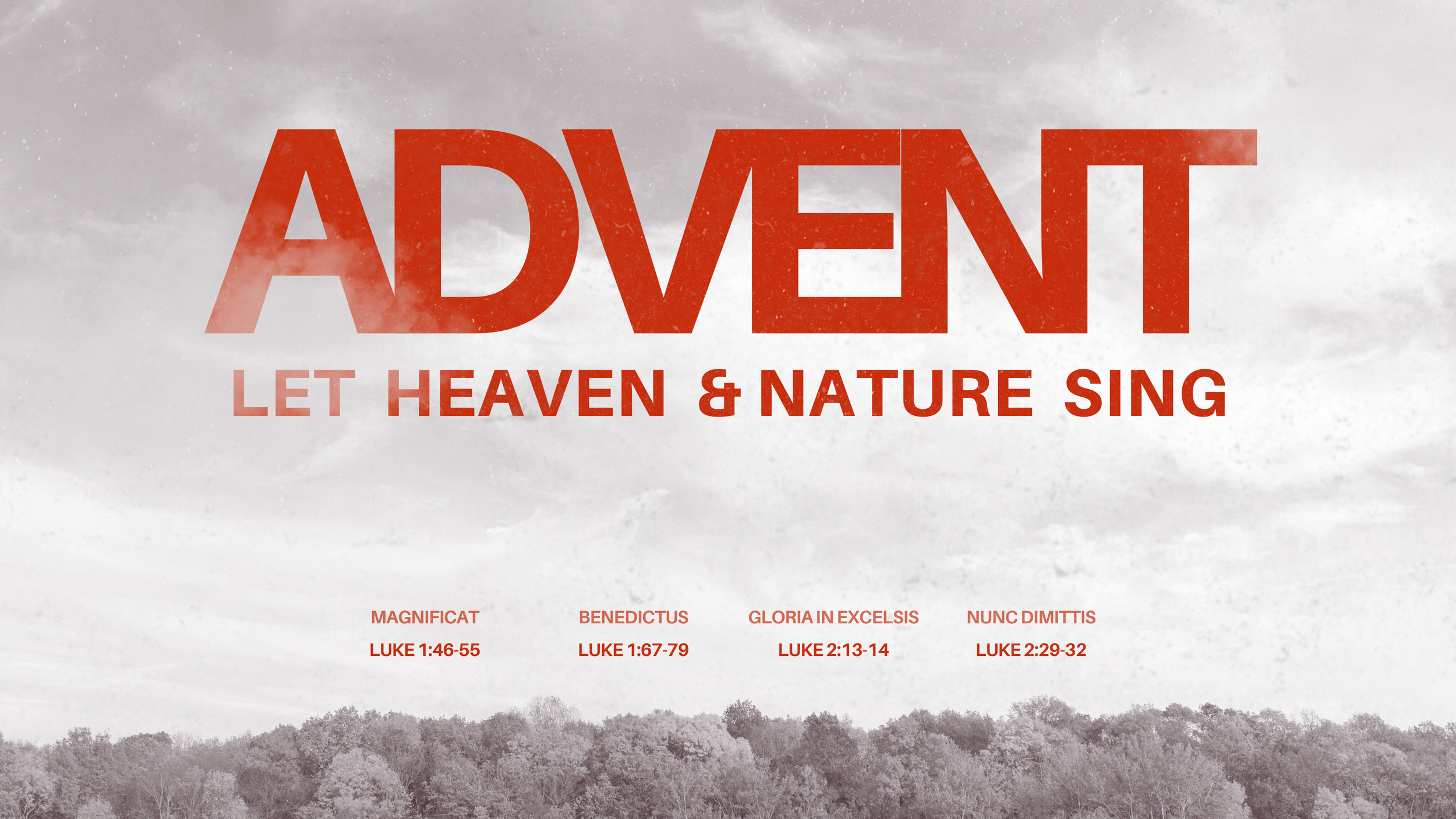
Luke 1–2 opens with an explosion of song — joy and worship saturate the coming of Jesus.
Mary’s Magnificat (1:46–55)
Zechariah’s Benedictus (1:68–79)
The angels’ Gloria (2:13–14)
Simeon’s Nunc Dimittis (2:29–32)
Main Idea: To maximize joy, you must magnify God.
I. The Need for Fellowship (1:39–40)
Luke 1:39–40: In those days Mary arose and went with haste into the hill country, to a town in Judah, and she entered the house of Zechariah and greeted Elizabeth.
II. The Joy of Redemption (1:41–45)
Luke 1:41–45: And when Elizabeth heard the greeting of Mary, the baby leaped in her womb. And Elizabeth was filled with the Holy Spirit, and she exclaimed with a loud cry, “Blessed are you among women, and blessed is the fruit of your womb! And why is this granted to me that the mother of my Lord should come to me? For behold, when the sound of your greeting came to my ears, the baby in my womb leaped for joy. And blessed is she who believed that there would be a fulfillment of what was spoken to her from the Lord.”
The gospel arrives with joy — it’s good news that makes us sing.
III. The Song of Worship (1:46–55)
Luke 1:46-55: And Mary said, “My soul magnifies the Lord,
and my spirit rejoices in God my Savior,
for he has looked on the humble estate of his servant.
For behold, from now on all generations will call me blessed;
for he who is mighty has done great things for me,
and holy is his name.
And his mercy is for those who fear him
from generation to generation.
He has shown strength with his arm;
he has scattered the proud in the thoughts of their hearts;
he has brought down the mighty from their thrones
and exalted those of humble estate;
he has filled the hungry with good things,
and the rich he has sent away empty.
He has helped his servant Israel,
in remembrance of his mercy,
as he spoke to our fathers,
to Abraham and to his offspring forever.”
A. The Character of Her Worship
Wholehearted — “My soul magnifies… my spirit rejoices.” (1:46-47)
Personal — “My soul… my spirit… my Savior.” (1:46-47)
God-centered — “He has… He is…” dominates the song. (1:48-55)
Bible-saturated — Echoes of Scripture
B. The Themes of Mary’s Song
1. God’s Grace (1:46–49)
“My spirit rejoices in God my Savior…He who is mighty has done great things for me, and holy is His name.”
2. God’s Ways (1:50–53)
“His mercy is for those who fear Him.”
“He has brought down the mighty.”
“He has exalted those of humble estate.”
“He has filled the hungry with good things.”
“He has sent the rich away empty.”
God’s kingdom is full of reversals:
The proud scattered → the humble exalted
The rich sent away → the hungry filled
Earthly thrones fall → heaven’s kingdom rises
“For those who would learn God’s ways, humility is the first thing, the second thing, and the third thing.”
~ Augustine
God dwells “in the high and holy place” and “with the contrite and lowly spirit.” (Isa. 57:15)
3. God’s Promises (1:54–55)
“He has helped His servant Israel, in remembrance of His mercy as He spoke to our fathers, to Abraham and to his offspring forever.”
Nine months after Mary sang this song, Jesus Christ was born to live and born to die. Every promise of God finds its “yes and amen” in Him.
The world says: “Minimize God to maximize joy.”
Scripture says: “Magnify God to maximize joy.”

Keep Growing
2 Peter 3:14-18
Keep growing
2 Peter 3:14-18
Main Idea: God’s people overcome laziness and resist liars in order to keep growing up in Christ.
I. Why God’s People Pursue Personal Christian Maturity (3:10-14)
2 Peter 3:10-14: But the day of the Lord will come like a thief, and then the heavens will pass away with a roar, and the heavenly bodies will be burned up and dissolved, and the earth and the works that are done on it will be exposed. Since all these things are thus to be dissolved, what sort of people ought you to be in lives of holiness and godliness, waiting for and hastening the coming of the day of God, because of which the heavens will be set on fire and dissolved, and the heavenly bodies will melt as they burn! But according to his promise we are waiting for new heavens and a new earth in which righteousness dwells. Therefore, beloved, since you are waiting for these, be diligent to be found by him without spot or blemish, and at peace.
The simple answer is that Christians are waiting for something better than this body and this age can offer. The orientation of their life has shifted from combustible things to indestructible things, from dissolvable assets to enduring rewards. They no longer follow their sensuality, but rather lean into the precious and very great promise that they have been made partners in the divine nature. They have a Day marked on the calendar of their hearts, like a bride with her wedding day A Day that rushes forward into every day of their lives as they anticipate the great Day of their Lord.
II. How God’s People Pursue Personal Christian Maturity (3:14-18a)
2 Peter 3:14-18: Therefore, beloved, since you are waiting for these, be diligent to be found by him without spot or blemish, and at peace. And count the patience of our Lord as salvation, just as our beloved brother Paul also wrote to you according to the wisdom given him, as he does in all his letters when he speaks in them of these matters. There are some things in them that are hard to understand, which the ignorant and unstable twist to their own destruction, as they do the other Scriptures. You therefore, beloved, knowing this beforehand, take care that you are not carried away with the error of lawless people and lose your own stability. But grow in the grace and knowledge of our Lord and Savior Jesus Christ.
Peter uses three different couplets to describe what he is getting at in our text.
In v. 11 he describes personal Christian maturity as “lives of godliness and holiness.”
In v. 14 he describes it as “being found by him without spot or blemish and at peace.”
In v. 18 he describes it as growing “in the grace and knowledge of our Lord and Savior Jesus Christ.”
For Peter and the other apostles, Christian maturity is a lifetime pursuit more than a daily checklist. It focuses on the end objective more than on the means of getting there.
For the Christian, living to grow up into Jesus is what life is all about.
1. God’s people pursue personal Christian maturity DILIGENTLY.
This is the fourth time in this letter that Peter has hit this concept. (2 Pet 1:5, 10, 15; 3:14) . Diligence is a big deal to both Peter and Paul.
Diligence means persistence.
Diligence implies effort.
Diligence requires focus.
2. God’s people pursue personal Christian maturity OBEDIENTLY
We do not have the prerogative to make the Scriptures say what we want them to say. Our responsibility is to understand what the holy prophets and the apostles of the Lord Jesus said and to orient our lives in obedience to “the Lord’s” predictions and commands.
3. God’s people pursue personal Christian maturity VIGILANTLY.
Because there are hard things to be worked through in the Scriptures and because there are “lawless people” who are being carried away in their own errors, those pursuing personal Christian maturity must “take care” to not be carried away in those twisted errors and thus “lose your own stability.”
III. Who God’s People Pursue Personal Maturity For (3:18b)
2 Peter 3:18: But grow in the grace and knowledge of our Lord and Savior Jesus Christ. To him be the glory both now and to the day of eternity. Amen.
God’s people pursue personal Christian maturity to magnify the name of Jesus.
A Savior to Stand On
2 Peter 3:14-18
A Savior to Stand On
2 Peter 3:14-18
Main Idea: Christ is both the means and the end of our waiting.
I. A Simple Summary (3:14)
1. Be diligent
“make every effort to supplement your faith with virtue” (1:5)
“be all the more diligent to confirm your calling and election” (1:10)
2. Without spot or blemish
“blots and blemishes, reveling in their deceptions while they feast with you” (2:13)
3. At peace
“Where is the promise of his coming?” (3:4)
“The Lord is not slow to fulfill his promise as some count slowness, but is patient toward you” (3:9)
II. Slippery Slopes (3:15-17)
Slippery Slope #1: We begin to perceive the Lord’s delay as dismissal.
Stable Christian Response: We receive the Lord’s delay as an invitation to active patience.
“We commonly associate patience with lying down.… Yet there is a patience that I believe is harder — the patience that can run.… It is the power to work under stress, to continue under hardship, to have anguish in your spirit and still perform daily talks. This is a Christian thing. The hardest thing is that most of us are called to exercise patience, not in the sickbed but in the street.”
- George Matheson
Two observations about Peter’s reference to Paul:
1. Paul wrote to these believers.
"Do you presume upon the riches of his kindness and forbearance and patience? Do you not know that God's kindness is meant to lead you to repentance?" (Rom. 2:4)
“Behold, now is the acceptable time; behold, now is the day of salvation.” (2 Cor. 6:2)
2. Peter viewed both he and Paul’s writings as Scripture.
Slippery Slope #2: Instead of remaining tethered to God’s Word in our waiting, we twist the Scriptures when we don’t understand or agree with them.
Stable Christian Response: As we wait on the return of God’s saving Word, Jesus, we cling to God’s written Word, the Bible, as our instructions for endurance.
“To bend Scripture to our will is to make ourselves sovereign. The interpreter’s first duty is to bow.”
- B.B. Warfield, On Inspiration.
III. A Stable Savior (3:18)
Colossians 2:6-7: Therefore, as you received Christ Jesus the Lord, so walk in him, rooted and built up in him and established in the faith, just as you were taught, abounding in thanksgiving.
John 14:1-3: Let not your hearts be troubled. Believe in God; believe also in me. In my Father's house are many rooms. If it were not so, would I have told you that I go to prepare a place for you? And if I go and prepare a place for you, I will come again and will take you to myself, that where I am you may be also.
Waiting for Our Patient God
2 Peter 3:1-13
Waiting for Our Patient God
2 Peter 3:1-13
Main Idea: Though he feels delayed, God is patiently keeping his promises for those waiting in repentance, holiness, and godliness.
I. A World of Transcendence (3:1-7)
Peter once more (cf. 1:12-15) urges his readers to remember the predictions of the holy prophets (Old Testament) and the commandment of the Lord and Savior, through the apostles (New Testament).
We must hold fast to the Word of God because “scoffers will come in the last days,” sarcastically asking “Where is the promise of his [Jesus’] coming?” These scoffers essentially make the same secular argument prevalent today, claiming “all things are continuing as they were from the beginning of creation” with no divine intervention or judgment to come.
Peter says these “scoffers” and false teachers are deliberately overlooking three realities:
God’s sovereign act of creating and sustaining the world (3:5; cf. Ps. 19:1; Rom. 1:19-20; Heb. 1:3)
God’s divine intervention in judgment with the flood (3:6; cf. 2:5)
God’s certain and promised future judgment (3:7)
Matthew 24:37–39: For as were the days of Noah, so will be the coming of the Son of Man. For as in those days before the flood they were eating and drinking, marrying and giving in marriage, until the day when Noah entered the ark, and they were unaware until the flood came and swept them all away, so will be the coming of the Son of Man.
“Do you believe in divine judgment? Do you believe in a God who acts as our judge? Many, it seems, do not. Speak to them of God as a Father, a friend, a helper, one who loves us despite all our weaknesses and folly and sin, and their faces light up; you are on their wavelength at once. But speak to them of God as Judge and they frown and shake their heads. Their minds recoil from such an idea. They find it repellent and unworthy. But there are few things stressed more strongly in the Bible than the reality of God’s work as Judge.”
~ J.I. Packer, Knowing God
II. A God of Patience (3:8-10)
In response to these “scoffers,” Peter points out three realities about the perceived delay of God’s return:
1. The Lord is not like us (3:8)
God does not have the same relationship with time as we do; for him “one day is as a thousand years, and a thousand years as one day” (cf. Ps. 90:4). “We are servants of time, but God is its sovereign Master.” ~ Charles Spurgeon
“You cannot judge God by your calendar. God may appear to be slow, but he never forgets his promises. He may seem to be working slowly or even to be forgetting his promises, but when his promises come true (and they will come true), they always burst the banks of what you imagined… God’s grace virtually never operates on our time frame, on a schedule we consider reasonable.”
~ Tim Keller, Hidden Christmas
2. The Lord is patient toward us (3:9)
The Lord’s seeming “delay” is not due to slowness but grace, allowing more time for repentance. Romans 2:4: Or do you presume on the riches of his kindness and forbearance and patience, not knowing that God’s kindness is meant to lead you to repentance?
3. The Lord’s return will surprise us (3:10; cf. Mt. 24:43-44; 1 Thess. 5:2)
Peter uses symbolic language to describe what the prophets have promised. One day, the “skies will roll up like a scroll” (Isa. 34:4; Rev. 6:14) and reveal all that has been hidden. The language of “burning up” is describing the purifying fire often associated with the “Day of the Lord.” (cf. Mal. 3:2-3; 4:1-2; 1 Cor. 3:11-15). The Lord will use this “fire” to cleanse and purify the earth from sin and its effects to usher in the new heavens and the new earth.
III. A People of Repentance (3:11-13)
As we wait for the new heavens and the new earth, Peter says we ought to be a people of “holiness and godliness.” Good and proper eschatology ought to lead to beautiful ethics in the Christian life.
In addition to holiness and godliness, Peter urges us to embrace the paradox of “waiting” and “hastening” the coming Day of God. “Waiting” reminds us that we are not the ones who usher in the Kingdom of God, while “hastening” invites us to participate in bearing witness to what will be by declaring and displaying the gospel.
“Waiting in the New Testament is not a passive word. The idea is an intentional effort to look for something. Don’t think of this word as being like watching a baseball game. It’s more like a guard scanning the horizon. There’s a sense of anticipation implied in the word… Peter is encouraging suffering Christians to direct their attention and be alert to the future. The idea is to live with a posture of spiritual watchfulness. Waiting in this context isn’t something that happens to you; it’s an intentional way of life as a Christian."
~ Mark Vroegop, Waiting Isn’t a Waste
James 5:7–8: Be patient, therefore, brothers, until the coming of the Lord. See how the farmer waits for the precious fruit of the earth, being patient about it, until it receives the early and the late rains. You also, be patient. Establish your hearts, for the coming of the Lord is at hand.
Psalm 25:1-3: “Indeed, none who wait for you shall be put to shame.”
The Rise and Fall of False Prophets
2 Peter 2:1-22
The Rise and Fall of False Prophets
2 Peter 2:1-22
Main Idea: Beware of destructive deception. Trust God’s divine discipline. Retrain your desires by delighting in Christ.
I. Destructive Deception (2:1–3)
2 Peter 2:1a: “But false prophets also arose among the people, just as there will be false teachers among you…”
“Did God really say you shall not eat from any tree in the garden?” (Gen 3:1)
“You will not surely die.” (Gen 3:4)
“God knows that when you eat, your eyes will be opened.” (Gen 3:5)
The false teacher playbook is established:
Distort the Word
Deny the judgment
Doubt the goodness of God
2 Peter 2:1b: “They secretly bring in destructive heresies…”
2 Corinthians 11:13–15: …for even Satan disguises himself as an angel of light. So it is no surprise if his servants, also, disguise themselves as servants of righteousness. Their end will correspond to their deeds.
2 Timothy 3:1–5: But understand this, that in the last days there will come times of difficulty. For people will be lovers of self, lovers of money, proud, arrogant, abusive, disobedient to their parents, ungrateful, unholy, heartless, unappeasable, slanderous, without self-control, brutal, not loving good, treacherous, reckless, swollen with conceit, lovers of pleasure rather than lovers of God, having the appearance of godliness, but denying its power. Avoid such people.
2 Peter 2:3b: “Their condemnation from long ago is not idle, and their destruction is not asleep.”
II. Divine Discipline (2:4–9)
“For if God did not spare angels when they sinned… if He did not spare the ancient world… if He condemned Sodom and Gomorrah… then the Lord knows how to rescue the godly and to keep the unrighteous under punishment.”
Case Study #1: The Rebellious Angels (2:4): “For if God did not spare angels when they sinned, but cast them into hell…”
Case Study #2: The Days of Noah (2:5): “If He did not spare the ancient world, but preserved Noah, a herald of righteousness…”
Case Study #3: Sodom and Gomorrah (2:6–8): “If by turning the cities of Sodom and Gomorrah to ashes He condemned them to extinction…“Then the Lord knows how to rescue the godly from trials, and to keep the unrighteous under punishment until the day of judgment.”
III. Deficient Desires (2:10–22)
The Vices of False Teachers (2:10-16)
The Arrogance of the False Teachers (2:10b–13a): “[They] indulge in the lust of defiling passion and despise authority. Bold and willful, they do not tremble as they blaspheme the glorious ones…”
The Appetites of the False Teachers (2:13b–14): “They count it pleasure to revel in the daytime…They have eyes full of adultery, insatiable for sin. They entice unsteady souls.”
The Avarice of the False Teachers (2:15–16): “...They have hearts trained in greed…
The Effect of False Teachers (2:17–19)
Spiritual Drought (2:17): “These are waterless springs and mists driven by a storm.”
Enslavement Under Sin (2:18–19): “They promise them freedom, but they themselves are slaves of corruption.”
The Danger of Apostasy (2:20–22)
2 Peter 2:20: “For if, after they have escaped the defilements of the world through the knowledge of our Lord and Savior Jesus Christ, they are again entangled in them and overcome, the last state has become worse for them than the first.”
“It does not matter how small the sins are provided that their cumulative effect is to edge the man away from the Light and out into the Nothing. Murder is no better than cards if cards can do the trick. Indeed the safest road to Hell is the gradual one—the gentle slope, soft underfoot, without sudden turnings, without milestones, without signposts.”
~ C.S. Lewis, Screwtape Letters
2 Peter 2:22: The dog returns to its own vomit, and the sow, after washing herself, returns to wallow in the mire.
John 6:66–69: After this many of his disciples turned back and no longer walked with him. So Jesus said to the twelve, “Do you want to go away as well?” Simon Peter answered him, “Lord, to whom shall we go? You have the words of eternal life, and we have believed, and have come to know, that you are the Holy One of God.
Warning! Warning! Warning!
2 Peter 2:1-22
Remember & Pay Attention
2 Peter 2:1-22
Main Idea: Do not be led astray by those who falsely say there is another way!
“It now becomes evident why the readers needed to be reminded about the importance of a godly life and why they needed to maintain the truth of Jesus’ future coming. False teachers had arisen within the church who denied the former and questioned the latter. If there is no future coming of the Lord, the foundation for ethics vanishes, and the way is opened for a dissolute lifestyle. The words in chapter 1 do not represent an abstract thesis on Christian growth. Peter urgently responded to a threat to the churches, to false teaching that was inevitably accompanied by an evil lifestyle.” ~ Thomas Schreiner, 1, 2 Peter, Jude
I. Recognize their Pattern (2:1-3)
Deuteronomy 13:1-5: “If a prophet or a dreamer of dreams arises among you and gives you a sign or a wonder, and the sign or wonder that he tells you comes to pass, and if he says, ‘Let us go after other gods,’ which you have not known, ‘and let us serve them,’ you shall not listen to the words of that prophet or that dreamer of dreams. For the Lord your God is testing you, to know whether you love the Lord your God with all your heart and with all your soul. You shall walk after the Lord your God and fear him and keep his commandments and obey his voice, and you shall serve him and hold fast to him. But that prophet or that dreamer of dreams shall be put to death, because he has taught rebellion against the Lord your God, who brought you out of the land of Egypt and redeemed you out of the house of slavery, to make you leave the way in which the Lord your God commanded you to walk. So you shall purge the evil from your midst.
II. Remember God’s Judgment (2:4-10a)

III. Remember God’s Judgment (2:4-10a)
“The words of 1 John apply well to what has happened in 2 Peter: “They went out from us, but they did not really belong to us. For if they had belonged to us, they would have remained with us; but their going showed that none of them belonged to us” (1 John 2:19). Peter pointed in the same direction in the illustration of the dog and pig. In the final analysis, those who fell away never really changed their nature. They remained dogs and pigs inside. They may have washed up on the outside and appeared to be different, but fundamentally they were dogs and pigs. In other words, they were always unclean; they only seemed to have changed. Perseverance, therefore, is the test of authenticity.”
~ Thomas Schreiner, 1, 2 Peter, Jude
Remember & Pay Attention
2 Peter 1:12-21
Remember & Pay Attention
2 Peter 1:12-21
Main Idea: We must remember God’s grace and pay attention to God’s Word until Christ’s promised return.
I. Remembering God’s Grace (1:12-15)
Since God has “granted to us all things that pertain to life and godliness” (1:3), Peter writes to “remind” us of these qualities that are ours in Christ. Though we “know them and are established in the truth,” we are prone to forget (cf. 1:9; Deut. 5:15; 16:3; 1 Cor. 15:1; 2 Tim. 2:8)
Peter’s urgency in this reminder is connected to his impending death (1:13-14; cf. Jn. 21:18-19). Finishing our race well and “confirming our calling and election” (1:10) means we must return and hold fast to the things we have already learned (cf. 2:20). Peter’s reminders are to ‘stir us up’ from any slumbers of indifference or tendencies to drift.
“The business of the church and of preaching is not to present us with new and interesting ideas, it is rather to go on reminding us of certain fundamental and eternal truths… the primary business of the Christian church and of her message and her preaching is not to indulge in vague general statements. It is to repeat the centralities of the Christian Gospel, to remind men and women of the truth of God as it is in Christ Jesus. The world is more liable to forget this than anything else. The world is interested in the general situation, politics, economics, social conditions, the possibilities of another war, and other similar things. The world, therefore, rather delights in these vague general statements that never lead to anything. But the business of the Christian church is constantly to remind men and women of certain things which they constantly tend to forget.”
~ Martyn Lloyd-Jones, Expository Sermons on 2 Peter
II. Standing Firm in the Grace of God (5:5b-14)
False teachers were claiming that Peter was devising or following “myths” regarding the “power and (second) coming” of Christ (cf. 3:3-4). False teaching about the return of Christ was a persistent issue in the early church (cf. 2 Tim. 2:18), and these false teachers denied Christ’s promised return in glory to “judge the living and the dead.”
To combat this false teaching, Peter refers back to the transfiguration of Christ (cf. Mk. 9:2-13). He draws attention to this moment for at least three reasons:
The transfiguration prefigures and anticipates the promised, glorious return of Christ (cf. Mk. 8:38)
Peter, James, and John were “eyewitnesses of his [Jesus’] majesty,” not receiving information second-hand
The transfiguration is the fulfillment of multiple OT Scriptures (cf. Deut. 18:15; Ps. 2:7, Isa. 42:1); it is “the Bible on display”
Peter is indicating to the recipients of this letter that we can listen to him because he has listened to Jesus: “this is my beloved Son; listen to him.” (Mk. 9:7)
III. Paying Attention to God’s Word (1:19-21)
We have the “prophetic word more fully confirmed” because of the finished work of Jesus Christ. Since he is the fulfillment and the center of all Scripture (cf. John 5:39; Lk. 24:44; 1 Pet. 1:11), we “do well to pay attention” to the Word of God.
Peter gives two pictures for the role of the Word of God in our lives:
A lamp shining in a dark place (cf. Ps. 119:105)
The morning star rising in our hearts, when the day dawns (cf. Num. 24:17; Rev. 22:16)
Until that glorious day arrives, Peter reminds us that “no prophecy of Scripture comes from someone’s own interpretation,” meaning that the Word of God cannot be interpreted however we desire. This is the activity and impulse of the false teachers Peter is combatting (cf. Jer. 14:14).
“Today, Western culture is dominated by expressive individualism, the idea that we are defined by our inner feelings, that our relationships with others place no natural or necessary obligations upon us, and that we can pick and choose them as they serve our emotional needs. This idea plays into the general cultural assertion of individual autonomy and rejection of external authority — or at least of traditional external authority — that requires some sacrifice of ourselves for others. Whether it is a child rebelling against the parent or the individual rebelling against the sex of his or her own body, today autonomy and personal desire are king; and these press against anything from outside that tells us who we are, what we should believe, or how we should live.”
~ Carl Trueman, The Rise and Triumph of the Modern Self
Instead, the Scriptures have come about because “men spoke from God, as they were carried along by the Holy Spirit” (1:21). We must pay attention to the Scriptures because they are the very words of God for the people of God to remember until the day Christ returns.
“The reason we may not fill the words of Scripture with our ideas is that God intends that they carry his ideas. The meaning of Scripture is not like putty that we can mold according to our desires. It is the work of the Holy Spirit and carries a solid, firm, divine intention. The glorious truth of this verse is that in Scripture God has spoken, and not merely man, and therefore our aim must be to hear God’s meaning, not merely our own.”
~ John Piper, “Men Moved by the Holy Spirit Spoke From God”
2 Corinthians 4:4–6: “… the god of this world has blinded the minds of the unbelievers, to keep them from seeing the light of the gospel of the glory of Christ, who is the image of God. For what we proclaim is not ourselves, but Jesus Christ as Lord, with ourselves as your servants for Jesus’ sake. For God, who said, “Let light shine out of darkness,” has shone in our hearts to give the light of the knowledge of the glory of God in the face of Jesus Christ.”
Forward, in Faith!
2 Peter 1:1-11
Forward, in Faith!
2 peter 1:1-11
Main Idea: Genuine faith in Christ unites, conforms, and compels us to glorify Him in all areas of our lives.
I. Know Your Faith (1:1-4)
2 Peter 1:1-2: Simeon Peter, a servant and apostle of Jesus Christ, To those who have obtained a faith of equal standing with ours by the righteousness of our God and Savior Jesus Christ: May grace and peace be multiplied to you in the knowledge of God and of Jesus our Lord.
1 Corinthians 1:18 (NIV): "For the message of the cross is foolishness to those who are perishing, but to us who are being saved it is the power of God."
2 Peter 1:3-4: His divine power has granted to us all things that pertain to life and godliness, through the knowledge of him who called us to his own glory and excellence, by which he has granted to us his precious and very great promises, so that through them you may become partakers of the divine nature, having escaped from the corruption that is in the world because of sinful desire.
“What were we made for? To know God. What aim should we set ourselves in life? To know God. What is the eternal life that Jesus gives? Knowledge of God. “This is life eternal, that they may know thee, the only true God, and Jesus Christ, whom thou hast sent” (John 17:3). What is the best thing in life, bringing more joy, delight, and contentment than anything else? Knowledge of God. “Thus saith the LORD, Let not the wise man glory in his wisdom, neither let not the mighty man glory in his might, let not the rich man glory in his riches; but let him that glorieth glory in this, that he understandeth and knoweth me” (Jeremiah 9:23). What, of all the states God ever sees man in, gives him most pleasure? Knowledge of himself. “I desire … the knowledge of God more than burnt offerings,” says God (Hosea 6:6).… Once you have become aware that the main business that you are here for is to know God, most of life’s problems fall into place of their own accord.”
~ J.I. Packer, Knowing God
II. Supplement Your Faith (1:5-9).
2 Peter 1:5-7: For this very reason, make every effort to supplement your faith with virtue, and virtue with knowledge, and knowledge with self-control, and self-control with steadfastness, and steadfastness with godliness, and godliness with brotherly affection, and brotherly affection with love.
1 John 4:7-8: Beloved, let us love one another, for love is from God, and whoever loves has been born of God and knows God. Anyone who does not love does not know God, because God is love.
2 Peter 1:8-9: For if these qualities are yours and are increasing, they keep you from being ineffective or unfruitful in the knowledge of our Lord Jesus Christ. For whoever lacks these qualities is so nearsighted that he is blind, having forgotten that he was cleansed from his former sins.
“Peter basically says that the believer’s re-creation into the image of Christ comes about by way of active participation in the pursuit of knowing him more and more. Many believers limit their knowledge of God to their conversion. “I came to know Christ” or “I believed in Christ” are frequent confessions, as if knowing him was a one-time deal tied to conversion. But knowing God, Peter says, is a lifetime pursuit. And it’s the avenue through which God’s children access all the powerful resources he’s provided to make them look more like Jesus.”
~ James Shaddix and Daniel L. Akin, Exalting Jesus in 2 Peter, Jude
III. Confirm Your Faith (1:10-11)
2 Peter 1:10-11: Therefore, brothers, be all the more diligent to confirm your calling and election, for if you practice these qualities you will never fall. For in this way there will be richly provided for you an entrance into the eternal kingdom of our Lord and Savior Jesus Christ.
Confirming is different than earning in several ways. In this sense, Peter urges us that no one has been saved by simply a profession of faith. You must possess it as well as profess it. This faith is graciously given from God alone and unites us to him. It never lulls us to sleep but compels us toward Christ and His kingdom.
Luke 22:31-32: Simon, Simon behold Satan demanded to have you, that he might sift you like wheat, but I have prayed for you that your faith may not fail, and when you have turned again, strengthen your brothers.
“With his own death imminent, Peter is set to strengthen those of us who follow in his train centuries later. It is as if by this letter, he lives today and can still be found preaching on how to move from falling to finishing well. Second Peter is his road map to Heaven. It confirms that we can also possess a faith that will not fail. On that fateful night long ago, Jesus told Peter that he had been praying for him—especially that his faith would not fail. That same Jesus stands today at the right hand of God interceding in like manner for you and for me.”
~ David Helm, 1 & 2 Peter and Jude