
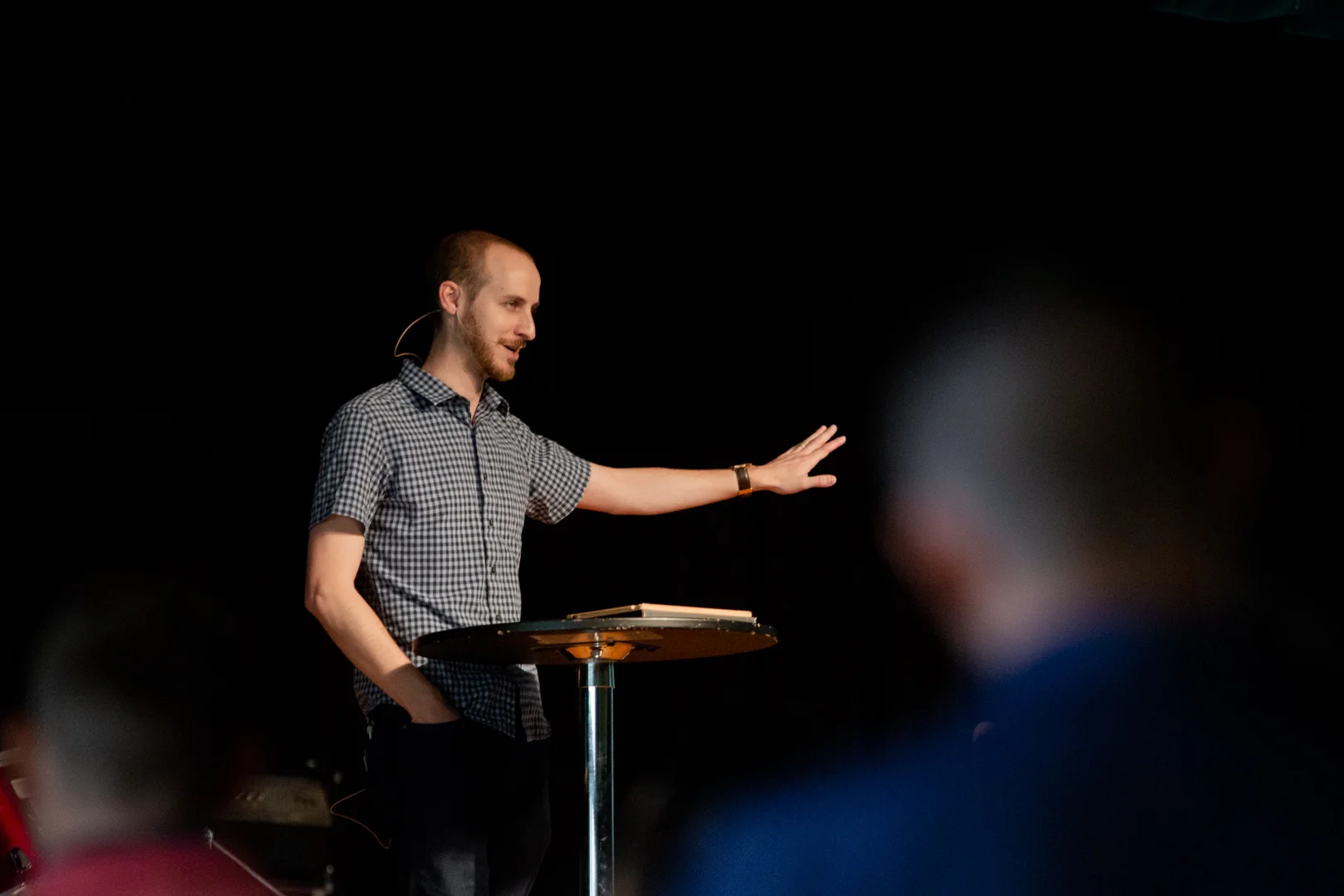

Seized by the Resurrection - Easter Sunday
Mark 15:40-16:8
Seized by the resurrection
Mark 15:40-16:8
Main Idea: The resurrection of Christ unsettles everything and evokes a response.
I. The Trauma of Death (15:40-47)
Death is always traumatic and an unwelcomed enemy and intruder (cf. 1 Cor. 15:26), but the crucifixion of Christ was especially traumatic. Joseph of Arimathea exercised “courage” because he was requesting the body of a convicted and executed man who was viewed to be cursed by God (cf. Isa. 53:9)
We owe it to those first Christian disciples to do our very best to understand the utter hopelessness of their situation after the crucifixion. They had invested their whole lives in what appeared to be a diabolical joke. They had seen their beloved Master scourged almost to death, dragged through the streets, nailed to a cross and abandoned to suffer public agony in the face of the obscene mockery of everybody in Jerusalem. Once they had basked in the reflected status of a celebrity who had been mobbed by large crowds; now he had been judged a nonperson, fit only for the most degrading and sadistic death that the human mind was capable of devising. If there had been any solidarity among his followers, it had vanished; not one person had dared to come forward in the Master's defense, and their supposed leader, Peter, had cravenly denied Jesus three times, There was nothing left… The Messiah was supposed to usher in the kingdom of God; for those disciples who had staked their lives on Jesus being that Messiah, it cannot be stated too strongly: there was no hope.
~ Fleming Rutledge, The Undoing of Death
II. The Shock of Resurrection (16:1-8)
Despite Jesus explicitly predicting his crucifixion and resurrection four times in Mark (8:31-32, 9:30-32, 10:32-34, 14:26-28), no one is expecting nor looking for Jesus to be raised from the dead. This is why the women are “seized… alarmed… trembling… astonished… and afraid.”
Mark’s ending points to a truth that often gets lost in the celebration: Easter is a frightening prospect. For the women, the only thing more terrifying than a world with Jesus dead was one in which he was alive.
~ Esau McCaulley, "The Unsettling Power of Easter”
III. The One Who Goes Before Us (16:7)
The resurrection of Christ should:
1. Challenge your reality (“see the place where they laid him”)
“Christianity, if false, is of no importance, and if true, of infinite importance, the only thing it cannot be is moderately important.”
~ C.S. Lewis, “God in the Dock”
2. Comfort your heart (“go, tell his disciples and Peter…”)
3. Change your life (“he is going before you to Galilee. There you will see him, just as he told you.”)
The resurrection of Christ is not just something to believe in; it’s something to be lived. Christ is not a dead teacher. If he was a dead teacher, then being a Christian would just be to believe what he said. Since he’s a risen Lord, he comes and penetrates our lives with a new order of being.
~ Tim Keller

Christ Crucified - Good Friday
Mark 15:21-39
Christ crucified
Mark 15:21-39
Main Idea: Christ has turned an instrument of terror and shame into our symbol of salvation and hope.
I. The Paradox of the Cross (15:21-32)
The crucifixion scene has a number of haunting, divine ironies:
Simon of Cyrene vs. Simon Peter
Those acting against Jesus are fulfilling prophecy (cf. Psalm 69:21; 22:18, Gen. 3:15)
The mockery of Jesus as being a “King” who is crucified and a “Savior” unable to save himself
[The cross] is the climax of human blindness and iniquity spilling over in brutal outrage against God’s Son; it shows a world that has gone topsy-turvy. Jesus is a king who died an outlaw’s death. Jesus is the Messiah, who was rejected by the people he came to deliver. Jesus is the mighty Son of God, who did not use his power for himself but died a seemingly powerless death. All traditional symbols have been reversed. Weakness is a sign of power. Death is the means to life. God forsakenness leads to reconciliation with God. The perpetrators who executed Jesus did not realize that they were executing God’s will (14:36) and that Jesus submitted willingly as God’s obedient Son (10:45). They also did not realize that this death would not be the end of him. Instead, it meant the end of their whole order. They could not fathom how such a powerless death disclosed the character and power of God.
~ David Garland
II. The Prayer of the Cross (15:33-37)
A supernatural darkness of divine judgment covered the land from 12pm-3pm, when the sun should be at its brightest; Jesus’ death is ultimately a cursed, sin-bearing, substitutionary death on behalf of a guilty humanity (Psalm 21:1ff)
[Jesus] is not on the cross by mistake… The crucifixion was not just an unfortunate thing that happened to Jesus on his way to the resurrection. It is not a momentary blip on the arc of his ascent to the Father. It is precisely on the cross that the work of Jesus is carried through to its completion.
~ Fleming Rutledge, Three Hours
III. The Power of the Cross (15:38-39)
Immediately after Jesus died, two things occur:
1. The temple curtain is torn in two (15:38; cf. 1:10)
Hebrews 10:19–22a: “Therefore, brothers, since we have confidence to enter the holy places by the blood of Jesus, by the new and living way that he opened for us through the curtain, that is, through his flesh, and since we have a great priest over the house of God, let us draw near with a true heart in full assurance of faith…”
2. A Roman Centurion acknowledges his true identity as the “Son of God” (15:39; cf 1:1)

The Cross of Jesus, the Christ
Mark 15:1-20
The Cross of Jesus, the christ
Mark 15:1-20
How was it that a cult inspired by the execution of an obscure criminal in a long-vanished empire came to exercise such a transformative and enduring influence on the world?
— Tom Holland
Main Idea: The cross of Jesus, the Christ, is the hinge of history and your story.
In the Christian theology of history, the death of Christ is the central point of history; here all roads of the past converge; hence all the roads of the future diverge.
— Bishop Stephen Neill
It is self-evident that everyone involved with what is happening here - except for Jesus - is oblivious to what is really going on.
Equally self-evident in the scope of the Bible’s storyline, what is really going on here is vastly more significant than what is happening, even though what is happening here is horrifying and shocking.
I. What is happening here?
A conspiracy hatched by Judaism’s elite is playing out.
A gross miscarriage of justice is carried out.
Everything Jesus foretold would happen to him is happening to him!
This is utterly astounding on two levels:
First, Jesus knew in graphic detail exactly what was going to happen to Him in Jerusalem days and months before it actually happened and he not only let it happen, but willingly stepped into it.
Second, how did he know? It is abundantly clear that everyone else in this story is being carried along by what is happening. And it is becoming clearer that Jesus is actually choreographing what is going on. As you read the other Gospel accounts, especially John’s, you cannot escape the fact that Jesus was both the architect of his execution and the victim of his execution.
II. What is really going on here?
Here is how the apostle Paul puts it when relaying the bigger story to believers in Corinth: “For I delivered to you as of first importance what I also received: that Christ died for our sins in accordance with the Scriptures…”
In other words, here is what is really going on in this chapter of Mark: Christ is dying for our sins according to the Scriptures.
Who is this man? - He is the Christ. That means Jesus is the One to whom all of the major promises made by God since the Fall have been pointing to.
By the time the Old Testament comes to an end the characteristics and conduct of the Messiah are so clear, that any charlatan could easily be exposed and only the true Messiah would truly fit the bill.
How did Jesus know what would happen to him? - the Scriptures! The early promises in the Bible point to it. The Son born to the woman would crush the snakes head, but in the process his heal would be bruised.
The entire Jewish system of worship was built around bulls and goats, sheep and doves dying in the place of penitent worshippers. Its high and holy days, such as Passover and the Day of Atonement - focused entirely on an innocent animal covering the sins of the guilty ones and standing between them and death.
It is not at all hard to imagine that Jesus, acquainted with the Scriptures and fully aware of who he truly was, knew precisely what was going to happen to him.
Here is the glory of Jesus, the Christ, our Savior. He so fully loved the LORD His God that he willingly stepped into his role so that the Father’s will of saving the world could be accomplished. Not only that, but Jesus so fully loved us, with whom he came to be “neighbor” that he laid down his life for us!
In the events Mark records in this passage of Scripture, no one wants Jesus. But Jesus wants them. So Christ died for our sins according to the Scriptures.

Two Trials
Mark 14:53-72
*Unfortunately we did not record the audio or video from this sermon. Pastor Ian's notes are available below for anyone interested. We sincerely apologize for any inconvenience.
Two Trials
Mark 14:53-72
Main Idea: Jesus was condemned in our place so that our fears and failures become the arena of God’s grace.
I. Jesus’ Trial (14:53-65)
Jesus remains silent because:
1. He is innocent
2. He is fulfilling prophecy written about him
Isaiah 53:7-8a: He was oppressed, and he was afflicted,
yet he opened not his mouth;
like a lamb that is led to the slaughter,
and like a sheep that before its shearers is silent,
so he opened not his mouth.
By oppression and judgment he was taken away
3. He is on trial in the place of the guilty
“Of all the things Jesus could have said, he specifically says he’s the judge. By his choice of text [Daniel 7 & Psalm 110], Jesus is deliberately forcing us to see the paradox. There’s been an enormous reversal. He is the judge of the entire world, being judged by the world. He should be in the judgment seat, and we should be in the dock, in chains. Everything is turned upside down.”
~ Tim Keller, King’s Cross
II. Peter’s Trial (14:66-72)
Luke 22:61: And the Lord turned and looked at Peter. And Peter remembered the saying of the Lord, how he had said to him, “Before the rooster crows today, you will deny me three times.”
There were volumes of meaning in that look… I think it was a heart-piercing look and a heart-healing look all in one — a look which revealed to Peter the blackness of his sin, and also the tenderness of his Master’s heart towards him.
~ Charles Spurgeon, “Peter’s Fall and Restoration”
Luke 22:31–32:“Simon, Simon, behold, Satan demanded to have you, that he might sift you like wheat, but I have prayed for you that your faith may not fail. And when you have turned again, strengthen your brothers.”
Simon Peter had to see, after his own sword-swinging and fireside-swearing and midnight running, that the answer for him was not that he had nothing to fear, but that the fears were answered by the one who stood on his behalf before the Father praying ‘that your faith may not fail’ (Luke 22:32). Only after all that, on the other side of the Devil’s danger, on the other side of his own terror, could Peter ‘strengthen your brothers.’ (Luke 22:32)
~ Russell Moore, The Courage to Stand
III. Our Guilt & God’s Grace
1 Corinthians 4:3–4: But with me it is a very small thing that I should be judged by you or by any human court. In fact, I do not even judge myself. For I am not aware of anything against myself, but I am not thereby acquitted. It is the Lord who judges me.
Hebrews 2:11: For he who sanctifies and those who are sanctified all have one source. That is why he is not ashamed to call them brothers
The Garden
Mark 14:26-52
The Garden
Mark 14:26-52
Main Idea: Trying times call for dependence on the dependable One.
I. The Denial of the Disciples (14:26-31)
II. The Agony of the Savior (14:32-42)
Psalm 75:8:
For in the hand of the Lord there is a cup
with foaming wine, well mixed,
and he pours out from it,
and all the wicked of the earth
shall drain it down to the dregs.
III. The Betrayal of the King (14:43-52)
There was no accident or chance in any part of the close of our Lord’s earthly ministry. The steps in which He walked from Gethsemane to Calvary, were all marked out hundreds of years before. The twenty-second Psalm, and the fifty-third chapter of Isaiah, were literally fulfilled. The wrath of His enemies,—His rejection by His own people,—His being dealt with as a malefactor,—His being condemned by the assembly of the wicked,—all had been foreknown, and all foretold. All that took place was only the working out of God’s great design to provide an atonement for a world’s sin.
- J. C. Ryle
1 Peter 5:5-8: Clothe yourselves, all of you, with humility toward one another, for “God opposes the proud but gives grace to the humble.” Humble yourselves, therefore, under the mighty hand of God so that at the proper time he may exalt you, casting all your anxieties on him, because he cares for you. Be sober-minded; be watchful. Your adversary the devil prowls around like a roaring lion, seeking someone to devour.
The Last Supper
Mark 14:12-25
The last supper
Mark 14:12-25
Main Idea: Jesus’ death is an act of grace for the undeserving and the sovereign fulfillment of Passover.
I. The Shadow of Passover (14:12-16)
Exodus 12:14: This day [Passover] shall be for you a memorial day, and you shall keep it as a feast to the Lord; throughout your generations, as a statute forever.
As the Israelites observed Passover in Jerusalem annually, each component of the meal was infused with symbolism and significance:
Unleavened bread (to remember their hasty exit from Egypt)
Bitter herbs (to remember their time of bitterness)
Cup of salt water (to remember their tears in Egypt and the crossing of the Red Sea)
Four cups of wine (to remember the four promises of Exodus 6:6-7)
A lamb (to remember their deliverance by the blood)
II. Sovereignty and Sin (14:17-21)
Romans 2:4: Or do you presume on the riches of his kindness and forbearance and patience, not knowing that God’s kindness is meant to lead you to repentance?
It is essential to keep together these two complementary ways of looking at the cross. On the human level, Judas gave him up to the priests, who gave him up to Pilate, who gave him up to the soldiers, who crucified him. But on the divine level, the Father gave him up, and he gave himself up, to die for us. As we face the cross, then, we can say to ourselves both, “I did it, my sins sent him there,” and “He did it, his love took him there.
~ John Stott, The Cross of Christ
III. The Substance of Christ (14:22-25)
As the fulfillment of Passover, Jesus presents his impending death and crucifixion as:
Sacrificial (cf. John 1:29, 1 Cor. 5:7b)
Substitutionary
The concept of substitution may be said to lie at the heart of both sin and salvation. The essence of sin is man substituting himself for God, while the essence of salvation is God substituting himself for man. Man asserts himself against God and puts himself where only God deserves to be; God sacrifices himself for man and puts himself where only man deserves to be. Man claims prerogatives that belong to God alone; God accepts penalties that belong to man alone.
~ John Stott, The Cross of Christ
When Jesus first shared the Supper with his disciples, he was giving them something firm to hold on to—like a beam set in concrete. Jesus would soon be betrayed and crucified in their place. He wanted them not only to remember the sacrifice, but also to grasp its significance. Jesus was leaving, and other people, priorities, and persecutions would soon threaten the devotion of their hearts. But the Lord’s Supper was a handle they could grasp through it all. Doubts would come, but they would remember. Dangers would come, but they would remember. Dissenters would abandon them, but they would remember that indelible moment when Jesus broke the bread and served the cup. It was a simple act, a common meal, but it would soon become their sustaining grace.
~ Daryl Crouch
1 Corinthians 11:26: For as often as you eat this bread and drink the cup, you proclaim the Lord’s death until he comes.

Object of Hope or Obstacle of Ambition
Mark 14:1:11
Object of hope or obstacle of ambition
Mark 14:1-11
Main Idea: Jesus is either the object of our hope or the obstacle of our ambition.
I. Religious Rage (14:1-2)
Mark 12:12: And they were seeking to arrest him but feared the people, for they perceived that he had told the parable against them. So they left him and went away.
II. Wondrous Worship (14:3-9)
“If a man once understands the sinfulness of sin, and the mercy of Christ in dying for him, he will never think anything too good or too costly to give to Christ… He will fear wasting time, talents, money, affections on the things of this world. He will not be afraid of wasting them on his Savior. He will fear going into extremes about business, money, politics, or pleasure; but he will not be afraid of doing too much for Christ.”
- JC Ryle
III. A Bankrupt Betrayer (14:10-11)
The End of the Temple and the End of the World
Mark 13:1-37
The End of the temple and the end of the World
Mark 13:1-37
Main Idea: We must endure through the hardships of this present world, staying alert and awake for the return of Christ.
I. Endurance in Suffering (13:1-13)
Life in the 1st century (and life in general in this fallen world) will be marked by the “non-signs” of:
Messianic Pretenders (13:6)
Military Conflict (13:7)
Political Upheaval (13:8a)
Natural Disasters (13:8b)
Persecution & Martyrdom (13:9, 11-13a)
Widespread Gospel Proclamation (13:10 | Acts 1:8)
1 Peter 1:6-7: In this you rejoice, though now for a little while, if necessary, you have been grieved by various trials, so that the tested genuineness of your faith—more precious than gold that perishes though it is tested by fire—may be found to result in praise and glory and honor at the revelation of Jesus Christ.
II. The Exultation of Christ (13:14-31)
A. The Roman Destruction of Jerusalem & the Temple (13:14-23)
B. The Vindication of the Son of Man (13:23-27)
Daniel 7:13–14: “I saw in the night visions,
and behold, with the clouds of heaven
there came one like a son of man,
and he came to the Ancient of Days
and was presented before him.
And to him was given dominion
and glory and a kingdom,
that all peoples, nations, and languages
should serve him;
his dominion is an everlasting dominion,
which shall not pass away,
and his kingdom one
that shall not be destroyed.
C. The Lesson of the Fig Tree (13:28-31)
“The destruction of Jerusalem and the temple and God’s judgment on Israel in 70 AD is all about Jesus. It’s about who he is and how he reigns as sovereign Lord. It’s about the truth of who he claimed to be, as over against the blasphemous lies and rejection of him by the religious leaders in Israel, together with the extent and duration of his dominion over all creation… [Jesus] is the true temple of God. He is the person and place of sacrifice where forgiveness is found and God's voice is heard and God's glory and presence are encountered. So, when the temple in Jerusalem was razed, leveled, and flattened such that not one stone was left upon another, the people of that day "saw" that everything the temple symbolized and achieved is now found in King Jesus who rules over all the universe. There has been a regime change. The temple is dethroned. Jesus is enthroned.”
~ Sam Storms, Kingdom Come
III. Expecting His Return (13:32-37)
As we consider the return of the “master,” we must:
Be on Guard (13:9, 23, 33)
Stay Awake (4x in 13:32-37 | cf. 1 Thess. 5:1-11)
2 Peter 3:8-12a: “But do not overlook this one fact, beloved, that with the Lord one day is as a thousand years, and a thousand years as one day. The Lord is not slow to fulfill his promise as some count slowness, but is patient toward you, not wishing that any should perish, but that all should reach repentance. But the day of the Lord will come like a thief, and then the heavens will pass away with a roar, and the heavenly bodies will be burned up and dissolved, and the earth and the works that are done on it will be exposed. Since all these things are thus to be dissolved, what sort of people ought you to be in lives of holiness and godliness, waiting for and hastening the coming of the day of God.”
The Greatest Commandment
Mark 12:28-44
The Greatest Commandment
Mark 12:28-44
Main Idea: We can only love God wholly and others rightly by beholding the loving Lordship of Christ.
I. The Greatest Commandment(s) (12:28-34)
1 John 4:11, 19-20: Beloved, if God so loved us, we also ought to love one another… We love because he first loved us. If anyone says, “I love God,” and hates his brother, he is a liar; for he who does not love his brother whom he has seen cannot love God whom he has not seen.
“One draws near to the kingdom of God not by proper theology but by drawing near to Jesus. Jesus exhibits his messianic authority in declaring who is on the threshold of the kingdom of God, which is present not in the Torah but in himself.”
~James Edwards
II. The Greater Lord (12:35-37)
Jesus quotes Psalm 110, a “coronation hymn,” which is the most frequently cited OT passage in the NT related to Jesus’ exaltation, ascension, and enthronement. Jesus cites this in order to assert:
The divine authorship of the Psalm (“in the Holy Spirit”)
The earthly monarchy was meant to prefigure the coming Messiah-King
He is not only David’s son, but also something more.
III. The Genuine Offering
Jesus contrasts the pretentious, public religious practice of the scribes with the humble, sincere faith of the widow as a conclusion to his public ministry that began in 1:17.
Matthew 6:1–2: “Beware of practicing your righteousness before other people in order to be seen by them, for then you will have no reward from your Father who is in heaven. “Thus, when you give to the needy, sound no trumpet before you, as the hypocrites do in the synagogues and in the streets, that they may be praised by others. Truly, I say to you, they have received their reward.”
“In purely financial terms, the value of her offering is negligible—and unworthy of compare to the sums of the wealthy donors. But in the divine exchange rate things look differently. That which made no difference in the books of the temple is immortalized in the Book of Life… How powerfully ironic is the word “more” in Mark’s description. Everything about this woman has been described in terms of less, particularly in comparison to the scribes and wealthy crowd. And yet, the contrast between her genuine piety and faith and the pretense of the wealthy is beyond compare. For Jesus, the value of a gift is not the amount given, but the cost to the giver.”
~ James Edwards
What Matters Most
Mark 12:13-27
What mATTERS mOST
Mark 12:13-27
Main Idea: What matters most to us truly comes down to who and what we represent!
I. Who We Represent (12:13-17):
Render to Caesar what are Caesar’s and what are God’s to God” that is the image of Caesar, which is on the coin to Caesar, and the image of God, which is on man, to God - so as to render to Caesar indeed money, and to render to God even yourself.
~ Tertullian
“The coin has no knowledge of its bearing the image of the prince. But you are the coin of God and so far highly superior as possessing mind and even life, so as to know the one whole image you bear.”
- Augustine.
II. What We Represent (12:18-27)
Once you become aware that the main business that you are here for is to know God, most of life's problems fall into place of their own accord.
~ J.I. Packer
Reflect: Is what matters most to you Christ and his gospel? Why or why not?