
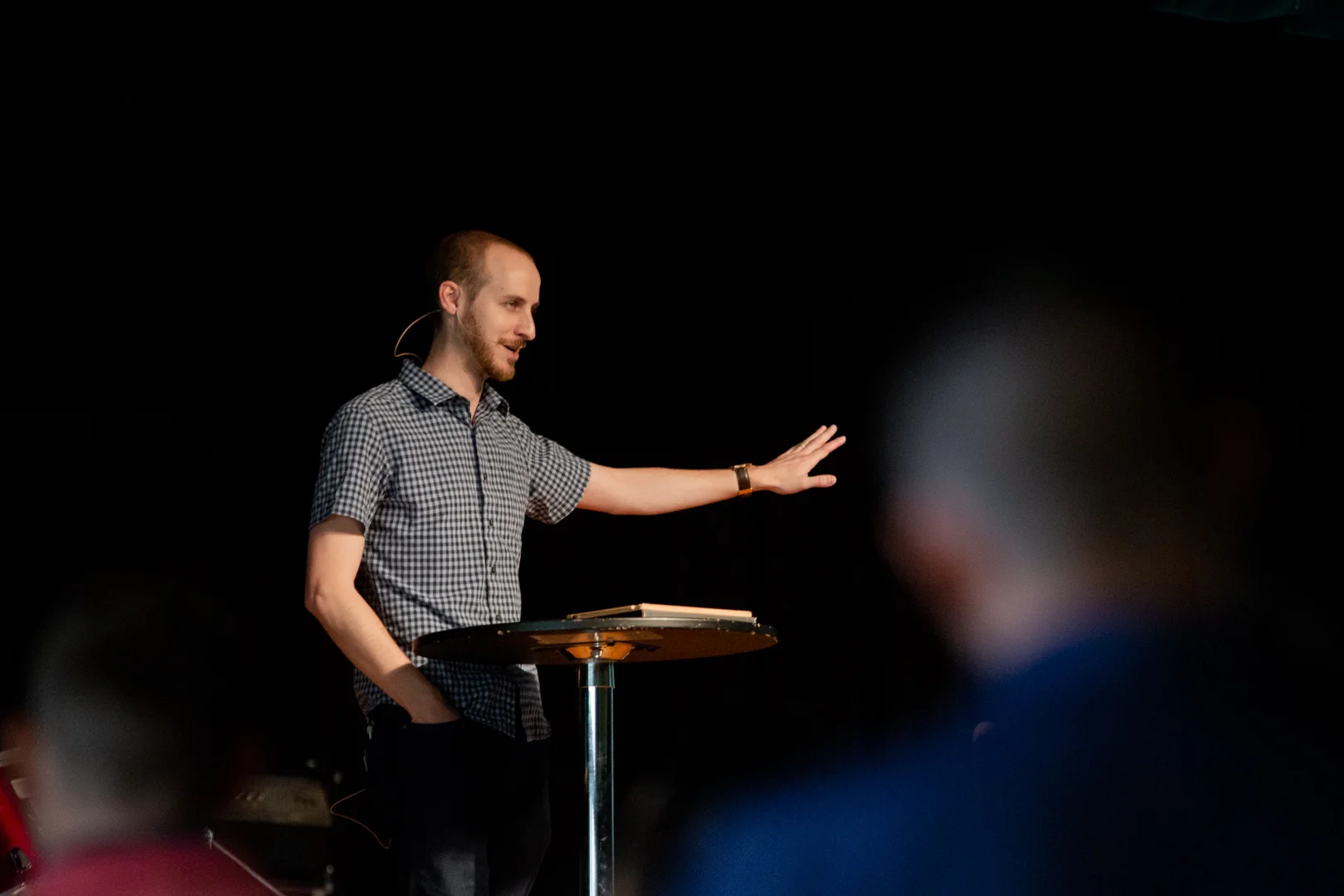

Don't Shoot the Messenger!
Malachi
Don’t shoot the messenger!
malachi
Main Idea: God loves us and calls us to trust his promises and worship him with all of life.
I. Remember God’s Love (Malachi 1:2-5)
Mal. 1:2–5: “I have loved you,” says the Lord. But you say, “How have you loved us?” “Is not Esau Jacob’s brother?” declares the Lord.
Rom. 8:35, 38–39: Who shall separate us from the love of Christ? Shall tribulation, or distress, or persecution, or famine, or nakedness, or danger, or sword?...For I am sure that neither death nor life, nor angels nor rulers, nor things present nor things to come, nor powers, nor height nor depth, nor anything else in all creation, will be able to separate us from the love of God in Christ Jesus our Lord.
II. Honoring God’s Name (Malachi 1:6-3:18)
Mal. 1:6: A son honors his father, and a servant his master. If then I am a father, where is my honor? And if I am a master, where is my fear? says the Lord of hosts to you, O priests, who despise my name. But you say, ‘How have we despised your name?’
1. Honor God in Worship (1:6-2:6)
Your sacrifices are blemished (1:7-11)
Your attitude is apathetic (1:12-13)
You have fallen short of your glorious purpose (1:14)
You approach God with irreverence (2:1-4)
You have been unfaithful in your teaching (2:5-9)
We become what we worship.
2. Honor God in Relationships (2:10-16)
Mal. 2:10–16: Have we not all one Father? Has not one God created us? Why then are we faithless to one another, profaning the covenant of our fathers? Judah has been faithless, and abomination has been committed in Israel and in Jerusalem. For Judah has profaned the sanctuary of the Lord, which he loves, and has married the daughter of a foreign god…You cover the Lord’s altar with tears, with weeping and groaning because he no longer regards the offering or accepts it with favor from your hand. But you say, “Why does he not?” Because the Lord was witness between you and the wife of your youth, to whom you have been faithless, though she is your companion and your wife by covenant.
We worship in our relationships.
3. Honor God with Your Wealth (3:6-12)
Mal. 3:6–12: “For I the Lord do not change; therefore you, O children of Jacob, are not consumed. From the days of your fathers you have turned aside from my statutes and have not kept them. Return to me, and I will return to you, says the Lord of hosts. But you say, ‘How shall we return?’ Will man rob God? Yet you are robbing me. But you say, ‘How have we robbed you?’ In your tithes and contributions.
We worship with our wallet.
III. Trust God’s Promises (Malachi 4:1-6)
Mal. 4:1-6: For behold, the day is coming, burning like an oven, when all the arrogant and all evildoers will be stubble. The day that is coming shall set them ablaze, says the Lord of hosts, so that it will leave them neither root nor branch. But for you who fear my name, the sun of righteousness shall rise with healing in its wings. You shall go out leaping like calves from the stall. And you shall tread down the wicked, for they will be ashes under the soles of your feet, on the day when I act, says the Lord of hosts. Remember the law of my servant Moses, the statutes and rules that I commanded him at Horeb for all Israel. Behold, I will send you Elijah the prophet before the great and awesome day of the Lord comes. And he will turn the hearts of fathers to their children and the hearts of children to their fathers, lest I come and strike the land with a decree of utter destruction.
The prophets cry out from the wilderness, and Jesus Christ answers.

Waiting in the Silence
Malachi 3:1-6, 4:1-6
When God feels silent, we must remember his character, his word, and his coming, as we await his return.
Malachi 3:1-6, 4:1-6
Main Idea: When God feels silent, we must remember his character, his word, and his coming, as we await his return.
I. Waiting & God’s Silence
Malachi, the last of the Old Testament prophets, delivered the messages in this book in the mid-5th century BC. The people of Israel have been home for around 100 years after the Edict of Cyrus allowed them to return, but things are not the same. There is a spiritual stagnancy and emptiness in Israel, and the Lord wants to prepare them for the silence that is coming.
When we are confronted with the silence, absence, or “hiddenness” of God, we can respond in two different ways. The first is to respond as the Israelites in Malachi:
They began to doubt God’s love & justice (1:2-5, 2:17-3:5)
They began to simply “go through the motions” of worship, in a half-hearted, disingenuous way (1:6-2:9)
They began to view obedience as optional (2:10-16, 3:7-12)
They began to view serving and loving God as being “in vain” (3:13-15)
The other way to respond in the face of God’s silence is to exercise faith. Part of this faith is crying out in honesty to God when we feel his silence or absence. The Biblical authors themselves wrestled with God in this way, asking him direct questions in the midst of their pain or confusion and we are invited to do the same thing (Job 30:20, Ps. 28:1-2).
This is the kind of faith described in Hebrews 11:1: “Now faith is the assurance of things hoped for, the conviction of things not seen.” How is it possible to have assurance and conviction in this way?
II. Waiting & God’s Witness (3:1, 6, 4:4-6)
Though God may seem silent, this does not mean he is absent. In this passage, God bears witness in 4 ways to why we can have this kind of assurance & conviction in faith:
1. God’s Character & Nature (3:6): God “does not change” (“immutable”) unlike everyone and everything else around us.
Numbers 23:19: God is not man, that he should lie, Or a son of man, that he should change his mind. Has he said, and will he not do it? Or has he spoken, and will he not fulfill it?
2. God’s Word (4:4): Even when God feels silent, we must remember that he has already spoken to us in his Word.
“You do not need another special revelation from God outside the Bible. You can listen to the voice of God every day. Christ still speaks, because the Spirit has already spoken. If you want to hear from God, go to the book that records only what he has said. Immerse yourself in the word of God. You will not find anything more sure.” ~ Kevin DeYoung
3. God’s Coming (3:1, 4:5): God promises to send a messenger in the spirit of Elijah to “prepare the way” for the Lord’s coming. This is precisely what happens when John the Baptist comes on the scene in the New Testament, as he clears the way for Jesus with his message of the Kingdom & repentance (cf. Matt. 3:1-3)
For those of us living this side of Christmas, we must remember that God has already come when we feel his silence. We can’t say that God does not care about us or that he is uninvolved, because he cared enough to enter into our mess in the incarnation, and he cared enough that he shed his own blood on the cross on our behalf.
4. God’s People (4:6): The result of God’s coming is captured in this promise that “hearts will be turned.” This happens first and foremost toward God and then to one another. Reconciliation within the church is meant to remind us of God’s presence, as his people are the “new temple” of God.
“In spite of God’s apparent hiddenness, the memory of what God has done in the past continues to activate hope for what he will do in the future. This is the movement of the Advent season. The God who hides himself is still the God of the covenant. He is absent and present at the same time… He may hide himself, but it can never be forgotten that he was once present in power and that he will be again. That is Advent- the time between.” ~ Fleming Rutledge
III. Waiting & God’s Return (3:2-5, 4:1-3)
When the “Lord of hosts” comes, no one can simply “stand” before the commander of the heavenly army. He is coming as “fire,” and this fire will separate the pure from the impure, and the true from the false.
For evildoers and the wicked, this is a day of judgment (3:5, 4:1), where God will put an end once and for all to all that has gone wrong in this world. John the Baptist warns: “bear fruit in keeping with repentance… even now the axe is laid to the root of the trees. Every tree therefore that does not bear good fruit is cut down and thrown into the fire.” (cf. Matt. 3:1-12)
For God’s people, this is a day of hope and healing. God will act as a “refiner” of his people, burning away all impurities from our lives. He will “purify” his people like the “fuller’s soap” that removes stains from clothing. This is the only way we can stand before the Lord of hosts who has promised to return.
At his return, Jesus will bring:
Light where there is darkness (the “sun of righteousness shall rise”)
Healing where there is sickness (with “healing” in his wings)
Freedom where there is bondage (“you shall go out leaping like calves from the stall”)
Victory where there is defeat (the wicked will be “ashes under the soles of your feet.”)