
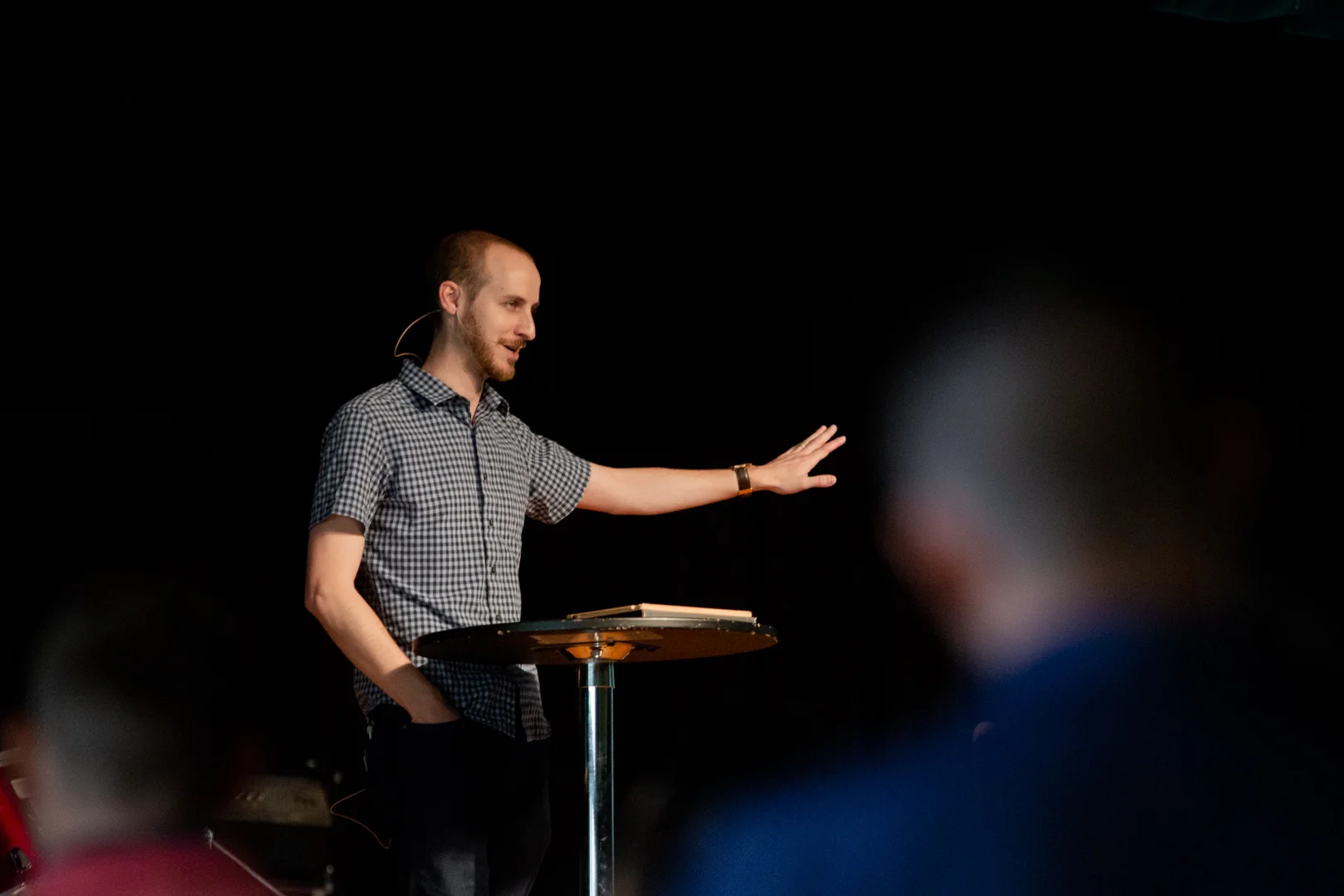

The Lowly King
Matthew 11:28-30
The Lowly King
Matthew 11:28-30
Main Idea: Jesus’ heart is gentle and his yoke is light for all who come to him.
I. His Heart
This passage is the unique self-disclosure of Jesus’ heart and his innermost being. His heart is:
Gentle: cf. Matt. 5:5; 21:5; 1 Pet. 3:4; can also communicate ‘meekness’ or ‘humility’
Zechariah 9:9: Rejoice greatly, O daughter of Zion!
Shout aloud, O daughter of Jerusalem!
Behold, your king is coming to you;
righteous and having salvation is he,
humble and mounted on a donkey,
on a colt, the foal of a donkey.
Lowly: the idea of being ‘low to the ground’ in humility (cf. Jas. 4:6); Christ’s very heart is accessible and approachable.
Isaiah 57:15: For thus says the One who is high and lifted up,
who inhabits eternity, whose name is Holy:
“I dwell in the high and holy place,
and also with him who is of a contrite and lowly spirit,
to revive the spirit of the lowly,
and to revive the heart of the contrite.
Gentleness, meekness, and lowliness often had negative cultural connotations in this time period, which is why many people overlooked and missed Jesus as the long-promised Messiah and the incarnate Son of God (cf. Isa. 42:1-4; Phil. 2:5-7).
“Meek. Humble. Gentle. Jesus is not trigger-happy. Not harsh, reactionary, easily exasperated. He is the most understanding person in the universe. The posture most natural to him is not a pointed finger but open arms… This, according to his own testimony, is Christ’s very heart. This is who he is. Lowly gentleness is not one way Jesus occasionally acts toward others. Gentleness is who he is. It is his heart. He can’t un-gentle himself toward his own any more than you or I can change the color of our eyes.”
~ Dane Ortlund, Gentle & Lowly: The Heart of Christ for Sinners and Sufferers
Christ’s gentle and lowly heart does not make him a “pushover” or timid in the face of injustice and wrongdoing (cf. 11:20-24); rather, his “heart” tells us that his righteous anger is an expression of his love, not in competition or contradiction with his mercy (cf. Ex. 34:6ff; Isa. 55:6-9).
“The OT speaks of God being ‘provoked to anger’ by his people dozens of times. But not once are we told that God is ‘provoked to love’ or ‘provoked to mercy.’ His anger requires provocation; his mercy is pent up, ready to gush forth. We tend to think his divine anger is pent up, spring-loaded and that divine mercy is slow to build. It’s just the opposite. Divine mercy is ready to burst forth at the slightest prick.”
~ Dane Ortlund, Gentle & Lowly
II. His Yoke
“A “yoke” was a wooden crossbeam placed on animals to harness their strength in agriculture and farming. The Bible often talks about a “yoke” metaphorically to represent bondage (Jer. 27:2-7; Isa. 14:25) or submission to a master (Gal. 5:1; 1 Tim. 6:1)
The scribes and Pharisees spoke positively of the Law as a “yoke,” but Jesus indicts them for creating a “burdensome” and heavy yoke around the neck of the people (cf. Matt. 23:4; Acts 15:10). In contrast, Jesus offers a yoke that is “easy” and a burden that is “light.” Rather than throwing off restraints altogether, Jesus invites us to exchange yokes.
Matthew 5:17: Do not think that I have come to abolish the Law or the Prophets; I have not come to abolish them but to fulfill them.
This yoke of Jesus is an invitation to “learn from him” as his disciple, and to embrace his loving constraints that free us for faithful living (cf. Rom. 6:15-18). 1 John 5:3: For this is the love of God, that we keep his commandments. And his commandments are not burdensome.
III. His Rest
Jesus is offering here what every single person longs for: “you will find rest for your souls.” However, Jesus extends this invitation not to the “wise and understanding" (11:25) but to “little children” who “labor and are heavy laden.”
Labor: those who are weary from their own work, toil, and struggle
Heavy laden: those who are burdened by things outside of their control
The invitation of Jesus is this: whatever has us weary and burdened, let them drive you to the heart of Christ, not away from him. Holy Week reminds us Christ bore the burdens and weight of our sin, shame, and guilt upon himself (cf. Isa. 53:4; 1 Pet. 2:24), so we might have eternal “rest for our souls.”
“Up this way, therefore, did burdened Christian run, but not without great difficulty, because of the load on his back. He ran thus till he came at a place somewhat ascending; and upon that place stood a cross, and a little below, in the bottom, a sepulcher [tomb]. So I saw in my dream, that just as Christian came up with the cross, his burden loosed from off his shoulders, and fell from off his back, and began to tumble, and so continued to do till it came to the mouth of the sepulcher, where it fell in, and I saw it no more. Then was Christian glad and lightsome, and said with a merry heart, “He has given me rest by his sorrow, and life by his death.”
~ John Bunyan, The Pilgrim’s Progress

The Meal
Matthew 26:17-30
The Meal
Matthew 26:17-30
Main Idea: The Lord’s Supper reminds us of Jesus’ substitutionary and sacrificial death until he returns.
I. The Shadow of Passover (26:17-19)
Surrounding Jesus’ final meal with his disciples is the observance of Passover. This was the high point of the Jewish calendar, as Passover was the most significant of their feasts and festivals in remembrance of God’s great deliverance of his people from slavery.
Exodus 12:14: This day [Passover] shall be for you a memorial day, and you shall keep it as a feast to the Lord; throughout your generations, as a statute forever.
As the Israelites observed Passover in Jerusalem annually, each component of the meal was infused with symbolism and significance:
Unleavened bread (to remember their hasty exit from Egypt)
Bitter herbs (to remember their time of bitterness)
Cup of salt water (to remember their tears in Egypt and the crossing of the Red Sea)
4 cups of wine (to remember the four promises of Exodus 6:6-7)
A lamb (to remember their deliverance by the blood)
II. The Sorrow of Sin (26:20-25)
In this intimate setting, Jesus prepares his disciples for his impending betrayal. Though this was in the sovereign plan of God (“as it is written of him”), it does not lessen the responsibility of this sinful action by Judas. The response of the other disciples (“Is it I, Lord?”) shows a humble awareness of their own capacity to sin, and established the need for this meal in the first place.
Matthew 26:31: Then Jesus said to them, “You will all fall away because of me this night. For it is written, ‘I will strike the shepherd, and the sheep of the flock will be scattered.’
It is essential to keep together these two complementary ways of looking at the cross. On the human level, Judas gave him up to the priests, who gave him up to Pilate, who gave him up to the soldiers, who crucified him. But on the divine level, the Father gave him up, and he gave himself up, to die for us. As we face the cross, then, we can say to ourselves both, “I did it, my sins sent him there,” and “He did it, his love took him there.
~ John Stott, The Cross of Christ
III. The Substance of Christ (26:26-30)
As Jesus presides over the Passover meal, he breaks from the script and the story to insert himself: “this is my body… this is my blood of the covenant.” As the fulfillment of Passover, Jesus presents his impending death and crucifixion as:
Sacrificial (cf. John 1:29, 1 Cor. 5:7b; 1 Peter 1:18-19)
Substitutionary
The concept of substitution may be said to lie at the heart of both sin and salvation. The essence of sin is man substituting himself for God, while the essence of salvation is God substituting himself for man. Man asserts himself against God and puts himself where only God deserves to be; God sacrifices himself for man and puts himself where only man deserves to be. Man claims prerogatives that belong to God alone; God accepts penalties that belong to man alone.
~ John Stott, The Cross of Christ
1 Corinthians 11:26: For as often as you eat this bread and drink the cup, you proclaim the Lord’s death until he comes.
[The Lord’s Supper] is a happy remembrance. Our remembrance of Christ is chastened with repentance, but it is also perfumed with faith. The Lord’s Supper is no funeral meal, but a festival; it is not a fast, but a feast. My happiest moments are spent with the King at his table, when his banner over me is love. The death of Christ is a well-spring of solemn joy
~ Charles Spurgeon, “The Blood Shed for Many”

The Trial
Luke 23:1-25
the trial
Luke 23:1-25
Main Idea: Amid the political actors of this world, Jesus is the true king who sets free guilty captives.
I. Political Posturing (23:1-5)
Jesus has been found guilty of blasphemy by the Sanhedrin (22:66-71), but they lack the power to condemn him to death. Therefore, they appeal to Pilate and make 3 political accusations against Jesus:
‘Misleading’ (lit. ‘subverting’) our nation (Israel)
Refusing to pay taxes to Caesar (cf. Luke 20:25)
Claiming to be Christ, a king (the most threatening accusation to Pilate)
Pilate’s question (“Are you the King of the Jews?”) is an attempt to drill down Jesus’ political alliance and agenda. Jesus’ brilliant answer (lit. ‘you say’) confronts the false expectations of a messiah and king, while not denying his royal identity. Jesus was indeed a King, but not a king like the people had in mind (cf. Jn. 18:36).
Jesus sees his messiahship [and kingship] in different terms. He insists that he really is the King. He really is the Messiah. He really does come from David’s line. But he’s also one who’s not so much interested in establishing a merely territorial, political kingdom. He comes to build his kingdom that captures men and women, to transform them, to forgive them, to prepare them for heaven, and to teach them how to live here: a domain in which God is sovereign and recognized as King. ~ D.A. Carson, “Why Jesus Christ Died”
II. Vain Curiosity (23:6-12)
Hearing that Jesus has connections to Galilee, Pilate sees an opportunity to pass him off to Herod and his jurisdiction. Herod Antipas desired to see a “sign,” but he had no genuine interest in the truth about Christ or faith in him. He is a political pawn whose conscience has been seared (cf. Luke 9:7-9).
Those who come to Jesus for any purpose other than knowing, loving, and following him will inevitably be disappointed... To desire Jesus because of signs and wonders, health and wealth, powers and privilege, or any other ulterior purposes is not to desire Jesus. ~ James Edwards, The Gospel According to Luke
1 Peter 2:22-23: He committed no sin, neither was deceit found in his mouth. When he was reviled, he did not revile in return; when he suffered, he did not threaten, but continued entrusting himself to him who judges justly.
Jesus’ interaction with Herod ends with two inverted ironies of the gospel:
Herod thinks nothing of Jesus and mockingly dresses up the true King of all kings in ‘splendid clothing’
Herod and Pilate experience reconciliation as a result of their united opposition against Christ (Ps. 2:2: “The kings of the earth set themselves, and the rulers take counsel together, against the Lord and against his Anointed”)
III. A Great Exchange (23:13-25)
Pilate asserts Jesus’ innocence three times (23:4, 14, 22) but the crowd, animated by the chief priests and rulers, is stirred up in a frenzy to condemn Jesus. Pilate lacks the moral fortitude and courage to do what is right and caves under the political pressure.
Luke 9:22: “The Son of Man must suffer many things and be rejected by the elders and chief priests and scribes, and be killed, and on the third day be raised.”
The release of ‘Barabbas’ (lit. ‘son of the father’) is the story of the gospel; though Jesus is innocent and righteous, he is condemned and faces the consequences in the place of the guilty, while the guilty one is released from his imprisonment and walks free (cf. Mk. 10:45, 1 Pet. 3:18).
The concept of substitution may be said to lie at the heart of both sin and salvation. The essence of sin is man substituting himself for God, while the essence of salvation is God substituting himself for man. Man asserts himself against God and puts himself where only God deserves to be; God sacrifices himself for man and puts himself where only man deserves to be. ~ John Stott, The Cross of Christ