
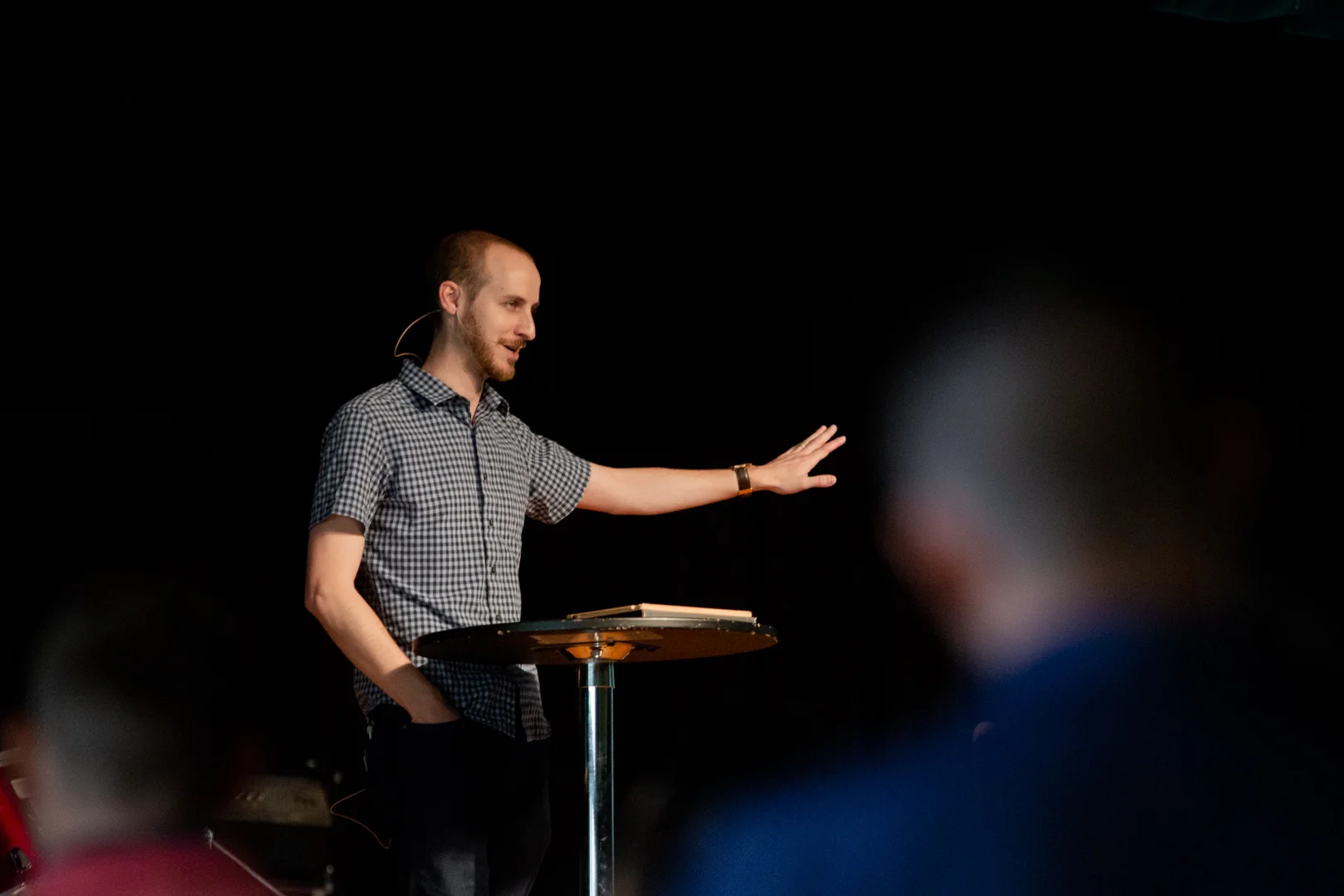

The King is Coming
Ruth 4
*Unfortunately, we were unable to record the sermon from Sunday, December 22, 2024. We sincerely apologize for any inconvenience.
The king is coming
Ruth 4
Much of Ruth looks very ordinary: we read about bread, family, death, daughters-in-law, widowhood, gossip, grief, bitterness, a baby, and other familiar things. But in truth Ruth magnifies God’s providence. God is at work in this ordinary family. Ruth tells us not to dismiss or despise the ordinary but to look within it for God’s extraordinary providence.
~ Tony Merida, Ruth For You
The story you believe is the story you live.
Past: How do you tell your story?
Present: How do you interpret your days?
Future: What do you believe the future holds?
Ps.115:3: But “our God is in the heavens; he does all that he pleases.”
Isa.46:9-10: [The Lord says] there is none like me. Only I can tell you the future before it even happens. Everything I plan will come to pass, for I do whatever I wish.
Job 42:2: I know you can do all things; no purpose of yours can be thwarted.
Your story is not random.
Your story is redemptive.
Main Idea: Jesus is the long-expected King who redeems us and restores us to bless the world through ordinary faithfulness.
I. The Redeemer’s Sacrifice (4:1-10)
The Gate (4:1)
The Twelve (4:2)
The Land (4:3-4)
Leviticus 25:25: “If your brother becomes poor and sells part of his property, then his nearest redeemer shall come and redeem what his brother has sold.”
The Bride (4:5-6)
The Sacrifice (4:7-10)
When the person from whom I have a right to expect nothing gives me everything.
~ Michael Card
II. The Blessed Wedding (4:11-17a)
A. The Threefold Blessing (4:11b-12)
House of Israel: Rachel and Leah
House of Bread: Renown in Bethlehem
House of Perez: Judah’s Offspring
B. The Fruitful Wedding (4:13)
C. The Restoration of Naomi (4:14-16)
III. The Royal Lineage (4:18-22)
Ruth 4:18–22: Now these are the generations of Perez: Perez fathered Hezron, Hezron fathered Ram, Ram fathered Amminadab, Amminadab fathered Nahshon, Nahshon fathered Salmon, Salmon fathered Boaz, Boaz fathered Obed, Obed fathered Jesse, and Jesse fathered David.
Matthew 1:1-16: The book of the genealogy of Jesus Christ, the son of David, the son of Abraham.
Abraham was the father of Isaac, and Isaac the father of Jacob, and Jacob the father of Judah and his brothers, and Judah the father of Perez and Zerah by Tamar, and Perez the father of Hezron, and Hezron the father of Ram, and Ram the father of Amminadab, and Amminadab the father of Nahshon, and Nahshon the father of Salmon, and Salmon the father of Boaz by Rahab, and Boaz the father of Obed by Ruth, and Obed the father of Jesse, and Jesse the father of David the king.
And David was the father of Solomon by the wife of Uriah, and Solomon the father of Rehoboam, and Rehoboam the father of Abijah, and Abijah the father of Asaph, and Asaph the father of Jehoshaphat, and Jehoshaphat the father of Joram, and Joram the father of Uzziah, and Uzziah the father of Jotham, and Jotham the father of Ahaz, and Ahaz the father of Hezekiah, and Hezekiah the father of Manasseh, and Manasseh the father of Amos, and Amos the father of Josiah, and Josiah the father of Jechoniah and his brothers, at the time of the deportation to Babylon.
And after the deportation to Babylon: Jechoniah was the father of Shealtiel, and Shealtiel the father of Zerubbabel, and Zerubbabel the father of Abiud, and Abiud the father of Eliakim, and Eliakim the father of Azor, and Azor the father of Zadok, and Zadok the father of Achim, and Achim the father of Eliud, and Eliud the father of Eleazar, and Eleazar the father of Matthan, and Matthan the father of Jacob, and Jacob the father of Joseph the husband of Mary, of whom Jesus was born, who is called Christ.
Cold Feet and Abundant Wheat
Ruth 3
Cold feet and abundant wheat
Ruth 3
Main Idea: Because the Lord is a trustworthy redeemer, we can hope in patience and righteousness.
I. A Risky Plan (3:1-5)
The events recorded in chapter 2 infuse Naomi with hope (cf. Ps. 42:5) for her and Ruth’s future in Bethlehem. She desires “rest” that it may be “well” (‘full’) for Ruth, meaning marriage, a home, children, and full integration into Israelite society.
The sheer fact that Naomi has a strategy teaches us something. People who feel like victims don’t make plans. As long as Naomi was oppressed; as long as she could only say, “The Almighty has dealt very bitterly with me,” she conceived no strategy for the future. One of the terrible effects of depression is the inability to move purposefully and hopefully into the future. Strategies of righteousness are the overflow of hope. When Naomi awakens in 2:20 to the kindness of God, her hope comes alive and the overflow is strategic righteousness. She is concerned about finding Ruth a place of care and security, and she makes a plan.
~ John Piper, “Ruth: Strategic Righteousness”
Naomi comes up with a plan of action because the harvest has ended (2:23) and Boaz has yet to act decisively toward Ruth. She proposes Ruth clean herself up to be physically presentable (cf. 2 Sam. 12:20), discreetly meeting Boaz at the “threshing floor” where winnowing would take place with the evening breeze.
Believing in sovereign providence does not stifle but stimulates human action. Belief in a sovereign God who orders all things does not enervate you but energizes you to action.
~ Dale Ralph Davis, “Cold Feet and Redemption”
This is a risky plan for a few reasons:
Ruth is vulnerable to assault by traveling at night (cf. 2:8-9; book of Judges)
Threshing floors were known for promiscuity (cf. Hos. 9:1), and her presence could be misinterpreted
She has no idea how Boaz will respond to this bold action
II. A Redeeming Promise (3:6-13)
Ruth follows through exactly on Naomi’s covert plan, “startling” Boaz at midnight. She immediately states her intentions to ensure there is no misunderstanding: “I am Ruth, your servant. Spread your wings (cf. 2:12) over your servant, for you are a redeemer,” asking Boaz to be the answer to his own blessing over her.
‘Spread your wings’ was a phrase used at times as a request for marriage (Eze. 16:8), and was used more broadly to speak of provision and protection (cf. 2:12; Ps. 57:1; 61:4; Mt. 23:37). Ruth calls Boaz to “redeem” her, appealing to the principles of Levirate marriage in Deut. 25:5-10. Though Boaz is not legally obligated to fulfill this role, Ruth is asking him to honor the spirit of God’s protection for the destitute as a kinsman-redeemer.
Boaz’s honorable response reveals why there may have been hesitation to initiate this relationship:
He is older than Ruth (2:10)
He is aware of a “nearer” kinsman-redeemer (2:12)
In his promise, Boaz is a picture of God’s “redemption” of Israel in the OT, and a picture of Christ’s redemption of the “household of God” in the NT. Christ is our “near kinsman-redeemer” who in his incarnation has been “made like his brothers in every respect” (Heb. 2:17) and is “not ashamed to call us brothers” (Heb. 2:11) as he delivers us from our dire situation, places us under his protection, and grants us ongoing provision as his bride (Eph. 5:32).
III. A Restful Patience (3:14-18)
To preserve Ruth’s dignity and reputation, Boaz sends her home early in the morning before others will see her. He ensures that she does not leave “empty-handed,” a reminder once more of the gracious reversal of Naomi’s “empty” situation (1:21) upon returning home.
This gift served multiple purposes:
It was a means of provision, a tangible picture of spreading his ‘wings’ over this family
It was an act of generosity toward Ruth and Noami
It was a “down payment” of something greater to come
In certain respects the widows’ situation as scene 3 ends resembles believers’ situation here and now, in the aftermath of the biblical storyline’s climactic (but not culminating) action. That is, on account of the life, death, and exaltation of the Lord Jesus Christ, believers presently enjoy salvation’s firstfruits but must await salvation’s full outworking (1 Jn. 3:1–3). We live in the already and not yet and look to the Lord’s second coming, when God will resolve all remaining tension and consummate his every promise. In the meantime, our redeemer encourages us by giving us a pledge. Boaz graciously guarantees his oath with six measures of barley, but the Lord Jesus guarantees his oath by giving us the Holy Spirit (2 Cor. 1:20–22). God’s gift of the Spirit demonstrates his trustworthiness and serves as the down payment of our inheritance until we obtain full possession of it (Eph. 1:13–14).
~ Mary Willson Hannah, “Ruth” (ESV Expository Commentary)
Psalm 130:5-8: I wait for the Lord, my soul waits,
and in his word I hope ;my soul waits for the Lord
more than watchmen for the morning,
more than watchmen for the morning.
O Israel, hope in the Lord!
For with the Lord there is steadfast love,
and with him is plentiful redemption.
And he will redeem Israel
from all his iniquities.
Refuge Under God’s Wings
Ruth 2
Refuge Under God’s Wings
Ruth 2
Ruth 1:20: Do not call me Naomi [which means “sweet”]; call me Mara [which means “bitter”], for the Almighty has dealt very bitterly with me. I went away full, and the LORD has brought me back empty. Why call me Naomi, when the Lord has testified against me and the Almighty has brought calamity upon me?
Main Idea: By faith let us seek and find refuge under God’s wings.
I. Ruth’s Faith
Ruth’s faith is in contrast to those around her:
Her ethnic heritage
Naomi
General Israelite culture during the time of the Judges
Evidence of Ruth’s Faith:
Ruth’s faith responds to God’s Word
Ruth’s faith leads to action
Ruth’s faith is seen in her godly character
Leviticus 19:9-10: When you reap the harvest of your land, you shall not reap your field right up to its edge, neither shall you gather the gleanings after your harvest. And you shall not strip your vineyard bare, neither shall you gather the fallen grapes of your vineyard. You shall leave them for the poor and for the sojourner: I am the LORD your God.
Faith in Yahweh does not mean being lazy and waiting around for him to act. Ruth tries to make the very best of her situation that she can, trusting God to be good to her as she does so.
~ Tony Merida, Ruth for You
Ruth 3:11: And now, my daughter, do not fear. I will do for you all that you ask, for all my fellow townsmen know that you are a worthy woman.
Proverbs 31:10: An excellent wife who can find? She is far more precious than jewels.
Ruth 2:12: The LORD repay you for what you have done, and a full reward be given you by the LORD, the God of Israel, under whose wings you have come to take refuge!
II. Boaz’s Favor
Ruth 2:1: Now Naomi had a relative of her husband’s, a worthy man of the clan of Elimelech, whose name was Boaz.
Ruth 2:10: Then she fell on her face, bowing to the ground, and said to him, “Why have I found favor in your eyes, that you should take notice of me, since I am a foreigner?”
Ruth 2:13: Then she said, “I have found favor in your eyes, my lord, for you have comforted me and spoken kindly to your servant, though I am not one of your servants.”
Boaz’s favor is generous:
He instructs her to stay in his field (2:8)
He instructs her to stay with his young women servants (2:8)
He invites her to drink from what the men have drawn from the well (2:9)
He warns his workers against sexual harassment (2:9)
He includes her in the meal for his servants (2:14)
He provides more than she could eat (2:14)
He gives her wine, not just water (2:14)
He gives permission to “glean among the sheaves” (2:15)
He tells the servants to “pull out bundles for her” (2:16)
Jesus, in his kindness, has sought the outcast, has given us refuge, has fed us at his table, and has become our Redeemer.
~ Tony Merida, Ruth for You
III. Naomi’s Fortune
Ruth 2:20: May he [that is, Boaz] be blessed by the LORD, whose kindness has not forsaken the living or the dead!
Ruth 2:3: So she [Ruth] set out and went and gleaned in the field after the reapers, and she happened to come to the part of the field belonging to Boaz, who was of the clan of Elimelech.
By excessively attributing Ruth’s good fortune to chance, he [the author] forces the reader to sit up and take notice, to ask questions concerning the significance of everything that is transpiring . . . . In reality he is screaming, ‘See the hand of God at work here!’ The same hand that had sent the famine (1:1) and later provided food (1:6) is the hand that brought Naomi and Ruth to Bethlehem precisely at the beginning of the harvest (1:22) and has now guided Ruth to that portion of the field belonging specifically to Boaz
~ Daniel Block, Ruth
This is not some impersonal fate or destiny at work here. This is not an accident. It is nothing less than the hand of a personal, loving God who is always working quietly and continuously through the ordinary things of life to bring His blessing to His people.
Ruth 2:10: Then she fell on her face, bowing to the ground, and said to him, “Why have I found favor in your eyes, that you should take notice of me, since I am a foreigner?”
Ruth is a picture of how we should respond to God’s undeserved, generous grace.
• She recognizes that she is in need.
• She recognizes that she is undeserving.
• She responds with humility and gratitude as she accepts his gracious provision.
So let us fall on our faces, bow before the Lord, confess our unworthiness, take refuge under the wings of God, and be astonished at his grace.
~ John Piper, Ruth: Under the Wings of God
Famine and Faith
Ruth 1
Famine and Faith
Ruth 1
Main Idea: In a world of sin and suffering, God has visited us with steadfast love, grace, and provision.
I. A World of Death (1:1-6)
The Book of Ruth takes place during the time of the “judges” of Israel. The repeated refrain of Judges indicates the spiritual climate in Israel: “In those days there was no king in Israel. Everyone did what was right in his own eyes.” (Jdg. 21:25).
The names and places in Ruth are filled with irony:
Bethlehem means “house of bread,” but is experiencing famine (cf. Deut. 28:22-24; 32:23-24)
Elimelech means “my God is King,” but acts contrary
Naomi means “pleasant” or “sweet,” but she will soon identify as “bitter” (1:20)
Mahlon (“weak”) and Chilion (“frail”) live up to their namesake, dying in Moab
Though geographically close to Bethlehem, Elimelech’s decision to move his family to Moab is deeply problematic. Moab was infamous to the Israelites, all for bad reasons:
They are the descendants of an incestuous relationship between Lot and his daughter (Gen. 19:30-38)
The King of Moab hired Balaam to curse Israel (Num 22), and some Moabites seduced Israel to false worship and sexual immorality (Num 25)
They worshipped false gods (Chemosh) and offered child sacrifice (2 Kings 3:26-27)
What began as a plan to “sojourn” turned into 10 years of pain, suffering, and death. However, God graciously allows Naomi to hear the good news that the Lord had “visited” his people (cf. Lk. 1:68, 77-79) with food in Bethlehem. In an act of “repentance,” she decides to return home (cf. Lk. 15:17-18; Rom. 2:4).
II. A Daughter of Faith (1:7-18)
From her place of misery and bitterness, and because of the bleak prospects for these Moabite women in Bethlehem, Naomi tries to convince Orpah and Ruth to “return” to Moab, where they would likely have a better chance of security and a future family. She asks the Lord to deal “kindly” with these women (Heb. ‘hesed’)
If you want to see what natural, human love, at its best looks like, look at Orpah. If you want to see what supernatural steadfast love looks like, look at Ruth.
~ John Carpenter, “Ruth’s Prequel to the Christmas Story”
While Naomi asks the Lord to bless Ruth with his steadfast, covenantal love, it is actually Ruth who is a picture of God’s hesed love for Naomi. In this commitment to her mother-in-law, she is making a profession of faith in Yahweh, turning to him in conversion.
[Ruth’s decision] is all the more amazing after Naomi’s grim description of their future with her. Ruth stays with her in spite of an apparently hopeless future of widowhood and childlessness. Naomi painted the future black and Ruth took her hand and walked into it with her.
~ John Piper, “Ruth: Sweet and Bitter Providence”
III. A God of Grace (1:19-22)
As Naomi and Ruth return to the small town of Bethlehem, the town is “stirred” at Naomi’s appearance. She requests to be called ‘Mara’ (lit. ‘bitter;’ cf. Ex. 15:22-24). Her posture toward the Lord is a mixed bag:
Positively, she has returned to the Promised Land and is taking her lament directly to the Lord, sure of his existence and sovereignty.
Negatively, she can only see her lack and “emptiness” from a place of self-absorption. She does not have eyes to see that she has not actually returned empty, but has a reminder of God’s faithfulness in Ruth’s presence
Naomi may have come back home in faith, but hers is a flawed faith. Unable to see human causation in Israel’s famine and in her own trials, the woman the neighbors greet is a bitter old woman. She does indeed ascribe sovereignty to God, but this is a sovereignty without grace, an omnipotent power without compassion, a judicial will without mercy.
~ Daniel Block, Judges, Ruth
This chapter ends with a beacon of light as we are told is the “beginning of barley harvest” in Bethlehem. Despite Israel’s sin and rebellion, the Lord has graciously provided bread and “filling” in place of “emptiness.”
Whereas Elimelech left the place of famine to seek a false blessing in Moab, Jesus Christ left the glories of heaven to bring us a true blessing on earth. Elimelech and Naomi sent themselves into exile from the land of promise, trying to build their own kingdom rather than waiting for God to do it; Jesus, though, went into exile from his Father’s presence so that he might rescue us from our own kingdom-building and grant us a true and living future in his kingdom. The God who empties us and strips away, however painfully, those precious things in which we are trusting knows what it is to be stripped of all of his possessions, left alone and abandoned by his friends, and hung empty on a cross. Every tear of loss that God inflicts on us is a tear whose cost he himself understands.
~ Iain M. Duguid, Esther and Ruth