
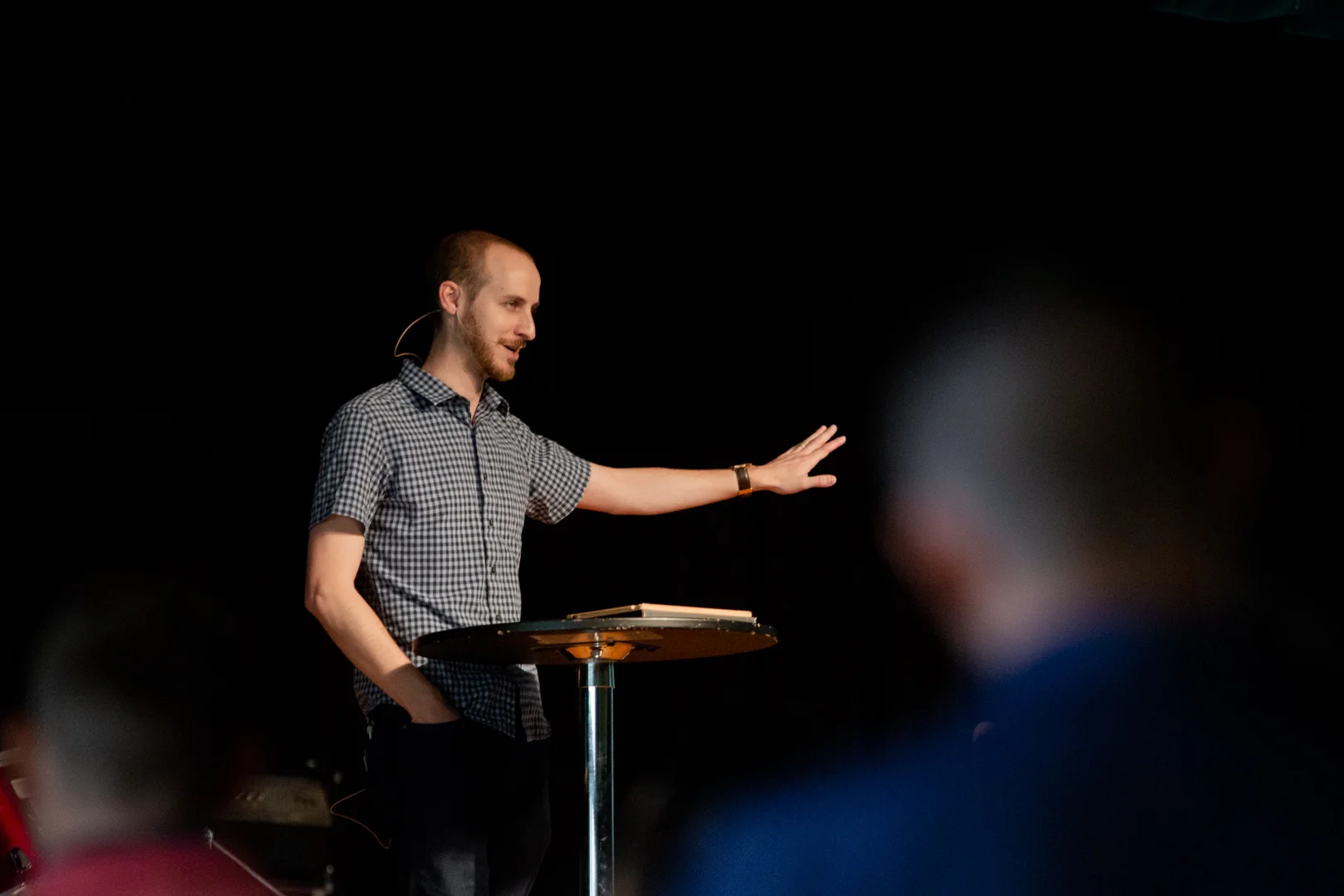

A House Forever
2 Samuel 7
A house forever
2 samuel 7
Main Idea: God relates to us on the basis of grace and establishes his eternal Kingdom in Christ.
I. A Grand Proposal (7:1-7)
As the Lord gave David “rest” from his enemies, it feels like the Kingdom of God has been established:
The Lord’s presence is dwelling with his people, as the ark is brought to Jerusalem (2 Sam. 6)
God’s chosen king (“a man after his own heart” - 1 Sam. 13:14) is on the throne
God’s people are in the promised land
However, “at every major point in redemptive history, God does what nobody expects” (D.A. Carson). The Lord gently rejects David’s offer because of his incarnational presence, his divine nature (cf. Is. 66:1, Acts 17:24-25), and his unrelenting grace.
II. A Gracious Promise
In a great reversal, the Lord graciously reminds David what he has done to bless him and what he will do for and through him to bless others.
A. God’s Grace to David (7:8-11)
The Lord promises to David:
A great name (7:9; cf. Abraham, Gen. 12:2)
A secure place (7:10a; cf. Ex. 15:17)
Enduring peace (7:10b-11a; cf. Rev. 21:25)
A “house” (dynasty) (7:11b)
B. God’s Grace Beyond David (7:12-17)
The promises of God look forward in the near term to Solomon, and in the far-term to Jesus Christ. He is promised:
An “offspring” (lit. ‘seed’) who will be established on the throne (cf. Gen. 3:15, Gal. 3:16)
This son will build a house for God’s name (Mt. 16:18, 1 Pet. 2:5)
The Lord will be to him as a Father (cf. Heb. 1:5, Lk. 1:32-33)
God’s covenant promise to David is ‘indefectible’ because death does not annul it (7:12-13), sin cannot destroy it (7:14-15), & time will not exhaust it (7:16) ~ Dale Ralph Davis, 2 Samuel: Out of Every Adversity. Though the Lord will discipline Davidic kings who go astray, he will not remove his covenant “steadfast love.”
There are two ways in which God could give David an eternal house. It could be that every descendant would be successful in producing a male heir—something that has always created problems for every human royal house. Or it could be that someday, a descendant would be born who would never die. According to the New Testament, this is what happened: the promise of an eternal house/seed is fulfilled in Jesus Christ, descendant of David, who because of his resurrection is an eternal person. And through the coming, person, and work of Jesus Christ, an eternal kingdom has already begun.
~ Peter Gentry & Stephen Wellum, God’s Kingdom through God’s Covenants
III. A Gospel Prayer
In response to this glorious and gracious covenant promise, David “sits” in the tabernacle before the Lord in a posture of humble prayer and whole-hearted worship.
This may be the most critical act that David ever does, the action that puts him out of the action. By sitting down, David renounces royal initiative. He takes himself out of the driver’s seat and deliberately places himself prayerfully before God the King… What we do not do for God is often far more critical than what we in fact do. God is the beginning, center, and end of the world’s life—of existence itself. But we are often unaware of God’s action except dimly and peripherally. Especially when we are in full possession of our powers—our formal education complete, our careers in full swing, people admiring us and prodding us onward—it is hard not to imagine that we are at the beginning, center, and end of the world, or at least that part of the world in which we are placed. Ambitious building projects, whether architectural or moral or programmatic, are dear to the religious spirit. But it is precisely at these moments that we are likely to need prophetic interference... We need to quit whatever we are doing and sit down. In sitting down, we let the dust raised by our furious activity settle; the noise generated by our building operations goes quiet; we become aware of the real world, God’s world. Christians are characteristically afraid of being caught doing too little for God. But there are moments, far more frequent than we suppose, when doing nothing is precisely the gospel thing to do.
~ Eugene Peterson, First & Second Samuel
As David humbly prays to the Lord, he gives thanks for God’s:
Past grace toward the undeserving (7:18-21)
Present grace for the redeemed people of God (7:22-24)
Future grace, asking with “courage” that the promises of God would come to pass (7:24-29)
Prayer is nothing but the promise reversed or God’s word turned inside out and formed into an argument and retorted back again upon God by faith.
~ William Gurnall

Holy Joy
2 Samuel 6
Holy Joy
2 samuel 6
Saying “God is holy” is like saying “God is uniquely God” or “God alone is God.” He has no rivals. He is his own category – 1 Samuel 2:2 describes it like this “There is no one holy like the Lord; there is no one besides you.” He is set apart, morally in a completely different category, and as an implication, if God is holy, God’s people are to be holy, characterized by being set apart and morally like God.
Habakkuk 2:20: For the earth will be filled with the knowledge of the glory of the Lord as the waters cover the sea.
Main Idea: God’s holiness does not suppress our joy but stimulates it.
I. The Ark (6:1-2)
2 Samuel 6:1-2: David again gathered all the chosen men of Israel, thirty thousand. And David arose and went with all the people who were with him from Baale-judah to bring up from there the ark of God, which is called by the name of the Lord of hosts who sits enthroned on the cherubim.
Number 10:25-26: And whenever the ark set out, Moses said, “Arise, O Lord, and let your enemies be scattered, and let those who hate you flee before you.” And when it rested, he said, “Return, O Lord, to the ten thousand thousands of Israel.
The Ark signifies God’s presence and underscores three realities:
Rulership: in 1 Chronicles 28:2 David refers to the ark as the “footstool of our God.” King’s sit on thrones and use footstools. If the ark is the LORD’s footstool then surely the LORD is king of the people with the ark.
Reconciliation: on the annual Day of Atonement the high priest would sprinkle blood of the sin-offering on the “mercy seat” of the ark (Leviticus 16:14-15). Ultimately, these annual sacrifices were highlighting and pointing to the need for a “better” sacrifice that would “once and for all” atone for the sins of the world (Hebrews 10:10-14)
Revelation: inside of the ark were the stone tablets containing the covenant commandments God had given to his people (Exodus 25:16; Deut. 10:1-5). Beyond that, the ark remained the place where the LORD would meet with Moses to communicate additional instructions for Israel (Exodus 25:22). The ark, for the people of God and Israel was the place of God’s directing word.
Observe how Jesus Christ fulfills all that the ark signifies. In my communion we often say that as our Redeemer Christ carries out the offices of prophet, priest, and king (see Westminster Shorter Catechism, nos. 23-26). Does the ark signify Yahweh's revelation? So Christ is our prophet who reveals to us, by his word and Spirit, the will of God for our salvation. Does the ark speak of Yahweh's reconciliation? So Christ is our priest who brought his own blood into the sanctuary (Heb. 9:12). Does the ark as Yahweh's foot-stool proclaim his rulership? So Christ is our king 'in subduing us to himself, in ruling and defending us, and in restraining and conquering all his and our enemies'. It shouldn't surprise us that this Old Testament furniture that so fully speaks of Yahweh should as fully point to Christ 'for in Christ all the fullness of the Deity lives in bodily form' (Col. 2:9, NIV). How can I keep Yahweh's presence central in my life, in my church? Answer: Turn your eyes upon Jesus.
~Dale Ralph Davis, 2 Samuel: Out of Every Adversity
II. The City (6:3-11)
Context: In chapter 7 we will see the LORD’s covenant promise with David to raise up one from the line of David who will “establish the throne of his kingdom forever” of whom the LORD will “be a father” and “he shall be a son” (2 Samuel 7:5-17). God, in his divine providence and orchestration is using the place, the people, and his presence, found in the ark itself, to bring about his plan for redemption. The place matters. Jerusalem is to be where the ark is kept.
Significance: In verse 8 we see that the anger of the lord “broke out” against Uzzah. This is the same word that was used back in chapter 5 when the LORD “broke out” against the Philistines and gave them into the hands of David. The truth is the holiness of God is dangerous for those who would stand opposed to him. First for the Philistines, and then here against his own people and in particular Uzzah.
Application: This leaves us asking the same question that David was asking in verse 9. He says “how can the ark come to me?” We must ask ourselves this same question. How can God ever come to us? Left on our own devices we are stuck; we can’t live with God because He is dangerous to sinners. But we can’t live without Him either, because He is the Source of Life and all good things.
III. The Priestly King (6:12-23)
What makes the difference? A "priest" offering a sacrifice. Something dies on route both times. The first time round it is Uzzah. The second time it is animals, dying in the place of the people. The first journey starts with celebration and ends in death and fear. The second starts with death — a sacrifice — but ends in blessing.
~ Tim Chester, 2 Samuel for You
In our churches there are any number of folks who are very concerned with services and externals and procedures and mechanics and meetings and decency and order but who really can't understand anything of the joy of the Lord. There are some who can muster enthusiasm and gusto over professional sports but who somehow cannot fathom anything but professional detachment over Jesus Christ. Exuberant praise and tears of repentance are strangers to them. W.G. Blaikie has carefully drawn the bottom line: There are, doubtless, times to be calm, and times to be enthusiastic; but can it be right to give all our coldness to Christ and all our enthusiasm to the world? Does the presence of God ever move us?”
~Dale Ralph Davis, 2 Samuel: Out of Every Adversity
Hebrews 12:2:…looking to Jesus, the founder and perfecter of our faith, who for the joy that was set before him endured the cross, despising the shame, and is seated at the right hand of the throne of God.
As an example, think about Paul, persecutor and hater of Christ, sees him and experiences his holiness and it changes everything. He becomes unashamed and even joyfully suffers for Christ's sake. (Rom. 1:16, 1 Cor. 1:23-25, & 1 Cor. 4:1-13)
Romans 1:16:For I am not ashamed of the gospel, for it is the power of God for salvation to everyone who believes, to the Jew first and also to the Greek.
1 Corinthians 4:10-13:We are fools for Christ’s sake, but you are wise in Christ. We are weak, but you are strong. You are held in honor, but we in disrepute. To the present hour we hunger and thirst, we are poorly dressed and buffeted and homeless, and we labor, working with our own hands. When reviled, we bless; when persecuted, we endure; when slandered, we entreat. We have become, and are still, like the scum of the world, the refuse of all things. I do not write these things to make you ashamed, but to admonish you as my beloved children.
Heidelberg Catechism, Questions 1 & 2
Q: “What is your only comfort
in life and in death?”
A. That I am not my own, but belong—body and soul, in life and in death—to my faithful Savior, Jesus Christ. He has fully paid for all my sins with his precious blood, and has set me free from the tyranny of the devil. He also watches over me in such a way that not a hair can fall from my head without the will of my Father in heaven; in fact, all things must work together for my salvation. Because I belong to him, Christ, by his Holy Spirit, assures me of eternal life and makes me wholeheartedly willing and ready from now on to live for him.
Q. "What must you know to live and die in the joy of this comfort?"
A. "Three things: first, how great my sin and misery are; second, how I am set free from all my sins and misery; third, how I am to thank God for such deliverance."
A Tale of Two Kingdoms
2 Samuel 2-5
a Tale of two kingdoms
2 samuel 2-5
“The earthly reign [of David] is a token in which we must contemplate the reign of our Lord Jesus Christ and the salvation of his Church to the end of the world.” ~ John Calvin
Ephesians 1:9-10: …making known to us the mystery of his will, according to his purpose, which he set forth in Christ as a plan for the fullness of time, to unite all things in him, things in heaven and things on earth.
Main Idea: Despite opposition, we must patiently wait for the coming Kingdom of God by looking to King Jesus.
I. The Kingdom Inaugurated (2:1-11)
After David “inquires of the Lord (2:1), he and his company go up to Hebron where the men of Judah anoint him as king. Though Hebron is theologically important (notably in the life of Abraham; cf. Mt. 1:1) and God’s chosen king is visibly ruling for the first time, this coronation seems insignificant and anticlimactic (cf. Matt. 13:31-32).
As David’s kingdom is being established by God, a rival kingdom is being established with a puppet king (Ish-bosheth) by human ambition in sinful rejection to God’s anointed (cf. Lk. 19:14, John 1:11). Though David had waited decades to receive his rightful kingdom, he must wait another seven and a half years for it to be fully realized.
Psalm 2:1-3: Why do the nations rage
and the peoples plot in vain?
The kings of the earth set themselves,
and the rulers take counsel together,
against the Lord and against his Anointed, saying,
“Let us burst their bonds apart
and cast away their cords from us.”
II. The Kingdom Opposed (2:12-4:12)
The opposition to the Kingdom of David mirrors the opposition to the Kingdom of God throughout history. There are four means of opposition highlighted in these chapters:
1. Opposed by Violence (2:12-32): Abner and Joab set up a “contest” to see who the true “Israel” was, only for the 12 combatants from each side to kill each other; this sparks a bitter, violent rivalry between Joab and Abner that results in death and bloodshed.
2. Opposed by Political Expediency (3:6-21): Though Abner knew that God had chosen David to be king over Israel (3:9-10), he only acknowledges this when the deck is stacked against him; there is no repentance in Abner, only self-serving political expediency to save his own life and maintain a sense of power and control.
Abner is not far from any one of us. We share an Abner-nature that harbors sin’s stupidity, perversity, and twistedness. Let Abner preach to you. Let him tell you that it is possible to know the truth but not embrace the truth, to quote the truth but not submit to the truth, to hold the truth and yet assault the truth.
~ Dale Ralph Davis, 2 Samuel: Out of Every Adversity
3. Opposed by Revenge (3:22-39):Joab mistakenly assumes he knows better than his King, assuming David is (at best) naïve and (at worst) weak and vulnerable in his response to Abner’s “defection.” He tricks Abner and murders him out of vengeance and personal vendetta in the same way his brother was killed in battle.
4. Opposed by Injustice (4:1-12)
They come with blood on their hands but theology on their lips, expecting that the latter will magically bleach the former. Murder always seems more pleasant when wrapped in religious considerations... Their methodology is [to] use theology to cover sin and folly. For them theology is not truth that lures us to worship God but technique that enables us to justify ourselves.
~ Dale Ralph Davis, 2 Samuel: Out of Every Adversity
III. The Kingdom Coming (5:1-5)
In the face of all this chaos, King David exhibits a few key postures that point us to the Kingdom of God and to King Jesus:
Patience & Humility: David refused to take the kingdom by unrighteousness or by his own hand; he trusted God and waited patiently to receive what was rightfully due to him by the Word of the Lord; David became strong as he waited on the Lord and his kingdom (cf. Ps. 27:14, 130:5)
Justice & Righteousness: Rather than delighting in the death of the wicked (cf. Ez. 33:11), David trusted that the Lord would repay evildoers (3:39; cf. Prov. 20:22, Rom. 12:17-19); he laments death, loves his enemies, and welcomes former rebels to his kingdom.
The people of Israel, now ready to acknowledge God’s anointed, recognize David (5:1-2) as their:
Head (cf. Col. 1:18)
Savior (Mt. 1:21, Acts 5:31)
Shepherd (Heb. 13:20, 1 Pet. 2:25, Rev. 7:17)
The Mighty Have Fallen
1 Samuel 31-2 Samuel 1
The mighty have fallen
1 Samuel 31 - 2 Samuel 1
Proverbs 22:8: Whoever sows injustice will reap calamity, and the rod of his fury will fail.
Main Idea: Unrepentance always leads to death, while repentance always leads to life.
I. The Fall of Saul (1 Samuel 31)
1 Samuel 31: Now the Philistines were fighting against Israel, and the men of Israel fled before the Philistines and fell slain on Mount Gilboa. And the Philistines overtook Saul and his sons, and the Philistines struck down Jonathan and Abinadab and Malchi-shua, the sons of Saul. The battle pressed hard against Saul, and the archers found him, and he was badly wounded by the archers.
Here then is Jonathan’s obituary. He remained a true friend to David and a faithful son of Saul. He surrendered his kingship to David (18:1–4); he sacrificed his life for Saul. In this hopeless fiasco, Jonathan was nowhere else but in the place Yahweh had assigned to him—at the side of his father…maybe this is not tragic at all. What is tragic about remaining faithfully in the calling God has assigned us? Was it tragic when Jonathan laid aside a kingdom he could not have to enter a kingdom he could not lose?
~ Dale Ralph Davis
Saul falls in battle on Mount Gilboa (v 1): Mountains are associated in the scriptures with worship. Normally, temples were built on high places, and they are always symbolically called high places. David will pick up on this in his lament, “Your glory is slain on the high places.” The mighty have fallen on high places.
Saul falls on his sword (v 4): In 1 Samuel 17, David refused Saul’s weapons and instead relied on God. In his speech to Goliath, he explicitly rejected the need of weapons. Now Saul dies by those very same weapons. Saul’s armour is placed in the temple of the Philistines (31:8–10). Perhaps it has returned home, for Saul’s attitude to military power has always been Philistine. “If you live by the sword you will die by the sword (Matthew 26:52).” But perhaps it is a reminder of when the ark was brought into Dagon’s temple in chapter 5, and therefore a reminder that God can bring victory out of defeat.
Saul falls from the throne: The Philistines did not remove him from his throne; David did not remove him from his throne (he refused to do so); Saul did it himself. He fashioned his own downfall through his faithlessness and disobedience. This was then confirmed by his suicide.
II. The Rise of David (2 Samuel 1)
2 Samuel 1:1-2: After the death of Saul, when David had returned from striking down the Amalekites, David remained two days in Ziklag. And on the third day, behold, a man came from Saul’s camp, with his clothes torn and dirt on his head. And when he came to David, he fell to the ground and paid homage.
1 Corinthians 15:3-4: For I delivered to you as of first importance what I also received: that Christ died for our sins in accordance with the Scriptures, that he was buried, that he was raised on the third day in accordance with the Scriptures.
When he comes to David, David repeats Eli’s question after a previous battle with the Philistines: “What happened?” (1 Samuel 4:16; 2 Samuel 1:4). The first question marked the end of a priestly house; the second, the end of a royal house.
A . Glory/beauty/gazelle slain; mighty fallen, v. 19
B. Daughters of Philistia do not rejoice; no offerings to Dagon, v. 20
C. Fallen shield, v. 21
C. Bow and sword in life, v 22-23
B. Daughters of Israel, weep: contrast to the Philistine women, v. 24
A. Mighty fallen; Jonathan slain on heights v. 25
1 Samuel 2: God reverses
2 Samuel 1: The mighty are fallen (the house of Saul)
2 Samuel 22: The lowly are raised (the house of David)
Mark 15:10: Who do people say that the Son of Man is? And they said, “Some say John the Baptist, others say Elijah, and others Jeremiah or one of the prophets.” He said to them, “But who do you say that I am?” Simon Peter replied, “You are the Christ, the Son of the living God.
The King, the Witch, and the Word of God
1 Samuel 28
The king, the witch, and the word of god
1 Samuel 28
Main Idea: In our moments of desperation and fear, we must look to God’s Son and listen to God’s Word.
I. Searching in Desperation (28:1-10)
Saul’s desperation comes from a 3-fold reality in this text (28:3-5):
Samuel’s Death (cf. 25:1)
Philistine Threat
The Lord’s Silence: the typical channels of revelation from God have been closed off to Saul (dreams received by kings, Urim used by priests, the word from prophets)
Saul here is presented as all on his own, and his desperation leads to great fear (6x in this chapter). Rather than trusting the Lord and obeying his voice (cf. Ps. 112:6-8a), Saul’s reality is “having no hope and without God in the world” (cf. Eph. 2:12).
Saul’s desperation drives him to a sinful, misguided place. Though the Law clearly forbids consulting mediums, necromancers, magicines, fortune-tellers, etc. (Lev. 19:31, 20:6-7, Deut. 18:10-12), Saul swears an oath by the Lord to do something the Lord forbids.
Saul seems to have two motivating desires in this action. He is:
desperate for guidance and a word from the Lord
desperate for companionship and the presence of the Lord
II. Looking Among the Dead (28:11-25)
To the medium’s surprise, Samuel appears; whether she typically operates as “fake” or uses deception does not matter, as the Lord shows his sovereignty and power over the “unseen” realm in bringing Samuel (cf. Col. 1:16). Samuel is wearing the same robe as his last encounter with Saul in ch. 15.
Luke 16:27-31: And he said, ‘Then I beg you, father, to send him to my father’s house— for I have five brothers—so that he may warn them, lest they also come into this place of torment.’ But Abraham said, ‘They have Moses and the Prophets; let them hear them.’ And he said, ‘No, father Abraham, but if someone goes to them from the dead, they will repent.’ He said to him, ‘If they do not hear Moses and the Prophets, neither will they be convinced if someone should rise from the dead.’ ”
Isaiah 8:19-22: And when they say to you, “Inquire of the mediums and the necromancers who chirp and mutter,” should not a people inquire of their God? Should they inquire of the dead on behalf of the living? To the teaching and to the testimony! If they will not speak according to this word, it is because they have no dawn. They will pass through the land, greatly distressed and hungry. And when they are hungry, they will be enraged and will speak contemptuously against their king and their God, and turn their faces upward. And they will look to the earth, but behold, distress and darkness, the gloom of anguish. And they will be thrust into thick darkness.
The problem is not that God has not spoken to us, but that often we do not want to hear what God has to say. We do not want to admit our need of God, and we do not want to submit our lives to God. We want comfort without demands. We walk away from the God who loves us and into the hands of people who exploit us or, worse still, into the hands of demons who deceive us. It is not just those who consult mediums who do this. We are all doing it… You may not be tempted to consult a medium, but you may try to predict the future and control your world through technology in a way that replaces trust in God. Christians are not immune from ignoring and replacing God. We may not consult a medium. But often we want some extra message. The Bible is not enough for us.
~ Tim Chester, 1 Samuel for You
Saul’s final meal is a tragic but fitting end to the arc of his life; his rule and reign begins by eating with Samuel in the house of the prophet, but now he is served a fattened calf in the house of a witch, with his death imminent (28:19). “It was a meal fit for a king. The trouble was, it was eaten by a man not fit to be king” (John Woodhouse, 1 Samuel: Looking for a Leader)
III. Listening to the Voice Beyond the Grave
The good news of the gospel tells us that there is one who has gone beyond the grave who answers the deepest longings of our desperation and fears:
The resurrected Jesus has given us his all-sufficient word (cf. Deut. 18:15-18, Heb. 1:1-2, 2 Pet. 1:16-19a)
The resurrected Jesus has promised us his presence through life’s fears and trials (Mt. 28:20)
Isaiah 55:6-7:
Seek the Lord while he may be found;
call upon him while he is near;
let the wicked forsake his way,
and the unrighteous man his thoughts;
let him return to the Lord, that he may have compassion on him,
and to our God, for he will abundantly pardon.
The Honorable Heir and the Mad King
1 Samuel 18-20
The Honorable Heir and the mad king
1 Samuel 18-20
For every new testament point, there is an old testament picture.
James 3:13-4:2: Who is wise and understanding among you? By his good conduct let him show his works in the meekness of wisdom. But if you have bitter jealousy and selfish ambition in your hearts, do not boast and be false to the truth. This is not the wisdom that comes down from above, but is earthly, unspiritual, demonic. For where jealousy and selfish ambition exist, there will be disorder and every vile practice. But the wisdom from above is first pure, then peaceable, gentle, open to reason, full of mercy and good fruits, impartial and sincere. And a harvest of righteousness is sown in peace by those who make peace. What causes quarrels and what causes fights among you? Is it not this, that your passions are at war within you? You desire and do not have, so you murder. You covet and cannot obtain, so you fight and quarrel.
Main Idea: Envy seeks to steal, kill, and destroy. Humility leads to peace, love, and joy.
I. The Honorable Heir (18:1-5)
1 Samuel 18:1-4: As soon as he had finished speaking to Saul, the soul of Jonathan was knit to the soul of David, and Jonathan loved him as his own soul. And Saul took him that day and would not let him return to his father’s house. Then Jonathan made a covenant with David, because he loved him as his own soul. And Jonathan stripped himself of the robe that was on him and gave it to David, and his armor, and even his sword and his bow and his belt.
David was thirty when he became king (2 Samuel 5:4). Saul reigned for forty years (Acts 13:21). So David must have been born in the tenth year of Saul’s reign. Jonathan was already fighting with Saul during the third year of his father’s reign (1 Samuel 13:1, see footnote); and an Israelite solider needed to be at least 20 (Numbers 1:3). So in the tenth year of Saul’s reign, when David was born, Jonathan must have been at least 27. This means that Jonathan is old enough to be David’s father.
Real love offers no room for envy.
1 Samuel 18:5: As they were coming home, when David returned from striking down the Philistine, the women came out of all the cities of Israel, singing and dancing, to meet King Saul, with tambourines, with songs of joy, and with musical instruments. And the women sang to one another as they celebrated, “Saul has struck down his thousands, and David his ten thousands.” And Saul was very angry, and this saying displeased him. He said, “They have ascribed to David ten thousands, and to me they have ascribed thousands, and what more can he have but the kingdom?” And Saul eyed David from that day on.
II. The Mad King (18:6-19:24)
1 Samuel 18:5: And David went out and was successful wherever Saul sent him, so that Saul set him over the men of war. And this was good in the sight of all the people and also in the sight of Saul’s servants.
It is through pride that the devil became the devil: Pride leads to every other vice: it is the complete anti-God state of mind.
~ C.S. Lewis, Mere Christianity
…sorrow for another’s good
~ Thomas Aquinas, Summa Theologica
Envy is self-destruction. Envy is self-deconstruction.
Love says, “I’m happy when you’re happy, I’m sad when you’re sad.”
Envy says, “I’m happy when you’re sad, and I’m sad when you’re happy.”
Romans 12:14-16: Bless those who persecute you; bless and do not curse them. Rejoice with those who rejoice, weep with those who weep. Live in harmony with one another. Do not be haughty, but associate with the lowly.
Throughout these three chapters (18–20) we see the envy of Saul fill him with murderous hate over ten times:
David evades the spear of Saul twice (18:11)
Saul sends David to the front lines (18:12)
Saul tries to form an alliance through marriage (18:17a)
Saul tries to outsource his murder (18:17b)
Saul gives his daughter to David on one condition (20-28)
Saul tells Jonathan and Company to Kill David (19:1-7)
Saul attempts to kill David by spear (19:8-10)
Saul sends messengers to kill David at his house (19:11–17)
Saul chases David to Ramah (19:18-24)
Saul places David on a hit-list (20:30-31)
Saul hates Jonathan as though he was David (20:32-33)
III. The Story Retold (20:1-42)
The Savior King
Matthew 3:16-17: And when Jesus was baptized, immediately he went up from the water, and behold, the heavens were opened to him, and he saw the Spirit of God descending like a dove and coming to rest on him; and behold, a voice from heaven said, “This is my beloved Son, with whom I am well pleased.”
Matthew 4:1-2,17: Then Jesus was led up by the Spirit into the wilderness to be tempted by the devil. And after fasting forty days and forty nights, he was hungry…From that time Jesus began to preach, saying, “Repent, for the kingdom of heaven is at hand.”
The Honorable Heirs
John 3:28-30: You yourselves bear me witness, that I said, ‘I am not the Christ, but I have been sent before him.’ The one who has the bride is the bridegroom. The friend of the bridegroom, who stands and hears him, rejoices greatly at the bridegroom’s voice. Therefore this joy of mine is now complete. He must increase, but I must decrease.”
The Mad Kings
When Jesus called out His hometown for their unbelief (Luke 4:16–30).
When Jesus challenged the Pharisee’s traditions about the Sabbath (Matthew 12:1–14; Mark 2:23–3:6; Luke 6:1–11).
When Jesus placed Himself above the Pharisee’s level of authority (John 5:1–18).
When Jesus called Himself by God’s name (John 8:48–59).
When Jesus referred to Himself as being God (John 10:31–39).
When Jesus raised Lazarus from the dead (John 11:45–57).
When Jesus cleansed the temple the final time of corruption (Mark 11:15–18; Luke 19:45–48).
When Jesus told the chief priests and Pharisees that the kingdom of God would be taken from them and given to another nation (Matthew 21:33–46; Mark 12:1–12; Luke 20:9–19)
Mark 15:10: For he perceived that it was out of envy that the chief priests had delivered him up.
Romans 8:32: He who did not spare his own Son but gave him up for us all, how will he not also with him graciously give us all things?
David, Goliath, and the Living God
1 Samuel 17
David, Goliath and the living god
1 Samuel 17
Main Idea: David’s victory over Goliath anticipates Christ’s victory as our mighty champion.
I. The Stand-off (17:1-11)
This scene opens with a stand-off, as the Isrealites are under threat from the Philistines, fearful of a “giant,” just as they were before they entered the promised land (cf. Num. 13:32-33). The Israelites’ fear of who dwelt in the promised land contributed to their 40 years of wandering in the wilderness, while their fearful stand-off in this scene has lasted for 40 days (17:16)
Goliath is given one of the most detailed descriptions of anyone in the Bible. As the “champion” (lit. ‘man of the in-between’), he is outwardly impressive and intimidating because of his:
Height: ~ 9.5 ft tall (or ~7 ft depending on manuscripts)
Armor: more than 125 pounds of bronze protection on his body
Weapons: wielded a large curved sword and a spear with a head of more than 15 pounds
Protection: a shield-bearer went before him to protect him from long-range attack
Goliath invites the Israelites into a “representative warfare,” urging them to “choose a man” for themselves to battle on behalf of each nation, while “defying” (taunting, scorning, or mocking) them. Though Saul is the obvious choice, both he and “all Israel… were dismayed and greatly afraid” (17:11).
II. The Contender (17:12-37)
David suddenly enters the storyline, underestimated by the people around him, just like the account of his anointing as the future king. As David brings provisions to his family, he hears the taunts of Goliath, and is stirred to righteous anger over his scorning of Israel and Yahweh.
David has never spoken before in our story. Now the silence is broken. David brings a whole new world view. To this point the narrative has been “godless” (much like our own stewing over some insoluble dilemma), but now David injects: Doesn’t having a living God make a difference in all this? … Israel thought the Philistine invulnerable; for David he was only uncircumcised. A living God gives a whole new view of things. David’s question is not a magic charm for solving every problem; but surely it instructs us... All the believer’s life and all the church’s life requires theocentric thinking. The tragedy is that were someone to hear our thoughts and words in our dangers and troubles they would never guess that we had a living God.
~ Dale Ralph Davis, 1 Samuel: Looking on the Heart
Before he stands up to Goliath, he must triumph over 2 others: Eliab (17:28-30) & Saul (17:31-37). David appeals to the wild beasts he has faced as a shepherd, confident that God delivered him then, he will deliver him now against this blasphemous giant. David had already learned dependence upon God in difficulty, and the Lord has trained and prepared him for this moment.
We ought not to be unmindful of the way by which the Lord our God has led us, for if we are we shall lose much. Some saints have very short memories. It has been well said that we write our benefits in dust and our injuries in marble, and it is equally true that we generally inscribe our afflictions upon brass, while the records of the deliverances of God are written in water. It ought not so to be. If our memories were more tenacious of the merciful visitations of our God, our faith would often be strengthened in times of trial.
~ Charles Spurgeon, “The Lion-Slayer—The Giant-Killer”
III. The Battle (17:38-49)
Saul (ironically) dresses David in his kingly armor, trying to equip him for battle like Goliath. David refuses, choosing to fight with the weapons of a shepherd, not the weapons of the world.
The lengthy speeches leading into the battle reveal the theological clash of this scene. Goliath is offended that Israel sends a young man to fight him, and curses David (and Yahweh) by his gods; David appeals to the true God, who saves through what the world would regard as weakness.
Psalm 118:22-23:
Even though I walk through the valley of the shadow of death,
I will fear no evil,
for you are with me;
your rod and your staff, they comfort me.
You prepare a table before me
in the presence of my enemies;
you anoint my head with oil;
my cup overflows.
Surely goodness and mercy shall follow me
all the days of my life,
and I shall dwell in the house of the Lord
forever.
IV. The Victory (17:50-58)
The narrator continually draws attention to the “head” of Goliath to show the folly of idolatry and as an allusion to Genesis 3:15. He has already described the armor of Goliath as being “scale-like” (17:5) as he defames the name of God. David takes the instrument of the enemy meant for evil and death and defeats him with it (cf. Heb. 2:14-15).
In the same way, we, as it were, stand on the hillside, surveying the story of history. Down in the valley we see our Christ, Jesus, entering the battle armed only with a beam of wood strapped to his shoulders. We see him face the snake who has tyrannized our lives, as he hangs on the cross. There is Jesus, like David, appearing small compared to the might of the Roman Empire, appearing weak compared to the power of the snake. But he enters the battle bravely. He entrusts himself to God. We see him saying, in effect, what David said: ‘You come against me with sword and spear and javelin, with lies and threats and accusations, with sin and law and death. But I come against you in the name of the LORD Almighty, whom you have defied. This day you may strike my heel, but the LORD will hand you over to me, and I will crush your head.’ As we look, we see defeat turn into victory as Jesus bursts from the tomb. The snake is defeated. His head is crushed.
~ Tim Chester, 1 Samuel for You
Upon the defeat of the enemy by their “champion,” the Israelites rush down the hill into the field of battle, striking down the Philistines, and plundering their camp. In the same way, we must follow our champion into the battle, plundering the camp of our defeated enemy, knowing the victory has already been won by Christ (cf. Eph. 6:10-20, 2 Cor. 10:3-5).
Romans 16:20: The God of peace will soon crush Satan under your feet. The grace of our Lord Jesus Christ be with you.
Seeing the King
1 Samuel 16
Seeing the king
1 Samuel 16
1 Sam. 16:7 [lit.]: “The Lord sees not as man sees, for man sees according to the eyes, but the Lord sees according to the heart.”
Main Idea: Though the Lord sees differently than we see, he has given us illumination by the Holy Spirit.
I. Seeing According to the Eyes (16:1-6)
Despite the failure of the king the people wanted for themselves, God will provide (lit. ‘see’) for himself a king to rule over his people, from the family of Jessie in Bethlehem.
Why did God not just simply announce to Samuel at the beginning who the new king would be?... Why did he need to have each of Jesse’s many sons presented to him rather than just David? The answer is that this episode is not primarily about the next king, but about God. God looks at people differently from how we do. When Samuel met the first of Jesse’s sons, it seemed as though this was the obvious choice as king. He had the right look and stature. It was as if he’d come straight from central casting. He looked the part. And that’s the point… God tells Samuel something significant here about humanity. We look at outward appearance. Not just that we notice one another’s outward appearance, which is natural and understandable, but that we assess one another by outward appearance... We know there’s more to people than how they look, but we nevertheless resort to making appearance what shapes our estimation of them.
~ Sam Allberry, What God has to Say About our Bodies
II. Seeing According to the Heart (16:7-12)
1 Samuel 13:14: The Lord has sought out a man after his own heart, and the Lord has commanded him to be prince over his people, because you have not kept what the Lord commanded you.
“A man after God’s own heart” has been taken in popular Christian jargon to mean a particularly godly man, a man with a heart like God’s. But I do not believe that the words can mean that. “A man after God’s own heart” means a man of God’s own choosing, a man God has set his heart on. “A man after God’s own heart” is—if I can put it like this—talking about the place the man has in God’s heart rather than the place God has in the man’s heart.
~ John Woodhouse, 1 Samuel: Looking for a Leader
Though David has “beautiful eyes” and is “handsome,” he is hardly kingly-material from an earthly valuation; in God’s economy, external appearance and impressiveness neither qualifies nor disqualifies someone. Jesse assumes it must be one of his 7 older sons, not the “youngest” (‘inconsequential’ or ‘insignificant’).
The Lord’s choosing of David as King is consistent with his great work of redemption:
The “insignificant” and “inconsequential” youngest son is precisely who God loves to use for his glory (cf. 1 Cor. 1:27-29)
The menial work of shepherding becomes the primary metaphor for leadership over God’s people (cf. Ps. 23, John 10:11)
This small place (cf. Mic. 5:2) and ordinary family will be the birthplace of the Messiah to come
The greater Son of David appeared to the eyes to be nothing special, but is the long-promised Christ (cf. Isa. 53:2-3, Mk. 6:3)
III. Seeing According to the Spirit (16:13-23)
In the OT, the Holy Spirit came upon particular individuals to empower and authorize them to complete God-given tasks, such as ruling, prophesying, or building. As the Spirit rushes onto David in his anointing (and remains from that day forward), He departs from Saul, removing his authority and ability to be an effective king over God’s people.
From an earthly perspective, David is filled by the Spirit and then immediately put into harm’s way and a dangerous situation. From a divine perspective, this is the consistent pattern of God (cf. Mk. 1:10-12) in order to learn dependency and submission to God. No matter what difficulties David encountered, “the Lord was with him” (16:18).
Yahweh equips David… but no sooner does the Spirit touch David than he is catapulted into endless trouble—the envy, anger, and plots of Saul from chapter 18 on. David, the man with the Spirit, will be hunted and betrayed, trapped and escaping, hiding in caves, living in exile, driven to the edge—right to the end of 1 Samuel. We must see this larger view of verse 13 in the context of the whole: The Spirit comes, the trouble begins … No sooner are we brought into subjection to Jesus than we are swamped in trouble; there may seem no end to the pressures, no relief from the pounding we seem to be taking. But if we remember David and his Descendant we begin to understand that this conflict is not a sign of our sin but a mark of our sonship, that we are under not God’s displeasure but his discipline. The wilderness is not the sign of the Spirit’s absence but the scene of his presence.
~ Dale Ralph Davis, 1 Samuel: Looking on the Heart
Because of the finished work of Christ, we have been given the indwelling Holy Spirit in order to have the “eyes of our hearts enlightened” (Eph. 1:18) to rightly see both our difficult circumstances and rightly behold Jesus.
Psalm 118:22-23:
The stone that the builders rejected
has become the cornerstone.
This is the Lord’s doing;
it is marvelous in our eyes.
A Sinful King and a Steadfast God
1 Samuel 15:1-35
A Sinful King and a steadfast god
1 Samuel 15:1:35
Main Idea: God is faithful to his promises even when we are unfaithful to his commands.
I. A Sinful People (15:1-3)
Misconception: God is a moral monster
Correction: God is a just judge
1 Samuel 15:2: Thus says the Lord of hosts, “I have noted what Amalek did to Israel in opposing them on the way when they came up out of Egypt.”
Exodus 17:14-17: Then the Lord said to Moses, “Write this as a memorial in a book and recite it in the ears of Joshua, that I will utterly blot out the memory of Amalek from under heaven.” And Moses built an altar and called the name of it, The Lord Is My Banner, saying, “A hand upon the throne of the Lord! The Lord will have war with Amalek from generation to generation.”
Deuteronomy 25:17-19: “Remember what Amalek did to you on the way as you came out of Egypt, how he attacked you on the way when you were faint and weary, and cut off your tail, those who were lagging behind you, and he did not fear God. Therefore when the Lord your God has given you rest from all your enemies around you, in the land that the Lord your God is giving you for an inheritance to possess, you shall blot out the memory of Amalek from under heaven; you shall not forget.”
To modern ears, this sounds alarmingly like ethnic cleansing. But this is ethical cleansing rather than ethnic cleansing. This is an act of judgment against sin. Destruction will come to the Amalekites not because they are Amalekites, but because they are sinners. In a sense, this should alarm us. Not because it is unfair, but because it is fair; and because while we are not Amalekites, we are sinners. Their destruction is a picture of what humanity deserves, and faces, from God. When judgment comes, nothing—nothing—is left.
-Tim Chester
Exodus 34:6-7: The Lord passed before him and proclaimed, “The Lord, the Lord, a God merciful and gracious, slow to anger, and abounding in steadfast love and faithfulness, keeping steadfast love for thousands, forgiving iniquity and transgression and sin, but who will by no means clear the guilty, visiting the iniquity of the fathers on the children and the children's children, to the third and the fourth generation.”
Genesis 4:7a: …sin is crouching at the door. Its desire is contrary to you, but you must rule over it.
Be killing sin, or it will be killing you.
-John Owen
II. A Sinister King (15:4-31)
Misconception: God is arbitrary and fickle
Correction: God is unchanging and steadfast
1 Samuel 15:6: Then Saul said to the Kenites, “Go, depart; go down from among the Amalekites, lest I destroy you with them. For you showed kindness to all the people of Israel when they came up out of Egypt.” So the Kenites departed from among the Amalekites.
1 Samuel 15:7-9: And Saul defeated the Amalekites from Havilah as far as Shur, which is east of Egypt. And he took Agag the king of the Amalekites alive and devoted to destruction all the people with the edge of the sword. But Saul and the people spared Agag and the best of the sheep and of the oxen and of the fattened calves and the lambs, and all that was good, and would not utterly destroy them. All that was despised and worthless they devoted to destruction.
1 Samuel 15:10-11: The word of the Lord came to Samuel: “I regret that I have made Saul king, for he has turned back from following me and has not performed my commandments.” And Samuel was angry, and he cried to the Lord all night.
Frequently the first step, upon hearing such a text, is to wax theological and ask how God could be so grieved over something he, if he’s God, must have known would happen. The next step is to introduce the term anthropomorphism (attributing human forms or characteristics to God) or anthropopathism (attributing human feelings to God) in order to indicate that sometimes the Bible must use the grammar of humanity to communicate the truth about deity, that sometimes Scripture stoops to use human categories to tell the truth about a God far beyond all our categories. That is all right, but there is a danger that we will dismiss the matter there and not go back to the text!
-Dale Ralph Davis
We so focus on the form in which the truth comes that we neglect the truth that comes. Did we really hear the parallel clause in Genesis 6:6, “and his heart was filled with pain” (NIV), and sense the intensity of divine sorrow over human sin? And ought not verse 11 of the present chapter move us beyond the problem of anthropomorphisms? “I am sorry that I made Saul king, because he has turned back from following me....” It is a tragedy when Saul refuses to be Yahweh’s disciple; it grieves Yahweh. He is not a “you win some, you lose some” god. Nonchalance is never listed as an attribute of the true God. Verse 11 does not intend to suggest Yahweh’s fickleness of purpose but his sorrow over sin; it does not depict Yahweh flustered over lack of foresight but Yahweh grieved over lack of obedience…We need to know that the God of the Bible is no cold slab of concrete impervious to our carefully defended apostasies.
-Dale Ralph Davis
III. A Sorrow-Filled Prophet
Misconception: God is vengeful
Correction: God is true, good, and beautiful
1 Samuel 15:32-33: Then Samuel said, “Bring here to me Agag the king of the Amalekites.” And Agag came to him cheerfully. Agag said, “Surely the bitterness of death is past.” And Samuel said, “As your sword has made women childless, so shall your mother be childless among women.” And Samuel hacked Agag to pieces before the Lord in Gilgal.
Kingdom Lost (Part II)
1 Samuel 14:24-52
Kingdom Lost (part II)
1 Samuel 14:24-52
Main Idea: The Lord desires a humble heart of faithfulness more than empty religiosity and worldly success.
I. Bright Eyes and Empty Bellies (14:24-35)
Even though “the Lord saved Israel that day” (14:23), the men of Israel were “hard pressed” (14:24a; cf. 13:6) because of a fasting oath laid upon them by King Saul. His motivation is selfishly related to the vindication of his own name (14:24b) rather than a concern for the Lord and His people.
As the people fight hard for Saul, they come upon a forest dripping with honey; Jonathan, unaware of the oath, eats some of the honey and his eyes become “bright” (invigorated & refreshed). While the people are “faint,” Jonathan sees the foolishness of Saul’s oath; he has forbidden a good thing provided by the Lord, ruining the spoils of a great victory (14:30).
Saul’s foolish man-made commandment ends up causing the people to break God’s clear commandment, as they “pounce” and eat meat with blood (cf. Lev. 17:10-13, Matt. 15:3). Ultimately, Saul is acting as a legalist, driven by his own fear and insecurities to use external religiosity to manipulate and curry God’s favor.
Works righteousness or legalism [is the] subtle proclivity to seek to leverage Christ’s favor with our behavior… There is an entire psychological substructure that, due to the fall, is a near-constant manufacturing of relational leveraging, fear-stuffing, nervousness, score-keeping, neurotic-controlling, anxiety-festering silliness that is not something we say or even think so much as something we exhale. And if you trace this fountain of scurrying haste, in all its various manifestations, down to the root… you find gospel deficit. You find a lack of felt awareness of Christ’s heart.
~ Dane Ortlund, Gentle & Lowly: The Heart of Christ for Sinners & Sufferers
II. Silly Vows and Silent Responses (14:36-46)
Though Saul has just built an altar to the Lord, he forgets about him moments later. The priest urges Saul to “draw near to God” in prayer before another attack, but “the Lord did not answer him that day” (cf. 8:18). The silence of the Lord is compounded by the silence of the people (14:39).
Saul suspects that his son Johathan has played a role in this situation, but he doubles down on his man-made oath. After Jonathan is “taken” by lot, Saul takes up the role of a prophet (cf. 13:11), willing to shed the blood of his own son who freely “confesses” his actions.
Jonathan’s conscience is unburdened and free because of his genuine faith in God, while Saul acts in wickedness, choosing himself and his foolish vow over his faithful son. The people courageously swear an oath of their own before the Lord and “ransom” Jonathan, knowing that he is the one who truly “worked with God this day.”
III. History’s Accounting and God’s Assessment (14:47-52)
This summary of Saul’s kingship seems to be positive, though it fulfills Samuel’s warnings (cf. 8:11) and hints that his kingship is coming to an end.
History’s judgment is that external human calculation of a person’s life and work. It’s what folks can observe. By such a standard, Saul had made his mark and made it well… But [history’s judgment] does not have the decisive verdict… The vital assessment cannot come from the applause of men within history but only from the God who reigns over history. What matters then is not success (whether political or military) but covenant. Yahweh is not looking for winners but for disciples. And for the Bible, covenant obedience matters far more than vocational achievement… We have then these two estimates of Saul, the historical and the covenantal. Both are true... But only one matters.
~ Dale Ralph Davis, 1 Samuel: Looking on the Heart
1 Samuel 16:7: But the Lord said to Samuel, “Do not look on his appearance or on the height of his stature, because I have rejected him. For the Lord sees not as man sees: man looks on the outward appearance, but the Lord looks on the heart.”
Mark 8:34-37: And calling the crowd to him with his disciples, he said to them, “If anyone would come after me, let him deny himself and take up his cross and follow me. For whoever would save his life will lose it, but whoever loses his life for my sake and the gospel’s will save it. For what does it profit a man to gain the whole world and forfeit his soul? For what can a man give in return for his soul?