
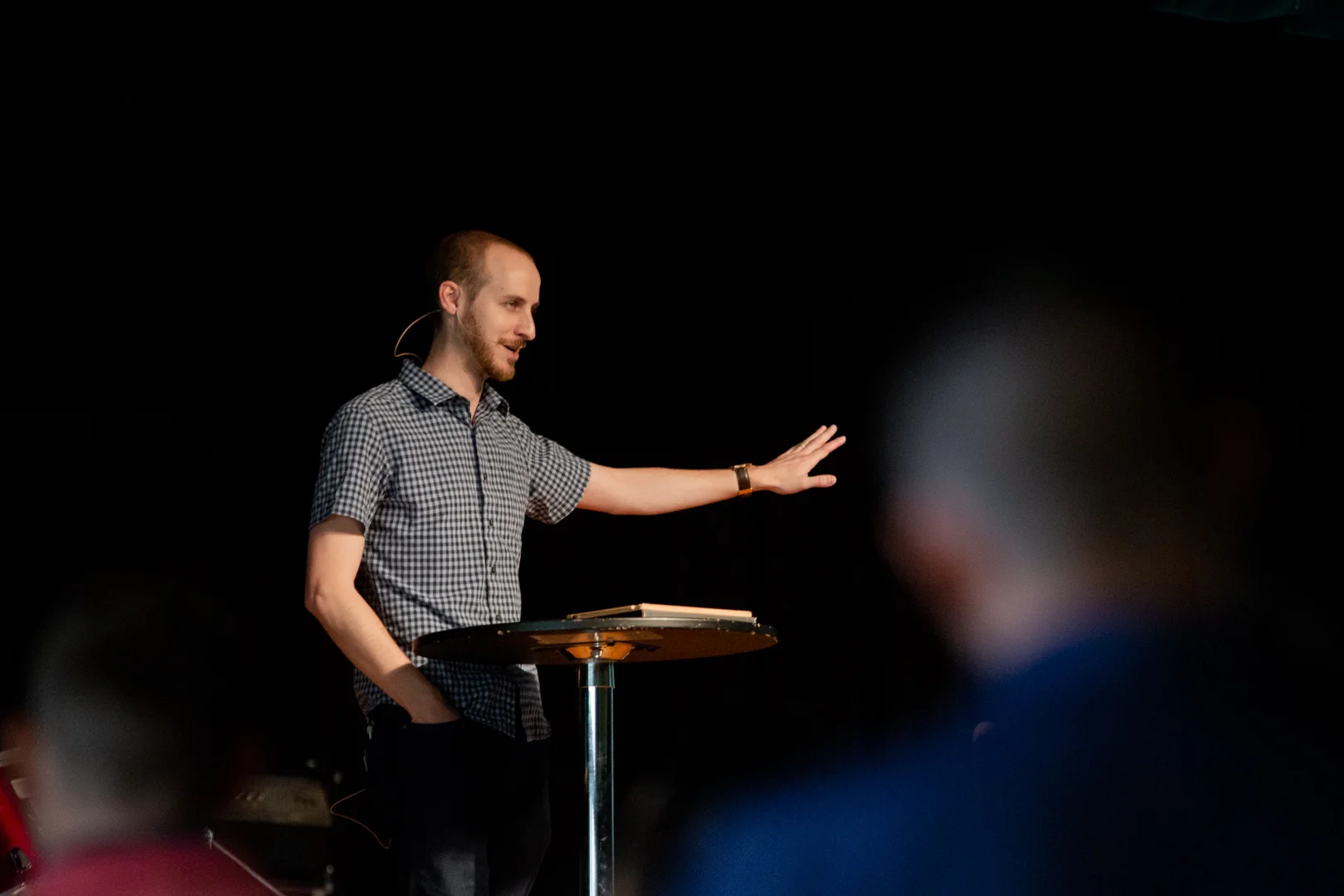

How God Shepherds His Flock
Psalm 23
HOW god shepherds his flock
Psalm 23
I. God’s Flock Has All of God for Every Need
Psalm 23:1: The Lord is my shepherd; I shall not want.
II. God Restores His Anxious and Drained Flock
Psalm 23:2-3a: He makes me lie down in green pastures. He leads me beside still waters. He restores my soul.
III. God Grows His Flock on Unnatural Paths
Psalm 23:3b: He leads me in paths of righteousness for his name's sake.
IV. God Secures His Frightened Flock
Psalm 23:4: Even though I walk through the valley of the shadow of death, I will fear no evil, for you are with me; your rod and your staff, they comfort me.
V. God Comforts His Flock with His Table
Psalm 23:5: You prepare a table before me in the presence of my enemies; you anoint my head with oil; my cup overflows.
VI. God Comforts His Flock with His Table
Psalm 23:6: Surely goodness and mercy shall follow me all the days of my life, and I shall dwell in the house of the Lord forever.
Our Gracious God
Psalm 41
OUr gracious God
Psalm 41
Main Idea: In Jesus, we can look to the Lord’s promises and make them our own.
I. The Position of Promise (v. 1-3)
Psalm 41:1-3: Blessed is the one who considers the poor!
In the day of trouble the Lord delivers him;
the Lord protects him and keeps him alive;
he is called blessed in the land;
you do not give him up to the will of his enemies.
The Lord sustains him on his sickbed;
in his illness you restore him to full health.
The Psalms are not trite, superficial answers to life's deepest problems. The Psalms take us deep down into the pain of this life, and then they take us up again into divine renewal and true hope. We see this when verse 10 begins by saying "But ..." David's pains are not the sum total of his life. The deepest reality of his life is the promises of God.
~Dane Ortlund, In The Lord I Take Refuge
Psalm 41 is the last psalm in book one of the Psalter (Psalms 1-41). While it is similar in content to Psalm 6 and Psalm 38 with cries of deliverance from illness or sickness, its opening line is clearly a call back to the first Psalm. They both open with the phrase “Blessed is…”
Psalm 1:1-2: Blessed is the man
who walks not in the counsel of the wicked,
nor stands in the way of sinners,
nor sits in the seat of scoffers;
but his delight is in the law of the Lord,
and on his law he meditates day and night.
While Psalm 1 pronounces blessing in those who obey God’s law, keeping them from trouble, Psalm 41 pronounces blessing on the weak who are in trouble by assuring them of rescue.
~ John Goldingay, Baker Commentary
We see David's position of declaring the LORD’s promises in his time of need in 5 distinct ways. These are all “theological truths” that David believes about the LORD. He says that the LORD:
Delivers (v. 1)
Protects (v. 2)
Keeps (v. 2)
Sustains (v. 3)
Restores (v. 3)
Hebrew 5:12-14: For though by this time you ought to be teachers, you need someone to teach you again the basic principles of the oracles of God. You need milk, not solid food, for everyone who lives on milk is unskilled in the word of righteousness, since he is a child. But solid food is for the mature, for those who have their powers of discernment trained by constant practice to distinguish good from evil.
1 Thessalonians 4:3: For this is the will of God, your sanctification.
II. A Personal Prayer (v. 4-10)
The power of verse 4 in this psalm cannot be understated. David turns impersonal principles about God, into personal prayer and applies the theological principles to his own life. His prayer echoes Psalm 32 where he turns to the Lord in prayer and acknowledges his sin to the Lord and confesses it. It is this confession of guilt that paradoxically and mysteriously turns him, and us, from betrayer to benefactor.
Your accuser goes on scoring points off you, as long as you insist on making your own excuses. So do you want to ensure that your accuser—the devil, that is—suffers and groans? Do what you have heard, do what you have learned, and say to your God, “I myself have said it, Lord. Have mercy on me, heal my soul, since I have sinned against you.” “I myself,” he says, “I myself have said it; not the devil, not luck, not fate. I myself have said it. I’m not making excuses, on the contrary, I accuse myself. I have said it. Have mercy on me, heal my soul.
~ Augustine
While David is the author of this Psalm, we can read it in light of the hope and truth of the Gospel as Jesus has revealed. Therefore, we have two pictures in mind. The type and their fulfillment (antitype). David was a type of Christ. David’s enemies, in particular Ahithophel (2 Samuel 15:12), were a type of the betrayer who would come (Judas). We can be confident of this because Jesus quotes this verse (41:9) in reference to Judas’ betrayal of him (John 13:18-26; Matthew 26:21-30).
It may seem too rudimentary, too simple, but what better plea can one bring in all our own guilt or in the face of the malice, hatred, and betrayal of others to a God who already has a grace-bent to His nature?
~ Dale Ralph Davis, My Exceeding Joy
III. The Power of Grace (v. 11-13)
Psalm 41:11-13: By this I know that you delight in me:
my enemy will not shout in triumph over me.
But you have upheld me because of my integrity,
and set me in your presence forever.
Blessed be the Lord, the God of Israel,
from everlasting to everlasting!
Amen and Amen.
The 'integrity' bothers some readers. After all, didn't David confess sin in verse 4? But 'integrity' is not sinlessness nor perfection; he only claims that this is the overall bent of his life-that he has not turned away from his devotion to Yahweh. And what has he found? That Yahweh has 'held on to' His servant. How much more secure can one be?
~ Dale Ralph Davis, My Exceeding Joy
John 10: 27-28: My sheep hear my voice, and I know them, and they follow me. I give them eternal life, and they will never perish, and no one will snatch them out of my hand.
The Good News of a Short Life
Psalm 39
The Good News of a Short Life
Psalm 39
Main Idea: Jesus turns our laments over this life’s fragility into hope in our eternal citizenship.
I. Silence to Lament (v. 1-6)
David turns from keeping his tongue silent in the midst of his distress to avoid sin to speaking out with his tongue to the Lord in prayer to avoid despair.
Psalm 37:3-15: Trust in the Lord, and do good; dwell in the land and befriend faithfulness. Delight yourself in the Lord, and he will give you the desires of your heart. Commit your way to the Lord; trust in him, and he will act. He will bring forth your righteousness as the light, and your justice as the noonday. Be still before the Lord and wait patiently for him; fret not yourself over the one who prospers in his way, over the man who carries out evil devices! Refrain from anger, and forsake wrath! Fret not yourself; it tends only to evil. For the evildoers shall be cut off, but those who wait for the Lord shall inherit the land. In just a little while, the wicked will be no more; though you look carefully at his place, he will not be there. But the meek shall inherit the land and delight themselves in abundant peace. The wicked plots against the righteous and gnashes his teeth at him, but the Lord laughs at the wicked, for he sees that his day is coming. The wicked draw the sword and bend their bows to bring down the poor and needy, to slay those whose way is upright; their sword shall enter their own heart, and their bows shall be broken.
I wonder how many believers stop speaking to God about their pain. Disappointed by unanswered prayers or frustrated by out-of-control circumstances, these people wind up in a spiritual desert unable—or refusing—to talk to God. This silence is a soul killer.
- Mark Vroegop
Lament is a prayer in pain that leads to trust.”
- Mark Vroegop.
Psalm 77:2-4: My soul refuses to be comforted. When I remember God, I moan; when I meditate, my spirit faints. You hold my eyelids open; I am so troubled that I cannot speak.
Lament does not give you an excuse to wallow in your questions or frustrations. It is a means to another end. In the same way a surgeon’s cut is meant to heal, so complaint is designed to move us along in our lament. You are not meant to linger in complaint. If you never move beyond complaint, lament loses its purpose and its power. Complaint is central to lament. But Christians never complain just to complain. Instead, we bring our complaints to the Lord for the purpose of moving us toward him. We allow the honest opening of our souls to become a doorway to the other elements of lament.
- Mark Vroegop.
Luke 12:13-21: Someone in the crowd said to him, “Teacher, tell my brother to divide the inheritance with me.” But he said to him, “Man, who made me a judge or arbitrator over you?” And he said to them, “Take care, and be on your guard against all covetousness, for one’s life does not consist in the abundance of his possessions.” And he told them a parable, saying, “The land of a rich man produced plentifully, and he thought to himself, ‘What shall I do, for I have nowhere to store my crops?’ And he said, ‘I will do this: I will tear down my barns and build larger ones, and there I will store all my grain and my goods. And I will say to my soul, “Soul, you have ample goods laid up for many years; relax, eat, drink, be merry.” But God said to him, ‘Fool! This night your soul is required of you, and the things you have prepared, whose will they be?’ So is the one who lays up treasure for himself and is not rich toward God.
II. Lament to Confession (v. 7-11)
David’s lament over the fragility of this life turns into a confession of hope that the Lord is the only one able to deliver and rescue him.
Luke 12:13-21: I have seen a wicked, ruthless man,
spreading himself like a green laurel tree.
But he passed away, and behold, he was no more;
though I sought him, he could not be found.
Mark the blameless and behold the upright,
for there is a future for the man of peace.
But transgressors shall be altogether destroyed;
the future of the wicked shall be cut off.
For the Christian, the exodus event—the place where we find ultimate deliverance—is the cross of Christ. This is where all our questions—our heartaches and pain—should be taken. The cross shows us that God has already proven himself to be for us and not against us.
- Mark Vroegop.
III. Confession to Appeal (v. 12-13)
David’s confession of hope turns into an appeal to his shared identity with the Lord as an exile in this world, longing for something beyond it.
Hebrews 11:13-16: These all died in faith, not having received the things promised, but having seen them and greeted them from afar, and having acknowledged that they were strangers and exiles on the earth. For people who speak thus make it clear that they are seeking a homeland. If they had been thinking of that land from which they had gone out, they would have had opportunity to return. But as it is, they desire a better country, that is, a heavenly one. Therefore God is not ashamed to be called their God, for he has prepared for them a city.
Ephesians 2:19: So then you are no longer strangers and aliens, but you are fellow citizens with the saints and members of the household of God.
The brevity of life and the sadness of death run throughout the Bible and the full revelation of the immortal world does dot remove them. This life is precious. Its joys and loves may be transcended but they cannot be replaced.
- Alec Motyer
There is a Hiding Place
Psalm 32
There is a hiding place
Psalm 32
I. The Blessings of Confessed Sin
II. The Burdens of Concealed Sin
III. The Beauty of Mercy and Grace
What We Love
Psalm 30
What WE love
Psalm 30
Main Idea: What we love drives what we do and affirms what we believe.
I. What Did David Love?
The plain and simple answer is “the LORD” and David tells us why. He describes a double deliverance in the two main stanzas of this psalm.
First, the LORD delivered David from external threats. (v.1-3)
Second, the LORD delivered David from internal despair. (v. 6-10)
C.S. Lewis calls this God’s “intolerable compliment” to those He loves. Having set His love upon us, the LORD will not let us remain who we were when He found us. He will scrub and clean, and break and mend, and squeeze and mold all our life long, relentlessly striving to make us just a little more like Jesus than we ever were and that much more like we shall be when we see him at last.
II. What Did David’s Love Drive Him to Do?
Again, the answer is simple and straight-forward. It drove him to build the Temple. We get a sense of what the Temple meant to him by looking at how he talks about it in his own words.
Psalm 27, the one thing David asks of the Lord and seeks after is to “dwell in the house of the LORD all the days of my life, to gaze upon the beauty of the LORD and to inquire in his temple.”
Psalm 122 indicates that visiting the Temple was David’s “happy place.” “I was glad when they said to him, “Let us go to the house of the LORD!”
According to Psalm 11, “The LORD is in His holy Temple.” It is from there that He sends help (Ps 20:4). It is there that He hears the cries of those who cry to Him. (Ps. 18:6) Those who will worship the LORD do so by “bowing down toward His holy Temple” (Ps. 5:7) and in His Temple, everyone cries, “Glory!” (Ps 29:9) In a life that David describes as being shepherded by goodness and mercy, his highest hope is to “dwell in the house of the LORD forever.” (Ps 23:6)
David’s passion for the Temple is not just exaggerated “religious language” poetically expressed. David literally put his money where his mouth was!
Along with cutting all of the stones that would be needed for the Temple, “David also provided great quantities of iron for nails for the doors of the gates and for clamps, as well as bronze in quantities beyond weighing, and cedar timbers without number... (1 Chron 22:3-5) A little later in that same chapter he says to Solomon: “With great pains I have provided for the house of the LORD 100,000 talents of gold, a million talents of silver, and bronze and iron beyond weighing, for there is so much of it; timber and stone, too, I have provided. To these you must add.” (1 Chron 22:14)
The rest of the chapters talk about how David organized the Levites for the maintenance of the Temple, how he organized the priests for the work of the Temple, how he arranged musicians to rotate through on monthly rhythms to fill the Temple with praise and music, how he structured the administrative infrastructure for guarding and supplying the Temple, and how he drew up the architectural renderings for the Temple.
III. What Did David Believe That Affirmed Such Love?
That there is something more than the current moment that matters most of all. That there is something beyond the Temple that is even better yet.
Psalm 2:10-12: Now therefore, O kings, be wise;
be warned, O rulers of the earth.
Serve the Lord with fear,
and rejoice with trembling.
Kiss the Son,
lest he be angry, and you perish in the way,
for his wrath is quickly kindled.
Blessed are all who take refuge in him.
Help in Time of Need
Psalm 27
HElp in time of need
Psalm 27
Main Idea: Everyone who trusts in the Lord will not be put to shame.
I. He’s Done it (27:1-6)
Let us learn, therefore, to put such a value on God’s power to protect us as to put to flight all our fears. Not that the minds of the faithful can, by reason of the infirmity of the flesh, be at all times entirely devoid of fear, but immediately recovering courage, let us, from the high tower of our confidence, look down on all our dangers with contempt. Those who have never tasted the grace of God tremble because they refuse to rely on him and imagine that he is often incensed against them, or at least far removed from them. But with the promises of God before our eyes and the grace which they offer, our unbelief does him grievous wrong, if we do not with unshrinking courage boldly set him against all our enemies. When God, therefore, kindly invites us to himself and assures us that he will take care of our safety, because we have embraced his promises or because we believe him to be faithful, it is fitting that we highly extol his power, so that it may ravish our hearts with admiration of him.
~ John Calvin, Commentary on the Psalms
II. He’s Doing It (27:7-12)
A. For He will hide me in his shelter in the day of trouble
a. He will conceal me under the cover of his tent
i. He will lift me high upon a rock
ii. And now my head shall be lifted up above my enemies
b. I will offer in his tent sacrifices with shouts of joy
B. I will sing and make melody to the Lord
III. He Will Do It Again (27:13-14)
Colossians 1:15-22
1. He is the image of the invisible God
2. He is the firstborn of all creation.
3. He has made all things in heaven and on earth
4. He has made everything that is visible and invisible
5. All things were created through him and for him
6. He is before all things
7. He holds everything together
8. He is the head of the church.
9. He is the firstborn from the dead
10. He is the preeminent one above all things
11. All the fullness of God was pleased to dwell
12. He is the reconciler of all things
13. He has made peace by the blood of his cross
14. He has reconciled his enemies by his death
15. He will present his people Holy and blameless before Himself
The King of Glory
Psalm 24
The King of Glory
Psalm 24
Main Idea: Jesus is the King of Glory who invites us to glorify and enjoy him forever.
I. The King of Creation (24:1-2)
Psalm 24:1-2: The earth is the Lord’s and the fullness thereof,
the world and those who dwell therein,
for he has founded it upon the seas
and established it upon the rivers
“There is not a square inch in the whole domain of our human existence over which Christ, who is Sovereign over all, does not cry, Mine!”
~ Abraham Kyper
John 1:1-3: In the beginning was the Word, and the Word was with God, and the Word was God. He was in the beginning with God. All things were made through him, and without him was not anything made that was made.
Colossians 1:15-16: He is the image of the invisible God, the firstborn of all creation. For by him all things were created, in heaven and on earth, visible and invisible, whether thrones or dominions or rulers or authorities —all things were created through him and for him.
II. The King of the Hill (24:3-4)
Psalm 24:1-2: The earth is the Lord’s and the fullness thereof,
the world and those who dwell therein,
for he has founded it upon the seas
and established it upon the rivers.
What are the requirements to ascend ascend the hill of the Lord?
Clean Hands: He must be free from sinful actions and clean in what he does, “literally, innocent, free from guilt.” (Ps 15)
Pure Heart: He must be blameless, free from impure motives, thoughts, and emotions. (Mk 7:14-23)
No False Worship: He must not lift up his soul in false worship. (Ex 20:1-7, Ps 25:1)
No Deceitfully Swearing: No deception or false motives fill his heart, his soul. He knows nothing of dishonesty or deceit. (Ex 20:16, Eph 4:25)
Romans 3:23: For all have sinned and fall short of the glory of God.
III. The King of Glory (24:7-10)
Psalm 24:7-10: Lift up your heads, O gates!
And be lifted up, O ancient doors,
that the King of glory may come in.
Who is this King of glory?
The LORD, strong and mighty,
the LORD, mighty in battle!
Lift up your heads, O gates!
And lift them up, O ancient doors,
that the King of glory may come in.
Who is this King of glory?
The LORD of hosts,
he is the King of glory!
Psalm 24:5-6: He will receive blessing from the LORD
and righteousness from the God of his salvation.
Such is the generation of those who seek him,
who seek the face of the God of Jacob.
Psalm 121:1: I lift up my eyes to the hills.
From where does my help come?
My help comes from the LORD,
who made heaven and earth.
The Doe of the Dawn
Psalm 22
The Doe of the Dawn
Psalm 22
Main Idea: The Lord blesses His people though their king suffers.
I. The Problem of Unwarranted Suffering (22:1-21a)
David writes Psalm 22 from the vantage point of an unwarranted sufferer. He is the anointed king of Israel enduring gross injustices at the hands and with the approval of the anointed king of Israel. It is a level of injustice that rightly confuses and outrages us at the same time.
He seems to draw his inspiration for this psalm from a shepherding experience. The imagery he uses to visualize the way unwarranted suffering tormented him parallels the plight of a prey animal under attack.
Our problem with unwarranted suffering manifests in at least two domains. It affects us philosophically and psychologically:
Philosophically, it drives us to ask why is this happening at all? Something in our makeup screams that this is not how the world should work.
Psychologically, it drives us to ask why is this happening to me? When predators are nipping at our heels, it's hard to think of anything else but what is this happening to me!?!
II. The Paradox of Unmerited Blessing (22:21b-31)
The scenario David has just played out may be everyday life on the African savannah with gazelles and lions or in Palestinian pastures among sheep and wolves, but for humans, it is just not supposed to be that way. When this kind of unwarranted suffering comes on and without intervention, we simply don’t have categories for it. It demands an explanation!
It is worth noting that David gives absolutely no detail on how he was delivered. Much less why this whole ordeal happened at all.
Explanations don’t provide what we need most. Outcomes trump explanations when it comes to unwarranted suffering.
The only consolation in the context of unwarranted suffering is the reality of unmerited blessing because “Kingship belongs to the LORD, and He rules over the nations.” (Ps. 22:28)
III. A Prophecy of Ultimate Redemption (Matthew 27:45-50)
Matt. 27:45-50: Now from the sixth hour[f] there was darkness over all the land until the ninth hour. And about the ninth hour Jesus cried out with a loud voice, saying, “Eli, Eli, lema sabachthani?” that is, “My God, my God, why have you forsaken me?” And some of the bystanders, hearing it, said, “This man is calling Elijah.” And one of them at once ran and took a sponge, filled it with sour wine, and put it on a reed and gave it to him to drink. But the others said, “Wait, let us see whether Elijah will come to save him.” And Jesus cried out again with a loud voice and yielded up his spirit.
Matt. 27:35 - when they had crucified him - thus piercing Jesus’ hand and feet. (Ps.22:16)
Matt. 27:35 - they divided his garments among them by casting lots!! (Ps. 22:18)
Matt. 27:39 - those who passed by derided him, wagging their heads, as did the villains He was crucified with (26:44) (Ps. 22:7, 13, 17)
Matt. 27:41-43 - the chief priests, scribes and elders mocked him saying, “He trusts in God; let God deliver him now, if he desires him.” (Ps. 22:8)
John 19:38 - Jesus thirsted, his tongue stuck to his jaw (Ps. 22:18)
Matt. 27:50 - After three hours hanging on the cross watching His life drip slowly away, Jesus “cried out again with a loud voice and yielded up His spirit.” (Ps. 22:14-15)
The main point of Psalm 22 before Jesus: The LORD blesses His people though their king suffers.
The main point of Psalm 22 after Jesus: The LORD blesses His people through their King’s suffering.
The God Who Speaks
Psalm 19
*Unfortunately, we were unable to record the sermon from this past Sunday. We sincerely apologize for any inconvenience.
THe god who speaks
Psalm 19
I. A Good Word (19:1-6)
Psalm 19:1-6: The heavens declare the glory of God,
and the sky above proclaims his handiwork.
Day to day pours out speech,
and night to night reveals knowledge.
There is no speech, nor are there words,
whose voice is not heard.
Their voice goes out through all the earth,
and their words to the end of the world.
In them he has set a tent for the sun,
which comes out like a bridegroom leaving his chamber,
and, like a strong man, runs its course with joy.
Its rising is from the end of the heavens,
and its circuit to the end of them,
and there is nothing hidden from its heat
The Universe is before our eyes like a beautiful book which all creatures, great and small are as letters to make us ponder the invisible things of God: his eternal power and his divinity.
-Belgic Confession (16th Century)
II. A Clear Word (19:7-11)
Psalm 19:7-11: The law of the Lord is perfect,[c]
reviving the soul;
the testimony of the Lord is sure,
making wise the simple;
the precepts of the Lord are right,
rejoicing the heart;
the commandment of the Lord is pure,
enlightening the eyes;
the fear of the Lord is clean,
enduring forever;
the rules[d] of the Lord are true,
and righteous altogether.
More to be desired are they than gold,
even much fine gold;
sweeter also than honey
and drippings of the honeycomb.
Moreover, by them is your servant warned;
in keeping them there is great reward.
III. A Final Word (19:12-14)
Psalm 19:12-14: Who can discern his errors?
Declare me innocent from hidden faults.
Keep back your servant also from presumptuous sins;
let them not have dominion over me!
Then I shall be blameless,
and innocent of great transgression.
Let the words of my mouth and the meditation of my heart
be acceptable in your sight,
O Lord, my rock and my redeemer.
Hebrews 4:12-13: For the word of God is living and active, sharper than any two-edged sword, piercing to the division of soul and of spirit, of joints and of marrow, and discerning the thoughts and intentions of the heart. And no creature is hidden from his sight, but all are naked and exposed to the eyes of him to whom we must give account.
Love of a Lifetime
Psalm 16
Love of a lifetime
Psalm 16
Main Idea: God offers fullness of Joy now and for eternity through the life and love of Jesus.
I. Help! (16:1-2)
In our need we seek to run somewhere, David is stating the truth that he needs the LORD in his time of need.
II. With a Little Help From My Friends (16:3-4)
God sets His people in community so they can spur one another toward Him and His ways. At a soul level, we want to belong somewhere and God hardwired us for community.
This is the battle of our Christian Life. Am I personally, daily seeking the Lord in my life or am I compromising to get what I think I need from a world that is woefully unequipped to carry me in times of trouble and need?
III. Fortunate Son (16:5-6)
IV. How Could I Ask For More (16:7-8)
The Lord speaks to David’s deepest parts. Deep down, the word is literally “kidneys” but that is not very poetic, David knows the goodness of God and hears Him. In his gut the Lord speaks to Him. Deep down we know too. The ways of the Lord aren’t a mystery but we long to satisfy ourselves externally instead of in the deepest parts of our soul.
God is stating the path to life runs through Him and the result is fullness of joy and pleasures forevermore.
It would seem that Our Lord finds our desires not too strong, but too weak. We are half-hearted creatures, fooling about with drink and sex and ambition when infinite joy is offered us, like an ignorant child who wants to go on making mud pies in a slum because he cannot imagine what is meant by the offer of a holiday at the sea. We are far too easily pleased.
- C.S. Lewis
V. The Greatest Love Of All (16:9-10)
Acts 2:29: Brothers, I may say to you with confidence about the patriarch David that he both died and was buried, and his tomb is with us to this day. 30 Being therefore a prophet, and knowing that God had sworn with an oath to him that he would set one of his descendants on his throne, 31 he foresaw and spoke about the resurrection of the Christ, that he was not abandoned to Hades, nor did his flesh see corruption. 32 This Jesus God raised up, and of that we all are witnesses.
The Lord God, creator of the universe, gives you this counsel: Follow the path of life through Jesus Christ, the founder and perfecter of our faith, who for the joy that was set before him endured the cross, despising the shame, and is seated at the right hand of the throne of God. Where is found fullness of joy and pleasures forevermore.