
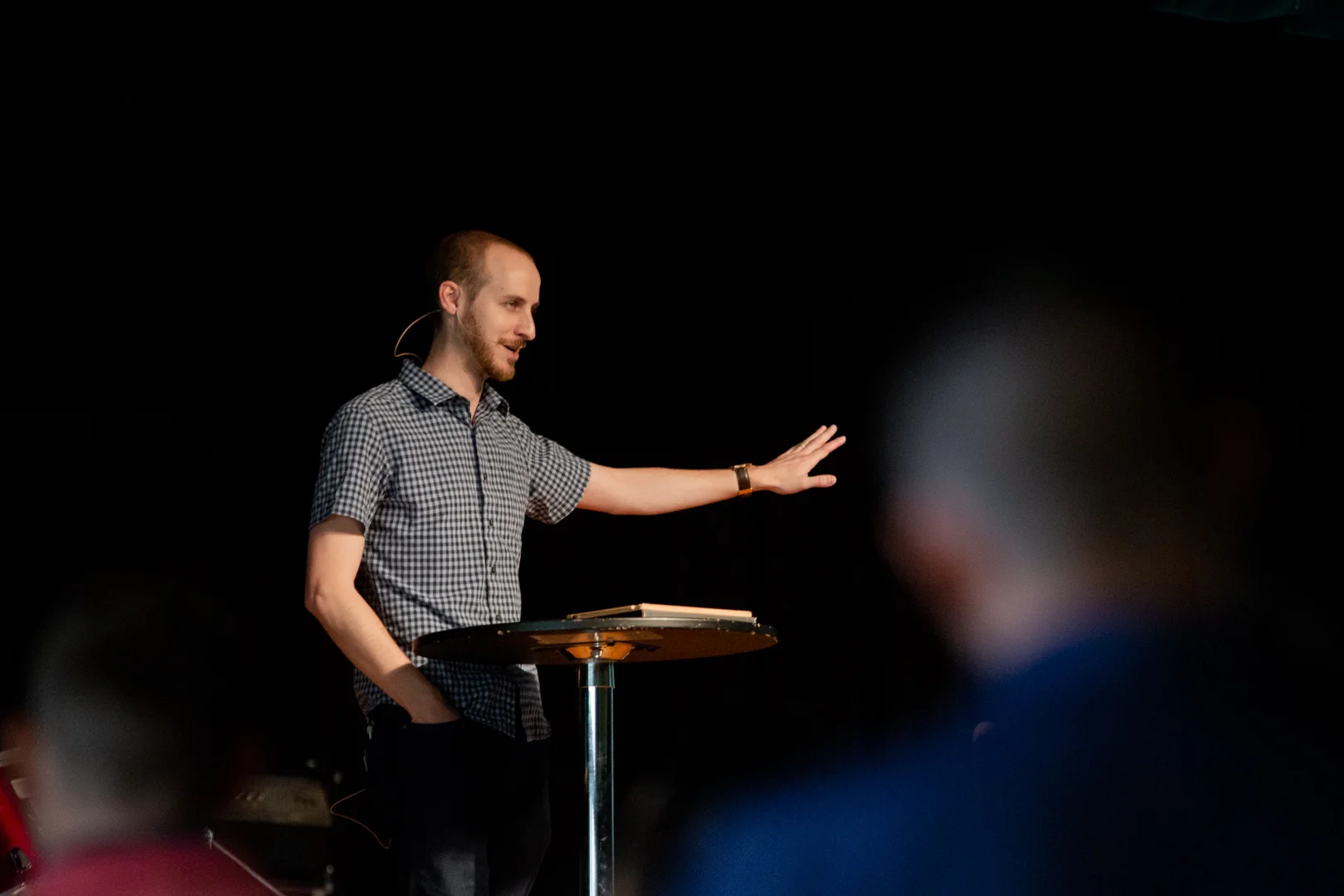

He Must Increase
John 3:22-36
He must increASE
John 3:22-36
Main Idea: Rejoice in Christ, recognize His reign, and rest in His reward.
I. Rejoice in His Rise (3:22–30)
John 3:22-23: After this Jesus and his disciples went into the Judean countryside, and he remained there with them and was baptizing. John also was baptizing at Aenon near Salim, because water was plentiful there, and people were coming and being baptized (for John had not yet been put in prison).
John 3:25-26: Now a discussion arose between some of John’s disciples and a Jew over purification. And they came to John and said to him, “Rabbi, he who was with you across the Jordan, to whom you bore witness—look, he is baptizing, and all are going to him.”
John 3:27-28: “A person cannot receive even one thing unless it is given him from heaven. You yourselves bear me witness, that I said, ‘I am not the Christ, but I have been sent before him.
John 3:29: The one who has the bride is the bridegroom. The friend of the bridegroom, who stands and hears him, rejoices greatly at the bridegroom’s voice. Therefore this joy of mine is now complete.
“The bridegroom’s friend, is jealous for the bridegroom. And he does not put himself forward as an adulterer in the bridegroom’s place but bears witness to his friend and commends the one who really was the bridegroom to the bride. He wants to be loved in him and hates the idea of being loved instead of him.”
~ Augustine
John 3:30: He must increase, but I must decrease.
II. Recognize His Reign (3:31–34)
John 3:31-34: He who comes from above is above all. He who is of the earth belongs to the earth and speaks in an earthly way. He who comes from heaven is above all. He bears witness to what he has seen and heard, yet no one receives his testimony. Whoever receives his testimony sets his seal to this, that God is true. For he whom God has sent utters the words of God, for he gives the Spirit without measure.
A. Recognize His Authority Over Your Mind
To recognize His reign is to surrender your reasoning to His Word.
B. Recognize His Authority Over Your Time
Because Jesus reigns, then He rules over your calendar, your work, your rest, and even your hidden life.
C. Recognize His Authority Over Your Confidence
When you recognize the supremacy of Christ you no longer brace yourself against His authority—you draw confidence from it. You do not resent His commands—you trust them. You do not fear His providence—you rest in it.
III. Rest in His Reward (vv. 35–36)
John 3:35-36: The Father loves the Son and has given all things into his hand. Whoever believes in the Son has eternal life; whoever does not obey the Son shall not see life, but the wrath of God remains on him.
A. Rest Means You Stop Trying to Save Yourself
Rest begins when self-salvation ends.
B. Rest Means You Take Judgment Seriously
If you are in Him, wrath does not remain on you. It fell on Christ. That is why you can rest.
C. Rest Means Daily Reliance
Belief is not a one-time glance. It is ongoing trust.
He Must Increase
John 3:22-36
He must increASE
John 3:22-36
Main Idea: He must increase, therefore we are wisest to always pursue a greater worship of Jesus.
I. The Heated Debate (3:22-26)
Any heated debate has at least three common elements. There is a situation, a flash point, and an escalation that turns up the heat.
The Situation - Jesus and his disciples baptizing near John and his disciples.
The Flash Point - A discussion arose over purification.
The Escalation - “He is baptizing, and all are going to him.”
II. A Humble Response (3:27-30)
Instead of being drawn into the controversy and escalating the debate, John steps out of the controversy and addresses the situation from a different - and proper - vantage point. John’s response de-escalates the debate by appealing to a universal constant, correcting the historical record, and stating the inescapable conclusion.
A. The Universal Constant
John 3:27: A person cannot receive even one thing unless it is given to him from heaven.”
John’s view of reality saw heaven intimately and intricately involved with and orchestrating affairs on earth. From this perspective, everything on earth is a gift from heaven. John was unfazed by the situation that led his disciples and this Jew into heated debate because he knew that heaven rules and earth follows.
B. The Record Correction
John 3:28: You yourselves bear me witness, that I said, ‘I am not the Christ, but I have been sent before him.’
John locks in on the the only two identity markers about himself that mattered to him:
I am not the Christ
I have been sent before the Christ
John affirms that his sense of identity is wrapped up in what God and the Scriptures say about him.
C. The Inescapable Conclusion
John 3:29-30: The one who has the bride is the bridegroom. The friend of the bridegroom, who stands and hears him, rejoices greatly at the bridegroom’s voice. Therefore this joy of mine is now complete. He [the bridegroom] must increase, but I must decrease.
John makes Jesus the center of attention, not himself or anyone else. Now that "that One” has arrived on the scene, John enjoys two blessings.
“This joy of mine is complete.”
My mission is fulfilled. “He must increase, but I must decrease.”
III. A Homiletical Summary (2:31-36)
Whether this section is a continuation of John the Witness or a chapter summary from John the Apostle, it stands as a three-point sermonic conclusion to the whole chapter:
He who comes from above is above all - v. 31. Listen to Him and do not be surprised that He sounds confusing to you.
He bears witness to what he has seen and heard. - vv. 32-35. His testimony is true. Those who reject it do not make Him false. Those who receive Him prove that what He testifies to is true.
Whoever believes in the Son has eternal life. - v. 36. To hear Him and repent is life. To ignore Him and rebel is to miss life and invite wrath.
So Loved
John 3:16-21
So Loved
John 3:16-21
Main Idea: Jesus was lifted up to love us into life and light.
I. Jesus Loves Us To Life (3:16-18)
John 3:16–18: For God so loved the world, that he gave his only Son, that whoever believes in him should not perish but have eternal life. For God did not send his Son into the world to condemn the world, but in order that the world might be saved through him. Whoever believes in him is not condemned, but whoever does not believe is condemned already, because he has not believed in the name of the only Son of God.
Romans 5:8: ... but God shows his love for us in that while we were still sinners, Christ died for us.
John 15:13: Greater love has no one than this, that someone lay down his life for his friends.
“Let not conscience make you linger, nor of fitness fondly dream; all the fitness he requireth is to feel your need of him”
~ “Come Ye Sinners”
II. Jesus Loves Us To Light (3:19-21)
John 3:19–21: And this is the judgment: the light has come into the world, and people loved the darkness rather than the light because their works were evil. For everyone who does wicked things hates the light and does not come to the light, lest his works should be exposed. But whoever does what is true comes to the light, so that it may be clearly seen that his works have been carried out in God.
Isaiah 25:9: It will be said on that day,
“Behold, this is our God; we have waited for him, that he might save us.
This is the Lord; we have waited for him;
let us be glad and rejoice in his salvation.”
Isaiah 35:10: And the ransomed of the Lord shall return
and come to Zion with singing;
everlasting joy shall be upon their heads;
they shall obtain gladness and joy,
and sorrow and sighing shall flee away.
“The reason the darkness may be faced and lived is that even in the darkness, there is one to address. The one to address is in the darkness, but not simply a part of the darkness. Because this one has promised to be in the darkness with us, we find the darkness strangely transformed, not by the power of easy light, but by the power of relentless solidarity.”
~ Walter Brueggemann
Born Again
John 3:1-15
Born Again
John 3:1-15
Main Idea: We all must be born again and made new through the finished work of Christ.
This passage answers three questions about the new birth: Who needs it? What is it? How do we receive it?
I. Who Needs It? (3:1-3)
We learn that Nicodemus is…
A Pharisee
A “ruler” of the Jews (a member of the Sanhedrin)
The “teacher of Israel” (3:9)
Wealthy (cf. 19:39)
Nicodemus would have been a highly respected member of the Jewish community and a religious and moral exemplar in his time. Though he recognizes something unique and divine in Jesus, he approaches him “by night,” a seeming illustration of the warning given in 2:23-25.
John 2:23-3:1: Now when he was in Jerusalem at the Passover Feast, many believed in his name when they saw the signs that he was doing. But Jesus on his part did not entrust himself to them, because he knew all people, and needed no one to bear witness about man, for he himself knew what was in man… Now there was a man of the Pharisees named Nicodemus…
Though Nicodemus was a prominent man of great respect, success, and stature, Jesus is clear: “unless one is born again, he cannot see the Kingdom of God” (3:3). If Nicodemus needed to be born again, then truly everyone “must be born again” (3:7).
Philippians 3:3–7: For we are the circumcision, who worship by the Spirit of God and glory in Christ Jesus and put no confidence in the flesh— though I myself have reason for confidence in the flesh… circumcised on the eighth day, of the people of Israel, of the tribe of Benjamin, a Hebrew of Hebrews; as to the law, a Pharisee; as to zeal, a persecutor of the church; as to righteousness under the law, blameless. But whatever gain I had, I counted as loss for the sake of Christ…
II. What Is It? (3:3-8)
The new birth is:
Spiritual not physical (3:3-4): “Born again” can also mean “born from above;” this is the theological concept of “regeneration.”
“Of water and the Spirit” (3:5; cf. Ezek. 36:25-27; Isa. 44:3; Titus 3:4-6); the ‘water’ is symbolic for cleansing and purification, something pictured in baptism.
Bringing new spiritual life out of spiritual deadness (3:6; cf. Ezek 37; 2 Cor. 5:17)
Unseen, but evidenced (3:7-8)
Acts 4:13: “Now when they saw the boldness of Peter and John, and perceived that they were uneducated, common men, they were astonished. And they recognized that they had been with Jesus.”
III. How Do We Receive It? (3:9-15)
Jesus is surprised that Nicodemus, “the teacher of Israel,” does not understand the promise of new birth found throughout the Scriptures, a clear indication of his need to be “born again.” If Nicodemus is stumbling over the entry to the Kingdom of God, then Jesus is unable to move to the more glorious details of life in this kingdom (“heavenly things” | 1:12).
His problem is not only a lack of understanding but also an issue of authority; Nicodemus is unable and unwilling (at this point) to receive Jesus’ testimony” (1:11). Jesus has authority to bear witness to this birth “from above,” because he is the one who has descended from heaven as the “Son of Man” (cf. Prov. 30:4; Dan. 7:13).
To further illustrate his point to Nicodemus, Jesus reminds him of another famous OT passage from Numbers 21. The Lord provides a source of healing from the curse of the serpent’s poison by looking at the bronze serpent that is “lifted up” on the pole.
The challenge of being “born again” is that it is a passive reality. Jesus does not command us to “go and be born,” because this is not how “birth” works. There are two “musts” in this passage:
“You must be born again” (3:7)
“The Son of Man must be lifted up” (3:14)
“You don’t go and get born. Birth happens to you, but the baby doesn’t do a thing. It’s all the mother. The baby is brought into this world through the mother’s labor. The baby is brought into the world through the mother’s pain. The baby is born through the mother bearing the weight through all those months. Somebody else suffers. Somebody else is burdened. Somebody else is in labor. Somebody else is in anguish. Somebody else is bleeding.” ~ Tim Keller, “The New Birth”
John 1:11-13: He came to his own, and his own people did not receive him. But to all who did receive him, who believed in his name, he gave the right to become children of God, who were born, not of blood nor of the will of the flesh nor of the will of man, but of God.
Good and Angry
John 2:12-25
Good and Angry
John 2:12-25
Main Idea: If Jesus is Lord, we must love what He loves, hate what He hates, and trust in His way.
I. The Symbol (2:12-17)
John 2:12-17: After this he went down to Capernaum, with his mother and his brothers and his disciples, and they stayed there for a few days. The Passover of the Jews was at hand, and Jesus went up to Jerusalem. In the temple he found those who were selling oxen and sheep and pigeons, and the money-changers sitting there. And making a whip of cords, he drove them all out of the temple, with the sheep and oxen. And he poured out the coins of the money-changers and overturned their tables. And he told those who sold the pigeons, “Take these things away; do not make my Father’s house a house of trade.” His disciples remembered that it was written, “Zeal for your house will consume me.”
“The temple courts were to be a place where the Scriptures were read, where sacrifices were offered, and where people came to pray… The one thing that would have been impossible at the temple was the one thing it had been made for: the reverent worship of God.”
~ Richard Phillips, John (Reformed Expository Commentary)
II. The Substance (2:18-22)
John 2:18-22: So the Jews said to him, “What sign do you show us for doing these things?” Jesus answered them, “Destroy this temple, and in three days I will raise it up.” The Jews then said, “It has taken forty-six years to build this temple, and will you raise it up in three days?” But he was speaking about the temple of his body. When therefore he was raised from the dead, his disciples remembered that he had said this, and they believed the Scripture and the word that Jesus had spoken.
1 Corinthians 3:16: Do you not know that you are God’s temple and that God’s Spirit dwells in you?
2 Corinthians 6:16: What agreement has the temple of God with idols? For we are the temple of the living God.
“God kept his promises through the death and resurrection of Jesus, who is the new and better Passover Lamb accomplishing a new and better exodus, after a more devastating destruction of the temple and a more impressive rebuilding of it on the third day, in his resurrection.”
~Jim Hamilton, ESV Expository Commentary
III. The Savior (2:23-25)
John 2:23-25: Now when he was in Jerusalem at the Passover Feast, many believed in his name when they saw the signs that he was doing. But Jesus on his part did not entrust himself to them, because he knew all people and needed no one to bear witness about man, for he himself knew what was in man.
John 6:64-66: But there are some of you who do not believe.” (For Jesus knew from the beginning who those were who did not believe, and who it was who would betray him.) And he said, “This is why I told you that no one can come to me unless it is granted him by the Father.”
Luke 14:26: If anyone comes to me and does not hate his own father and mother and wife and children and brothers and sisters, yes, and even his own life, he cannot be my disciple.
"My faith rests not in what I am, or shall be, or feel, or know, but in what Christ is, in what he has done, and in what he is doing for me."
~ Charles Spurgeon, Morning by Morning
Jeremiah 20:9: If I say, 'I will not mention him, or speak any more in his name,' there is in my heart as it were a burning fire shut up in my bones, and I am weary with holding it in, and I cannot.
1 Corinthians 9:16: Woe to me if I do not preach the gospel!
“Unless I am convinced by the testimony of the Scriptures or by clear reason, my conscience is captive to the Word of God. I cannot and will not recant anything, for to go against conscience is neither right nor safe. Here I stand; I can do no other. God help me. Amen”
~ Martin Luther, The Diet of Worms (1521)
Pure Worship, True Temple, Genuine Faith
John 2:12-25
Pure Worship, True Temple, Genuine Faith
John 2:13-25
Main Idea: The crucified and resurrected Jesus calls us to pure worship and genuine faith.
I. Pure Worship (2:13-17)
1. Jesus is passionate about our pure worship.
“The temple courts were to be a place where the Scriptures were read, where sacrifices were offered, and where people came to pray… The one thing that would have been impossible at the temple was the one thing it had been made for: the reverent worship of God.”
~ Richard Phillips, John (Reformed Expository Commentary)
2. Jesus’ righteous anger against what God hates
“Jesus shows us that godly people are passionate people – passionate for the things of God, passionate in their love of good and in their hatred of evil. Jesus hated what he found at the temple and, employing all his great moral energy, cleansed it of impurity.”
~ Richard Phillips, John (Reformed Expository Commentary)
3. Jesus does what was expected of the Messiah.
II. True Temple (2:18-22)
Malachi 3:1, 3: And the Lord whom you seek will suddenly come to his temple; and the messenger of the covenant in whom you delight, behold, he is coming, says the LORD of hosts… He will sit as a refiner and purifier of silver, and he will purify the sons of Levi and refine them like gold and silver, and they will bring offerings in righteousness to the LORD.
Two things that are significant about Jesus referring to his body as a temple:
Jesus has come to be the new temple
Jesus has come to be the ultimate sacrifice
III. Genuine Faith (2:23-25)
These two expressions tell us something about this “faith” is not right:
1. “When they saw the signs…”
John 6:2: And a large crowd was following him, because they saw the signs that he was doing on the sick
John 6:14- 15: Therefore when the people saw the sign which He had performed, they said, ‘This is indeed the Prophet who is to come into the world!’ Jesus perceived that the people were going to take Him by force to make Him king of Israel, so He withdrew to the mountain by Himself.
John 6:26: Truly, truly, I say to you, you are seeking me, not because you saw signs, but because you ate your fill of the loaves.
2. Jesus knows what is in us.
“Jesus knows what is in every heart, and so he can see when someone believes in a way that is not really believing. In other words, Jesus’ ability to know every heart perfectly leads to the unsettling truth that some belief is not the kind of belief that obtains fellowship with Jesus and eternal life. Some belief is not saving belief.”
~ John Piper
Water to Wine
John 2:1-11
Water to Wine
John 2:1-11
Main Idea: As our true bridegroom, Jesus replaces our emptiness with abundant life and fullness of joy.
I. The Wedding (2:1-5)
Jesus, his disciples, and his mother attend a wedding in Cana on the “third day” (the seventh day in John 1-2). Weddings in this time period lasted as long as a week, involved the whole community, and required great preparation and hospitality. “When the wine ran out,” this was a potential source of great shame and embarrassment to the groom and his family.
As Mary informs Jesus about the situation, his response is very abrupt: “Woman, what does this have to do with me?” This response is not disrespectful (cf. 19:26), but it is a redefinition of their relationship and expectations.
“Now that Jesus had entered into the purpose of his coming, everything, even family ties, had to be subordinated to his divine mission… It is a remarkable fact that everywhere Mary appears during the course of Jesus’ ministry, Jesus is at pains to establish distance between them. This is not callousness on Jesus’ part: on the cross he makes provision for her future (19:25–27). But she, like every other person, must come to him as to the promised Messiah, the Lamb of God who takes away the sin of the world. Neither she nor anyone else dare presume to approach him on an ‘inside track.’”
~ D.A Carson, The Gospel According to John
II. The Wine (2:6-10)
In the Scriptures, wine is a symbol of joy, abundance, and blessing (Ps. 104:15). Wine was often invoked by the prophets to describe the blessing of the coming messianic age (Amos 9:13-14; Joel 3:18; Isa. 25:6).
Though Jesus’ “hour has not come,” (cf. 7:30; 8:20; 12:23-24, 27; 13:1; 17:1) this miracle is an acted out parable pointing to the greater realities of who he is and what he came to do:
1. Jesus has come to bring a better purification for sins
“The old covenant was a marriage between Yahweh and Israel, and at the wedding on the third day, the wine ran out. John notes these details to signify that the old covenant has been exhausted. Water jars used for the keeping for the regulations of the old covenant are filled, pointing to the fulfillment of the allotted time and intended purpose of the old covenant and its purification rites. Out of the old is drawn something new and better: the best wine… John has carefully selected and framed his presentation to bring out the ways in which Jesus is effecting the shift of the ages, the movement from old covenant to new, from water to wine.”
~ Jim Hamilton, John (ESV Expository Commentary)
1 John 1:7: But if we walk in the light, as he is in the light, we have fellowship with one another, and the blood of Jesus his Son cleanses us from all sin.
Revelation 7:14b: They have washed their robes and made them white in the blood of the Lamb.
2. Jesus has come to bring abundant life and fullness of joy: Jesus here produces between 120-180 gallons of the best wine (cf. 10:10; Matt. 16:24-25).
3. Jesus has come to save us from shame: Jesus saves this groom and his family from the shame of running out of wine, and he allows the groom to be credited with saving the festivities.
“It is a blessed need that makes room for Jesus to come in with miracles of love. It is good to run short that we may be driven to the Lord by our necessity, for he will more than supply it. If we have no need, Christ will not come to us. But if we are in dire necessity, his hands will stretch out to us. If our needs stand before us like huge empty water pots, or if our souls are as full of grief as those same pots were filled with water up to the brim, Jesus can, by his sweet will, turn all the water into wine—the sighing into singing. We should be glad to be weak so the power of God may rest on us.”
~ Charles Spurgeon, “The Beginning of Miracles Which Jesus Did”
III. The Wonder (2:11)
John tells us that this was the first of Jesus' “signs” that “manifested his glory” (cf. 1:14). In the gospel of John, all of Jesus’ “signs” point beyond themselves to greater realities, with the same invitation: “that you may believe that Jesus Christ is the Son of God, and that by believing you may have life in his name” (21:31).
In this “sign,” Jesus takes on the role of the true and ultimate bridegroom, who provides all that is needed for the wedding festivities to continue (cf. Matt. 9:14-17). Jesus looks beyond this wedding to the day of his own wedding to his bride, the church, “which he obtained with his own blood” (Acts 20:28).
Revelation 19:6–9a, 21:2: Then I heard what seemed to be the voice of a great multitude, like the roar of many waters and like the sound of mighty peals of thunder, crying out,
“Hallelujah!
For the Lord our God
the Almighty reigns.
Let us rejoice and exult
and give him the glory,
for the marriage of the Lamb has come,
and his Bride has made herself ready;
it was granted her to clothe herself
with fine linen, bright and pure”—
for the fine linen is the righteous deeds of the saints. And the angel said to me, “Write this: Blessed are those who are invited to the marriage supper of the Lamb… And I saw the holy city, new Jerusalem, coming down out of heaven from God, prepared as a bride adorned for her husband.
Who Are You Following?
John 1:35-51
Who Are you following
John 1:35-51
Main Idea: Following Jesus means knowing him, being known by him, and making him known.
I. Know Jesus (1:35-39)
Followers of Jesus rightly recognize who Jesus is.
“Following Jesus is not heroic. We follow him not the way David’s mighty men followed him to serve him and protect him as their revered sovereign. No. We follow him the way sheep follow the shepherd—because we need to be protected. We need to have our sins forgiven. We are weak, and he is strong. We are foolish, and he is wise. We are hungry, and he is bread. We are thirsty, and he is living water.”
~ John Piper, “We Have Found the Messiah”
II. Be Known by Jesus (1:40-49)
Followers of Jesus find freedom in being fully known by him.
Ephesians 2:10: For we are his workmanship, created in Christ Jesus for good works, which God prepared beforehand, that we should walk in them.
"Christ’s eye was upon Nathanael when he thought himself most alone. He was 'under the fig tree,' perhaps in prayer, perhaps in meditation, perhaps in some secret conflict of soul. But wherever he was, the Eye that never slumbers nor sleeps was fixed upon him in love."
~ J.C. Ryle
Psalm 139:1-4: “O Lord, you have searched me and known me! You know when I sit down and when I rise up; you discern my thoughts from afar. You search out my path and my lying down and are acquainted with all my ways. Even before a word is on my tongue, behold, O Lord, you know it altogether.”
III. Make Jesus Known (1:40–42, 45, 50-51)
Followers of Jesus are compelled to share this good news with others.
Romans 10:14–17: How then will they call on him in whom they have not believed? And how are they to believe in him of whom they have never heard? And how are they to hear without someone preaching? And how are they to preach unless they are sent? As it is written, “How beautiful are the feet of those who preach the good news!” But they have not all obeyed the gospel. For Isaiah says, “Lord, who has believed what he has heard from us?” So faith comes from hearing, and hearing through the word of Christ.
“Faith cannot be idle, for when Christ truly reveals himself to us, he at the same time appoints us witnesses of his grace.” ~ John Calvin, The Institutes of the Christian Religion
Who Are You Following?
John 1:35-51
Who Are You Following?
John 1:35-51
Main Idea: Jesus calls us to know Him, follow Him, and share Him.
I. Know Jesus (1:35-39a, 47-48)
John 1:35–39a: The next day again John was standing with two of his disciples, and he looked at Jesus as he walked by and said, “Behold, the Lamb of God!”The two disciples heard him say this, and they followed Jesus. Jesus turned and saw them following and said to them, “What are you seeking?” And they said to him, “Rabbi” (which means Teacher), “where are you staying? “Come and you will see.”
Notice the pattern:
They hear about Jesus
They see Jesus
They follow Jesus
They abide with Jesus
John 1:39b: So they came and saw where he was staying, and they stayed with him that day, for it was about the tenth hour.
To know Jesus is to recognize him.
When Peter and John stand before the Sanhedrin, their boldness astonishes the authorities, who “recognize that they had been with Jesus” (Acts 4:13).
To know Jesus is also to be known by Jesus.
John 1:47–48: Jesus saw Nathanael coming toward him and said of him, “Behold, an Israelite indeed, in whom there is no deceit!” Nathanael said to him, “How do you know me?” Jesus answered him, “Before Philip called you, when you were under the fig tree, I saw you.
The One who knows us at our worst is full of grace and truth.
II. Follow Jesus (1:37–51)
Following Jesus changes everything.
John 1:37: The two disciples heard him say this, and they followed Jesus.
Following Jesus brings transformation.
John 1:40–42: One of the two who heard John speak and followed Jesus was Andrew, Simon Peter’s brother. He first found his own brother Simon and said to him, “We have found the Messiah” (which means Christ). He brought him to Jesus. Jesus looked at him and said, “You are Simon the son of John. You shall be called Cephas” (which means Peter).
“All to Jesus I surrender,
All to Him I freely give;
I will ever love and trust Him,
In His presence daily live.
All to Jesus I surrender;
Humbly at His feet I bow,
Worldly pleasures all forsaken;
Take me, Jesus, take me now.”
~ Judson W. Van DeVenter, “I Surrender All” (1896)
The One who calls us to follow is Lord and King, worthy of our surrender and obedience.
III. Share Jesus (1:40–51)
Romans 10:14–17: How then will they call on him in whom they have not believed? And how are they to believe in him of whom they have never heard? And how are they to hear without someone preaching? And how are they to preach unless they are sent? As it is written, “How beautiful are the feet of those who preach the good news!” But they have not all obeyed the gospel. For Isaiah says, “Lord, who has believed what he has heard from us?” So faith comes from hearing, and hearing through the word of Christ.
Share Jesus Case Study #1: Andrew’s Witness
John 1:40–41: One of the two who heard John speak and followed Jesus was Andrew, Simon Peter’s brother. He first found his own brother Simon and said to him, “We have found the Messiah” He brought him to Jesus.
Share Jesus Case Study #2: Philip’s Witness
John 1:43–46: The next day Jesus decided to go to Galilee. He found Philip and said to him, “Follow me.” Now Philip was from Bethsaida, the city of Andrew and Peter. Philip found Nathanael and said to him, “We have found him of whom Moses in the Law and also the prophets wrote, Jesus of Nazareth, the son of Joseph.” Nathanael said to him, “Can anything good come out of Nazareth?” Philip said to him, “Come and see.”
The One who sends us to speak is the Lamb of God, whose glory is too great to keep silent.
Who Are You?
John 1:19-34
Who Are You?
John 1:19-34
Main Idea: A faithful witness makes little of himself and much of Jesus.
I. Know Who You Are Not (1:19-21)
John 1:19: And this is the testimony of John, when the Jews sent priests and Levites from Jerusalem to ask him, “Who are you?”
John 1:20–21: He confessed, and did not deny, but confessed, “I am not the Christ.” And they asked him, “What then? Are you Elijah?” He said, “I am not.” “Are you the Prophet?” And he answered, “No.”
Deuteronomy 18:15–18: The Lord your God will raise up for you a prophet like me from among you, from your brothers—it is to him you shall listen— just as you desired of the Lord your God at Horeb on the day of the assembly… And the Lord said to me, ‘They are right in what they have spoken. I will raise up for them a prophet like you from among their brothers. And I will put my words in his mouth, and he shall speak to them all that I command him.
Faithful witness begins with knowing who you are not.
Jesus would say some astounding things about John. Matthew 11:11: Truly, I say to you, among those born of women there has arisen no one greater than John the Baptist.
And Jesus would assign the proper title to John. Matthew 11:13–15: For all the Prophets and the Law prophesied until John, and if you are willing to accept it, he is Elijah who is to come. He who has ears to hear, let him hear.
If we don’t know who we are not, we will steal glory that isn’t ours.
II. Know Who You Are (1:22-28)
John 1:22: So they said to him, “Who are you? We need to give an answer to those who sent us. What do you say about yourself?”
John 1:23: He said, “I am the voice of one crying out in the wilderness, ‘Make straight the way of the Lord,’ as the prophet Isaiah said.”
John 1:24–28: They asked him, “Then why are you baptizing, if you are neither the Christ, nor Elijah, nor the Prophet?” John answered them, “I baptize with water, but among you stands one you do not know, even he who comes after me, the strap of whose sandal I am not worthy to untie.” These things took place in Bethany across the Jordan, where John was baptizing.
A faithful witness is not the message — simply the messenger.
III. Know Who Jesus Is (1:29-34)
John 1:29: The next day he saw Jesus coming toward him, and said, “Behold, the Lamb of God, who takes away the sin of the world!
Who saves us from death? —The Lamb of God!
Who takes our sin away? —The Lamb of God!
Who bears our shame? —The Lamb of God!
Who wins the victory? —The Lamb of God!
Who saves us forever? —The Lamb of God!
A faithful witness always points to the Lamb.
John 1:30–33: This is he of whom I said, ‘After me comes a man who ranks before me, because he was before me. I myself did not know him, but for this purpose I came baptizing with water, that he might be revealed to Israel.” And John bore witness: “I saw the Spirit descend from heaven like a dove, and it remained on him. I myself did not know him, but he who sent me to baptize with water said to me, ‘He on whom you see the Spirit descend and remain, this is he who baptizes with the Holy Spirit.
John 1:34: And I have seen and have borne witness that this is the Son of God.”