
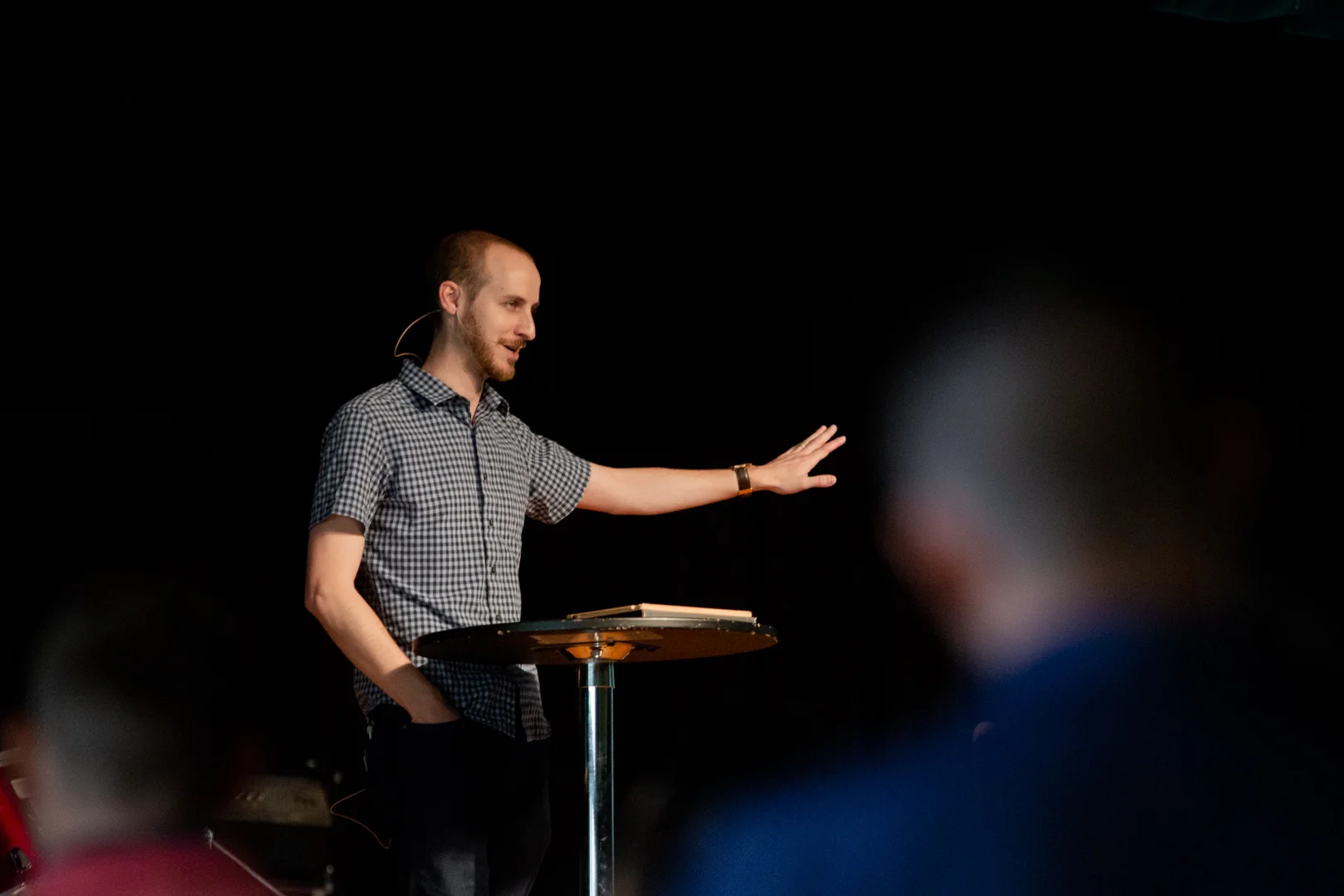

When You Go Through…
Isaiah 42:17 - 43:7
When You Go Through…
Isaiah 42:17 - 43:7
Here is how I see Isaiah unpacking this passage:
First, he addresses why we face the adversity we do.
What we really need when we face adversity.
How the Lord provides what we really need to face our adversity.
How to avail ourselves of what the Lord provides when facing adversity.
The main point is this: The presence of God is our only peace in adversity.
————————-
I. WHY DO WE FACE THE ADVERSITY WE ALL DO? (Isaiah 42:18-25)
Living as a human being involves dealing with adversity. Setbacks, cruelty, affliction are “normal” parts of life as we know it. Everyone goes through hard times. Everyone. The writer of Job puts it poetically, “Man is born to trouble as the sparks fly upward.” There are at least three competing ideas out there today as to why this is.
--------------------------
The Bible offers an answer too. In fact you catch the Bible’s answer by reading between the lines of Isaiah’s text here.
The Bible contends that the Being, who is Creator, is also the one place in the known universe with whom peace and joy are constantly and abundantly present. (Ps 16:11) The good news is that there IS such a place.
-------------------------
C.S. Lewis put it this way: “God made us: invented us as a man invents an engine. A car is made to run on petrol, and it would not run properly on anything else. Now God designed the human machine to run on Himself. He Himself is the fuel our spirits were designed to burn, or the food our spirits were designed to feed on. There is no other. That is why it is just no good asking God to make us happy in our own way without bothering about religion. God cannot give us a happiness and peace apart from Himself, because it is not there. There is no such thing.”
------------------------
II. WHAT WE REALLY NEED WHEN WE FACE ADVERSITY. (Isaiah 43:1)
It is worth noting that what the Lord offers through Isaiah as our real need in adversity is very different from what we typically think we need when adversity strikes. We tend to imagine that our best life now is very similar to the one we had before adversity came.
In our adversity, our greatest need is not to be taken out of the adversity, but rather to find the One whose presence is peace and joy forevermore. We do not merely need God to get us out of this fix so that we can get our lives back on track. We need to abandon our off-track lives for the one He is leading us into. We do not merely need to be rescued, we need a Rescuer.
Adversity is nothing if God is present. Comfort is nothing if He is absent.
---------------------
III. HOW DOES THE LORD PROVIDE FOR US WHAT WE REALLY NEED? (Isaiah 43:1)
The word “redeemed” here speaks to a rich, ancient concept that is mostly lost on modern Westerners like us. It is the concept of a kinsman-redeemer. Like no other prophet in the Old Testament, Isaiah foresees a servant of the Lord, a person born of David’s line, who becomes the kinsman-redeemer for God’s people. A person who comes to be with us in our adversity and to shepherd us through it safely home.
Isaiah is talking about Jesus.
---------------------
IV. HOW DO WE AVAIL OURSELVES OF WHAT THE LORD PROVIDES WHEN FACING ADVERSITY? (Isaiah 43:1,5)
The answer in the text is found in the two “FEAR NOTS” in this passage.
Fear not, for I have redeemed you (Isa 43:1)
Fear not, for I am with you (Isa 43:5)
Here is what the Lord is saying. This thing that has come upon you is from Me. Whatever you have done to bring upon yourself is over. I have taken up the debt upon Myself and paid it in full. I am what you need right now and I will be with you. I will bring you home.
God’s Sovereignty & Our Strength
Isaiah 40:1-11, 52:7-10
God’s Sovereignty & Our Strength
Isaiah 40:12-31
Main Idea: We find strength for our weary souls by waiting in faith for the sovereign, omnipotent God.
I. The Sovereignty of God (40:12-26)
The Lord asks 14 rhetorical questions in these 15 verses in order to remind Israel of his character & nature. The emphasis is on the sovereignty, omnipotence, and uniqueness of God over and above all things.
1. God’s Sovereignty over Creation (40:12-14, 25-26)
The immensity & “bigness” of God is emphasized in these verses:
He can measure all of the waters of the earth in the “hollow” (palm) of his hand
He can measure all the dust of the earth & he can place the mountains on a scale
He marked off the heavens with the “span” (outstretched thumb to pinky) of his hand
Though the Babylonians worshipped the stars, God has created every single star in the sky & he calls each of them by name. The stars witness the glory of God himself.
Implication: Just as “not one star is missing” under the sovereignty of God, not one of his people is missing either. God can be trusted because of both his transcendence and his immanence.
2. God’s Sovereignty over the Nations (40:15-17, 21-24)
The nations, as mighty as they may seem to us on earth, are like a “drop from a bucket” before the Lord. Even the most lavous of offering before God would still fall short of his glory & majesty. “Before him” the nations do not compare.
Likewise, the leaders of the nations are like mere grasshoppers before the Lord who sits enthroned above the horizon & the heavens.
Psalm 2:2, 4a: “The kings of the earth set themselves,
and the rulers take counsel together,
against the Lord and his Anointed…
He who sits in the heavens laughs;
Implication: Tying our hopes to any earth princes or rulers, seeking to find our strength in them, will inevitably contribute to our weariness & fatigue. We do not need to fear Babylon, but instead trust in the Sovereign Lord over the nations.
3. God’s Sovereignty over Idols (40:18-20)
Rather than explicitly criticizing idols, Isaiah sarcastically describes how they are crafted & made. Even though idols might look orante with gold & silver, and even if they are crafted with the finest of wood that does not rot, they ultimately must be “propped up” so they do not fall.
Implication: Despite the foolishness of idolatry, we know that there is a constant temptation toward this false worship, as our hearts are a “perpetual factory of idols” (John Calvin). Idolatry gives us a false sense of control, power, and convenience that ends up turning against us. We must turn in repentance from our trust in idols back to the sovereign God.
II. The Strength of God (40:27-31)
Israel’s complaint (40:27) was that God did not care about them; they assumed he had neglected them and no longer answered their prayers. But the problem lies not with God, but within themselves. They had a deficient view of God & a deficient experience with God. They needed a reminder that God is not only great, but that he is also good.
God is inviting his people to turn away from the things that will only contribute to their weariness (themselves, the things of creation, nations & their leaders, idols, etc.) and to instead turn to him. The posture of strength is found in waiting on the Lord.
“The Christian’s waiting and watching is hoping – based on the conviction that God is actively involved in His creation and vigorously at work in redemption. Hoping does not mean doing nothing. It is not fatalistic resignation. It means going about our assigned tasks, confident that God will provide the meaning and the conclusion. It is not compelled to work away at keeping up appearances with a bogus spirituality. It is the opposite of desperate and panicky manipulation, of scurrying and worrying. Hoping is not dreaming. It is not spinning an illusion or fantasy to protect us from our boredom or our pain. It means a confident, alert expectation that God will do what He said He will do.” ~ Eugene Peterson
When we wait on the Lord, our strength is renewed even if our circumstances do not change. We will experience the freedom & ease of an eagle flying, and we will have a resiliency to keep moving forward through the life of faith as we wait for the promise of God’s coming.
This invitation to come to the Lord in our weariness & our fatigue is embodied in the ministry of Jesus Christ.
Matthew 11:28–30: “Come to me, all who labor and are heavy laden, and I will give you rest. Take my yoke upon you, and learn from me, for I am gentle and lowly in heart, and you will find rest for your souls. For my yoke is easy, and my burden is light.”
God’s Coming & Our Comfort
Isaiah 40:1-11, 52:7-10
God’s Coming & Our Comfort
Isaiah 40:1-11, 52:7-10
“If the Bible were an hourglass, Isaiah 40 would be the middle where the sands of time falling through the old covenant begin to accumulate and take shape to forecast the new age to come through Christ.” ~ Jared Wilson
Main Idea: God promises us comfort through the certainty of his own coming in glory and grace.
I. The Comfort of God (40:1-5)
Despite the sin & rebellion of God’s people that resulted in exile, the Lord’s deepest heart for his people is comfort. He wants to win their hearts back (‘speak tenderly’) and still claims them as his own (‘my people, says your God’).
Heidelberg Catechism Q&A 1:
Q. What is your only comfort in life and in death?
A. That I am not my own, but belong with body and soul, both in life and in death, to my faithful Savior, Jesus Christ.
This comfort is not generic; it is redemptive. We see this in 3 promises:
Freedom (“her warfare is ended”)
Forgiveness (“her iniquity is pardoned”)
Full Acceptance (“she has received from the Lord’s hand double for all her sins”)
“There is an end to God’s disciplines but there is no end to God’s comforts… see in God not a frown but a smile, not distance but nearness. Even when we don’t act like the people of God, he still identifies with us.” ~ Ray Ortlund
The Lord promises comfort because he himself is coming to them (40:3-5). When the Lord comes in all his glory, he will figuratively level the mountains & fill the valleys. Isaiah is envisioning a new moral landscape created when the glory of the Lord comes.
All four gospel writers connect Isaiah 40 to the ministry of John the Baptist, who is the voice crying in the wilderness: “repent & believe, for the Kingdom of God is at hand.” Just as the ancients would build a new highway for royalty, we must prepare our own souls to receive the coming of the King.
II. The Certainty of God (40:6-8)
Though the grass and the flowers might be beautiful, they are here one day & gone the next. All flesh & people are like this, something the Isrealites knew first hand in exile (cf. King Hezekiah in Isa. 39).
The certainty of the Word of the Lord compared to our own flesh is meant to be a humbling reality. But it is also hopeful: the Lord has promised comfort, forgiveness of sins, and the end of all who stand against him & his Kingdom. This has already happened at the coming of Christ & it will happen in full when he returns again.
God is inviting Israel & us to trust in his word rather than things that will fade away like the flowers and the grass. Are we trusting in the certainty of God’s Word and promises?
III. The Greatness of God (40:9-11, 52:7-10)
The exiles are given a more detailed picture of the coming of the Lord. The vision of the good news (‘gospel’) of God’s coming emphasizes both his glory & his grace.
God’s Glory (40:10, 52:10): He comes is a mighty warrior-king, whose arm will rule over all the nations
God’s Grace (40:11): He comes as a tender shepherd-king, whose arm gathers up his lambs & gently leads them
Jesus is the full manifestation of both the glory & the grace of God. In his first coming, we have experienced the tender grace & mercy of our “Good Shepherd” who is also the “lamb of God” who takes away our sins & gives us redemptive comfort. In his second coming, he will fully consummate his Kingdom as a mighty-warrior king who conquers evil once and for all & establishes his eternal kingdom.
“If we come to God, as fierce as his lion-like judgment would have been against us, so deep will be his lamb-like tenderness for us.” ~ Dane Ortlund
As we behold our God who reigns & who is coming, we are two respond in two ways:
Worship (52:8-9)
Proclamation (40:9, 52:7)
Vision of the King
Isaiah 33:1-24
Vision of the King
Isaiah 33:1-24
Main Idea: The fear of the Lord drives us to the foot of the cross where we behold the beauty of the King and are redeemed.
“Ah, you destroyer, who yourself have not been destroyed, you traitor; whom none has betrayed! When you have ceased to destroy, you will be destroyed; and when you have finished betraying, they will betray you.” (Isaiah 33:1)
I. The Fear of the Lord (Isaiah 33:1-6)
“O Lord, be gracious to us, we wait for you. Be our arm every morning, our salvation in the time of trouble.” (Isaiah 33:2)
you lift yourself up, nations are scattered, (Is 33:3)
The Lord is exalted, for he dwells on high; he will fill Zion with justice and righteousness, and he will be the stability of your times, abundance of salvation, wisdom, and knowledge, the fear of the Lord is Zions treasure.” (Isaiah 33:5-6)
II. The Judge Arises (Isaiah 33:7-12) (10)
“Behold, their heroes cry in the streets; the envoys of peace weep bitterly. The highways lie waste; the traveler ceases. Covenants are broken; cities are dispose; there is no regard for man. The land mourns and languishes; Lebanon is confounded and withers away; Sharon is like a desert, and Bashan and Carmel shake off their leaves. (Isaiah 33:7-9)
“Now I will arise,” says the Lord. “Now I will lift myself up; now I will be exalted.” (Isaiah 33:10)
“a broken and contrite heart, O God, you will not despise. (Ps 51:17)”
“But when he came to himself, he said, ‘How many of my father’s hired servants have more than enough bread, but I perish here with hunger! I will arise and go to my father, and I will say to him, “Father, I have sinned against heaven and before you. I am no longer worthy to be called your son. Treat me as one of your hired servants.” And he arose and came to his father. But while he was still a long way off, his father saw him and felt compassion, and ran and embraced him and kissed him. (Lk 15:17–20)
We may be reluctant to turn. Reluctant to repent. But our Father is not reluctant to show compassion.
III. The Posture of the Righteous (Isaiah 33:13-16)
Hear, you who are far off, what I have done; and you who are near, acknowledge my might. The sinners in Zion are afraid; trembling has seized the godless: “Who among us can dwell with the consuming fire? Who among us can dwell with everlasting burnings?” (Isaiah 33:13-14)
He who walks righteously and speaks uprightly, who despises the gain of oppressions, who shakes his hands, lest they hold a bribe, who stops his ears from hearing of bloodshed and shuts his eyes from looking on evil, He will dwell on the heights; his place of defense will be the fortress of rocks; his bread will be given him; his water will be sure.” (Isaiah 33:15-16)
IV. The Vision of the King (Isaiah 33:17-24)
“Your eyes will behold the King in his beauty.” (Isaiah 33:17)
“Behold Zion, the city of our appointed feast! Your eyes will see Jerusalem, an untroubled habitation, an immovable tent, whose stakes will never be plucked up, nor will any of its chords be broken. But there the Lord in majesty will be for us a place of broad rivers and streams, where no galley with oars can go, more majestic ship can pass. For the Lord is our judge; the Lord is our lawgiver; the Lord is our King, he will save us.” (Isaiah 33:20-22)
33 But seek first the kingdom of God and his righteousness, and all these things will be added to you. (Mt 6:33)
“Your chords hang loose; they cannot hold the mast firm in its place or keep the sail spread out. Then prey and spoil in abundance will be divided; even the lame will take the prey. And no inhabitant will say, “I am sick”; the people who dwell there will be forgiven their iniquity.” (Isaiah 33:23-24)
“And no inhabitant will say, “I am sick”; the people who dwell there will be forgiven their iniquity. (Isaiah 33:24)
21 And Aaron shall lay both his hands on the head of the live goat, and confess over it all the iniquities of the people of Israel, and all their transgressions, all their sins. And he shall put them on the head of the goat and send it away into the wilderness by the hand of a man who is in readiness. 22 The goat shall bear all their iniquities on itself to a remote area, and he shall let the goat go free in the wilderness. (Leviticus 16:21–22)
Turn your eyes upon Jesus,
look full, in his wonderful face.
And the things of earth will grow strangely dim
in the light of his glory and grace.

Pastoral Ministry | Pastoral Appointments
1 Peter 5:1-4
Pastoral Ministry
1 Peter 5:1-4
Main Idea: Faithful pastors are a gift to the church & a picture of the Chief Shepherd.
6 observations on Pastoral Ministry:
Pastors serve in a plurality. 5:1a: “So I exhort the elders among you, as a fellow elder…”
Pastors serve in the context of suffering. 5:1b: “... and a witness of the sufferings of Christ, as well as a partaker in the glory that is going to be revealed”
Pastors shepherd the flock. 5:2a:“... shepherd the flock of God that is among you, exercising oversight”
Pastors are called men. 5:2b: “... not under compulsion, but willingly, as God would have you; not for shameful gain, but eagerly”
Pastors are examples. 5:3: “... not domineering over those in your charge, but being examples to the flock.”
Pastors are under-shepherds to the Chief Shepherd. 5:4: “And when the chief Shepherd appears, you will receive the unfading crown of glory.”
*For more on our conviction regarding leadership in the church, you can see more information by clicking here including a full sermon we preached back on January 10, 2021 titled “The Church & Her Leaders.”
The Holy Lord of Hosts
Isaiah 6:1-13
The Holy Lord of Hosts
Isaiah 6:1-13
Main Idea: God’s glory displaces us, his grace saves us, and his greatness commissions us.
I. The Holiness of the Lord (6:1-4)
King Uzziah died in ~740BC after a 52-year long & prosperous reign, bringing uncertainty about the future. The end of his reign was marked by sin, as he grew “proud to his destruction” (2 Chron. 26:5, 16), desecrating the temple.
In the face of the uncertainty of the death of an earthly king, Isaiah is swept up to see the King of all Kings “high and lifted up” above the temple; He is unable to describe the Lord himself, but he does describe all that is happening around him:
He is on his throne, the “foundation of justice & righteousness” (Ps. 89:14)
The train of his robe filled the temple
Seraphim: lit. the ‘burning ones’ are above him with their eyes & feet covered, unable to look directly at his glory.
The seraphim cry out “holy, holy, holy” to one another; repetition is a sign of emphasis in the Scriptures, and this three-fold repetition is the only time it occurs in the OT. This speaks to God’s “otherness” & “set-apartness” in a superlative sense; he is holy beyond comparison.
“We must not think of God as highest in an ascending order of beings, starting with the single cell and going on up from the fish to the bird to the animal to man to angel to cherub to God. God is as high above an archangel as above a caterpillar, for the gulf that separates the archangel from the caterpillar is but finite, while the gulf between God and the archangel is infinite.” ~ A.W. Tozer
“We keep trying to fill [earth] with monuments to our own glory—kingdoms, businesses, hit songs, athletic victories, and other mechanisms of self-salvation. But the truth is better than all that. Created reality is a continuous explosion of the glory of God. And history is the drama of his grace awakening in us dead sinners’ eyes to see and taste to enjoy and courage to obey.” ~ Ray Ortlund
At the proclamation of the angelic beings, the whole foundations of the temple “shook” & smoke ( the presence of God) filled the house. An encounter with the true holiness of God such as this is dangerous & terrifying.
II. The Grace of the Lord (6:5-7)
As Isaiah is confronted with the holiness, glory, & transcendence of the Lord, he pronounces a “self-woe” (cf. 6 ‘woes’ in Isaiah 5). He specifically identifies that he is a man of “unclean lips” because:
The proclamation of the seraphim
His unique role as a prophet & mouthpiece of God to Israel
His “lips” being an overflow of his heart (Mt. 12:34)
“When people encounter the true God, they experience a self-quake. That’s one way you can tell if you’ve met Israel’s God or simply a figment of your imagination. A made-up God will leave your world undisturbed, conveniently aligning your priorities without displacing anything, because ultimately you are more glorious than it is. The real God, however, will land in the middle of your life like an elephant crashing through the ceiling, displaying your sin, changing all your priorities, and forcing you to reorient yourself around the weight of glory.” ~ Andrew Wilson
Just as Isaiah experiences this “displacement,” the Lord of glory also shows himself to be the Lord of grace. A burning coal from the altar, where blood was shed & sins atoned for, touches the mouth of Isaiah, meeting his confessed place of need with grace & mercy. This act of atonement is a picture of the atoning work of Jesus Christ.
III. The Commission of the Lord (6:8-13)
The experience with God’s grace opens Isaiah ears to hear the voice of the Lord. Isaiah is both humbled and emboldened by what has just happened and he answers the call of the Lord to go to his rebellious people.
Verses 9-10 are the most quoted verses from Isaiah in the NT; they are most often connected to Jesus’ reason for teaching in parables (cf. Mt. 13:10-17). The ministry of Isaiah is a picture of all true gospel ministry; the word of God either hardens or softens those who listen to it, and a supernatural work is required to bring about salvation.
After the land is defeated (6:11), exile (6:12), and further destruction (6:13a), an unexpected hope appears. Though all appears to be burned down & destroyed, a “holy seed” and “stump” will remain. Within this stump is the seed of new life & hope, ultimately to be seen through the promise of a “shoot from the stump of Jesse” (11:1).
John 12:41: Isaiah said these things because he saw his [Jesus’] glory and spoke of him.
The Lord’s Vineyard
Isaiah 5:1-30
The Lord’s Vineyard
Isaiah 5:1-30
“What comes into our minds when we think about God is the most important thing about us.” ~ A.W. Tozer
Main Idea: We rightly worship the exalted Lord by receiving his grace with the fruit of repentance & faith
I. The Lord’s Vineyard (5:1-7)
The Lord communicates to Israel through a parable about an owner & a vineyard. The owner does all of the work required to plant this vineyard and yield a crop, investing years of attention, care, and hard work (5:1-2). However, when it was time to yield grapes, he only found “wild grapes” (lit. “stink-fruit”).
Since the owner could not have done anything more to yield a successful harvest (5:4), the vineyard must be destroyed; all of its sources of protection & nutrients will be cut off, briers & thorns (cf. Gen. 3:18) will take over, and he curses the clouds so that it would not rain.
The chilling conclusion to the parable (5:7) reveals that the owner is the Lord & the vineyard is Israel & Judah, his chosen people. He expected a flourishing vineyard marked by “justice” & “righteousness” but instead only found “bloodshed” and “outcry” (screams from the oppressed).
“What can now be done for the people of God when a total work of grace has been lavished on them and yet they remain as if grace had never touched them?” ~ Alec Motyer
Like Israel, we must carefully consider if we have rightly received God’s grace, leading to the fruit of a transformed life (Mt. 7:16-20), or if we have received the grace of God in vain (2 Cor. 6:1)
Romans 2:4: “Or do you presume on the riches of his kindness and forbearance and patience, not knowing that God’s kindness is meant to lead you to repentance?”
II. The Lord’s Judgment (5:8-14, 18-30)
Rather than being receptive to God’s grace & ownership, the people of Israel were resistant in at least 6 ways:
Woe #1 (5:8-10): Aggressive Greed
“The righteous (just) are willing to disadvantage themselves to advantage the community; the wicked are willing to disadvantage the community to advantage themselves.” ~ Bruce Waltke
Woe #2 (5:11-12): Sinful Excess & Self-Indulgence
Woe #3 (5:18-19): Self-Deception & Mockery
Woe #4 (5:20): Rationalizing Sin
Woe #5 (5:21): Blind Arrogance
Woe #6 (5:22-23): Corruption & Injustice
The bookends of woes related to injustice are the very reason the Lord has rejected their worship (cf. 1:11-17). How we treat others is a significant indicator of the health of our relationship with God. The affluence & seeming flourishing of Judah numbed & blinded them to the Lord.
Because of Israel’s resistance to God’s grace & their sin against both his love & his law, there are consequences coming:
Exile (5:13-14)
Destruction (5:24-25)
Military Defeat (5:26-30)
III. The Lord’s Exaltation (5:15-17)
All those who are proud & “haughty” (lit. ‘high’) will be brought low, while the Lord of hosts reigns “exalted” (lit. ‘high’). This is an expression of God’s holiness, seen through justice & righteousness. God, in his justice, will bring to nothing the proud & the haughty, so that he might be rightly worshipped & esteemed.
John the Baptist, in the Spirit of the message of Isaiah (Lk. 3:3-6), urges the crowds who have received God’s grace in vain to “bear fruit in keeping with repentance” (Lk. 3:7-8). We do this by abiding in the “true vine” (John 15:1) which causes us to bear fruit to the glory of God.
Isaiah often speaks of a remnant (“lambs”) that rightly acknowledges God for who he is & humble themselves before him. The invitation before us is to acknowledge God as the ‘owner’ & to receive his grace with the fruit of repentance & faith.

The Witness of the Church
2 Thessalonians 3:1-18
The Witness of the Church
2 Thessalonians 3:1-18
Main Idea: We await the return of Christ by praying for gospel advancement & faithfully working
I. The Gospel & Our Praying (3:1-5)
Paul urges the Thessalonians to pray for the advancement of the gospel, emphasizing the power and importance of prayer in all genuine gospel ministry (cf. Col. 4:2-3).
Paul exhorts us to pray for gospel advancement in 3 specific ways:
We pray that the word of God would spread out (“speed ahead”) into the world
We pray that the word of God would be honored in the church
We pray against the work of those who desire to stop this advancement (cf. The Parable of the Sower: Mk. 4:1-20)
“In this respect, prayer is like a spiritual walkie-talkie on the battlefield of the world. Prayer calls to heavenly artillery to blast open a way for the gospel (Col 4:3) and asks God at heavenly headquarters for clarity and courage in presenting the gospel (Eph 6:18–20; Col 4:4–6). Paul calls in to headquarters for the wisdom and power to win the war and for strength and protection from the enemy” ~ G.K. Beale
We are invited to pray this way in confidence because “the Lord is faithful” & is committed to his word. He will establish & strengthen his people for this work, precisely what happened in Thessalonica.
II. The Gospel & Our Working (3:6-15)
Paul’s previous warnings about ‘idleness’ (1 Thess. 4:10-12, 5:14) have not been followed, so he urges the church to deal more seriously with this issue. There are two temptations for us as we consider our own work, calling, or vocation today:
1. Idleness in Work
Those walking in “idleness” in Thessalonica were unnecessarily burdening others & were living as ‘busybodies,’ a word connected with false teaching in the NT (cf. 1 Tim. 5:13). They were living a “disordered” life that was damaging the witness of the church & the community of believers.
2. Idolatry of Work
“When work is your identity, success goes to your head, and failure goes to your heart.” ~ Tim Keller
What is a better witness for God’s people in regard to their work ethic?
We work hard, following the example of Paul & the Lord Jesus (3:7-9)
We work quietly & diligently (3:12a; cf. 1 Thess. 4:11)
We work to earn a living (3:12b; lit. ‘eat your own bread;’) & not be a burden to others
We work with perseverance (3:13)
For those who persist in this “idleness,” Paul urges that the church community warn this person as a brother or sister in Christ so they might be drawn to repentance. This “church discipline” was to maintain the witness of the church & to guard the souls
Galatians 6:1–2: “Brothers, if anyone is caught in any transgression, you who are spiritual should restore him in a spirit of gentleness. Keep watch on yourself, lest you too be tempted. Bear one another’s burdens, and so fulfill the law of Christ.”
III. The Gospel & Our Waiting (3:16-18)
As we await the return of Christ, Paul’s benediction reminds us of what kind of blessing we need to endure until that day:
God’s Peace (3:16a)
God’s Presence (3:16b)
God’s Grace (3:18)
Standing Firm in the End
2 Thessalonians 2:1-17
Standing Firm in the End
2 Thessalonians 2:1-17
16 All Scripture is breathed out by God and profitable for teaching, for reproof, for correction, and for training in righteousness, (2 Ti 3:16)
Main Idea: We stand firm against the schemes of the evil one by clinging to the grace of the righteous one.
1. Expectations for now and then. (2 Thessalonians 1-12)
Now concerning the coming of our Lord Jesus Christ and our being gathered together to him, we ask you, brothers, not to be quickly shaken in mind or alarmed, either by a spirit or a spoken word, or a letter seeming to be from us, to the effect that the Day of the Lord has come. Let no one deceive you. (2 Thessalonians 2:1-3)
A. The Rebellion (The Great Revolt, Or Apostia)
B. The Rebel (Man of Lawlessness of Antichrist)
For that day will not come, unless the rebellion comes first, and man of lawlessness is revealed, the son of destruction, who opposes and exalts himself against every so-called god or object of worship, so that he takes his seat in the temple of God, proclaiming himself to be God. (2 Thes 2:3b-5)
The Antinomian (The man of lawlessness, v.3)
The Doomed (The Son of Destruction, v.3)
The Enemy (The one who will oppose God, v.4)
The Climber (The one who exalts himself claiming to be God, v.4)
Mt 24:12 And because lawlessness will be increased, the love of many will grow cold.
Isaiah 14:12-14 “How you are fallen from heaven, O Day Star, son of Dawn! How you are cut down to the ground, you who laid the nations low! You said in your heart, ‘I will ascend to heaven; above the stars of God I will set my throne on high; I will sit on the mount of assembly in the far reaches of the north; I will ascend above the heights of the clouds; I will make myself like the Most High.’
Ezekiel 28:1-2 “Because your heart is proud, and you have said, ‘I am a god, I sit in the seat of the gods, in the heart of the seas,’ yet you are but a man, and no god, though you make your heart like the heart of a god—
Daniel 11:31 Forces from him shall appear and profane the temple and fortress, and shall take away the regular burnt offering. And they shall set up the abomination that makes desolate.
Daniel 11:36-37 “And the king shall do as he wills. He shall exalt himself and magnify himself above every god, and shall speak astonishing things against the God of gods. He shall prosper till the indignation is accomplished; for what is decreed shall be done. 37 He shall pay no attention to the gods of his fathers, or to the one beloved by women. He shall not pay attention to any other god, for he shall magnify himself above all.
Revelation 13:3 One of its heads seemed to have a mortal wound, but its mortal wound was healed, and the whole earth marveled as they followed the beast.
Revelation 13:12 It exercises all the authority of the first beast in its presence, and makes the earth and its inhabitants worship the first beast, whose mortal wound was healed.
1 John 2:18 Children, it is the last hour, and as you have heard that antichrist is coming, so now many antichrists have come. Therefore we know that it is the last hour.
1 John 2:22 Who is the liar but he who denies that Jesus is the Christ? This is the antichrist.
Matthew 24:24 For false christs and false prophets will arise and perform great signs and wonders, so as to lead astray, if possible, even the elect.
2 Thes 2:6-8 And you know what is restraining him now so that he may be revealed in his time. For the mystery of lawlessness is already at work. Only he who now restrains it will be revealed, whom the Lord Jesus will kill with the breath of his mouth and bring to nothing by the appearance of his coming.
“His anti-social, anti-law, anti-God movement is at present largely underground. We detect its subversive influence around us today—in the atheistic stance of secular humanism, in the totalitarian tendencies of extreme left-wing and right-wing ideologies, in the materialism of the consumer society which puts things in the place of God, in those so-called ‘theologies’ which proclaim the death of God and the end of moral absolutes, and in the social permissiveness which cheapens the sanctity of human life, sex, marriage and family, all of which God created or instituted." ~ John Stott
2 Thes 2:9-12 The coming of the lawless one is by the activity of Satan with all power and false signs and wonders, and with all wicked deception for those who are perishing, because they refused to love the truth and so be saved. Therefore God sends them a strong delusion, so that they may believe what is false, in order that all may be condemned who did not believe the truth but had pleasure in unrighteousness.
They delight in sin.
They refuse to believe and love the truth.
Satan deceives them.
God gives them over to the lie they’ve chosen.
They are condemned.
2. Assurance for now and then
2 Thessalonians 2:13-14 But we ought always to give thanks for you, brothers beloved by the Lord, because God chose you as the first fruits to be saved, through sanctification by the Spirit and belief in the truth. To this he called you through our gospel, so that you may obtain the glory of our Lord Jesus Christ.
2 Co 10:4–5 For the weapons of our warfare are not of the flesh but have divine power to destroy strongholds. We destroy arguments and every lofty opinion raised against the knowledge of God, and take every thought captive to obey Christ.
John 6:37 All that the Father gives me will come to me, and whoever comes to me I will never cast out.
John 15:16 You did not choose me, but I chose you and appointed you that you should go and bear fruit and that your fruit should abide.
2 Thessalonians 2:15 So then, brothers stand firm and hold to the traditions that you were taught by us, either by our spoken word or by our letter.
Eph 2:20 built on the foundation of the apostles and prophets, Christ Jesus himself being the cornerstone,
2 Ti 4:3–5 For the time is coming when people will not endure sound teaching, but having itching ears they will accumulate for themselves teachers to suit their own passions, 4 and will turn away from listening to the truth and wander off into myths. (But hear this) 5 As for you, always be sober-minded, endure suffering, do the work of an evangelist, fulfill your ministry. (2 Ti 4:3–5)
Rev 12:11 And they have conquered him by the blood of the Lamb and by the word of their testimony, for they loved not their lives even unto death. (Rev 12:11)
And though this world with devils filled should threaten to undo us. We will not fear, for God hath willed His truth to triumph through us. The Prince of Darkness grim, we tremble not for him. His rage we can endure, for lo, his doom is sure. One little word shall fell him.
~ Martin Luther
2 Thes 2:13-17 Now may our Lord Jesus Christ himself, and God our Father, who loved us and gave us eternal comfort and good hope through grace, conform your hearts and establish them in every good work and word.
Enduring in Light of the End
2 Thessalonians 1:1-12
Enduring in Light of the End
2 Thessalonians 1:1-12
Main Idea: We faithfully endure by patiently awaiting the return of the Savior and Judge.
2 Thessalonians 1:1-2 Paul, Silvanus, and Timothy. To the church of the Thessalonians in God our Father and the Lord Jesus Christ: Grace to you and peace from God our Father and the Lord Jesus Christ.
1. Thanksgiving (verses 3-4)
1 Th 5:16–18 Rejoice always, pray without ceasing, give thanks in all circumstances; for this is the will of God in Christ Jesus for you.
Mt 13:20–21 As for what was sown on rocky ground, this is the one who hears the word and immediately receives it with joy, yet he has no root in himself, but endures for a while, and when tribulation or persecution arises on account of the word, immediately he falls away.
2 Th 1:5 This is evidence of the righteous judgment of God, that you may be considered worthy of the kingdom of God, for which you are also suffering.
Ac 5:41 Then they left the presence of the council, rejoicing that they were counted worthy to suffer dishonor for the name.
2 Ti 3:12 Indeed, all who desire to live a godly life in Christ Jesus will be persecuted,
2. Judgement (verses 6-10)
2 Th 1:6–9 since indeed God considers it just to repay with affliction those who afflict you, and to grant relief to you who are afflicted as well as to us, when the Lord Jesus is revealed from heaven with his mighty angels in flaming fire, inflicting vengeance on those who do not know God and on those who do not obey the gospel of our Lord Jesus. They will suffer the punishment of eternal destruction, away from the presence of the Lord and from the glory of his might.
Jn 1:3 All things were made through him, and without him was not any thing made that was made.
Col 1:15–16 For by him all things were created, in heaven and on earth, visible and invisible, whether thrones or dominions or rulers or authorities—all things were created through him and for him.
Jn 3:17–19 For God did not send his Son into the world to condemn the world, but in order that the world might be saved through him. Whoever believes in him is not condemned, but whoever does not believe is condemned already, because he has not believed in the name of the only Son of God. And this is the judgment: the light has come into the world, and people loved the darkness rather than the light because their works were evil.
A. Justice for the Persecuted (6-7)
“The character of God is the guarantee that all wrongs will be righted someday; when the ‘day of God’s wrath, when his righteous judgment will be revealed’ (Rom 2:5) arrives, retribution will be exact, and no problems of cosmic unfairness will remain to haunt us. God is the Judge, so justice will be done”.
- J.I. Packer
B. Vengeance for the Persecutors (7b-10)
2 Th 1:7–9 when the Lord Jesus is revealed from heaven with his mighty angels in flaming fire, inflicting vengeance on those who do not know God and on those who do not obey the gospel of our Lord Jesus. They will suffer the punishment of eternal destruction, away from the presence of the Lord and from the glory of his might.
3. Vindication (verses 10-12)
2 Th 1:10–12 when he comes on that day to be glorified in his saints, and to be marveled at among all who have believed, because our testimony to you was believed. To this end we always pray for you, that our God may make you worthy of his calling and may fulfill every resolve for good and every work of faith by his power, so that the name of our Lord Jesus may be glorified in you, and you in him, according to the grace of our God and the Lord Jesus Christ.
Revelation 4:8. “Holy, holy, holy, is the Lord God Almighty, who was and is and is to come!”