
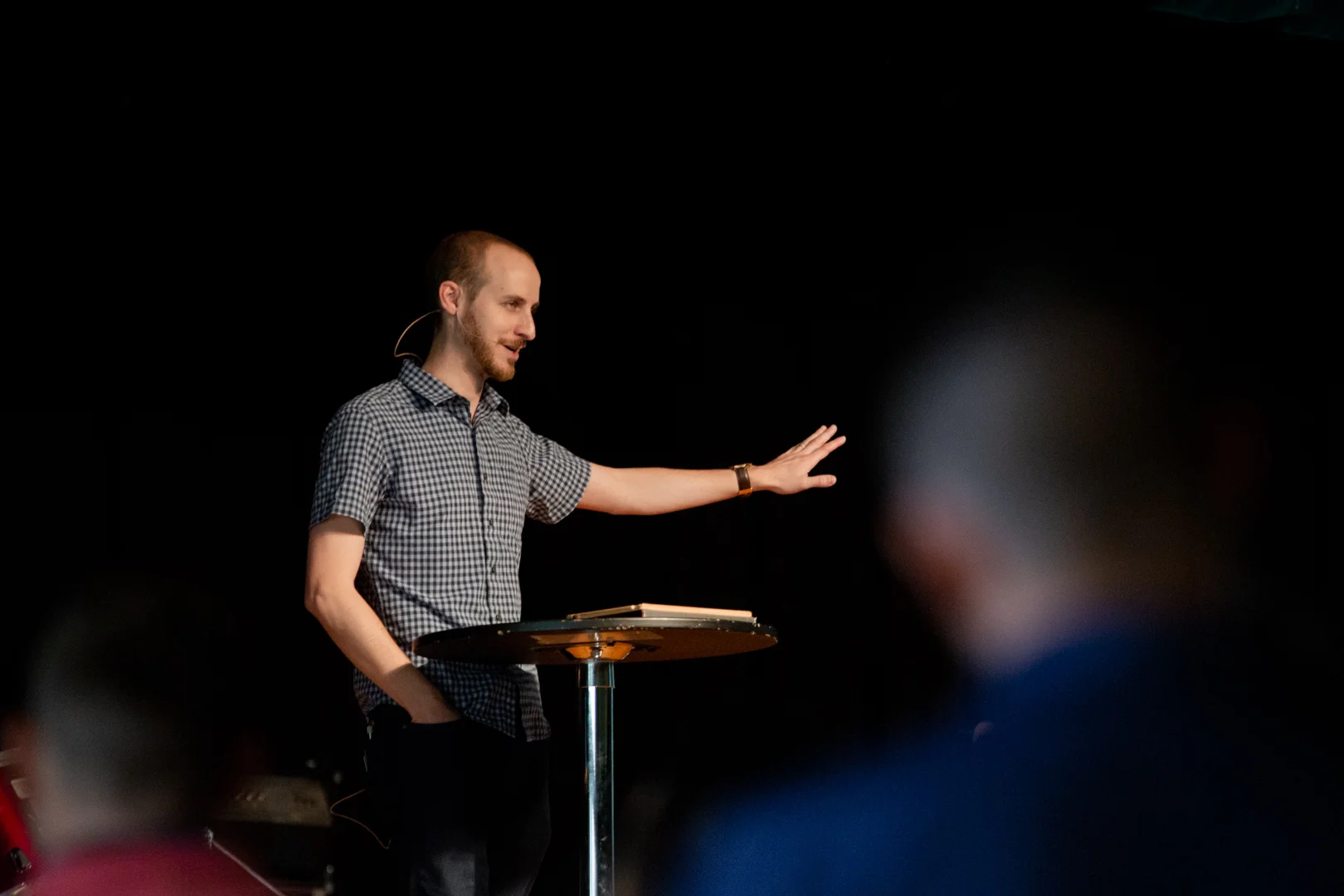

Family Matters
Ephesians 6:1-4
Family Matters
Ephesians 6:1-4
Main idea: We glorify God by living together in Gospel-shaped families.
Matthew 19:14: “but Jesus said, “Let the little children come to me and do not hinder them, for to such belongs the kingdom of heaven.””
Ps 127:3–5: Behold, children are a heritage from the Lord, the fruit of the womb a reward. Like arrows in the hand of a warrior are the children of one’s youth. Blessed is the man who fills his quiver with them! He shall not be put to shame when he speaks with his enemies in the gate.
“From God you receive them. To God you lead them.” ~Dietrich Bonhoeffer
1 Samuel 1:26–28: 26 And she said, “Oh, my lord! As you live, my lord, I am the woman who was standing here in your presence, praying to the Lord. 27 For this child I prayed, and the Lord has granted me my petition that I made to him. 28 Therefore I have lent him to the Lord. As long as he lives, he is lent to the Lord.” And he worshiped the Lord there.
John 14:18–21: “I will not leave you as orphans; I will come to you. Yet a little while and the world will see me no more, but you will see me. Because I live, you also will live. In that day you will know that I am in my Father, and you in me, and I in you. Whoever has my commandments and keeps them, he it is who loves me. And he who loves me will be loved by my Father, and I will love him and manifest myself to him.”
“One's heart goes out to the children of such fathers, and those of us who are fathers ourselves know that we too are far from perfect. ButGod the Father is not called Father because he copies earthly fathers.He is not some pumped-up version of your dad. To transfer the failingsof earthly fathers to him is, quite simply, a misstep. Instead, things arethe other way around: it is that all human fathers are supposed to reflect him--only where some do that well, others do a better job of reflecting the devil.” ~James Miller
Hebrews 12:7–11: 7 It is for discipline that you have to endure. God is treating you as sons. For what son is there whom his father does not discipline? 8 If you are left without discipline, in which all have participated, then you are illegitimate children and not sons. 9 Besides this, we have had earthly fathers who disciplined us and we respected them. Shall we not much more be subject to the Father of spirits and live? 10 For they disciplined us for a short time as it seemed best to them, but he disciplines us for our good, that we may share his holiness. 11 For the moment all discipline seems painful rather than pleasant, but later it yields the peaceful fruit of righteousness to those who have been trained by it.
Deuteronomy 6:7–9: 7 You shall teach them diligently to your children, and shall talk of them when you sit in your house, and when you walk by the way, and when you lie down, and when you rise. 8 You shall bind them as a sign on your hand, and they shall be as frontlets between your eyes. 9 You shall write them on the doorposts of your house and on your gates.
The Mystery of Marriage
Ephesians 5:22-33
The Mystery of Marriage
Ephesians 5:22-33
Main Idea: Marriage is a profound mystery pointing us to the ultimate marriage of Christ and the church.
I. Appreciating the Mystery (5:30-32)
Marriage is a “profound (lit. ‘mega’) mystery” that reveals to us something of eternal significance. We must appreciate both the design and the destination for marriage if we are to understand this mystery.
1. The Design of Marriage (Gen. 2:18-25)
In the Garden of Eden, God sees that “it is not good” that Adam is alone, so he creates Eve, a “helper fit for him” (2:18)
“Helper” does not imply inferiority; this term is most used of God himself in the OT and the Holy Spirit in the NT. The original marriage had a design of “head” (Eph. 5:23) and “helper.”
“Fit” speaks to the complementary relationship between the man and the woman; they were equal but not equivalent or interchangeable. Adam and Eve needed one another as essential partners to fulfill the mandates from the Lord.
Ultimately, the design of marriage was not meant to culminate with Adam and Eve, but with Christ’s love for the church. We must think of marriage today in light of the eternal love story of Christ for his bride.
“Every time a bride and a groom stand there and take their vows, they are reenacting the biblical love story, whether they realize it or not. The Son of God stepping down out of eternity, entering time, taking on flesh, pursuing and winning his bride as his very heart and body with his inmost, sincerest love so that he can fit her to be with him forever above – that dramatic super-reality is the breathtaking reason why human marriage exists.” ~ Ray Ortlund
2. The Destination of Marriage (Rev. 19:6-9, 21:1-2)
“The echoes of Genesis 2 are unmistakable. Again, we see God bringing a bride to her husband, only this time the husband is Jesus and we are the bride. In that first marriage, Adam failed to step in and help his wife when she needed him. But at the end of time there will be another wedding, the wedding supper of the Lamb, and its purpose is also to fill the world with children of God. It will succeed where the first marriage failed because, while the first husband in history failed, the Second Husband did not. The true Adam, Jesus Christ, will never fail his spouse, the Second Eve, his church.” ~ Tim Keller
II. Inhabiting the Mystery (5:22-29, 33)
With the foundation of this “mystery” revealed to us in Christ, we can make more sense of the exhortations Paul gives to both wives and husbands:
1. Wives (5:22-24): submit to your own husbands as to the Lord
3 notes on this exhortation:
This is not based on “traditionalism” or cultural constructs, but is consistently affirmed as God’s good design for marriage (cf. Col. 3:18, 1 Pet. 3:1)
This is voluntary posture, not under compulsion, for a specific context: wives to your own husbands, not women (in general) to men (in general)
This is an expression of obedience to the Lord (“as to the Lord”) and respect (5:33) for her husband
Philippians 2:3–7: Do nothing from selfish ambition or conceit, but in humility count others more significant than yourselves… Have this mind among yourselves, which is yours in Christ Jesus, who, though he was in the form of God, did not count equality with God a thing to be grasped, but emptied himself, by taking the form of a servant, being born in the likeness of men.
2. Husbands (5:25-29): love your wives (3x)
Paul gives two analogies to explain what this love should look like:
Love your wife as Christ loves the church (5:25-27); this posture is marked by 4 verbs: give yourself up, sanctify, cleanse, and present. Husbands should love their wives in such a way that they are more like Christ, preparing for the day when we will be glorified in splendor.
“How does Christ love and lead his church? He does so by laying down his own life to the point of crucifixion. A husband’s leadership is about a special accountability for sabotaging his own wants and appetites with a forward-looking plan for the best interests of his wife and children. Headship is not about having one’s laundry washed or one’s meals cooked or one’s sexual drive met, but rather about constantly evaluating how to step up first to lay one’s life down for his family.” ~ Russell Moore
Love your wife as you love your own body (5:28-29), marked by nourishing & cherishing this one-flesh union. Husbands ought to love their wife in both action and affection. The covenant nature of marriage creates the environment for the connection of intimacy.
Walk It Out
Ephesians 5:1-21
Walk It Out
Ephesians 5:1-21
Main Idea: In Christ, we imitate God by walking in love, light, and wisdom.
I. Walk in Love (5:1-2)
a. Imitate the love of the Father (1)
“Therefore be imitators of God, as beloved children.” (Ephesians 5:1)
“ In love, he predestined us for adoption to himself as sons through Jesus Christ, according to the purpose of his will, (Ephesians 1:5)
b. Imitate the love of the Son (2)
“And walk in love, as Christ loved us and gave himself up for us, a fragrant offering and sacrifice to God.” (Ephesians 5:2)
“but God shows (demonstrates) his love for us in that while we were still sinners, Christ died for us.” (Romans 5:8)
“a fragrant offering and sacrifice to God.” (Ephesians 5:2)
“I appeal to you therefore, brothers, by the mercies of God, to present your bodies as a living sacrifice, holy and acceptable to God, which is your spiritual worship.” (Romans 12:1)
II. Walk in Light (5:3-14)
8 For at one time you were darkness, but now you are light in the Lord. Walk as children of light. (Eph 5:8)
a. Sex, Greed, Speech (5:3-5)
3 But sexual immorality and all impurity or covetousness must not even be named among you, as is proper among saints. 4 Let there be no filthiness nor foolish talk nor crude joking, which are out of place, but instead let there be thanksgiving. 5 For you may be sure of this, that everyone who is sexually immoral or impure, or who is covetous (that is, an idolater), has no inheritance in the kingdom of Christ and God. (Ephesians 5:3-5)
"With some (Christians) the last part of their nature that ever gets sanctified is their pockets." ~ Charles Spurgeon
5 For you may be sure of this, that everyone who is sexually immoral or impure, or who is covetous (that is, an idolater), has no inheritance in the kingdom of Christ and God. 6 Let no one deceive you with empty words, for because of these things the wrath of God comes upon the sons of disobedience. 7 Therefore do not become partners with them; (Ephesians 5:5–7)
“18 And we all, with unveiled face, beholding the glory of the Lord, are being transformed into the same image from one degree of glory to another. For this comes from the Lord who is the Spirit.” (2 Corinthians 3:18)
b. Goodness, Righteousness, Truth (5:9-10)
9 (for the fruit of light is found in all that is good and right and true), 10 and try to discern what is pleasing to the Lord. (Ephesians 5:9–10)
c. Expose and Transform (5:11-14)
11 Take no part in the unfruitful works of darkness, but instead expose them. 12 For it is shameful even to speak of the things that they do in secret. 13 But when anything is exposed by the light, it becomes visible, 14 for anything that becomes visible is light. Therefore it says,
“Awake, O sleeper,
and arise from the dead,
and Christ will shine on you.”
(Ephesians 5:11–14)
III. Walk in Wisdom (5:15-21)
15 Look carefully then how you walk, not as unwise but as wise, 16 making the best use of the time, because the days are evil. 17 Therefore do not be foolish, but understand what the will of the Lord is. 18 And do not get drunk with wine, for that is debauchery, but be filled with the Spirit, 19 addressing one another in psalms and hymns and spiritual songs, singing and making melody to the Lord with your heart, 20 giving thanks always and for everything to God the Father in the name of our Lord Jesus Christ, 21 submitting to one another out of reverence for Christ.” (Ephesians 5:15–21)
16 Let the word of Christ dwell in you richly, teaching and admonishing one another in all wisdom, singing psalms and hymns and spiritual songs, with thankfulness in your hearts to God. (Colossians 3:16)
New Life in Christ
Ephesians 4:17-32
New Life in Christ
Ephesians 4:17-32
Main Idea: Our new life in Christ empowers us to live in a transformed way.
I. A New Identity (4:17-24)
The “once… but now” pattern of Ephesians shows up again here. Paul urges the church to no longer walk as the ‘Gentiles’ (speaking morally, not ethnically) do. He compares their old and new selves:
1. The Old Self (4:17-19)
Their mind was futile and darkened, their hearts were hardened and callous, and their actions were impure, immoral, and insatiable. The totality of who they were (head, heart, and hands) was ‘alienated from the life of God.’
2. The New Self (4:20-24)
Paul reminds these Gentiles that they have been taken to the “school of Christ” (4:20-21), where they have learned him, heard him, and taught him who is himself the truth. Because of Christ, we have a new way of thinking, a new way of responding, and new behaviors.
“If a man becomes Christ’s disciple by conversion, he must remain Christ’s disciple, throughout the rest of his life, by sitting at his Master’s feet, and receiving instruction from him; for it is only as we are taught of God that we shall be able to keep up the high spiritual distinction between ourselves and the rest of mankind. We are under the tutorship of the Holy Spirit; he has taken us into his school; he has taught us something already, he is teaching us more now, and he will keep on teaching us more and more till we shall know even as we are known.” ~ Charles Spurgeon
Just as we get dressed and put on clothes each day, we are to “put off the old self” and “put on the new self,” which is Christ himself (Rom. 13:14, Col. 3:9-10, Gal. 3:27). This putting off of the old and putting on of the new has already happened decisively at salvation, and we now live out this new reality daily.
2 Corinthians 5:17: Therefore, if anyone is in Christ, he is a new creation. The old has passed away; behold, the new has come.
The bridge between this “putting off” and “putting on” is to “be renewed” in the present. This is the work of the Spirit who is conforming us into the image of Christ (2 Cor. 3:18). This is the sanctification process of the Christian life, where we become functionally who we already are positionally in Christ.
II. A New Way of Living (4:25-32)
Paul now practically applies this new identity to a new way of living, marked by ongoing repentance, faith, and gospel transformation. “When our Lord and Master Jesus Christ said “Repent,” he intended that the entire life of believers should be repentance.” ~ Martin Luther
This new way of living is described in the same pattern in these verses:
Repentance (negative: stop doing this…)
Faith (positive: instead, do this…)
Theological / gospel motivation
1. Truth-telling (4:25)
Repentance: Put away all falsehood
Faith: Speak the truth with our neighbor
Theological: We are members of one another; the body is strengthened and united by truth, not falsehood (Eph. 4:15-16)
2. Anger (4:26-27)
Repentance: Turn from unrighteous anger
Faith: Live with righteous anger
Theological: Do not give an opportunity to the devil, who is the Father of lies and a murderer from the beginning (Jn. 8:44)
3. Work (4:28)
Repentance: No longer steal or work dishonestly
Faith: Work hard and honestly
Theological: We work hard in order that we might be generous toward those who are in need
4. Speech (4:29-30)
Repentance: No more corrupting speech (cf. ‘rotten fruit of Mt. 7:17-18)
Faith: Edifying speech for building up, full of grace
Theological: Do not grieve the Holy Spirit, who has sealed us and is transforming us from the inside-out
Luke 6:45: The good person out of the good treasure of his heart produces good, and the evil person out of his evil treasure produces evil, for out of the abundance of the heart his mouth speaks.
5. Attitudes (4:31-32)
Repentance: Bitterness, wrath, (unrighteous) anger, clamar, slander, and malice must be put away
Faith: Be kind, tenderhearted, and forgiving to one another
Theological: Christ has forgiven us and acted toward us in this very way
When we realize that Christ has treated us in all of these ways out of his grace, kindness, and mercy, we begin to realize the power to change and be transformed. The gospel does not call us to a list of moralistic activities, but to a new life and a new way of living marked by Christ himself (5:1-2).

The Resurrection of Christ | Easter
John 20: 1-18
The Resurrection of Christ
John 20:1-18
Main Idea: The resurrection of Christ means the curse is reversed and we have hope.
I. The Tomb is Empty (20:1-10)
Sunday morning begins with Mary Magdalene going to the tomb early in the morning while it is still dark on the “first day of the week.” John presents the resurrection as being the beginning of a new creation, with the “darkness” being pushed back by a glorious light.
Mary is presumably traveling to the tomb to mourn the death of Christ. Despite Jesus’ predictions that he would be raised, no one is expecting or looking for a resurrection. This did not fit into either the Jewish or the Greco-Roman worldview. Mary assumes a grave robbery has occurred.
As Peter and John show up at the tomb, they realize the burial linen cloths and the face cloth are both neatly folded up. Peter and John begin to “theorize” what has happened, and John himself “believes” as he steps foot in this empty tomb.
Acts 2:24: God raised him [Jesus] up, loosing the pangs of death, because it was not possible for him to be held by it.
Isaiah 25:7–8: And he will swallow up on this mountain
the covering that is cast over all peoples,
the veil that is spread over all nations.
He will swallow up death forever;
and the Lord God will wipe away tears from all faces,
and the reproach of his people he will take away from all the earth,
for the Lord has spoken.
Though they do not realize it yet, Christ “must rise from the dead.” Everything hinges upon the resurrection, and the empty tomb is an invitation for us. “The reason the stone was rolled away on Jesus's tomb was not so that Jesus could get out, but so that we could get in.” ~ Tim Keller
“The truest fact of the universe is an empty tomb. The Resurrection is the only evidence that love triumphs over death, weakness prevails over strength, and beauty outlives ashes. If Jesus is risen in actual history, with all the palpability of flesh, fingers, bone, and blood, there is hope that our mourning will be comforted, and that death will not have the final word.”
~ Tish Harrison Warren
II. The Curse is Reversed (20:11-18)
This resurrection encounter shows us that the curse of sin and its impact on the world is being rolled back. We see this in three categories:
The Setting: Jesus is buried in a “garden tomb” (19:41); gardens have great significance in the Scriptures from the Garden of Eden all the way to the “Garden-City” of the New Heavens and the New Earth (Rev. 21-22)
The People
Angels: In the Garden of Eden, angels were placed by the Lord to prevent anyone from entering & accessing (Gen. 3:24); in this garden, the angels are welcoming Mary into the empty tomb
“The Gardener”
“Mary’s intuitive guess, that he must be the gardener, was wrong at one level and right, deeply right, at another. This is the new creation. Jesus is the beginning of it. Here he is: the new Adam, the gardener, charged with bringing the chaos of God’s creation into new order, into flower, into fruitfulness. He has come to uproot the thorns and thistles and replace them with blossoms and harvests.”
~ N.T. Wright
Mary:
Unlike Adam and Eve who hide from the presence of the Lord and his call in Genesis 3, Mary’s eyes are opened and her faith is ignited as the “Good Shepherd” calls her name. John 10:27: My sheep hear my voice, and I know them, and they follow me.
Eve is deceived in a garden by the serpent, and sin enters the world and spreads to all of creation. Mary, who had felt the full weight of the serpent’s schemes (cf. Lk. 8:2), is the first to encounter the risen Christ in a garden, and is commissioned to announce the gospel that will spread to all of creation.
3. The Message
Jesus did not want Mary to “cling” to him because his presence was going to come to be with them in the Holy Spirit. Christ’s followers would have an even greater intimacy and relationship with him through the indwelling Spirit, our great “Helper” (Jn. 16:7).
The alienation of the Garden of Eden between humans and God and humans with one another has now been solved because of the finished work of Christ: “go to my brothers and say to them, ‘I am ascending to my Father and your Father, to my God and your God.’”
All of humanity is living in one of two story lines: we either walk out of a garden into a tomb, or we walk out of a tomb into a garden. By God’s grace and in the power of Christ’s resurrection, we are being invited to new life and into a “living hope” (1 Pet. 1:3).

The Cross of Christ | Good Friday
John 19:16b-37
The Cross of Christ
John 19:16b-37
Luke 9:23-24: And he said to all, “If anyone would come after me, let him deny himself and take up his cross daily and follow me. For whoever would save his life will lose it, but whoever loses his life for my sake will save it.”
I. A Forsaken King (19:16b-22)
It was customary for the charge against the crucified one to be displayed above them. For Christ: “Jesus of Nazareth, the King of the Jews.” The haunting, divine irony of the situation is that they are indeed crucifying the true King of all kings. Pilate’s stubbornness communicates this truth in three different languages, symbolic for the universal, world-wide reign of Christ.
“The Crucified One is the true king, the kingliest king of all; because it is He who is stretched on the cross, He turns an obscene instrument of torture into a throne of glory and reigns from the tree.” ~ F.F. Bruce
II. A Forceful Shame (19:23-24)
Though the physical pain of crucifixion would have been unthinkable, the emphasis in the gospel accounts is on the shame, disgrace, and forsakenness of the cross. Jesus’ death was a “curse-bearing” death:
His nakedness echos the nakedness of the Garden of Eden (Gen. 3:7)
He is mockingly given a crown of thorns (Gen. 3:18)
Jewish Law stated that everyone who was “hanged on a tree” was cursed by God (Deut. 21:22-23)
John indicates that there is more going on than we might realize in this scene; he sees the fulfillment of Psalm 22, which Jesus directly quotes in other gospel accounts. The Holy Spirit spoke through David in this Psalm to transcend his own experience and point us to the cross of Christ.
III. A Family Crisis (19:25-27)
Mary’s presence at the cross is a fulfillment of Simeon’s words in Luke 2:34-35 and a reminder of the faithfulness of God from Psalm 22:9-11.
“Even as Jesus’ disciples fled from him in shame, he could cite Psalm 22 while looking out from the cross at his mother. In the moment of his greatest desolation, Jesus could see the invisible outline of God’s mercy and presence there in the one whom, in his human nature, he learned to trust a fathering, nurturing God. He learned that from his mother. And there she stood.” ~ Russell Moore
John (the beloved disciple) is also there with Mary, even though he does not yet believe or understand. Jesus gives them to one another in this moment and this “adoption” is the beginning of the church, a new family joined together by the blood of the cross.
IV. A Finished Work (19:28-30)
John does not present Jesus as a helpless victim who is powerless on the cross; Jesus knows that a greater story is being written. His physical “thirst” (Ps. 22:15; Ps. 69:21) is part of the larger story of God’s plan for redemption that has led to this climactic moment.
Jesus’ cry of “it is finished” is not a cry of defeat or a comment on his impending death. It is a phrase meaning “mission accomplished” and the completion of a task. His death was the fulfillment of his introduction as “the Lamb of God who takes away the sin of the world!” (John 1:29, 1 Cor. 5:7)
“Jesus is not on the cross by mistake… The crucifixion was not just an unfortunate thing that happened to Jesus on his way to the resurrection. It is not a momentary blip on the arc of his ascent to the Father. It is precisely on the cross that the work of Jesus is carried through to its completion.” ~ Fleming Rutledge
V. A Fulfilled Promise (19:31-37)
The ‘blood and the water’ from Jesus’ side was to show that he really was dead. But even in the aftermath of this horrific scene, John reminds us of the faithfulness of God. His faithfulness and his promises were still true even at the place of the skull.
“The lack of broken bones there at the cross was a sign to Jesus that whatever happened could not go any further than God’s purposes, and that God’s purposes were good… God might seem absent at the cross, but he was not. He was there providentially ruling, even through the most wicked actions imaginable… Jesus could count all his bones because of the mystery of God’s providence, which works behind, and through, even the most awful things that happen to us. Jesus’ intact skeleton was a sign that no matter how much it seemed that he had been abandoned, the steadfast love of God would not depart. God was still there.”~ Russell Moore
Body Building in the Local Church
Ephesians 4:7-16
Body Building in the Local Church
Ephesians 4:7-16
Main Point: A local church grows into its mature, functioning reality as each of us speaks the Truth to one another in love.
In this passage we see:
What does a mature, functioning local church look like?
Where do the resources for becoming such a church come from?
Where does the responsibility lie for becoming such a church?
How does a local church become more mature and functional?
I. What does a mature, functioning local church look like?
It looks like a healthy, active adult human being.
A healthy, active adult human being is one that can be fully engaged with what it was made to do without giving a thought to itself. In a similar way, the maturing, functional local church is one that can be fully engaged in the work of ministry to which Jesus called it without tripping over itself, getting in its own way.
II. Where do the resources for becoming this kind of local church come from?
They come from Jesus as expressions of His kingly rule over the right-now world as foretold in the Scriptures.
The two basic resources Jesus provides for His people to become mature functional local church communities are GRACE and “GOSPELIZERS.”
GRACE here is the embarrassment of riches Jesus gives to the local church through the skills and capabilities inherent in the believers who are its members.
In addition to this, He has given a cohort of gifted individuals I have lumped under the label “GOSPELIZERS.”
III. Where does responsibility lie for becoming this kind of local church?
The responsibility for becoming this kind of local church lies with each of us. We are “the saints” who need to be equipped for the work of ministry so that we can build up the body of Christ, which, in this usage, is obviously the local church in Ephesus. (4:12)
Our responsibility is two-fold. We are to:
Arrive at mature adulthood in Christ.
So that we can stop being like immature children.
IV. How does a local church become more mature and functional?
The answer is simple and straightforward: By speaking the Truth to one another in love.
In context, the Truth Paul has been talking about is the gospel as revealed in Jesus. In other words, the local church’s growth into healthy maturity is directly correlated to the gospel fluency of each and every member of that local church.

The Least of These
Matthew 25:31-46
The Least of These
Matthew 25:31-46
Main Idea: True disciples of Jesus are so transformed by the gospel that the King’s interests joyfully become their own.
I. The Sheep
The ‘sheep’ are sorted from the ‘goats’ at the coming judgment, evaluated by their care & concern for the “least of these.” The sheep provided the basic necessities for human life to those in need: food, water, clothing, shelter, and companionship.
Jesus indicates that the ‘least of these’ are ‘my brothers,’ having in mind needy Christians. If we can’t begin with caring for the ‘least of these’ within the church, we will be unable to move outward to those in need in the world. Galatians 6:10: So then, as we have opportunity, let us do good to everyone, and especially to those who are of the household of faith.
On the surface, the sheep and the goats seem to contradict the message of salvation by grace. A few important observations from the passage that push against this:
The surprise of the sheep (25:37-39) reveals their actions were evidence of their citizenship in God’s kingdom, not the cause. Their tangible care was the fruit of salvation, not the root (cf. James 2:14-17).
The sheep are rewarded their ‘inheritance’ from the Father (25:34), which is not earned but received.
“A man does not fear to lose that which he wins by descent from his parent. If heaven had been the subject of earning, we might have feared that our merits had not really deserved it… but we do know whose sons we are; we know whose love it is that makes glad our spirits, and when we “inherit” the kingdom we shall enter it not as strangers or as foreigners, but as sons coming to their birthright.” ~ Charles Spurgeon
The Kingdom is prepared “from the foundation of the world” (25:34)
II. The Goats
On the other hand, the “goats” failed to act when they had an opportunity to do so, and are equally as surprised as the “sheep” at the judgment from the King. Their lack of concern for the least of these shows their misunderstanding of the gospel of the Kingdom.
In Jesus’ final teaching in Matt. 25, a common theme develops in his parables:
The foolish bridesmaids failed to prepare for the groom (25:1-13)
The wicked servant failed to increase the talent entrusted to him (25:14-30)
The goats failed to act when they saw those in need (25:41-43)
Each group is guilty of sins of omission (cf. James 4:17). Indifference to the needs of fellow brothers, sisters, and neighbors (cf. Parable of the Good Samaritan) is ultimately an indifference toward the interests of Jesus himself.
“Hell is real and eternal because God’s holiness is real and eternal… the frightening thing is that, to enter hell, all one has to do is nothing… all you have to do to go to hell is not rock the boat. Accept the status quo. Hell is quite easy to enter. Because outside of Christ we stand condemned already (Jn. 3:18), we need simply do nothing.” ~ Jared Wilson
III. The King
Though Jesus is “hidden” right now to most, a promised day is coming where all will recognize his universal kingship as he sits on his “glorious throne” to judge the nations.
To be transformed by the gospel we must first look at the King. This passage shows us that Jesus identifies profoundly with his people (cf. Matt. 12:46-50, Acts 9:4). For the King to identify with the “least of these” in his Kingdom is an incredible picture of his character and nature.
In order to be transformed in this way, we must recognize ourselves in the least of these. When we are swept up in the reality that Jesus has met us at our worst and in our place of need with his grace, the interests of our King will joyfully become our own. Have you recognized yourself in this place of need?
The Unity of the Church
Ephesians 4:1-6
The Unity of the Church
Ephesians 4:1-6
Main Idea: We must diligently maintain unity by walking in Christlikeness and remembering our common confession of faith.
I. The Attitudes of Unity (4:1-2a)
As Paul hits the “hinge” point of his letter to the Ephesians, he exhorts the church in Ephesus to pursue four attitudes necessary for unity:
1. Urgency
Paul exhorts the Ephesians to “walk” in a manner consistent with their calling in Christ. Our walking in unity will not happen accidentally or nonchalantly, but takes urgency and intentionality.
Colossians 2:6: “Therefore, as you received Christ Jesus the Lord, so walk in him…”
2. Humility
Humility is an essential attitude to unity, but in Roman culture this concept was used in a derogatory way. Jesus entered this world in the “form of a servant” in ultimate humility, and we are to take up this same mindset in the church, considering others more significant than ourselves (Phil. 2:1-11).
“The truth is this: pride must die in you or nothing of heaven can live in you. Under the banner of the truth, give yourself up to the meek and humble spirit of the holy Jesus. Humility must sow the seed or there can be no reaping in heaven. Look not at pride only as an unbecoming temper, nor at humility only as a decent virtue: for the one is death and the other is life; the one is hell and the other is heaven. So much as you have of pride within you, you have of the fallen angel alive in you; so much as you have of true humility, so much you have of the Lamb of God within you…Humility is the only soil in which graces root” ~ Andrew Murray
3. Gentleness
Gentleness is not timidity or weakness; it is “meekness” (cf. Mt. 5:5) which has the idea of strength under control. It means dealing with others kindly rather than harshly, and with compassion rather than demanding. This is following after Christ who himself is “gentle and lowly in heart” (Mt. 11:28-29).
4. Patience
This is the posture of being ‘longsuffering’ with the people around us in endurance and steadfastness, just as Christ has been patient with each one of us.
II. The Actions of Unity (4:2b-3)
Forbearance in love
Ephesians 4:15–16: Rather, speaking the truth in love, we are to grow up in every way into him who is the head, into Christ, from whom the whole body, joined and held together by every joint with which it is equipped, when each part is working properly, makes the body grow so that it builds itself up in love.Eager to maintain the unity of the Spirit in the bond of peace
We are not called to create unity in the church but instead to maintain unity. We are already united in the Spirit as Jesus has made peace (2:15). The church must do this “eagerly,” making every effort to continue on in this work.
“Those who love their dream of a Christian community more than the Christian community itself become destroyers of that Christian community even though their personal intentions may be ever so honest, earnest, and sacrificial.” ~ Dietrich Bonhoeffer
III. The Anchor of Unity (4:4-6)
Paul appears to be quoting an early “Christian” creed modeled after the OT ‘Shema’ from Deuteronomy 6:4. This creed has a trinitarian structure:
We are one in God the Spirit (4:4): Despite all of our differences, as one body we share the same Spirit and the same hope of our calling.
We are one in God The Son (4:5): In the Lord, we have one faith and one baptism.
John 17:20–23: “I do not ask for these only, but also for those who will believe in me through their word, 21 that they may all be one, just as you, Father, are in me, and I in you, that they also may be in us, so that the world may believe that you have sent me. 22 The glory that you have given me I have given to them, that they may be one even as we are one, 23 I in them and you in me, that they may become perfectly one, so that the world may know that you sent me and loved them even as you loved me.We are one in God the Father (4:6)
“The unity of the church is as indestructible as the unity of God himself. It is no more possible to split the church than it is possible to split the Godhead.” ~ John Stott
Prayer’s Power to Form and Fill
Ephesians 3:14-21
Prayer’s Power to Form and Fill
Ephesians 3:14-21
Main Point: Attending to God in prayer is how he takes you from here to there.
In prayer we attend to the care of the Triune God
In prayer we access the cache of the Father’s riches
In prayer we acquire the capacity of the Spirit’s power
In prayer we ask for comprehension of Christ’s love