
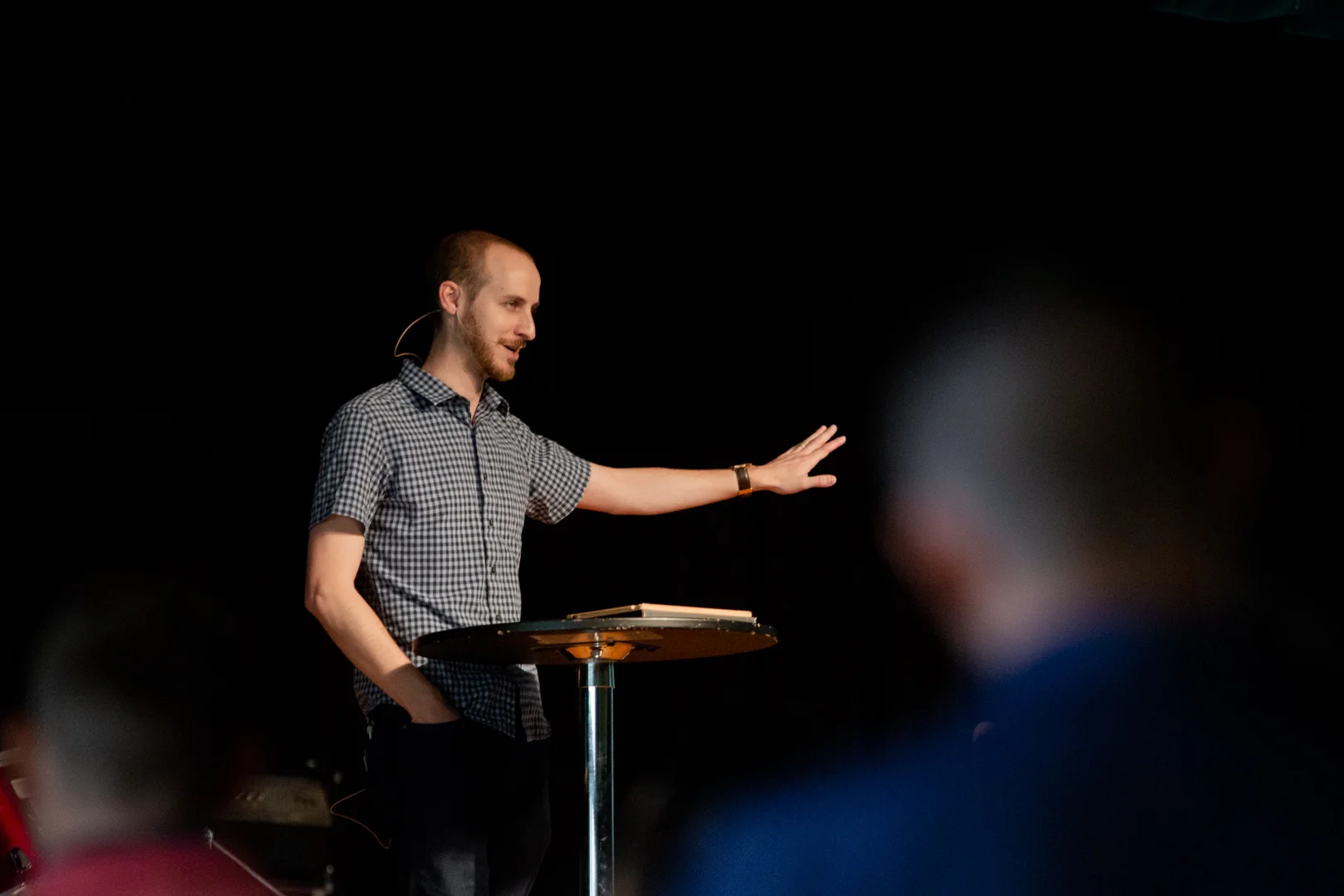

A Trustworthy Authority
Mark 11:27-12:12
A Trustworthy Authority
Mark 11:27-12:12
Main Idea: We can build our life on Jesus because he has a trustworthy, heavenly authority over all things.
I. The Water (11:2-33):
The religious leaders reject Jesus for 3 reasons:
They are unwilling to acknowledge his authority (11:27-28)
They are unwilling to consider the evidence in good faith (11:29-31)
They fear man more than they fear God (11:32-33)
II. The Vineyard (12:1-9)
Hebrews 1:1-2: Long ago, at many times and in many ways, God spoke to our fathers by the prophets, but in these last days he has spoken to us by his Son, whom he appointed the heir of all things, through whom also he created the world.
Matthew 23:37-38: O Jerusalem, Jerusalem, the city that kills the prophets and stones those who are sent to it! How often would I have gathered your children together as a hen gathers her brood under her wings, and you were not willing! See, your house is left to you desolate.
Romans 2:4: Or do you presume on the riches of his kindness and forbearance and patience, not knowing that God’s kindness is meant to lead you to repentance?
His graciousness is as conspicuous as his glory. There was never such a one as he. None of us loves men as Christ loves them; and if the loves of all the tender-hearted in the world could be run together, they would make but a drop compared with the ocean of the compassion of Jesus… He hid not his face from shame and spitting, nor his body from the shedding of blood, nor his soul from deadly agony; but he loved the church, and gave himself for it. It is this lover of souls that becomes God’s advocate with us, and pleads with us that we would cease from our rebellion. Do not refuse him! If you reject him, he answers you with tears; if you wound him, he bleeds out cleansing; if you kill him, he dies to redeem; if you bury him, he rises again to bring us resurrection.
~ Charles Spurgeon, “The Pleading of the Last Messenger”
III. The Stone (12:10-12)
In Hebrew, the punch line involves a provocative pun: a story about a rejected son (‘ben’) becomes a lyric about a rejected stone (‘eben’), which then becomes the most foundational stone of all. For those with ears to hear, it is a parable about Jesus: the Son, and the Stone, who is cast aside, only to be vindicated and exalted to the place of highest honor.
~ Andrew Wilson, The God of All Things
The True Temple
Mark 11:1-25
The True Temple
Mark 11:1-25
Main Idea: Jesus’ messianic arrival invites us to exchange empty religious practice for faith and fruitfulness in him.
I. Parades and Palms (11:1-11)
The divine royalty of Jesus:
His sovereign authority to acquire a colt
The reception and praise of the people
The humility of Jesus:
The humility of a colt
The anti-climax of his arrival
Zechariah 9:9: Rejoice greatly, O daughter of Zion!
Shout aloud, O daughter of Jerusalem!
Behold, your king is coming to you;
righteous and having salvation is he,
humble and mounted on a donkey,
on a colt, the foal of a donkey.
“They believe that salvation means the Messiah will come and destroy the people oppressing them. They will be saved or liberated, and the oppressors will be destroyed. They expect Jesus to judge the nations and save them. They never would have expected that he would judge them and save the nations. What is missing in the story is a repentant people who realize that the true problem is not the Romans but themselves.”
~ Jason Meyer, Mark For You
II. Trees and Temples (11:12-21)
Jeremiah 7:3-11: Thus says the Lord of hosts, the God of Israel: Amend your ways and your deeds, and I will let you dwell in this place. Do not trust in these deceptive words: ‘This is the temple of the Lord, the temple of the Lord, the temple of the Lord.’ “For if you truly amend your ways and your deeds, if you truly execute justice one with another, if you do not oppress the sojourner, the fatherless, or the widow, or shed innocent blood in this place, and if you do not go after other gods to your own harm, then I will let you dwell in this place, in the land that I gave of old to your fathers forever. “Behold, you trust in deceptive words to no avail. Will you steal, murder, commit adultery, swear falsely, make offerings to Baal, and go after other gods that you have not known, and then come and stand before me in this house, which is called by my name, and say, ‘We are delivered!’—only to go on doing all these abominations? Has this house, which is called by my name, become a den of robbers in your eyes? Behold, I myself have seen it, declares the Lord.
“In the temple you had all the leaves, you had all the externals of worship, but there was no true prayer, no belief in the great Lamb of God’s Passover, no truth, no righteousness, no love of men, no care for the glory of God; and so the temple, which had been a house of prayer, had become a den of thieves. You do not marvel that the temple was destroyed. You and I may become just like that temple. We may go on with all the externals of religions, nobody may miss us out of our seat at Tabernacle, nay, we may never miss our Christian engagements; we may be in all external matters more precise than we used to be, and yet for all that, we may have become in our hearts a den of thieves; the heart may be given to the world while external ceremonies are still kept up and maintained. Let us beware of this, for such a place cannot be long without a curse.”
~ Charles Spurgeon, Nothing But Leaves
III. Faith and Fruit (11:22-25)
John 15:5-7: I am the vine; you are the branches. Whoever abides in me and I in him, he it is that bears much fruit, for apart from me you can do nothing. If anyone does not abide in me he is thrown away like a branch and withers; and the branches are gathered, thrown into the fire, and burned. If you abide in me, and my words abide in you, ask whatever you wish, and it will be done for you.

Entering the Kingdom
Mark 10:13-31
Entering the Kingdom
Mark 10:13-31
Main Idea: We can only enter the Kingdom of God by receiving Christ’s generosity empty-handed like a child.
I. The Dependency of a Child (10:13-16)
“Children are not blessed for their virtues but for what they lack: they come only as they are—small, powerless, without sophistication, as the overlooked and dispossessed of society. To receive the kingdom of God as a child is to receive it as one who has no credits, no clout, no claims. A little child has absolutely nothing to bring, and whatever a child receives, he or she receives by grace on the basis of sheer neediness rather than by any merit inherent in himself or herself. Little children are paradigmatic disciples, for only empty hands can be filled”
~ James Edwards
II. The Trap of Riches (10:17-22)
1 Timothy 6:9-10: But those who desire to be rich fall into temptation, into a snare, into many senseless and harmful desires that plunge people into ruin and destruction. For the love of money is a root of all kinds of evils. It is through this craving that some have wandered away from the faith and pierced themselves with many pangs.
“How do you know that money isn't just money to you? Here are some of the signs: You can't give large amounts of it away. You get scared if you might have less than you're accustomed to having. You see people who are doing better than you, even though you might have worked harder or might be a better person, and it gets under your skin. And when that happens, you have one foot in the trap. Because then money is no longer just a tool; it's the scorecard. It's your essence, your identity. No matter how much money you have, though it's not intrinsically evil, it has incredible power to keep you from God.”
~ Tim Keller
III. The Economy of the Kingdom (10:23-31)
"The entrance fee to the Christian life is nothing at all, and the annual subscription is everything you have."
~ Dick Lucas
1 Timothy 6:17–19: As for the rich in this present age, charge them not to be haughty, nor to set their hopes on the uncertainty of riches, but on God, who richly provides us with everything to enjoy. They are to do good, to be rich in good works, to be generous and ready to share, thus storing up treasure for themselves as a good foundation for the future, so that they may take hold of that which is truly life.
2 Corinthians 8:9: For you know the grace of our Lord Jesus Christ, that though he was rich, yet for your sake he became poor, so that you by his poverty might become rich.
Marriage & Divorce
Mark 10:1-12
Marriage & Divorce
Mark 10:1-12
Main Idea: Despite the world’s confusion and our own sin, Jesus calls us to honor God’s design for marriage
I. The Distortion of Marriage (10:1-5)
Matthew 19:3: And Pharisees came up to him and tested him by asking, “Is it lawful to divorce one’s wife for any cause?”
“You do not learn to fly an airplane by following the instructions for making a crash landing; you will not be successful in war if you train by the rules for beating a retreat. The same is true of marriage and divorce. The exceptional measures necessary when a marriage fails are of no help in discovering the meaning and intention of marriage. Jesus endeavors to recover God’s will for marriage, not to argue about possible exceptions to it. His opponents ask what is permissible; he points to what is commanded…The divine intention for marriage cannot be determined from a text about divorce.”
~James Edwards
II. The Design of Marriage (10:6-12)
Jesus quotes Genesis 1:27 and 2:24 to teach:
Marriage is God’s idea, not a human invention
“If the Bible is telling the truth about reality, then the universe we live in was created primarily with marital romance in mind. The heavens and the earth were created for the marriage of Adam & Eve. The new heavens & the new earth will be created for the marriage of Christ & his bride. The whole cosmic reality exists as the venue for the eternal honeymoon of the perfect husband with his perfect bride in marital bliss forever and ever. This is the breathtaking claim of the Bible.”
~ Ray Ortlund, Marriage and the Mystery of the GospelMarriage is between one man and one woman
Marriage is intended to be a covenant, permanent relationship
III. The Mystery of Marriage (cf. Eph. 5:32)
Ephesians 5:32: This mystery is profound, and I am saying that it refers to Christ and the church.
“The cross shows us the permanence of marriage, in a covenant sealed with blood. The cross also shows us that the nature of marriage is the sacrifice of self. That means we give ourselves to each other. We do not wield the threat of divorce as a means of self-protection. Instead, we build marriages that, as best as we can, reflect the one-flesh union of Christ and his church. And then we run to that cross-shaped gospel even when we fail.”
~ Russell Moore, The Storm-Tossed Family

The Refuge for the Restless
Psalm 46
The Refuge for the Restless
Psalm 46
Main Idea: As we live in a restless world, we can find true rest in the Lord.
We will see how we can rest by observing how the Lord secures His people, the Lord lives with His people, and how the Lord leads His people in prevailing peace.
I The Lord Secures His People (1-3)
“What troubles you today? What is it about which you think, “If I can just get that sorted out, life will become manageable. What worries your heart as you lie awake in bed? God says I, not any circumstantial solution am the refuge amidst your adversities. I am the very present help in trouble. I am God. Be still.” - Dane Ortlund
II. The Lord lives among His people (4-7)
III The Lord leads His people in prevailing peace (8-11)

The Greatest Gift
John 3:16
The Greatest Gift
John 3:16
“For God so loved the world, that he gave his only Son, that whoever believes in him should not perish but have eternal life.” John 3:16
Why does God give?
What does God give?
How do we receive God’s gift?
What are the results of God’s gift?
The Humble People
Luke 2:8-20
The Humble People
Luke 2:8-20
Main Idea: Christmas is good news of great joy and an invitation to worship.
I. The Content of Christmas (2:8-12)
As the shepherds are keeping their flock by night, suddenly an angel of the Lord appears and the “glory of the Lord shone around them.” This ‘glory’ (God’s radiant beauty and perfection) produces a great (mega) fear within them, as they feel the weight of God’s holiness. At the bottom of all of our fears is the reality of our sin and guilt.
In the midst of their fear, the angel assures them: “Fear not, for behold I bring you good news (‘gospel’) of great (‘mega’) joy.” Each word in this ‘gospel’ tells us about the meaning of Christmas:
Unto you (and for all the people)
Is born this day in the city of David (the promise of a royal son from the Davidic line)
A Savior
Christ (‘Messiah;’ the long-promised anointed one of God)
The Lord (God himself; cf. Isa. 9:6-7)
“The crucial significance of the cradle at Bethlehem lies in its place in the sequence of steps that led the Son of God to the cross of Calvary… the Christmas message is that there is hope for a ruined humanity – hope of pardon, hope of peace with God, hope of glory – because at the Father’s will Jesus Christ became poor and was born in a stable so that thirty years later he might hang on a cross. It is the most wonderful message that the world has ever heard or will hear.”
~ J.I. Packer, Knowing God
II. The Chorus of Christmas (2:13-14)
Suddenly a multitude of the ‘heavenly host’ appears with the angel. This language indicates the angelic army (cf. Josh 5:13-15). They are proclaiming a battle-cry:
Glory to God in the highest: of all the things this heavenly host had seen God do before, this moment of the incarnation of Christ spurs this response
Peace on earth: the coming of Christ brings peace and joy to those who have been stuck in the bondage of sin and fear, knowing that Jesus has come to accomplish peace through the hostility of the cross.
III. The Call of Christmas (2:15-20)
Christmas is an invitation to go and investigate further the claim of a Savior who has been born unto us. “Christianity, if false, is of no importance, and if true, of infinite importance, the only thing it cannot be is moderately important.” ~ C.S. Lewis
We see three exemplary responses in this passage:
Wonder & Amazement (2:18)
Treasuring & Pondering (2:19)
“The more we look at [the incarnation], the more we are astonished; the more we become accustomed to it, the more have we a sense of its surpassing splendor of love and grace. There is more of God’s glory and majesty to be seen in the manger and the cross, than in the sparkling stars above, the rolling deep below, the towering mountain, the teeming valleys, the abodes of life, or the abyss of death. Let us then give ourselves up to holy wonder, such as will produce gratitude, worship, love, and confidence, as we think of that great “mystery of godliness, God manifest in the flesh.”
~ Charles SpurgeonGlorifying & Praising (2:20)
The Humble Place
Micah 5:1-5a
The Humble Place
Micah 5:1-5a
Main Idea: Jesus is the promised King, born in humility, who will shepherd us into security and peace.
I. The Promise of A Ruler (5:1-2)
Micah’s prophetic ministry coincides with Isaiah, with the Assyrians having conquered the Northern Kingdom and now closing in on Jerusalem. Micah warns that things will be worse before they improve; they should “muster their troops” for warfare, as their city is on the brink of destruction and their “judge” (king) is publicly humiliated.
In contrast, God promises a ruler to come in verse 2. We learn 3 things about this promised king:
He is “from old, from ancient days”
He will serve God faithfully
He will be born in Bethlehem
1 Corinthians 1:27–29: But God chose what is foolish in the world to shame the wise; God chose what is weak in the world to shame the strong; God chose what is low and despised in the world, even things that are not, to bring to nothing things that are, so that no human being might boast in the presence of God.
II. A Tale of Two Kings (5:3-4a, cf. Matt. 2:1-18)
This prophecy related to Bethlehem creates a collision in the NT between:
King Herod. The (self-proclaimed) “King of the Jews” channeled all the world’s power and strategies to promote his own glory, willing to use violence and any means necessary to make a name for himself.
King Jesus. Micah promises that Jesus will gather God’s people back together after a period of exile, and that he will rule as a “shepherd” over his flock in toughness and in tenderness, showcasing the strength of God over and against the strength of mankind.
“Christ then rules not in his Church as a dreaded tyrant, who distresses his subjects with fear; but he is a Shepherd who gently deals with his flock. Nothing therefore can exceed the kindness and gentleness of Christ towards the faithful, as he performs the office of a Shepherd.”
~ John Calvin
While Herod was willing to sacrifice others in order to benefit himself, Jesus sacrifices himself to benefit others (cf. Jn. 10:11, Mk. 10:45). Bethlehem is the perfect birthplace for Jesus, as it sets the trajectory for a life and ministry marked by humility. The cradle in Bethlehem ultimately leads to the cross of Christ.
III. The Results of His Reign (5:4b-5a)
While Christ is lowborn in obscurity and killed in scandal, he is the King who has been resurrected in glory and promises to return to make all things new, establishing his earthly throne forever. The promises here in Micah draw our attention beyond the first advent of Christ to his second coming.
There are two results for those in the Kingdom of Christ:
Security: Those in his flock will “dwell secure” as a result of his greatness that will extend to the ends of the earth. Those who take up the humble place before his greatness, embracing their own obscurity and smallness, will experience this promise (cf. Jn. 3:30, Ps. 131)
Peace: The peace that we all long for is not found in better circumstances or in the next best thing that the world has to offer, but only in Christ.
“Christ is always born in Bethlehem among the little ones. Big hearts never get Christ inside of them; Christ lives not in great hearts, but in little ones. Mighty and proud spirits never have Jesus Christ, for he comes in at low doors, but he will not come in at high ones. He who has a broken heart, and a low spirit, shall have the Savior, but none else… He is the Christ of the little ones.”
~ Charles Spurgeon
The Humble Principle
Luke 1:46-55
The Humble Principle
Luke 1:46-55
Main Idea: The coming of Christ is the great reversal, putting the proud on notice and exalting the humble.
I. God is Mindful (1:46-48, 54-55)
Though the news from the Angel Gabriel to Mary would have been incredibly disruptive, she responds by searching (1:29; lit. ‘taking an audit’), then surrendering (1:38), and finally singing in praise (1:46ff). She responds in with humble gratitude and praise because:
1. Her eyes are focused on God (1:46-48)
Mary is able to “magnify” the Lord because she is caught up that the Lord of the universe is mindful of her (cf Ps. 8:1-4). Though she did not seek this out, and her circumstances will be difficult, she will be “blessed” because of what God is doing.
2. Her mind is filled with Scripture (1:54-55)
Nearly every line of Mary’s Magnificat is a Biblical quotation (most notably, Hannah’s song in 1 Sam. 2). While it would have been easy to believe that God had forgotten about his promises, he has “remembered” his word to Israel and Abraham (cf. 2 Pet. 1:8-9). His ‘mindfulness’ is seen supremely in the story of Christmas, as he moves toward those helpless and of humble estate in the incarnation of Christ.
II. God is Mighty (1:49-53)
Mary sings about the “mighty” works of God, and specifically, how he brings low those who are lofty in pride. She speaks in the past tense, echoing great stories of the OT where the might of God and his strong “arm” delivered his people. “[The gospel] is not only a complete reversal of everything that man has ever proposed, it condemns, it demolishes, it scatters everything in which man by nature trusts” ~ Martyn Lloyd-Jones, Magnify the Lord
Mary’s song identifies three specific areas of pride that will be overthrown by God:
The Pride of Intellect & Wisdom (1:51)
Through the cross of Christ, God has “made foolish” the wisdom of this world, “destroying the wisdom of the [so-called] “wise” (1 Cor. 1:18-25); God has hidden the truths of the gospel from the “wise and understanding” who are blinded in their pride, and “revealed them to little children” (Matt. 11:25).The Pride of Position & Power (1:52)
As the One who has the ultimate throne and the heavenly seat of authority, God is the one who “removes kings and sets up kings” (Dan. 2:21). The seemingly powerful by the standards of this world will be brought down, while the humble will be exalted.
Matthew 5:5: “Blessed are the meek, for they shall inherit the earth.”The Pride of Wealth & Riches (1:53)
The coming of Christ creates a paradox: the “full” will leave empty and hungry, while the hungry and the empty will be filled. Riches and wealth can create an illusion of “fullness” that leaves no room for God; those who are already satisfied with their life, status, and financial standing have no need of help or salvation from God.
Matthew 5:6: “Blessed are those who hunger and thirst for righteousness, for they shall be satisfied.”
Christmas and the Magnificat tell the story of the “great reversal,” as God works in ways we would not expect. The wise of this world will be made foolish, those who occupy thrones will be brought low, and the rich will be sent away empty, all because the omniscient One comes as a baby, the King of all kings is born in weakness and obscurity, and the Heir of the universe becomes poor.
“When the King of kings and the Lord of lords came into this world, he came into a stable. If you do not feel a sense of holy laughter within you, I do not see that you have a right to think that you are a Christian. Thank God, this is the gospel, this is salvation. God turning upside down, reversing everything we have ever thought, everything we have taken pride in. The mighty? Why, he will pull them down from their seats. He has been doing so. He is still doing so. Let any man arise and say he is going to govern, to be the god of the whole world; you need not be afraid—he will be put down. Every dictator has gone down; they all do. Finally, the devil and all that belong to him will go down to the lake of fire and will be destroyed forever. The Son of God has come into the world to do that.”
~ Martyn Lloyd-Jones, Magnify the Lord
III. God is Merciful (1:50, 54)
If God is only mindful and mighty, but not merciful, we are all in trouble. But Mary’s song reminds us: “his mercy is for those who fear him” and he has helped the humble “in remembrance of his mercy.” But it is only those who take up the “low place” in the fear of the Lord and receive the humble principle of grace (cf. Mark 2:17).
1 Peter 5:5b-6:Clothe yourselves, all of you, with humility toward one another, for “God opposes the proud but gives grace to the humble.” Humble yourselves, therefore, under the mighty hand of God so that at the proper time he may exalt you,
The Humble Path
Isaiah 8:19-9:7
The Humble Path
Isaiah 8:19-9:7
“Advent is the season that, when properly understood, does not flinch from the darkness that stalks us all in this world. Advent begins in the dark and moves toward the light—but the season should not move too quickly or too glibly, lest we fail to acknowledge the depth of the darkness… Advent bids us take a fearless inventory of the darkness: the darkness without and the darkness within.”
~ Fleming Rutledge
Main Idea: God calls us out of our pride through the glorious gift of Jesus, who must be humbly received.
I. The Darkness of Pride (8:19-22)
Assyria was closing in on Israel, but rather than looking to the Lord & his Word for wisdom and guidance (8:20), they consulted mediums and “looked to the earth” (8:22) for the solutions to their problems. They pridefully assumed they could figure out how to get out of the darkness on their own, and it only led them into further “thick” darkness.
Advent reminds us that the state of this fallen world is darkness, representing chaos, evil, and sin in the Scriptures (cf. Jn. 3:19). While it is easy for us to focus on all of the problems external to us, we must also acknowledge the problems internal to us if we are to repent of our pride (cf. Isaiah 5-6, Ps. 130:3)
“If only it were so simple, that there were evil people somewhere insidiously committing evil deeds, and it were necessary only to separate them from the rest of us and destroy them. But the line dividing good and evil cuts through the heart of every human being.”
~ Alexander Solzhenitsyn
II. The Path of Glory (9:1-5)
Those who dwell in Galilee, most vulnerable to invasion and who dwell in “deep darkness” (lit. ‘death shadow’) will suddenly and unexpectedly have a light shine (flash) upon them (Mt. 4:12-17). This light comes from outside the world, not from within it.
This glorious light will bring about:
Joy (9:3): as in the day of full harvest & after a military victory.
Freedom (9:4): the Lord will break the yoke, rod, and staff of the oppressors, just as he did in the day of Midian (Judges 6-7)
Peace (9:5): all the necessities of warfare will go into the “bonfire of God’s grace” (Ray Ortlund)
III. The Gift of the Child (9:6-7)
How will God bring about this joy, freedom, and peace? He will do so through the most unexpected means: “For to us a child is born, to us a son is given...”
“God’s answer to everything that has ever terrorized us is a child. The power of God is so far superior to the Assyrians and all the big shots of this world that he can defeat them by coming as a mere child. His answer to the bullies swaggering through history is not to become an even bigger bully. His answer is Jesus.”
~ Ray Ortlund
Isaiah indicates that this is not merely a royal birth announcement; these names (Wonderful Counselor, Mighty God, Everlasting Father, Prince of Peace) are only attributable to God himself. These names push us beyond the manger scene to the totality of the life of this promised King. Though it appeared that darkness snuffed out Jesus at the cross, his resurrection three days later definitely proves “the light shines in the darkness and the darkness has not overcome it” (Jn. 1:5).
The invitation of this good news is to repent of our pride that contributes to the darkness, and to step foot in faith into the light of the glorious reign of this promised child. But the only way to experience this glory is the humble path.
“There has never been a gift offered that makes you swallow your pride to the depths that the gift of Jesus Christ requires us to do. Christmas means that we are so lost, so unable to save ourselves, that nothing less than the death of the Son of God himself could save us. That means you are not somebody who can pull yourself together and live a moral and good life. To accept the true Christmas gift, you have to admit you're a sinner. You need to be saved by grace. You need to give up control of your life. That is descending lower than any of us really wants to go. Yet Jesus Christ’s greatness is seen in how far down he came to love us. Your spiritual regeneration and eventual greatness will be achieved by going down the same path.”
~ Tim Keller, Hidden Christmas