
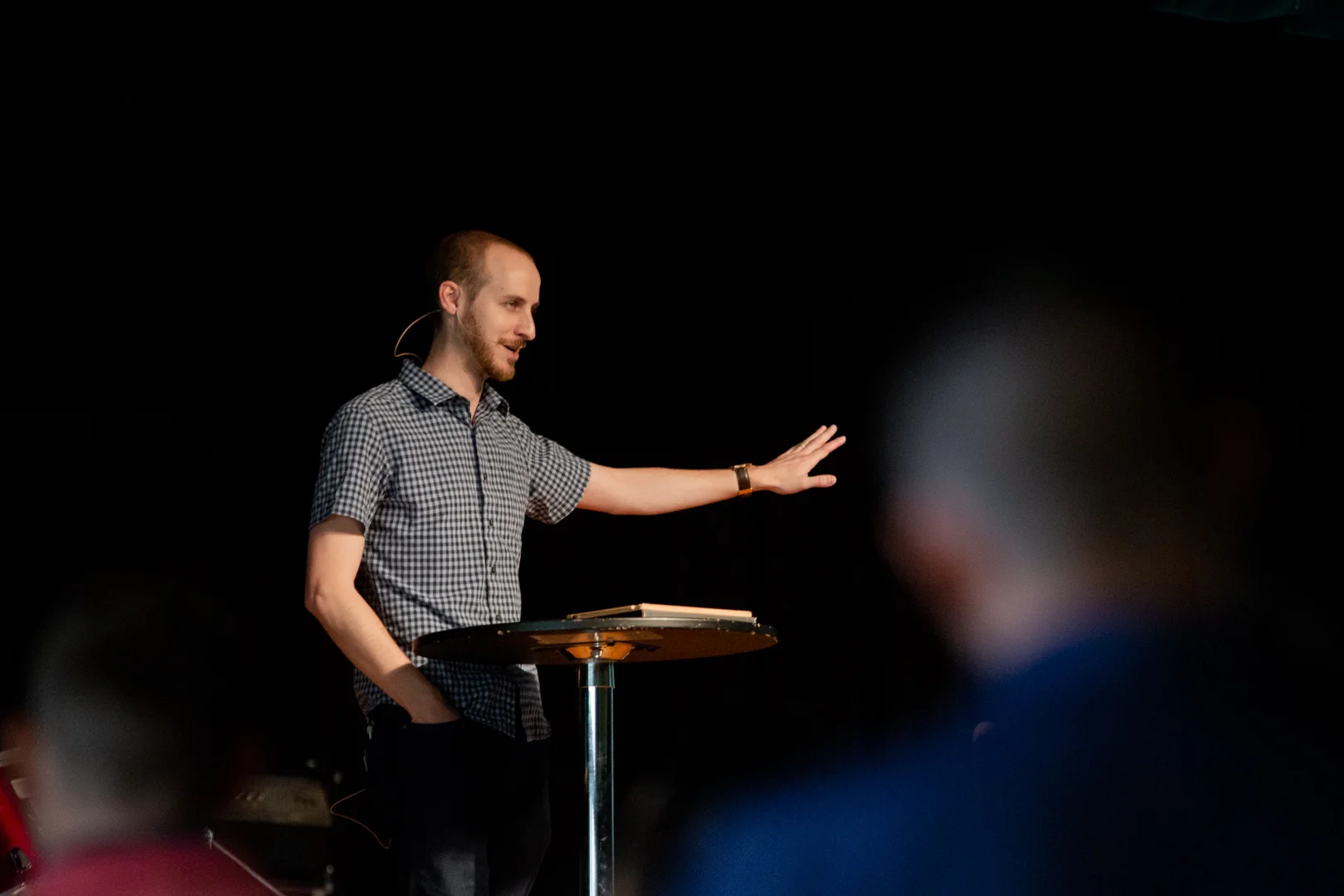

Adorning the Gospel Together
Titus 2:1-10
adorning the gospel together
Titus 2:1-10
Main Idea: We adorn the beauty of the gospel by living with ordinary faithfulness in every season together.
I. The Priorities of Ministry (2:1, 7-8)
In his role as pastor/elder, Titus must be a ‘model’ (prototype) of sound doctrine and good works, so that the church is built up (Eph. 4:11-12) and opponents are silenced (2:8).
Apart from Christian theology, we don’t know what the Christian life should look like. If we believe the Christian life should be characterized by hospitality, forgiveness, love, mercy, and faith, we need Christian doctrine to fill those words with Christian meaning. Without doctrine, we’re left with mere sentiment.
~ Trevin Wax, The Thrill of Orthodoxy
II. The Household of Faith (2:2-6, 9-10)
A. Older Men (2:2)
Ecclesiastes 7:10: Say not, “Why were the former days better than these?” For it is not from wisdom that you ask this.
B. Older Women (2:3)
C. Younger Women (2:4-5)
It would not be legitimate to base on this word either a stay-at-home stereotype for all women, or a prohibition of wives being also professional women. What is rather affirmed is that if a woman accepts the vocation of marriage, and has a husband and children, she will love and not neglect them… What he is opposing is not a wife’s pursuit of a profession, but ‘the habit of being idle and going about from house to house. (1 Tim. 5:13)
~ John Stott, The Message of 1 Timothy & Titus
D. Younger Men (2:6)
E. Bondservants (2:9-10)
While we cannot defend the indolence or cowardice of two further Christian centuries which saw this social evil but failed to eradicate it, we can at the same time rejoice that the gospel immediately began even in the first century to undermine the institution; it lit a fuse which at long last led to the explosion which destroyed it.
~ John Stott, The Message of Ephesians
Colossians 3:23–24: Whatever you do, work heartily, as for the Lord and not for men, knowing that from the Lord you will receive the inheritance as your reward. You are serving the Lord Christ.
Conclusion: Adorning the Beauty of the Gospel (2:10b)
Making the World a Better Place
Titus 1:7-2:1
Making the world a better place
Titus 1:7-2:1
Main Idea: Every Christian is called to strategically counteract error, especially those who nurture others.
I. Why is this so important?
The simple answer is that false ideas and bad behavior do not make the world a better place. They are like a cancer that invades a person’s life then metastasizes to their family, their neighborhood, and eventually their whole culture. If you know anything about cancer, it is an apt metaphor to the damage false ideas and bad behavior bring into the world. Cancer never makes things better. It must be counteracted.
II. How are we called to do it?
The right and simple answer here is: STRATEGICALLY. By this we mean thoughtfully, intentionally, tactfully. Keep in mind that Jesus’ objective for the moral wasteland that is Crete is to reclaim it for Himself, redeem its inhabitants to Himself, and release it to flourish and prosper under His generous rule. He wants to make Crete a better place. Central to doing that is addressing the bad behavior and false ideas that are currently
destroying Crete and its inhabitants
Holding firm to the word of God:
Confronting error strategically with a view to making the world a better place requires a reference point. Something must exist that differentiates error from truth, cancer from healthy tissue. Something must paint a compelling vision of what “better” looks like that is more than merely my opinion versus yours. And whatever that reference point is, we must track to it as we would to True North were we lost in a trackless wilderness. “Holding firm to the faithful Word” is being convinced that there is such a thing as True North and organizing all our ideas and actions into alignment and agreement with it.

Re-orient our expectations into alignment with the gospel and the “last days.”
Titus 2:11-14: For the grace of God has appeared, bringing salvation for all people, training us to renounce ungodliness and worldly passions, and to live self-controlled, upright, and godly lives in the present age, waiting for our blessed hope, the appearing of the glory of our great God and Savior Jesus Christ, who gave himself for us to redeem us from all lawlessness and to purify for himself a people for his own possession who are zealous for good works.
Putting into Order
Titus 1:1-9
Putting into Order
Titus 1:1-9
Main Idea: God’s church is rightly ordered when we hold to sound doctrine, pursue godliness, and follow exemplary leadership.
I. Eternal Gospel Hope (1:1-4)
Paul’s ministry as a servant and an apostle was for the sake of the “faith of the elect.” This faith is marked by two components, a “knowledge of the truth” that “accords with godliness.”
We can have confidence in the hope of eternal life because of:
God’s Promise (“...promised before the ages began”)
God’s Character (“God, who never lies…” cf. Num. 23:19)
“This is very comforting to the Christian, that whatever God has said in the divine purpose is never changed. The decrees of God were not written upon sand, but upon the eternal brass of his unchangeable nature.”
~ Charles Spurgeon, “What God Cannot Do!”God’s Word (“at the proper time manifested in his word through the preaching…”)
2 Timothy 4:1–5: I charge you in the presence of God and of Christ Jesus, who is to judge the living and the dead, and by his appearing and his kingdom: 2 preach the word; be ready in season and out of season; reprove, rebuke, and exhort, with complete patience and teaching. 3 For the time is coming when people will not endure sound teaching, but having itching ears they will accumulate for themselves teachers to suit their own passions, 4 and will turn away from listening to the truth and wander off into myths. 5 As for you, always be sober-minded, endure suffering, do the work of an evangelist, fulfill your ministry.
II. Exemplary Gospel Leadership
Titus must “put what remained into order” by appointing elders (or pastors) who are “above reproach” in:
Marriage & Family (1:6; cf. 1 Tim. 3:5)
Character & Conduct (1:7-8)
Doctrine & Instruction (1:9; cf. 1 Tim. 4:16)
“[Pastors] have the responsibility of explaining what God has said in his Word, declaring what God has done in his Son, and applying this message to the hearts of people.”
~ Tony Merida, The Faithful Church Planter“The pastor ought to have two voices: one, for gathering the sheep; and another, for warding off and driving away wolves and thieves. The Scripture supplies him with the means of doing both; for he who is deeply skilled in it will be able both to govern those who are teachable, and to refute the enemies of the truth.”
~ John Calvin

Gospel Mission
Romans 15:1-7
The GOSPEL AND adoption
rOMANS 15:1-7
Acts 17:6–7: “These men who have turned the world upside down have come here also… saying that there is another king, Jesus.”
Main Idea: We are called to ordinary gospel-driven lives to the glory of God.
I. We Love Our Neighbors (15:1–2)
Romans 15:1–2: “We who are strong have an obligation to bear with the failings of the weak, and not to please ourselves. Let each of us please his neighbor for his good, to build him up”
II. We Resolve to Appear Foolish for Christ’s Sake (15:3)
Romans 15:3: “For Christ did not please himself, but as it is written, “The reproaches of those who reproached you fell on me.”
1 Corinthians 1:18: “For the word of the cross is folly to those who are perishing, but to us who are being saved it is the power of God.”
III. We Holdfast to the Sufficiency of Scripture (15:4)
Romans 15:4: For whatever was written in former days was written for our instruction, that through endurance and through the encouragement of the Scriptures we might have hope
1 Peter 3:15: “In your hearts honor Christ the Lord as holy, always being prepared to make a defense to anyone who asks you for a reason for the hope that is in you; yet do it with gentleness and respect.”
1 Corinthians 15:3–4:“Christ died for our sins in accordance with the Scriptures, that he was buried, that he was raised on the third day in accordance with the Scriptures.”
IV. We Live in Christ Exalting Harmony (15:5-6)
Romans 15:5–6: May the God of endurance and encouragement grant you to live in such harmony with one another, in accord with Christ Jesus, that together you may with one voice glorify the God and Father of our Lord Jesus Christ.
V. We Welcome One Another as Christ has Welcomed Us (15:7)
Romans 15:7: Therefore welcome one another as Christ has welcomed you
Conclusion: For the Glory of God (15:7b)
We exist to see a greater worship of Jesus through declaring and displaying the gospel.

The Gospel and Adoption
Romans 8:12-17
The GOSPEL AND adoption
rOMANS 8:12-17
What is a Christian? The question can be answered in many ways, but the richest answer I know is that a Christian is one who has God as Father… If you want to judge how well a person understands Christianity, find out how much he makes of the thought of being God’s child, and having God as his Father. If this is not the thought that prompts and controls his worship and prayers and his whole outlook on life, it means that he does not understand Christianity very well at all.
~ J.I. Packer, Knowing God
Main Idea: Though we were orphans, we have been adopted into God’s family and guaranteed an inheritance with Christ.
I. Brothers & Sisters by the Spirit (8:12-13)
John 14:16-18: “And I will ask the Father, and he will give you another Helper, to be with you forever, even the Spirit of truth, whom the world cannot receive, because it neither sees him nor knows him. You know him, for he dwells with you and will be in you. I will not leave you as orphans; I will come to you.”
II. Sons of the Father (8:14-16)
The Spirit makes the heart of Christ real to us: not just heard, but seen; not just seen, but felt; not just felt, but enjoyed. The Spirit takes what we read in the Bible and believe on paper about Jesus’ heart and moves it from theory to reality, from doctrine to experience. It is one thing, as a child, to be told your father loves you. You believe him. You take him at his word. But it is another thing, unutterably more real, to be swept up in his embrace, to feel the warmth, to hear his beating heart within his chest, to instantly know the protective grip of his arms. It’s one thing to hear he loves you; it’s another thing to feel his love. That is the glorious work of the Spirit.
~ Dane Ortlund, Gentle & Lowly
III. Co-Heirs with the Son (8:17)
We should not try to correct Scripture. It is true that in Rome ‘sonship’ was a status of privilege and power given only to males. Yet Paul now has the boldness to apply this to us - to all believers! This shows that God does not distinguish in giving honor. All Christians, male and female, are now his heirs. It was a subversive thing for Paul to take a masculine-only institution and show that, in Christ, the institution of "empowering-through-adoption" is used on females as well as males without distinction. Christian women should not resent being called "sons" any more than Christian men should resent being called part of the bride of Christ (Revelation 21:2).
~ Tim Keller, Romans 8-16 For You
Our inheritance with Christ means:
Our Past is Redefined (Gal. 3:13-14)
Our Present is Redeemed (Heb. 2:11)
Our Future is Secure (Eph. 1:3)

The Gospel and Church Planting
Romans 1:1-15
The GOSPEL AND CHURCH PLANTING
rOMANS 1:1-15
Matthew 28:18-20 And Jesus came and said to them, “All authority in heaven and on earth has been given to me. Go therefore and make disciples of all nations, baptizing them in the name of the Father and of the Son and of the Holy Spirit, teaching them to observe all that I have commanded you. And behold, I am with you always, to the end of the age.
Main Idea: The gospel compels us to plant churches among the nations for the sake of Jesus’ name.
I. The Foundation of Church Planting (1:1-5a)
The Gospel of God (1:1; cf. 1:16)
The Word of God (1:2)
The Son of God (1:3-4)
The Grace and Commissioning of God (1:5a)
II. The Aim of Church Planting (1:5b)
“... to bring about the obedience of faith for the sake of his name” (cf. Phil. 2:9-11)
The highest of all missionary motives is neither obedience to the Great Commission (important as that is), nor love for sinners who are alienated and perishing (strong as that incentive is), but rather zeal — burning and passionate zeal — for the glory of Jesus Christ.”
~ John Stott, The Message of Romans
III. The Scope of Church Planting (1:5c)
“... among all the nations.” (cf. 15:8-9, 20-24)
By planting churches, we have the privilege of being in on God's sovereign work in the world. God's redemptive plan has always involved having a people for himself (Titus 2:14; 1 Pet. 2:9-10). When you start a church, you’re doing more than starting an event at a storefront, school, under a tree, in a house, or at some other location You're actually participating in the grand narrative of God having a people for himself (Acts 18:10), a story that culminates in John's glorious vision in Revelation where a people from every tribe and language and nation are giving praise to the Lamb (Rev. 5:1-14). This vision compels us to be faithful in our present generation until the mission is finished.
~ Tony Merida, The Faithful Church Planter
IV. The Results of Church Planting (1:8-15)
The Gospel is Preached (1:15)
The Lost are Saved (1:13-14)
Churches are Strengthened (1:11-12)
God is Glorified
Implications:
We must pray for the work of church planting (cf. Matt. 9:35-38)
We must be generous toward the work of church planting
We must be eager to share the gospel to catalyze the work of church planting
Social networks are the basic mechanism through which conversions take place ... Most conversions are not produced by professional missionaries conveying a new message, but by [church] members who share their faith with their friends and relatives ... Although the very first Christian converts in the West may have been by full-time missionaries, the conversion process soon became self-sustaining as new converts accepted the obligation to spread their faith and did so by missionizing their immediate circle of intimates.
~ Rodney Stark, Cities of God

Seized by the Resurrection - Easter Sunday
Mark 15:40-16:8
Seized by the resurrection
Mark 15:40-16:8
Main Idea: The resurrection of Christ unsettles everything and evokes a response.
I. The Trauma of Death (15:40-47)
Death is always traumatic and an unwelcomed enemy and intruder (cf. 1 Cor. 15:26), but the crucifixion of Christ was especially traumatic. Joseph of Arimathea exercised “courage” because he was requesting the body of a convicted and executed man who was viewed to be cursed by God (cf. Isa. 53:9)
We owe it to those first Christian disciples to do our very best to understand the utter hopelessness of their situation after the crucifixion. They had invested their whole lives in what appeared to be a diabolical joke. They had seen their beloved Master scourged almost to death, dragged through the streets, nailed to a cross and abandoned to suffer public agony in the face of the obscene mockery of everybody in Jerusalem. Once they had basked in the reflected status of a celebrity who had been mobbed by large crowds; now he had been judged a nonperson, fit only for the most degrading and sadistic death that the human mind was capable of devising. If there had been any solidarity among his followers, it had vanished; not one person had dared to come forward in the Master's defense, and their supposed leader, Peter, had cravenly denied Jesus three times, There was nothing left… The Messiah was supposed to usher in the kingdom of God; for those disciples who had staked their lives on Jesus being that Messiah, it cannot be stated too strongly: there was no hope.
~ Fleming Rutledge, The Undoing of Death
II. The Shock of Resurrection (16:1-8)
Despite Jesus explicitly predicting his crucifixion and resurrection four times in Mark (8:31-32, 9:30-32, 10:32-34, 14:26-28), no one is expecting nor looking for Jesus to be raised from the dead. This is why the women are “seized… alarmed… trembling… astonished… and afraid.”
Mark’s ending points to a truth that often gets lost in the celebration: Easter is a frightening prospect. For the women, the only thing more terrifying than a world with Jesus dead was one in which he was alive.
~ Esau McCaulley, "The Unsettling Power of Easter”
III. The One Who Goes Before Us (16:7)
The resurrection of Christ should:
1. Challenge your reality (“see the place where they laid him”)
“Christianity, if false, is of no importance, and if true, of infinite importance, the only thing it cannot be is moderately important.”
~ C.S. Lewis, “God in the Dock”
2. Comfort your heart (“go, tell his disciples and Peter…”)
3. Change your life (“he is going before you to Galilee. There you will see him, just as he told you.”)
The resurrection of Christ is not just something to believe in; it’s something to be lived. Christ is not a dead teacher. If he was a dead teacher, then being a Christian would just be to believe what he said. Since he’s a risen Lord, he comes and penetrates our lives with a new order of being.
~ Tim Keller

Christ Crucified - Good Friday
Mark 15:21-39
Christ crucified
Mark 15:21-39
Main Idea: Christ has turned an instrument of terror and shame into our symbol of salvation and hope.
I. The Paradox of the Cross (15:21-32)
The crucifixion scene has a number of haunting, divine ironies:
Simon of Cyrene vs. Simon Peter
Those acting against Jesus are fulfilling prophecy (cf. Psalm 69:21; 22:18, Gen. 3:15)
The mockery of Jesus as being a “King” who is crucified and a “Savior” unable to save himself
[The cross] is the climax of human blindness and iniquity spilling over in brutal outrage against God’s Son; it shows a world that has gone topsy-turvy. Jesus is a king who died an outlaw’s death. Jesus is the Messiah, who was rejected by the people he came to deliver. Jesus is the mighty Son of God, who did not use his power for himself but died a seemingly powerless death. All traditional symbols have been reversed. Weakness is a sign of power. Death is the means to life. God forsakenness leads to reconciliation with God. The perpetrators who executed Jesus did not realize that they were executing God’s will (14:36) and that Jesus submitted willingly as God’s obedient Son (10:45). They also did not realize that this death would not be the end of him. Instead, it meant the end of their whole order. They could not fathom how such a powerless death disclosed the character and power of God.
~ David Garland
II. The Prayer of the Cross (15:33-37)
A supernatural darkness of divine judgment covered the land from 12pm-3pm, when the sun should be at its brightest; Jesus’ death is ultimately a cursed, sin-bearing, substitutionary death on behalf of a guilty humanity (Psalm 21:1ff)
[Jesus] is not on the cross by mistake… The crucifixion was not just an unfortunate thing that happened to Jesus on his way to the resurrection. It is not a momentary blip on the arc of his ascent to the Father. It is precisely on the cross that the work of Jesus is carried through to its completion.
~ Fleming Rutledge, Three Hours
III. The Power of the Cross (15:38-39)
Immediately after Jesus died, two things occur:
1. The temple curtain is torn in two (15:38; cf. 1:10)
Hebrews 10:19–22a: “Therefore, brothers, since we have confidence to enter the holy places by the blood of Jesus, by the new and living way that he opened for us through the curtain, that is, through his flesh, and since we have a great priest over the house of God, let us draw near with a true heart in full assurance of faith…”
2. A Roman Centurion acknowledges his true identity as the “Son of God” (15:39; cf 1:1)

The Cross of Jesus, the Christ
Mark 15:1-20
The Cross of Jesus, the christ
Mark 15:1-20
How was it that a cult inspired by the execution of an obscure criminal in a long-vanished empire came to exercise such a transformative and enduring influence on the world?
— Tom Holland
Main Idea: The cross of Jesus, the Christ, is the hinge of history and your story.
In the Christian theology of history, the death of Christ is the central point of history; here all roads of the past converge; hence all the roads of the future diverge.
— Bishop Stephen Neill
It is self-evident that everyone involved with what is happening here - except for Jesus - is oblivious to what is really going on.
Equally self-evident in the scope of the Bible’s storyline, what is really going on here is vastly more significant than what is happening, even though what is happening here is horrifying and shocking.
I. What is happening here?
A conspiracy hatched by Judaism’s elite is playing out.
A gross miscarriage of justice is carried out.
Everything Jesus foretold would happen to him is happening to him!
This is utterly astounding on two levels:
First, Jesus knew in graphic detail exactly what was going to happen to Him in Jerusalem days and months before it actually happened and he not only let it happen, but willingly stepped into it.
Second, how did he know? It is abundantly clear that everyone else in this story is being carried along by what is happening. And it is becoming clearer that Jesus is actually choreographing what is going on. As you read the other Gospel accounts, especially John’s, you cannot escape the fact that Jesus was both the architect of his execution and the victim of his execution.
II. What is really going on here?
Here is how the apostle Paul puts it when relaying the bigger story to believers in Corinth: “For I delivered to you as of first importance what I also received: that Christ died for our sins in accordance with the Scriptures…”
In other words, here is what is really going on in this chapter of Mark: Christ is dying for our sins according to the Scriptures.
Who is this man? - He is the Christ. That means Jesus is the One to whom all of the major promises made by God since the Fall have been pointing to.
By the time the Old Testament comes to an end the characteristics and conduct of the Messiah are so clear, that any charlatan could easily be exposed and only the true Messiah would truly fit the bill.
How did Jesus know what would happen to him? - the Scriptures! The early promises in the Bible point to it. The Son born to the woman would crush the snakes head, but in the process his heal would be bruised.
The entire Jewish system of worship was built around bulls and goats, sheep and doves dying in the place of penitent worshippers. Its high and holy days, such as Passover and the Day of Atonement - focused entirely on an innocent animal covering the sins of the guilty ones and standing between them and death.
It is not at all hard to imagine that Jesus, acquainted with the Scriptures and fully aware of who he truly was, knew precisely what was going to happen to him.
Here is the glory of Jesus, the Christ, our Savior. He so fully loved the LORD His God that he willingly stepped into his role so that the Father’s will of saving the world could be accomplished. Not only that, but Jesus so fully loved us, with whom he came to be “neighbor” that he laid down his life for us!
In the events Mark records in this passage of Scripture, no one wants Jesus. But Jesus wants them. So Christ died for our sins according to the Scriptures.

Two Trials
Mark 14:53-72
*Unfortunately we did not record the audio or video from this sermon. Pastor Ian's notes are available below for anyone interested. We sincerely apologize for any inconvenience.
Two Trials
Mark 14:53-72
Main Idea: Jesus was condemned in our place so that our fears and failures become the arena of God’s grace.
I. Jesus’ Trial (14:53-65)
Jesus remains silent because:
1. He is innocent
2. He is fulfilling prophecy written about him
Isaiah 53:7-8a: He was oppressed, and he was afflicted,
yet he opened not his mouth;
like a lamb that is led to the slaughter,
and like a sheep that before its shearers is silent,
so he opened not his mouth.
By oppression and judgment he was taken away
3. He is on trial in the place of the guilty
“Of all the things Jesus could have said, he specifically says he’s the judge. By his choice of text [Daniel 7 & Psalm 110], Jesus is deliberately forcing us to see the paradox. There’s been an enormous reversal. He is the judge of the entire world, being judged by the world. He should be in the judgment seat, and we should be in the dock, in chains. Everything is turned upside down.”
~ Tim Keller, King’s Cross
II. Peter’s Trial (14:66-72)
Luke 22:61: And the Lord turned and looked at Peter. And Peter remembered the saying of the Lord, how he had said to him, “Before the rooster crows today, you will deny me three times.”
There were volumes of meaning in that look… I think it was a heart-piercing look and a heart-healing look all in one — a look which revealed to Peter the blackness of his sin, and also the tenderness of his Master’s heart towards him.
~ Charles Spurgeon, “Peter’s Fall and Restoration”
Luke 22:31–32:“Simon, Simon, behold, Satan demanded to have you, that he might sift you like wheat, but I have prayed for you that your faith may not fail. And when you have turned again, strengthen your brothers.”
Simon Peter had to see, after his own sword-swinging and fireside-swearing and midnight running, that the answer for him was not that he had nothing to fear, but that the fears were answered by the one who stood on his behalf before the Father praying ‘that your faith may not fail’ (Luke 22:32). Only after all that, on the other side of the Devil’s danger, on the other side of his own terror, could Peter ‘strengthen your brothers.’ (Luke 22:32)
~ Russell Moore, The Courage to Stand
III. Our Guilt & God’s Grace
1 Corinthians 4:3–4: But with me it is a very small thing that I should be judged by you or by any human court. In fact, I do not even judge myself. For I am not aware of anything against myself, but I am not thereby acquitted. It is the Lord who judges me.
Hebrews 2:11: For he who sanctifies and those who are sanctified all have one source. That is why he is not ashamed to call them brothers