
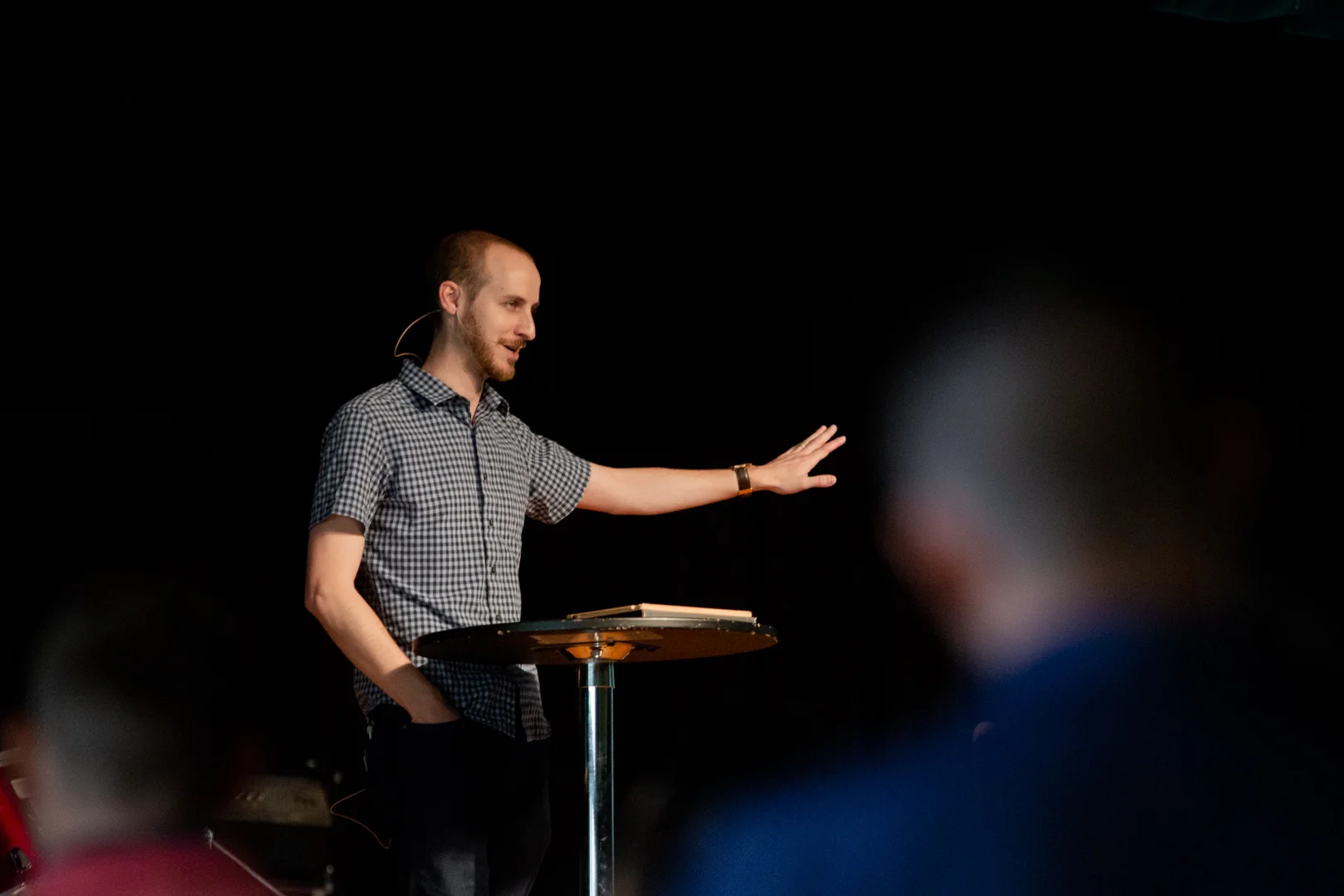

The King of Glory
Psalm 24
The King of Glory
Psalm 24
Main Idea: Jesus is the King of Glory who invites us to glorify and enjoy him forever.
I. The King of Creation (24:1-2)
Psalm 24:1-2: The earth is the Lord’s and the fullness thereof,
the world and those who dwell therein,
for he has founded it upon the seas
and established it upon the rivers
“There is not a square inch in the whole domain of our human existence over which Christ, who is Sovereign over all, does not cry, Mine!”
~ Abraham Kyper
John 1:1-3: In the beginning was the Word, and the Word was with God, and the Word was God. He was in the beginning with God. All things were made through him, and without him was not anything made that was made.
Colossians 1:15-16: He is the image of the invisible God, the firstborn of all creation. For by him all things were created, in heaven and on earth, visible and invisible, whether thrones or dominions or rulers or authorities —all things were created through him and for him.
II. The King of the Hill (24:3-4)
Psalm 24:1-2: The earth is the Lord’s and the fullness thereof,
the world and those who dwell therein,
for he has founded it upon the seas
and established it upon the rivers.
What are the requirements to ascend ascend the hill of the Lord?
Clean Hands: He must be free from sinful actions and clean in what he does, “literally, innocent, free from guilt.” (Ps 15)
Pure Heart: He must be blameless, free from impure motives, thoughts, and emotions. (Mk 7:14-23)
No False Worship: He must not lift up his soul in false worship. (Ex 20:1-7, Ps 25:1)
No Deceitfully Swearing: No deception or false motives fill his heart, his soul. He knows nothing of dishonesty or deceit. (Ex 20:16, Eph 4:25)
Romans 3:23: For all have sinned and fall short of the glory of God.
III. The King of Glory (24:7-10)
Psalm 24:7-10: Lift up your heads, O gates!
And be lifted up, O ancient doors,
that the King of glory may come in.
Who is this King of glory?
The LORD, strong and mighty,
the LORD, mighty in battle!
Lift up your heads, O gates!
And lift them up, O ancient doors,
that the King of glory may come in.
Who is this King of glory?
The LORD of hosts,
he is the King of glory!
Psalm 24:5-6: He will receive blessing from the LORD
and righteousness from the God of his salvation.
Such is the generation of those who seek him,
who seek the face of the God of Jacob.
Psalm 121:1: I lift up my eyes to the hills.
From where does my help come?
My help comes from the LORD,
who made heaven and earth.
The Doe of the Dawn
Psalm 22
The Doe of the Dawn
Psalm 22
Main Idea: The Lord blesses His people though their king suffers.
I. The Problem of Unwarranted Suffering (22:1-21a)
David writes Psalm 22 from the vantage point of an unwarranted sufferer. He is the anointed king of Israel enduring gross injustices at the hands and with the approval of the anointed king of Israel. It is a level of injustice that rightly confuses and outrages us at the same time.
He seems to draw his inspiration for this psalm from a shepherding experience. The imagery he uses to visualize the way unwarranted suffering tormented him parallels the plight of a prey animal under attack.
Our problem with unwarranted suffering manifests in at least two domains. It affects us philosophically and psychologically:
Philosophically, it drives us to ask why is this happening at all? Something in our makeup screams that this is not how the world should work.
Psychologically, it drives us to ask why is this happening to me? When predators are nipping at our heels, it's hard to think of anything else but what is this happening to me!?!
II. The Paradox of Unmerited Blessing (22:21b-31)
The scenario David has just played out may be everyday life on the African savannah with gazelles and lions or in Palestinian pastures among sheep and wolves, but for humans, it is just not supposed to be that way. When this kind of unwarranted suffering comes on and without intervention, we simply don’t have categories for it. It demands an explanation!
It is worth noting that David gives absolutely no detail on how he was delivered. Much less why this whole ordeal happened at all.
Explanations don’t provide what we need most. Outcomes trump explanations when it comes to unwarranted suffering.
The only consolation in the context of unwarranted suffering is the reality of unmerited blessing because “Kingship belongs to the LORD, and He rules over the nations.” (Ps. 22:28)
III. A Prophecy of Ultimate Redemption (Matthew 27:45-50)
Matt. 27:45-50: Now from the sixth hour[f] there was darkness over all the land until the ninth hour. And about the ninth hour Jesus cried out with a loud voice, saying, “Eli, Eli, lema sabachthani?” that is, “My God, my God, why have you forsaken me?” And some of the bystanders, hearing it, said, “This man is calling Elijah.” And one of them at once ran and took a sponge, filled it with sour wine, and put it on a reed and gave it to him to drink. But the others said, “Wait, let us see whether Elijah will come to save him.” And Jesus cried out again with a loud voice and yielded up his spirit.
Matt. 27:35 - when they had crucified him - thus piercing Jesus’ hand and feet. (Ps.22:16)
Matt. 27:35 - they divided his garments among them by casting lots!! (Ps. 22:18)
Matt. 27:39 - those who passed by derided him, wagging their heads, as did the villains He was crucified with (26:44) (Ps. 22:7, 13, 17)
Matt. 27:41-43 - the chief priests, scribes and elders mocked him saying, “He trusts in God; let God deliver him now, if he desires him.” (Ps. 22:8)
John 19:38 - Jesus thirsted, his tongue stuck to his jaw (Ps. 22:18)
Matt. 27:50 - After three hours hanging on the cross watching His life drip slowly away, Jesus “cried out again with a loud voice and yielded up His spirit.” (Ps. 22:14-15)
The main point of Psalm 22 before Jesus: The LORD blesses His people though their king suffers.
The main point of Psalm 22 after Jesus: The LORD blesses His people through their King’s suffering.
The God Who Speaks
Psalm 19
*Unfortunately, we were unable to record the sermon from this past Sunday. We sincerely apologize for any inconvenience.
THe god who speaks
Psalm 19
I. A Good Word (19:1-6)
Psalm 19:1-6: The heavens declare the glory of God,
and the sky above proclaims his handiwork.
Day to day pours out speech,
and night to night reveals knowledge.
There is no speech, nor are there words,
whose voice is not heard.
Their voice goes out through all the earth,
and their words to the end of the world.
In them he has set a tent for the sun,
which comes out like a bridegroom leaving his chamber,
and, like a strong man, runs its course with joy.
Its rising is from the end of the heavens,
and its circuit to the end of them,
and there is nothing hidden from its heat
The Universe is before our eyes like a beautiful book which all creatures, great and small are as letters to make us ponder the invisible things of God: his eternal power and his divinity.
-Belgic Confession (16th Century)
II. A Clear Word (19:7-11)
Psalm 19:7-11: The law of the Lord is perfect,[c]
reviving the soul;
the testimony of the Lord is sure,
making wise the simple;
the precepts of the Lord are right,
rejoicing the heart;
the commandment of the Lord is pure,
enlightening the eyes;
the fear of the Lord is clean,
enduring forever;
the rules[d] of the Lord are true,
and righteous altogether.
More to be desired are they than gold,
even much fine gold;
sweeter also than honey
and drippings of the honeycomb.
Moreover, by them is your servant warned;
in keeping them there is great reward.
III. A Final Word (19:12-14)
Psalm 19:12-14: Who can discern his errors?
Declare me innocent from hidden faults.
Keep back your servant also from presumptuous sins;
let them not have dominion over me!
Then I shall be blameless,
and innocent of great transgression.
Let the words of my mouth and the meditation of my heart
be acceptable in your sight,
O Lord, my rock and my redeemer.
Hebrews 4:12-13: For the word of God is living and active, sharper than any two-edged sword, piercing to the division of soul and of spirit, of joints and of marrow, and discerning the thoughts and intentions of the heart. And no creature is hidden from his sight, but all are naked and exposed to the eyes of him to whom we must give account.
Love of a Lifetime
Psalm 16
Love of a lifetime
Psalm 16
Main Idea: God offers fullness of Joy now and for eternity through the life and love of Jesus.
I. Help! (16:1-2)
In our need we seek to run somewhere, David is stating the truth that he needs the LORD in his time of need.
II. With a Little Help From My Friends (16:3-4)
God sets His people in community so they can spur one another toward Him and His ways. At a soul level, we want to belong somewhere and God hardwired us for community.
This is the battle of our Christian Life. Am I personally, daily seeking the Lord in my life or am I compromising to get what I think I need from a world that is woefully unequipped to carry me in times of trouble and need?
III. Fortunate Son (16:5-6)
IV. How Could I Ask For More (16:7-8)
The Lord speaks to David’s deepest parts. Deep down, the word is literally “kidneys” but that is not very poetic, David knows the goodness of God and hears Him. In his gut the Lord speaks to Him. Deep down we know too. The ways of the Lord aren’t a mystery but we long to satisfy ourselves externally instead of in the deepest parts of our soul.
God is stating the path to life runs through Him and the result is fullness of joy and pleasures forevermore.
It would seem that Our Lord finds our desires not too strong, but too weak. We are half-hearted creatures, fooling about with drink and sex and ambition when infinite joy is offered us, like an ignorant child who wants to go on making mud pies in a slum because he cannot imagine what is meant by the offer of a holiday at the sea. We are far too easily pleased.
- C.S. Lewis
V. The Greatest Love Of All (16:9-10)
Acts 2:29: Brothers, I may say to you with confidence about the patriarch David that he both died and was buried, and his tomb is with us to this day. 30 Being therefore a prophet, and knowing that God had sworn with an oath to him that he would set one of his descendants on his throne, 31 he foresaw and spoke about the resurrection of the Christ, that he was not abandoned to Hades, nor did his flesh see corruption. 32 This Jesus God raised up, and of that we all are witnesses.
The Lord God, creator of the universe, gives you this counsel: Follow the path of life through Jesus Christ, the founder and perfecter of our faith, who for the joy that was set before him endured the cross, despising the shame, and is seated at the right hand of the throne of God. Where is found fullness of joy and pleasures forevermore.
Faithfully Responding to Suffering
Psalm 13
Faithfully Responding to Suffering
Psalm 13
Main Idea: We can respond faithfully in suffering through honest complaint, bold prayer, and choosing to trust.
Lament is how we bring our pain and sorrow to God. It is how we live between the reality of our hard life and our trust in God’s goodness.
Lament is a neglected dimension of the Christian life for many Christians today. We need to recover the practice of honest spiritual struggle that gives us permission to vocalize our pain and wrestle with our sorrow. Lament avoids trite answers and quick solutions, progressively moving us toward deeper worship and trust.”
- Mark Vroegop, Dark Clouds, Deep Mercy
I. Honest Complaint (13:1-2)
We can honestly and transparently come to God with our pain. Our pain and suffering are real. We do not need to “suffer in silence” before God. God gives us permission to lament.
We bring our complaints to God, because we seek to move “upward and inward”, to move further towards Him. So, our complaint actually opens the door to the next part of lament, and that is prayer.
II. Bold Prayer (13:3-4)
We should not hesitate to ask God specific, bold requests in our suffering.
The various trials of life can become a platform to reaffirm our dependence upon the Lord. The requests of lament can become the place where we celebrate our need for God’s help. In this way, our requests become more than just expressions of need. These petitions are prayers of faith anchored in what we believe about God . . . . The point of those requests is not only to meet a need. The point is to rely upon God.
- Mark Vroegop, Dark Clouds, Deep Mercy
Pray boldly and specifically. Don’t give up. We pray because we are not self-sufficient. By our prayers we show that we depend on God – He is worthy of that trust.
III. Choosing to Trust (13:5-6)
Rather than focus on his perceptions of God’s neglect – David chooses to trust in the reality of God’s salvation.
Our hope in suffering is not because we know when our suffering will end, or even if it will end in this life, but because we know and trust the character of God.
It is not “my faith” that is my strength and my salvation; it is my God. It is not the strength of my belief; it is the strength of the One in whom I believe.
Three things about God that David places his faith in:
1. David places his faith in God’s character
Hesed is translated by different versions as: faithfulness, lovingkindness, steadfast love, mercy, unfailing love, faithful love.
Exodus 34:6-7: “The LORD passed before him [Moses] and proclaimed, “The LORD, the LORD, a God merciful and gracious, slow to anger, and abounding in steadfast love and faithfulness, keeping steadfast love for thousands, forgiving iniquity and transgression and sin.”
2. David places his faith in God’s covenant promises
Exodus 6:5-8: Moreover, I have heard the groaning of the people of Israel whom the Egyptians hold as slaves, and I have remembered my covenant. Say therefore to the people of Israel, ‘I am the LORD, and I will bring you out from under the burdens of the Egyptians, and I will deliver you from slavery to them, and I will redeem you with an outstretched arm and with great acts of judgment. I will take you to be my people, and I will be your God, and you shall know that I am the LORD your God, who has brought you out from under the burdens of the Egyptians. I will bring you into the land that I swore to give to Abraham, to Isaac, and to Jacob. I will give it to you for a possession. I am the LORD.’”
But, God is not interested in a market transaction, a contract whereby He will do something if only we will do something. Instead, God is interested in the relationship, the covenant that he has already established with us. And, our response to His covenant with us, in the midst of suffering, is not to look to our performance, but to trust in His grace.
3. David places his faith in God as the true and ultimate source of his salvation
Awesome Wonder in the Majestic God-Man
Psalm 8
Awesome Wonder in the Majestic God-Man
Psalm 8
Main Idea: Psalm 8 invites us to renew our wonder and joy in the majesty of Christ seen in His condescension for us through the old and new creation.
“Through the dark valleys of lament and pleas for deliverance of Psalm 3-7, we arrive at the crest of Psalm 8 to a welcome prospect of breathtaking beauty and awesome delight. Psalm 8 introduces us to the first experience of joyful praise and adoration in the Psalter. Here in Psalm 8 if just for a moment, darkness and suffering are driven away by the commanding vision of the sovereign God of the created universe and His unfathomable care for humanity.”
- Gerald H. Wilson, Psalms, Application Commentary
I. The Majesty of God Displayed in the Universe (8:1)
David uses the art of contrasting 4 times in Psalm 8. This is the first contrast. David contrasts God’s glory in the earth and His glory above the heavens (1 Kgs 8:27)
II. God’s Majesty Displayed in Using Weakness to Defeat Strength (8:2)
David contrasts the seeming power of His big enemies with the small, helpless and weakest humans on earth.
This verse has both a literal and a figurative meaning (Mt. 21:14-16; 1 Cor. 1:28-29)
Matthew 21:14-16: And the blind and the lame came to him in the temple, and he healed them. But when the chief priests and the scribes saw the wonderful things that he did, and the children crying out in the temple, “Hosanna to the Son of David!” they were indignant, and they said to him, “Do you hear what these are saying?” And Jesus said to them, “Yes; have you never read, “‘Out of the mouth of infants and nursing babies you have prepared praise’?”
III. God’s Majesty Displayed in Using Weakness to Defeat Strength (8:2)
David contrasts the creation of the space with the creation of mankind and it causes him to feel with fresh forcefulness his smallness compared to the bigness of God.
IV. God’s Majesty Displayed in the Rule of the Second Adam (8:5-9)
The final contrast is seen in how God uses lowly men to rule his world instead of mighty angels.
The big picture here is God becoming man to fulfill Genesis 1:26-31 to bring all things under the subjection of man through Jesus. The apostles of the New Testament applied these verses to Jesus (Heb. 2:5-9; 1 Cor. 15:25-28).
Hebrews 2:5-9: For it was not to angels that God subjected the world to come, of which we are speaking. It has been testified somewhere, “What is man, that you are mindful of him, or the son of man, that you care for him? You made him for a little while lower than the angels; you have crowned him with glory and honor, putting everything in subjection under his feet.” Now in putting everything in subjection to him, he left nothing outside his control. At present, we do not yet see everything in subjection to him. But we see him who for a little while was made lower than the angels, namely Jesus, crowned with glory and honor because of the suffering of death, so that by the grace of God he might taste death for everyone.
“It costs God nothing to create nice things: but to convert rebellious wills cost Him crucifixion”
- C.S. Lewis, Mere Christianity
A Tale of Two Kingdoms
Psalm 2
A tale of two kingdom
Psalm 2
Main Idea: Jesus offers the raging enemies of this world refuge in Him and residency in His heavenly kingdom.
I. The Raging Rebels and the Laughing Lord (2:1-6)
The Posture of the Nations
The Position of the Lord
Acts 4:23-31: When they were released, they went to their friends and reported what the chief priests and the elders had said to them. And when they heard it, they lifted their voices together to God and said, “Sovereign Lord, who made the heaven and the earth and the sea and everything in them, who through the mouth of our father David, your servant, said by the Holy Spirit, ‘Why did the Gentiles rage, and the peoples plot in vain? The kings of the earth set themselves, and the rulers were gathered together, against the Lord and against his Anointed’—for truly in this city there were gathered together against your holy servant Jesus, whom you anointed, both Herod and Pontius Pilate, along with the Gentiles and the peoples of Israel, to do whatever your hand and your plan had predestined to take place. And now, Lord, look upon their threats and grant to your servants to continue to speak your word with all boldness, while you stretch out your hand to heal, and signs and wonders are performed through the name of your holy servant Jesus.” And when they had prayed, the place in which they were gathered together was shaken, and they were all filled with the Holy Spirit and continued to speak the word of God with boldness.
II. Divine Decree and Refuge in the Son (2:7-12)
The Position of the Lord
Hebrews 1:1-5a: Long ago, at many times and in many ways, God spoke to our fathers by the prophets, but in these last days he has spoken to us by his Son, whom he appointed the heir of all things, through whom also he created the world. He is the radiance of the glory of God and the exact imprint of his nature, and he upholds the universe by the word of his power. After making purification for sins, he sat down at the right hand of the Majesty on high, having become as much superior to angels as the name he has inherited is more excellent than theirs. For to which of the angels did God ever say, “You are my Son, today I have begotten you?”
Acts 13:33-34a: …this he has fulfilled to us their children by raising Jesus, as also it is written in the second Psalm, ”You are my Son, today I have begotten you.” And as for the fact that he raised him from the dead, no more to return to corruption…
2. The Posture of the Nations
There is no refuge from him, only in him.
~ Derik Kidner
Two Ways
Psalm 1
TWo Ways
Psalm 1
Main Idea: Blessing is found in Christ by walking in his way, delighting in his truth, and experiencing his life.
I. The Way of Blessedness (1:1-2)
As the introduction to the entirety of the Psalter, Ps. 1 is a “wisdom” song, inviting us into a life that is truly “blessed” or “flourishing” before God. The blessed person (1:1):
Walks not in the counsel of the wicked
Nor stands in the way of sinners
Nor sits in the seat of scoffers
“A seat is a place to deliberate, to make judgments, to render decisions… They sit in the company of know-it-alls. A place of cynicism, gossip, and superficial witticisms. They hold nothing in authority but their own cleverness. No judge sits over them; no counsel informs them. They are intoxicated with verbal wine and drunkenly survey the world, blearily reading into it their own confusion and malaise.”
~ Eugene Peterson, As Kingfishers Catch Fire
Instead, the blessed person delights in the law (‘torah’) of the Lord, and meditates upon it day and night. God’s Word is their “daily bread” and their guiding light at all times and in all circumstances (Ps. 119:11).
II. The Way of Rootedness (1:3-4)
The Psalmist gives two pictures of these contrasting ways of living:
1. A Deeply Rooted Tree (1:3)
Through delight and meditation on God’s Word, the blessed person has access to a deep reservoir of gospel nutrients. This leads to a life of stability, fruitfulness, endurance, and prosperity, even through seasons of “heat” or “drought.”
Jeremiah 17:5–8:
Thus says the Lord:
“Cursed is the man who trusts in man
and makes flesh his strength,
whose heart turns away from the Lord.
He is like a shrub in the desert,
and shall not see any good come.
He shall dwell in the parched places of the wilderness,
in an uninhabited salt land.
“Blessed is the man who trusts in the Lord,
whose trust is the Lord.
He is like a tree planted by water,
that sends out its roots by the stream,
and does not fear when heat comes,
for its leaves remain green,
and is not anxious in the year of drought,
for it does not cease to bear fruit.”
“Blessed is the man who has such a promise as this. But we must not always estimate the fulfillment of a promise by our own eye-sight… For though we know our interest in the promise, yet are we so tried and troubled, that sight sees the very reverse of what that promise foretells. But to the eye of faith this word is sure, and by it we perceive that our works are prospered, even when everything seems to go against us. It is not outward prosperity which the Christian most desires and values; it is soul prosperity which he longs for... Our worst things are often our best things. As there is a curse wrapped up in the wicked man’s mercies, so there is a blessing concealed in the righteous man’s crosses, losses, and sorrows.”
~ Charles Spurgeon, The Treasury of David
2. Chaff
As the grain harvest was collected it would be brought to a “threshing floor,” where the grain would be separated from the chaff; the chaff (dried husks) would either be blown away by the wind or burned up. No matter what it may look like (cf. Ps. 37:35-36, 73:3), the unrighteous have no substance or root; they are “tossed to and fro by the waves and carried about by every wind of doctrine, by human cunning, by craftiness in deceitful schemes” (Eph. 4:14).
III. The Way of Righteousness (1:5-6)
Because the wicked are life ‘chaff’ they will not withstand the judgment of God, nor join the congregation of the righteous. Their “way” will perish (cf. Prov. 14:12). However, the Lord “knows” (intimately) the “way” of the righteous, and he will lead us to life and life abundant (Jn. 10:10).
John 14:6: Jesus said to him, “I am the way, and the truth, and the life. No one comes to the Father except through me.”
“[Christ] himself is the only gate by which we can find admission, and the way to enter in through Jesus Christ is not by working, but by believing. Then, as to the strife we are urged to carry on, it is an earnest endeavor to steer clear of all the rocks, and shoals, and quicksands of popular fallacies and deceitful traditions, and to sail in the deep waters, with his covenant for our chart, and his Word for our compass, in simple obedience to his statutes, trusting him as our pilot, whose voice we always hear, though his face we cannot see.”
~ Charles Spurgeon, “The Strait Gate”

The Return of the King
Revelation 11:15-19
The Return of the king
Revelation 11:15-19
Main Idea: We can have an enduring hope because of the coming and forever kingdom of Christ
I. God’s Forever Kingdom (11:15-17)
As the seventh trumpet is blown, the “third woe” occurs (11:14) marking the end of history. The New Testament often associates the return of Christ with a trumpet blast (1 Thess. 4:16a, 1 Cor. 15:51-52)
Two things to note about this coming reality:
1. The Kingdom of God will overcome the ‘kingdom’ of this world (cf. Ps. 2:2, Isa. 11:9, Hab. 2:14, Rev. 21:1-2)
“Rather than saying that Christ has returned to defeat all the different kingdoms on earth, the voices speak of a single earthly kingdom that is opposed to Christ. Daniel’s prophecy foretold the rising of different kingdoms in succession, each symbolized by its particular beast (Dan. 7:1–8), but in Revelation there is one beast that is a composite of them all (Rev. 13:1–2). All the secular empires are actually one earthly kingdom under the reign of Satan… When Christ returns, the “kingdom of the world” will yield to “the kingdom of our Lord and of his Christ” (Rev. 11:15).” ~ Richard Phillips, Revelation
2. Christ will reign as King forever and ever (cf. 2 Sam. 7:16, Dan. 7:13-14, Lk. 1:33, Phil. 2:9-11)
The 24 elders worship God by bowing down in worship and giving thanks. Every time we worship and “give thanks in all circumstances” (1 Thess. 5:18), we are a preview of life everlasting and we experience a foretaste of glory.
II. God’s Final Judgment (11:18)
This particular vantage point of the return of Christ and the end of history zooms in on the righteous and final judgements of God. This is the overwhelming emphasis of the Creeds:
Apostles’ Creed: “The third day he rose again from the dead. He ascended to heaven and is seated at the right hand of God the Father almighty. From there he will come to judge the living and the dead.”
Nicene Creed: “He will come again in glory to judge the living and the dead, and his kingdom will have no end”
This divine verdict will have two different outcomes:
The wicked who “raged” will be judged and condemned (cf. Ps. 2, Isa. 40:10, Rev. 20:12)
The righteous (servants, prophets, saints) who “fear your name” will be rewarded (cf. Mt. 5:11-12, 6:19-20, 25:14-30, 2. Cor. 4:16-18, Heb. 11:16)
“‘Rejoice and be glad.’ Why? ‘For great is your reward in heaven.’ Here is one of these great central principles you will find running all the way through the Bible. It is this consideration of the end, our final destiny… According to this argument, my whole outlook upon everything that happens to me should be governed by these three things: my realization of who I am, my consciousness of where I am going, and my knowledge of what awaits me when I get there… But someone may ask: ‘How is this reward possible? I thought that man was saved by grace; why speak of reward?’ The answer of Scripture seems to be that even the reward itself is of grace. It does not mean we merit or deserve salvation. It just means God treats us as a Father… It is not that the child merits a reward. It is given of grace, and it is the expression of the Father’s love.”
~ Martyn Lloyd-Jones, Studies in the Sermon on the Mount
III. God’s Faithful Presence (11:19)
Verse 19 recalls the fall of Jericho in Josh. 6 as well as the Lord’s theophanic presence at Mt. Sinai in Ex. 19. In both of these stories of God’s redemption, there is a “collapse” of the old order and an inauguration of a new era. The same will happen at the end of history, as life everlasting is ushered in.
The ‘ark of the covenant’ that dwells in the heavenly ‘temple’ signifies two realities:
God’s Covenant Promises: the ark contained the Word of God as a reminder of God’s covenant commitments to his people
God’s Constant Presence: the ark resided in the “holy of holies” where the presence and glory of God dwelt in the midst of the camp of his people
Revelation 21:3, 22–23: And I heard a loud voice from the throne saying, “Behold, the dwelling place of God is with man. He will dwell with them, and they will be his people, and God himself will be with them as their God… And I saw no temple in the city, for its temple is the Lord God the Almighty and the Lamb. And the city has no need of sun or moon to shine on it, for the glory of God gives it light, and its lamp is the Lamb.
The Faithful Witnesses
Revelation 11:1-14
The Faithful Witnesses
Revelation 11:1-14
Main Idea: The perpetual presence of God protects and empowers his people to bear faithful witness in the midst of persecution.
I. The Temple Protected and Preserved (11:1-2)
Revelation 11:1-2: Then I was given a measuring rod like a staff, and I was told, “Rise and measure the temple of God and the altar and those who worship there, but do not measure the court outside the temple; leave that out, for it is given over to the nations, and they will trample the holy city for forty-two months.
Every time the language of a temple appears in Revelation, it all points to the people of God. It will show up again in Revelation 21-22. All throughout the New Testament, the apostles teach the Church is the new temple, and this is how Revelation 11 was read by the early church fathers. Earlier John described the church on earth like an army of 144,000 and the church in heaven as a great multitude that can’t be counted. Here he describes the church again, this time in terms of the people of God as the Temple.
John says 42 months, or 1,260 days, or a time and times and a half time. This would be similar to someone saying four score and seven years ago or 9/11. Both of these numbers point our minds to events. John is telling us what this time will be like, not how long this time will last.
This period seems to be associated with a time of rebellion during which God’s faithful people are protected in the midst of trials.
We must be comforted before we’re commissioned.
II. The Witnesses Empowered and Deployed (11:3-6)
Revelation 11:3-6: And I will grant authority to my two witnesses, and they will prophesy for 1,260 days, clothed in sackcloth.” These are the two olive trees and the two lampstands that stand before the Lord of the earth. And if anyone would harm them, fire pours from their mouth and consumes their foes. If anyone would harm them, this is how he is doomed to be killed. They have the power to shut the sky, that no rain may fall during the days of their prophesying, and they have power over the waters to turn them into blood and to strike the earth with every kind of plague, as often as they desire.
The “two witnesses” represent all of God’s people.
They’re described as “lampstands”, which in Revelation 1:20 are local churches (v 4).
John has already used the term “witness” to describe the martyr Antipas (2:13; 6:9).
John himself is in exile because of his “testimony” or “witness” to Jesus (1:9).
The job description Jesus himself gave to his followers before his ascension was to be his “witnesses” (Acts 1:8, Luke 24:47–49)
John has already affirmed that Jesus has made us “a kingdom and priests” (Revelation 1:6).
The victorious ones are pillars in God’s temple (3:12)—priestly language—and seated on Christ’s throne (3:21)—royal language.
We are redeemed to be a royal priesthood and bear faithful witness.
Romans 1:16: Then I was given a measuring rod like a staff, and I was told, “Rise and measure the temple of God and the altar and those who worship there, but do not measure the court outside the temple; leave that out, for it is given over to the nations, and they will trample the holy city for forty-two months.
III. The Persecuted Victorious (11:7-14)
Revelation 11:7-12: And when they have finished their testimony, the beast that rises from the bottomless pit will make war on them and conquer them and kill them, and their dead bodies will lie in the street of the great city that symbolically is called Sodom and Egypt, where their Lord was crucified. For three and a half days some from the peoples and tribes and languages and nations will gaze at their dead bodies and refuse to let them be placed in a tomb, and those who dwell on the earth will rejoice over them and make merry and exchange presents, because these two prophets had been a torment to those who dwell on the earth. But after the three and a half days a breath of life from God entered them, and they stood up on their feet, and great fear fell on those who saw them. Then they heard a loud voice from heaven saying to them, “Come up here!” And they went up to heaven in a cloud, and their enemies watched them.
2 Corinthians 2:14-16: But thanks be to God, who in Christ always leads us in triumphal procession, and through us spreads the fragrance of the knowledge of him everywhere. For we are the aroma of Christ to God among those who are being saved and among those who are perishing, to one a fragrance from death to death, to the other a fragrance from life to life.
We should expect to suffer like Jesus.
"The blood of the martyrs is the seed of the church." ~ Tertullian
Why must we be comforted before we’re commissioned? Because the mission always meets opposition.
Romans 8:35-37: Who shall separate us from the love of Christ? Shall tribulation, or distress, or persecution, or famine, or nakedness, or danger, or sword? As it is written, “For your sake we are being killed all the day long; we are regarded as sheep to be slaughtered.” No, in all these things we are more than conquerors through him who loved us.
Matthew 28:18-20: “All authority in heaven and on earth has been given to me. Go therefore and make disciples of all nations, baptizing them in the name of the Father and of the Son and of the Holy Spirit, teaching them to observe all that I have commanded you. And behold, I am with you always, to the end of the age.”