
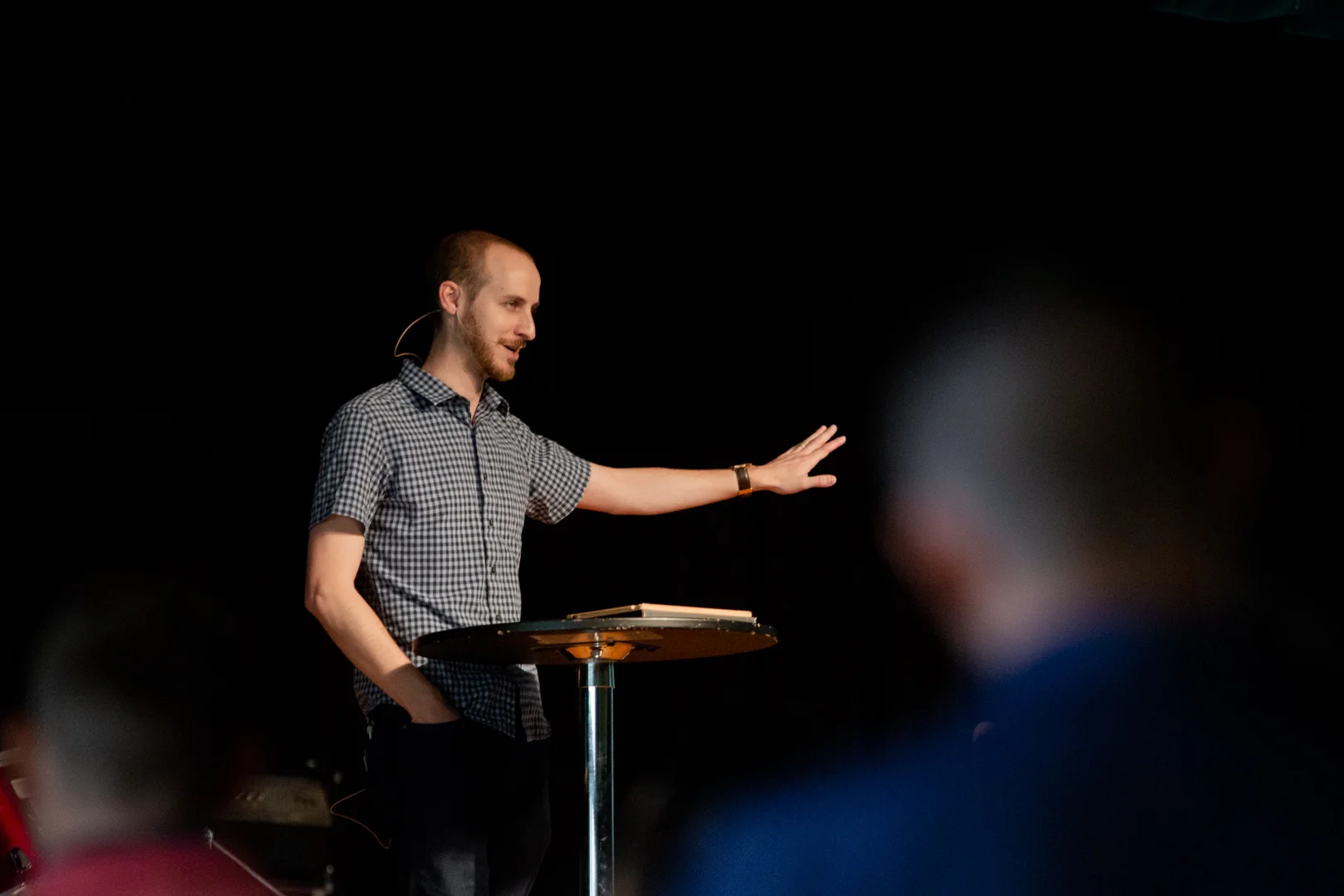

Full of Grace & Truth
John 1:14
Full of Grace & Truth
John 1:14
Main Idea: Christmas is the good news that God has come to us full of grace and truth.
I. God Has Come
Christianity tells us that the ‘Word’ (‘logos’; see John 1:1) has come as a person. Christmas tells us that God is not content being studied as a concept or being theorized about from a distance; He has gone to great lengths so that we might know him personally,
The “word became flesh” tells us the glorious, mysterious reality of the incarnation; Jesus, “the only Son from the Father” is both fully man and fully God.
“The birth of Christ was the incarnation of God: it was God taking upon himself humanity— a mystery, a wondrous mystery, to be believed in rather than to be defined… Infinite, and an infant — eternal, and yet born of a woman — Almighty, supporting the universe, and yet needing to be carried in a mother’s arms — King of angels, and yet the reputed son of Joseph — Heir of all things and yet the carpenter’s despised son.”
~ Charles Spurgeon, “His Name – Wonderful!”
“Dwelt among us” lit. means “pitched his tent” or “tabernacled” among us. The tabernacle helps us understand some key things about Christ:
God’s Presence: “The Word became flesh and blood, and moved into the neighborhood” (John 1:14, The Message)
God’s Glory: An encounter with God’s glory is dangerous in the Bible, but in Christ we have “seen his glory.”
God’s Forgiveness: The tabernacle was the place where atoning sacrifices for sin were made. “Behold, the Lamb of God who takes away the sin of the world!” (John 1:29)
II. Full of Grace & Truth
Jesus comes full of both grace and truth; he does not “balance” these two attributes out, but embodies both of them fully, at all times, essentially and inseparably.
God’s glory, grace, and truth come together in a cosmic way at the crucifixion of Christ. Jesus is “glorified” on the cross (cf. John 13:31-32), where we are simultaneously told the truth about our sin and offered “grace upon grace” (John 1:16) We must look to the cross to appreciate the meaning of Christmas.
“The crucial significance of the cradle at Bethlehem lies in its place in the sequence of steps that led the Son of God to the cross of Calvary… the Christmas message is that there is hope for a ruined humanity – hope of pardon, hope of peace with God, hope of glory – because at the Father’s will Jesus Christ became poor and was born in a stable so that thirty years later he might hang on a cross. It is the most wonderful message that the world has ever heard or will hear.”
~ J.I. Packer, Knowing God

The Greatest Gift
John 3:16
The Greatest Gift
John 3:16
“For God so loved the world, that he gave his only Son, that whoever believes in him should not perish but have eternal life.” John 3:16
Why does God give?
What does God give?
How do we receive God’s gift?
What are the results of God’s gift?

The Resurrection of Christ | Easter
John 20: 1-18
The Resurrection of Christ
John 20:1-18
Main Idea: The resurrection of Christ means the curse is reversed and we have hope.
I. The Tomb is Empty (20:1-10)
Sunday morning begins with Mary Magdalene going to the tomb early in the morning while it is still dark on the “first day of the week.” John presents the resurrection as being the beginning of a new creation, with the “darkness” being pushed back by a glorious light.
Mary is presumably traveling to the tomb to mourn the death of Christ. Despite Jesus’ predictions that he would be raised, no one is expecting or looking for a resurrection. This did not fit into either the Jewish or the Greco-Roman worldview. Mary assumes a grave robbery has occurred.
As Peter and John show up at the tomb, they realize the burial linen cloths and the face cloth are both neatly folded up. Peter and John begin to “theorize” what has happened, and John himself “believes” as he steps foot in this empty tomb.
Acts 2:24: God raised him [Jesus] up, loosing the pangs of death, because it was not possible for him to be held by it.
Isaiah 25:7–8: And he will swallow up on this mountain
the covering that is cast over all peoples,
the veil that is spread over all nations.
He will swallow up death forever;
and the Lord God will wipe away tears from all faces,
and the reproach of his people he will take away from all the earth,
for the Lord has spoken.
Though they do not realize it yet, Christ “must rise from the dead.” Everything hinges upon the resurrection, and the empty tomb is an invitation for us. “The reason the stone was rolled away on Jesus's tomb was not so that Jesus could get out, but so that we could get in.” ~ Tim Keller
“The truest fact of the universe is an empty tomb. The Resurrection is the only evidence that love triumphs over death, weakness prevails over strength, and beauty outlives ashes. If Jesus is risen in actual history, with all the palpability of flesh, fingers, bone, and blood, there is hope that our mourning will be comforted, and that death will not have the final word.”
~ Tish Harrison Warren
II. The Curse is Reversed (20:11-18)
This resurrection encounter shows us that the curse of sin and its impact on the world is being rolled back. We see this in three categories:
The Setting: Jesus is buried in a “garden tomb” (19:41); gardens have great significance in the Scriptures from the Garden of Eden all the way to the “Garden-City” of the New Heavens and the New Earth (Rev. 21-22)
The People
Angels: In the Garden of Eden, angels were placed by the Lord to prevent anyone from entering & accessing (Gen. 3:24); in this garden, the angels are welcoming Mary into the empty tomb
“The Gardener”
“Mary’s intuitive guess, that he must be the gardener, was wrong at one level and right, deeply right, at another. This is the new creation. Jesus is the beginning of it. Here he is: the new Adam, the gardener, charged with bringing the chaos of God’s creation into new order, into flower, into fruitfulness. He has come to uproot the thorns and thistles and replace them with blossoms and harvests.”
~ N.T. Wright
Mary:
Unlike Adam and Eve who hide from the presence of the Lord and his call in Genesis 3, Mary’s eyes are opened and her faith is ignited as the “Good Shepherd” calls her name. John 10:27: My sheep hear my voice, and I know them, and they follow me.
Eve is deceived in a garden by the serpent, and sin enters the world and spreads to all of creation. Mary, who had felt the full weight of the serpent’s schemes (cf. Lk. 8:2), is the first to encounter the risen Christ in a garden, and is commissioned to announce the gospel that will spread to all of creation.
3. The Message
Jesus did not want Mary to “cling” to him because his presence was going to come to be with them in the Holy Spirit. Christ’s followers would have an even greater intimacy and relationship with him through the indwelling Spirit, our great “Helper” (Jn. 16:7).
The alienation of the Garden of Eden between humans and God and humans with one another has now been solved because of the finished work of Christ: “go to my brothers and say to them, ‘I am ascending to my Father and your Father, to my God and your God.’”
All of humanity is living in one of two story lines: we either walk out of a garden into a tomb, or we walk out of a tomb into a garden. By God’s grace and in the power of Christ’s resurrection, we are being invited to new life and into a “living hope” (1 Pet. 1:3).

The Cross of Christ | Good Friday
John 19:16b-37
The Cross of Christ
John 19:16b-37
Luke 9:23-24: And he said to all, “If anyone would come after me, let him deny himself and take up his cross daily and follow me. For whoever would save his life will lose it, but whoever loses his life for my sake will save it.”
I. A Forsaken King (19:16b-22)
It was customary for the charge against the crucified one to be displayed above them. For Christ: “Jesus of Nazareth, the King of the Jews.” The haunting, divine irony of the situation is that they are indeed crucifying the true King of all kings. Pilate’s stubbornness communicates this truth in three different languages, symbolic for the universal, world-wide reign of Christ.
“The Crucified One is the true king, the kingliest king of all; because it is He who is stretched on the cross, He turns an obscene instrument of torture into a throne of glory and reigns from the tree.” ~ F.F. Bruce
II. A Forceful Shame (19:23-24)
Though the physical pain of crucifixion would have been unthinkable, the emphasis in the gospel accounts is on the shame, disgrace, and forsakenness of the cross. Jesus’ death was a “curse-bearing” death:
His nakedness echos the nakedness of the Garden of Eden (Gen. 3:7)
He is mockingly given a crown of thorns (Gen. 3:18)
Jewish Law stated that everyone who was “hanged on a tree” was cursed by God (Deut. 21:22-23)
John indicates that there is more going on than we might realize in this scene; he sees the fulfillment of Psalm 22, which Jesus directly quotes in other gospel accounts. The Holy Spirit spoke through David in this Psalm to transcend his own experience and point us to the cross of Christ.
III. A Family Crisis (19:25-27)
Mary’s presence at the cross is a fulfillment of Simeon’s words in Luke 2:34-35 and a reminder of the faithfulness of God from Psalm 22:9-11.
“Even as Jesus’ disciples fled from him in shame, he could cite Psalm 22 while looking out from the cross at his mother. In the moment of his greatest desolation, Jesus could see the invisible outline of God’s mercy and presence there in the one whom, in his human nature, he learned to trust a fathering, nurturing God. He learned that from his mother. And there she stood.” ~ Russell Moore
John (the beloved disciple) is also there with Mary, even though he does not yet believe or understand. Jesus gives them to one another in this moment and this “adoption” is the beginning of the church, a new family joined together by the blood of the cross.
IV. A Finished Work (19:28-30)
John does not present Jesus as a helpless victim who is powerless on the cross; Jesus knows that a greater story is being written. His physical “thirst” (Ps. 22:15; Ps. 69:21) is part of the larger story of God’s plan for redemption that has led to this climactic moment.
Jesus’ cry of “it is finished” is not a cry of defeat or a comment on his impending death. It is a phrase meaning “mission accomplished” and the completion of a task. His death was the fulfillment of his introduction as “the Lamb of God who takes away the sin of the world!” (John 1:29, 1 Cor. 5:7)
“Jesus is not on the cross by mistake… The crucifixion was not just an unfortunate thing that happened to Jesus on his way to the resurrection. It is not a momentary blip on the arc of his ascent to the Father. It is precisely on the cross that the work of Jesus is carried through to its completion.” ~ Fleming Rutledge
V. A Fulfilled Promise (19:31-37)
The ‘blood and the water’ from Jesus’ side was to show that he really was dead. But even in the aftermath of this horrific scene, John reminds us of the faithfulness of God. His faithfulness and his promises were still true even at the place of the skull.
“The lack of broken bones there at the cross was a sign to Jesus that whatever happened could not go any further than God’s purposes, and that God’s purposes were good… God might seem absent at the cross, but he was not. He was there providentially ruling, even through the most wicked actions imaginable… Jesus could count all his bones because of the mystery of God’s providence, which works behind, and through, even the most awful things that happen to us. Jesus’ intact skeleton was a sign that no matter how much it seemed that he had been abandoned, the steadfast love of God would not depart. God was still there.”~ Russell Moore

The Long-Expected Son
John 1:14 | Christmas is the good news that God has come to us full of grace and truth.
The Long-Expected Son
John 1:14
“The great majority of people will go on observing forms that cannot be explained; they will keep Christmas Day with Christmas gifts and Christmas benedictions; they will continue to do it; and someday suddenly wake up and discover why.” ~ G.K. Chesterton
Main Idea: Christmas is the good news that God has come to us full of grace and truth.
I. God Has Come
Christianity says that the ‘Word’ (‘logos’; cf. Jn. 1:1) has come as a person. Christmas tells us that God is not content being studied as a concept or being theorized about from a distance; God has gone to great lengths so that we might know him personally.
“The birth of Christ was the incarnation of God: it was God taking upon himself humanity—a mystery, a wondrous mystery, to be believed in rather than to be defined… Infinite, and an infant — eternal, and yet born of a woman — Almighty... supporting the universe, and yet needing to be carried in a mother’s arms — King of angels, and yet the reputed son of Joseph — Heir of all things and yet the carpenter’s despised son.” ~ Charles Spurgeon
“Dwelt among us” lit. means “tabernacled” among us. The OT tabernacle dealt with two realities:
1. God’s Presence
“The Word became flesh and blood, and moved into the neighborhood” (John 1:14, The Message)
2. God’s Glory
An encounter with God’s glory is dangerous in the Bible (cf. Ex. 33), but yet in Jesus Christ we have “seen his glory.”
II. Full of Grace & Truth
Jesus comes full of both grace and truth; he does not “balance” these two attributes out, but embodies both of them fully, at all times.
God’s glory, grace, and truth come together in a cosmic way at the crucifixion of Christ. Jesus is ultimately “glorified” on the cross (cf. John 13:31-32), which means we must always connect the cradle to the cross to appreciate the full message of Christmas.
“The gospel is this: We are more sinful and flawed than we ever dared believe, yet at the very same time we are more loved and accepted in Jesus Christ than we ever dared hope.” ~ Tim Keller
Luke 2:10-11: “Fear not, for behold, I bring you good news of great joy that will be for all the people. For unto you is born this day in the city of David a Savior, who is Christ the Lord.”


I Believe in the Holy Spirit
John 14:15-27 | The greatest gift the Father gives to those who follow the Son is the Holy Spirit.
I Believe in the Holy Spirit
John 14:15-27
Main Idea: The greatest gift the Father gives to those who follow the Son is the Holy Spirit.
I. Who is the Holy Spirit? (V14-17)
A. The Holy Spirit is a Person
A person who can be grieved. (Ephesians 4:30)
A person who can be outraged (Hebrews 10:29)
A person who can be lied to (Acts 5:3)
A person who loves (Romans 15)
B. The Holy Spirit is Fully God
Heteros - another of different (class group or type) quality than the former
Allos - another of the same kind
II. What does the Holy Spirit do? (V16-17, 26-27)
A. Regenerates
“And I will give you a new heart, and a new spirit I will put within you. And I will remove the heart of stone from your flesh and give you a heart of flesh. And I will put my Spirit within you, and cause you to walk in my statutes and be careful to obey my rules.” Ezekiel 36:26-27
B. Advocates
“Likewise the Spirit helps us in our weakness. For we do not know what to pray for as we ought, but the Spirit himself intercedes for us with groanings too deep for words. And he who searches hearts knows what is the mind of the Spirit, because the Spirit intercedes for the saints according to the will of God. And we know that for those who love God all things work together for good, for those who are called according to his purpose.” Romans 8:26-28
C. Teaches
“For no prophecy was ever produced by the will of man, but men spoke from God as they were carried along by the Holy Spirit.” 2 Peter 1:21
““But when the Helper comes, whom I will send to you from the Father, the Spirit of truth, who proceeds from the Father, he will bear witness about me. And you also will bear witness, because you have been with me from the beginning.” John 15:26-27
“When the Spirit of truth comes, he will guide you into all the truth, for he will not speak on his own authority, but whatever he hears he will speak, and he will declare to you the things that are to come. He will glorify me, for he will take what is mine and declare it to you.” John 16:13-14
III. Why do we need the Holy Spirit?
The Holy Spirit warms our affections for Christ.