
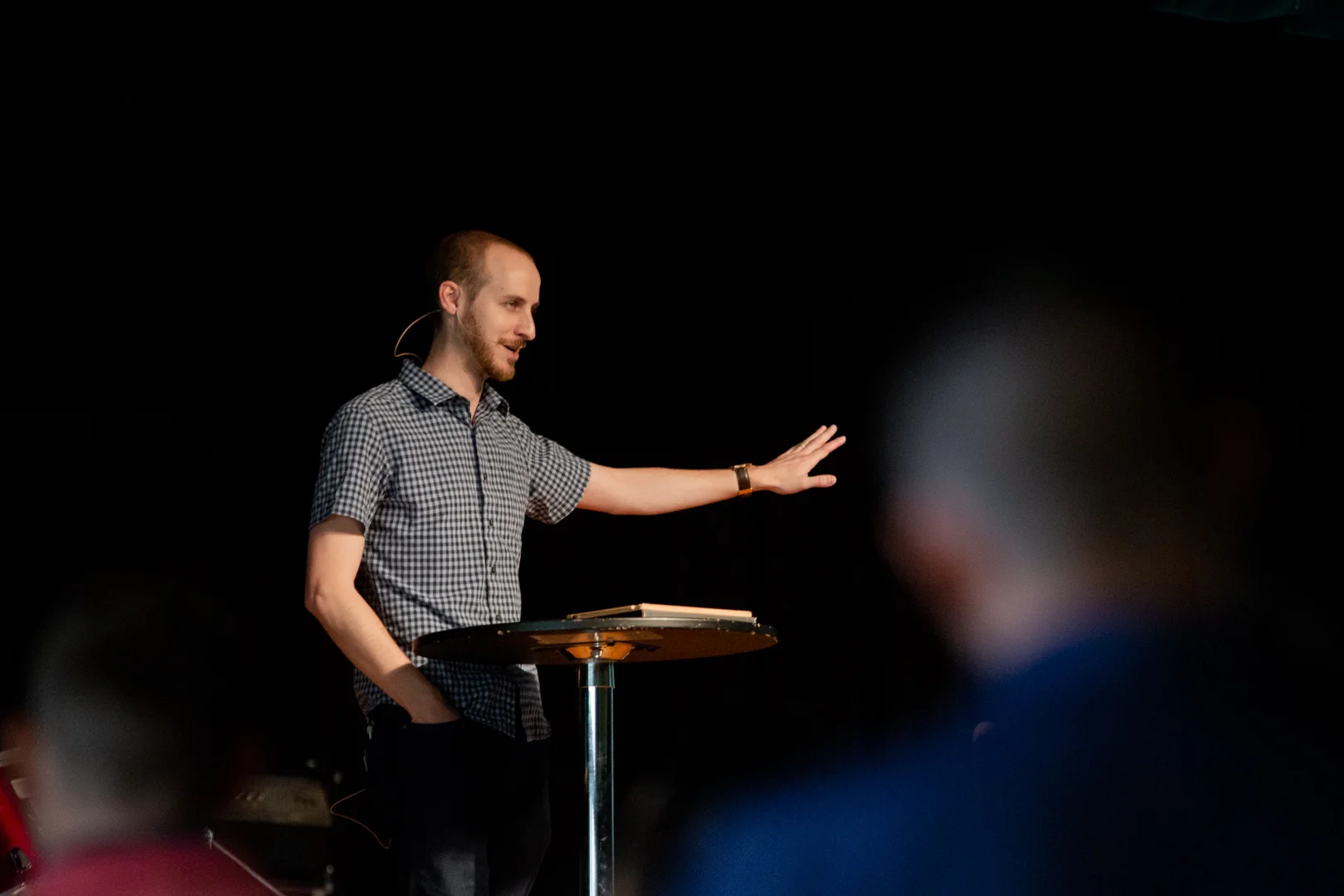

The Scandal of Jesus
Mark 2:13-3:6
The Scandal of Jesus
Mark 2:13-3:6
Main Idea: Jesus is scandalous to those who care more about religious self-righteousness than humbly receiving the gospel.
I. The Scandal of Grace (2:13-17)
As Jesus continues to call disciples to follow him, he controversially calls Levi (Matthew), a tax-collector. In this time period, tax-collectors were despised because they were paid by exploiting and extorting, and they were viewed as traitors who ensured Roman occupation continued over the Jewish people.
Jesus, dignifying Levi, goes to his home, shares a meal with him (signifying friendship, acceptance, and intimacy), and throws a party with more “sinners” and tax-collectors joining in. The Pharisees are threatened by this activity of Jesus. Their concern over strict observance of the Torah and public morality had created a rigid “exterior” focused religious practice that began to overvalue tradition to the neglect of the intent of the Law and love of others (cf. Lk. 18:9).
“The scandal of this story is that Jesus does not make moral repentance a precondition of his love and acceptance. Rather, Jesus loves and accepts tax collectors and sinners as they are. If they forsake their evil and amend their lives, they do so not in order to gain Jesus’ favor but because Jesus has loved them as sinners.” ~ James Edwards
Jesus’ calling of Levi as a disciple does not deny the reality or the seriousness of sin (cf 1:14-15); it is, however, a reminder that we are not excluded from following Jesus because of our sin. We are all “sick” and in need of a Savior. The question is: do you realize you are a sinner? Or are you “righteous” with no need for Jesus?
Matthew 21:31b: Jesus said to them, “Truly, I say to you, the tax collectors and the prostitutes go into the kingdom of God before you.
“Churches should be more like a waiting room for a doctor than the waiting room for a job interview.” ~ Tim Keller
II. The Scandal of Feasting (2:18-22)
Another conflict arises with Jesus related to fasting, one of the main pillars of Judaism (along with almsgiving and prayer). The Pharisees normally fasted twice a week, even though the OT only required one day of fasting a year (on the Day of Atonement). It was a sign of religious commitment and a seriousness toward the things of God.
Jesus’ followers, however, do not fast, because the “bridegroom” is with them. The whole point of fasting is to draw near to God, and Jesus is telling them that God has come to them and is in their midst. As long as Jesus is with them, it is not a time for mourning or fasting, but feasting and joyful celebration, just like a wedding celebration (cf. Amos 9:13).
The Pharisees do not rejoice, however, because they do not acknowledge who Jesus is. Matthew 11:19: The Son of Man came eating and drinking, and they say, ‘Look at him! A glutton and a drunkard, a friend of tax collectors and sinners!’
Jesus gives two parables common to everyday life in this time period, each one teaching that combining something new with something old will destroy both. Jesus is saying that he is something new. He has come not to abolish the Law, but to fulfill the Law and show the point of all religious observance is to receive the bridegroom.
“The question posed by the image of the wedding feast and the two parables is not whether disciples will, like sewing a new patch on an old garment or refilling an old container, make room for Jesus in their already full agendas and lives. The question is whether they will forsake business as usual and join the wedding celebration; whether they will become entirely new receptacles for the expanding fermentation of Jesus and the gospel in their lives.” ~ James Edwards
III. The Scandal of True Religion (2:23-3:6)
Two final conflicts with the Pharisees deal with issues related to Sabbath-observance, one of the key markers of Jewish identity in the Greco-Roman world. Typically, Jesus intensifies the Law (cf. Sermon on the Mount), but he takes a different approach with the Sabbath for a few reasons:
The Sabbath was being twisted & misused (2:23-27)
The Pharisees' theology communicated that “man was made for the Sabbath” rather than the “Sabbath was made for man.” The Law of God was not to restrict and burden, but to lead to life and flourishing.The Sabbath was being weaponized (3:1-6)
The Pharisees were so concerned about their religious “correctness” and their authority in interpreting the Law that they were willing to use this man and his suffering for their evil schemes. Jesus is angered by their “hardness of heart” and silence to his simple question.The Sabbath was ultimately about Jesus (2:28)
Jesus is the Lord of the Sabbath and the point of it all. We are designed to find “rest for our souls” (Mt. 11:28-30) not in our own religious observance, but in Jesus alone.
Jesus comes as our bridegroom forgiving, befriending, and feasting with sinners, inviting us to true rest and restoration in him. Have you humbly received his offer, seeing yourself as a sinner in need of grace, or are you “righteous” on your own with no need for him?
*Bonus Content (MArk 3:7-35)
Pastor Ian and Pastor Andrew recorded a podcast discussion surrounding the remaining portions of Chapter 3 which were not covered during the sermon on Sunday morning. You see both the video and audio recordings of this bonus content below.
The Word at Work
Mark 2:1-12
The Word at Work
Mark 2:1-12
Main Idea: Jesus Alone, the Word made flesh, has the authority to forgive sins.
The Word Preached (v1-2)
The Word Forgives (v3-5)
“The presence of the kingdom of God, which Jesus has been speaking about (2:2; cf. 1:14–15), must usher in the forgiveness of sins” David Garland.
The Word Questioned (v6-7)
The Scribes, those who should have recognized the signs of the messiah, demean and accuse God of doing what he must do, primarily forgiving the sins of his people.
The Word Responds to Doubt (v8-9)
The Word Heals (v10-11)
Christ’s primary purpose is to redeem his people from their greatest ailment, their greatest paralysis, sin.
Galatians 4:4–5: But when the fullness of time had come, God sent forth his Son, born of woman, born under the law, to redeem those who were under the law, so that we might receive adoption as sons.
The Word Gets Glory (v12)
Because Jesus rose from the dead, everything he said was true. And since Jesus rose from the grave, we can trust and believe that He has the authority to forgive our sins. All of them. And that identifies us with Jesus; we are his, and he is ours.
The Authority of the King
Mark 1:16-45
The Authority of the King
Mark 1:16-45
Main Idea: Jesus has divine authority as King to restore all that is broken in our lives and the world.
Authority as Rabbi (1:16-22)
On the heels of Jesus’ announcement that the Kingdom of God was at hand and the invitation to repentance and faith, he begins his work by calling disciples to follow him. There are three distinct aspects to his calling:
Jesus initiates the call, reversing the usual Rabbi - pupil selection process.
Jesus calls them to himself, asking these disciples to redefine their inheritance and their identity in light of him.
Jesus calls them into a greater mission, taking their ordinary vocations and giving them new meaning and purpose as they follow Christ. He calls them from the place of chaos (the waters) and shows his mastery over everything in creation.
Jesus spent considerable time teaching in synagogues, and the people were ‘astonished’ with his authority. Unlike the Scribes, he was teaching without formal training and was appealing to his own authority, not some other school of thought or Rabbi.
“The word ‘authority’ literally means ‘out of the original stuff.’ It comes from the same root as the word author. Mark means that Jesus taught about life with original rather than derived authority. He didn’t just clarify something that they already knew, or simply interpret the Scriptures in the way the teachers of the law did. His listeners sensed somehow that he was explaining the story of their lives as the author, and it left them dumbfounded.” ~ Tim Keller
Luke 24:32: They said to each other, “Did not our hearts burn within us while he [Jesus] talked to us on the road, while he opened to us the Scriptures?”
II. Authority as Restorer (1:23ff)
Jesus’ ministry of restoration is two-fold:
1. Redeeming (1:23-27, 1:34)
Early in the gospel of Mark, Jesus encounters many demons or “unclean” spirits. They know who Jesus is and what he came to do as he brings his kingdom of light and life to push back the darkness. Jesus simply speaks an authoritative word of rebuke and the unclean spirits flee.
“The voice of Jesus is not like any other voice ever heard. There is a note of command over all that is, or was, or is to come. It’s a voice of authority, cosmic, universal authority, proclaiming the destiny of the world… This is the voice that has given confidence, courage, and hope to oppressed and subjugated peoples all over the world, and that reaches into the depths of every single human heart afflicted with anxiety, or pain, or confusion, or hopelessness.” ~ Fleming Rutledge
Though we might be skeptical of demon possessions, in the Scriptures they are an extreme picture of a condition that we all find ourselves in. Without the redeeming work of Christ, all of us are possessed, enslaved, and controlled by something (cf. John 8:34-36). Jesus has come to set the captives free from the schemes of the evil one and the sin that enslaves and traps us.
2. Healing (1:40-45)
Jesus’ encounter with a leper shows his total concern for sinners and sufferers. Leprosy was a horrible reality that included suffering:
Physically: Leprosy had no known cures or treatments, and severe cases (cf. Lk. 5:12) resulted in your body literally deteriorating and falling apart.
Socially: Lepers were not allowed to be near other human beings or inhabited places because they were contagious; they were forced to live in isolation without human contact
Spiritually: They were viewed as being “cursed” by God and had to declare their status of “unclean” to anyone who they saw coming near them
This leper breaks all social and religious expectations as he approaches Jesus. Rather than recoiling or scolding the man, Jesus has “pity” (lit. ‘anger’), and he touches him. Rather than the leprosy making Jesus unclean, Jesus’ holiness is contagious and he heals this man holistically.
By the end of the encounter, Jesus and the leper have exchanged places (Isa. 53:11); the leper is now on the “inside” and Jesus is on the “outside,” foreshadowing what will happen at the end of Jesus’ life as he is crucified outside the gates of Jerusalem, giving his life as a “ransom for many” (10:45).
The Son of God
Mark 1:1-15
The Son of God
Mark 1:1-15
Main Idea: God’s plan of salvation culminates in the coming of Christ, inviting us to repentance and faith.
I. The Forerunner (1:2-8)
Mark begins his gospel account with the figure of John the Baptist, who is the fulfillment of a number of promises made in the OT:
John is the “messenger” promised in Mal. 3:1 who will prepare the way of the Lord. This messenger in Malachi is one who will come like Elijah (Mal. 4:5-6) who will turn hearts back to the Lord in repentance
Isaiah 40:3 is a word of comfort from God to his people in Babylonian exile, hearing a voice crying in the wilderness to prepare the way of the Lord himself, who is coming to his people
At the time of John’s coming, there had been 400 years of silence from God to his people. Israel was fractured, divided, and under harsh Roman occupation. John’s message and baptism all revolve around one issue: repentance. The only way to “clear a path” and to “make straight” the way of our own hearts for the coming of God is to take up the posture of humble repentance.
“The word translated “prepare” means to clear out, like spring-cleaning… Glory and clutter don’t go together. So Isaiah [and John the Baptist] are saying, “The King is coming with blessing in his hands for you. So, empty your hands. Clear away the obstacles to his glory entering your world.” God is not calling us to pedal faster; he is calling us to open up. He is calling us to repentance.”
~ Ray Ortlund
II. The Son (1:9-13)
Mark tells us three things about Jesus as the Son of God:
1. The Son is Divine
Three “signs” occur at the baptism of Jesus to confirm his divine identity:
The heavens are “torn” open (cf. Isa. 64:1; Rev. 19:11), signifying a divine, heavenly intervention into earthly affairs
The spirit “descended on him like a dove,” echoing Genesis 1:2
The voice of the Father from heaven declares Jesus is his “Beloved Son” (cf. Ps. 2:7), coming with the full pleasure and authority of God.
Just as creation itself was the product and accomplishment of the Triune God (Gen. 1:1-2, Col. 1:16), so too is the new creation and redemption in Christ.
2. The Son will Suffer
The Spirit immediately “drove” Jesus out into the wilderness (desert) to face temptation, following the same pattern as Adam and the same story as Israel. The “wilderness” is the place of testing, training, and emptiness, but it is also the place where God meets his people.
The wilderness is not a detour or an accidental stop on the way; Jesus is entering into the story of God’s people and succeeding where Adam and Israel failed. Jesus will win the cosmic conflict through suffering and hardship, not in spite of it.
3. The Son Identifies with His People
In both his baptism and his temptation, Jesus is profoundly identifying with sinners and sufferers.
“Mockery of every sort was added to their [Christian’s] deaths. Covered with the skins of wild beasts, they were torn by dogs and perished, or were nailed to crosses, or were doomed to the flames and burnt, to serve as a nightly illumination, when daylight had expired.”
~ Tacitus (Roman Historian, 64AD)
Hebrews 4:15–16: For we do not have a high priest who is unable to sympathize with our weaknesses, but one who in every respect has been tempted as we are, yet without sin. Let us then with confidence draw near to the throne of grace, that we may receive mercy and find grace to help in time of need.
III. The King (1:14-15)
Jesus begins announcing the good news that the “time is fulfilled” and the “kingdom of God is at hand.” The rest of Mark’s Gospel will tell us that the Kingdom of God is an upside-down Kingdom to the world, and Jesus the King is an unlikely King. He comes not to ascend a throne but to be enthroned on a cross.
Since the time is fulfilled and the Kingdom of God is at hand, Jesus invites us to the “twin responses” of the gospel: repentance and faith. Repentance and faith are both the entrance to the “way” of Jesus, and the road we must continually walk with him day by day as disciples.
“This is how true Christians live; they repent as bitterly for sin as if they knew they should be condemned for it; but they rejoice as much in Christ as if sin were nothing at all. Oh, how blessed it is to know where these two lines meet, the stripping of repentance, and the clothing of faith! The repentance that ejects sin as an evil tenant, and the faith which admits Christ to be the sole master of the heart; the repentance which purges the soul from dead works, and the faith that fills the soul with living works; the repentance which pulls down, and the faith which builds up… the repentance which ordains a time to weep, and the faith that gives a time to dance—these two things together make up the work of grace within.”
~ Charles Spurgeon

The End of the Matter
Ecclesiastes 11:7-12:14
The End of the Matter
Ecclesiastes 11:7-12:14
Main Idea: We wisely live in light of our death by rejoicing in the gift of life and remembering God.
I. Rejoice in the Gift of Life (11:7-9, 12:1-8)
As we consider our own death, the Preacher urges and commands us to rejoice in the life we have been given. Despite the Preacher’s often bleak assessment of life under the sun, this is a consistent refrain throughout the book (cf. Ecc. 3:12-13, 22, 5:18-20, 9:9).
“The first great and primary business to which I ought to attend every day is to have my soul happy in the Lord” ~ George Mueller
The sin of pride causes us to miss out on this rejoicing; when we treat life as “gain” or something to be mastered, we miss that it is a gift to be enjoyed. We are following in the footsteps of the first sin of Genesis 3:
“This was the nerve the serpent had touched in Eden, to make even Paradise appear an insult” (Derek Kidner).
Despite the hardships of life, there is joy to be found in the midst of the pain. The incarnation of Christ reminds us that although death and vanity mark our lives here under the sun, God himself is with us - even in the mundane, the disappointments, and the ordinary.
The Preacher urges us to rejoice in the gift of life while we still can:
For those who are “young” (11:9, 12:1), we must not look ahead to some uncertain time in the future to find joy. If we do, we will run out of time as the dark clouds of death gather (12:2-7).
For those who lived “many years” (11:8), we are to rejoice in them all, not looking back with nostalgia (cf. 7:10). Those who are old are to look forward to their “eternal home” (12:5) which draws close, remembering that the enemy of death cannot defeat those in Christ (cf. Isa. 40:28-31).
II. Remove Vain Pursuits (11:10, 12:9-12)
The Preacher urges us to “remove vexation from your heart.” This does not mean we must remove the feeling of vexation and frustration, but instead set aside the impossible and futile pursuit of trying to make sense of every detail of our lives of “smoke.”
We practically “remove” this kind of vexation by:
Listening to the Word of God (12:9-11)
God’s Word reminds us of what is true, good, and beautiful. It guides us through the “narrow gate” and the “hard way” of discipleship that leads to life (Mt. 7:13-14), like goads that keep animals moving in the proper direction. We must locate and prioritize the voice of our “Shepherd” amidst all the other voices in our lives.Humbly embracing the limitations of life (12:12)
The Preacher warns us of the temptation to go “beyond” what God has given us to understand (cf. 2 Pet. 1:3, 2 Tim. 3:7). This quest will lead to vexation and weariness and we will never find what we are looking for.
“You will be tempted to think that you must move beyond the wisdom words of God in order to make a difference and find your purpose. His words will at times seem too small and quiet a thing amid the clamor and importance of the world. You will be tempted to think that you need something more than your relationship with God in order to prove worthy and credible under the sun. But I tell you, after everything is said and done, the end of the matter, the grand purpose for which we live, the ‘whole duty’ of your life is this: trust God, follow what he says, and this, right where you are.” ~ Zack Eswine
III. Remember Your Creator (12:1, 13-14)
As we contemplate our own death, the brevity of life, and all that the Preacher has said in Ecclesiastes, we are to remember our Creator. We do this by:
Fearing God
Keeping his commandments
Remembering our life beyond the sun
“If there is no God, and therefore no final judgment, then it is hard to see how anything we do really matters. But if there is a God who will judge the world, then everything matters. This is not all there is. There is a God in heaven who rules the world. There is a life to come. One day the dead will be raised and every person who has ever lived will stand before God. And when that day comes, it will become clear that there is eternal significance in everything that anyone ever thought, said or did.” ~ Philip Ryken
Philippians 1:21: “For to me to live is Christ, and to die is gain.”
The Vanity of Wealth
Ecclesiastes 5:8-20
The Vanity of Wealth
Ecclesiastes 5:8-20
Main Idea: Joy and satisfaction are not found in money but in our contentment in God.
I. The Problem Outside (8-9)
Genesis 2:5,7 “When no bush of the field was yet in the land and no small plant of the field had yet sprung up—for the LORD God had not caused it to rain on the land, and there was no man to work the ground… then the LORD God formed the man of dust from the ground and breathed into his nostrils the breath of life, and the man became a living creature.”
II. The Problem Inside (10-11, 13-17)
“You can love money and have a lot, and you can love money and have a little. The issue is not how much you have; the issue is the heart. The issue is failure to be content with what you have. There was a time in your life when you would have jumped at the opportunity to have the income, family, and house that you presently have, but now it is not enough.”
-Jonathan Akin
Job 1:21 And he said, “Naked I came from my mother’s womb, and naked shall I return. The LORD gave, and the LORD has taken away; blessed be the name of the LORD.”
III. The Solution Above (12, 18-20)
Universal
Narrow
Philippians 4:11-13 Not that I am speaking of being in need, for I have learned in whatever situation I am to be content. I know how to be brought low, and I know how to abound. In any and every circumstance, I have learned the secret of facing plenty and hunger, abundance and need. I can do all things through him who strengthens me.
Reverent Religion
Ecclesiastes 5:1-7
Reverent Religion
Ecclesiastes 5:1-7
Main Idea: Proper fear of God causes us to rightly relate to Him, guard our hearts, and in all of life worship Jesus as Lord.
As you look at our text today, you will see both paragraphs mirror each other. You will see a positive exhortation (v. 1; 4-5), negative exhortation (v. 2; 6), and a parable (v. 3; 7). Verse 1 and 7 frame up our whole passage and everything in the middle and help us answer the question, how do you approach God?
I. Religious Ritual (v. 1-3)
Ecclesiastes 5:1-3: “Guard your steps when you go to the house of God. To draw near to listen is better than to offer the sacrifice of fools, for they do not know that they are doing evil. Be not rash with your mouth, nor let your heart be hasty to utter a word before God, for God is in heaven and you are on earth. Therefore let your words be few. For a dream comes with much business, and a fool’s voice with many words.”
Understanding Our Identity (v. 1)
Understanding our identity in light of God’s identity calls us to listen first by the very nature of our relationship. This is a call for us to both think about what we are doing, and who we are doing it to. This type of listening is active. It implies hearing and obeying.
Our listening, how well we listen, and who we listen to as authority will directly impact our spiritual lives. Listening leads to understanding. Truly understanding leads to transformation. For God’s word to change you you need to understand it. Which means we need to listen.
“The ear is the Christian's primary sense organ. Listening to what God has said is our main spiritual discipline. […] When it comes to relating to God, we are out of order as far as using our sense organs goes. The things we see and the things we can touch dominate the way we perceive reality: We are fundamentally active creatures. We are what we do. But Ecclesiastes says that we become more human when we are what we receive. Life is a gift, and God's Word is the most precious of gifts, to be honored and loved and treasured above all others. Ecclesiastes is one long meditation on the need to use our ears for God's Word alongside our eyes in God's world.”
~David Gibson, Living Life Backwards
This is also why the church in the protestant tradition has centered corporate worship on the preaching of the word of God. Although other elements such as singing, praying, and taking communion are vital as well, listening is at the heart and center of our worship.
Understanding Our Actions (v. 2)
While the overarching theme may be to listen. This does not imply that we are to sit and do nothing either. If this was even possible. The preacher says “When” and not “if” you go to the house of God. There is a right assumption that all people must do something, the question for us is what, or better still who, are our actions our actions rooted in? Are they in ourselves, our peers, our cultural, political figures, media, or God.
“The sacrifice of fools indicates those who take part in religious ceremony and observances and who look to that participation in order to justify themselves as being close to God and good among people. But it isn’t sacrifice but mercy that God calls us to (Ps. 51:16-17)”
~Zack Eswine, Recovering Eden
Understanding Our “Dreams” (v. 3)
If you follow the preacher’s logic he creates a broad and all encompassing picture of human life. He is saying who you are (identity) affects who you listen to, who you listen to affects what you do, and what you do affects what you “dream” about or love. This circular pattern does seem accurate as we look at our own lives, doesn’t it?
II. Reverent Approach (v. 4-6)
Ecclesiastes 5:4-6: “When you vow a vow to God, do not delay paying it, for he has no pleasure in fools. Pay what you vow. It is better that you should not vow than that you should vow and not pay. Let not your mouth lead you into sin, and do not say before the messenger that it was a mistake. Why should God be angry at your voice and destroy the work of your hands?”
We live in a world filled with lies, broken promises, and unkept vows. For the Christian, this ought to both grieve and challenge us. We ought to be a people slow to make promises as if we have ultimate authority, and quick to fulfill the ones we do make. As we worship God for who he is, we can practice restraint while we practice reverence.
Matthew 5:37: “Let what you say be simply ‘Yes’ or ‘No’; anything more than this comes from evil.”
III. Considering Christ (v. 7)
Ecclesiastes 5:7: “For when dreams increase and words grow many, there is vanity; but God is the one you must fear.”
Circling back to our initial question: How do you approach God? In what seems like an unlikely possibility Jesus gives us an option to consider: Himself.
John 10:30 “I and the Father are one.”
John 14:6 “I am the way, and the truth, and the life. No one comes to the Father except through me.
John 14:10–11: “I am in the Father and the Father is in me? The words that I say to you I do not speak on my own authority, but the Father who dwells in me does his works. Believe me that I am in the Father and the Father is in me, or else believe on account of the works themselves.”
John 14:26: “The Helper, the Holy Spirit, whom the Father will send in my name, he will teach you all things and bring to your remembrance all that I have said to you.”
John 19:30: “It is finished,” and he bowed his head and gave up his spirit.”
John 21:19 “Follow me”
“The fear of the Lord is the only fear that imparts strength [...] Those who fear God are simultaneously humbled and strengthened before his beauty and magnificence. [...] All of us are temperamentally inclined to lean one way or another. Some are natural rhinos: strong and thick-skinned, but not gentle. Others are more like deer:sweet and gentle, to be sure, but nervous and flighty. The fear of the Lord corrects and beautifies both temperaments, giving believers a gentle strength. It makes them – like Christ – simultaneously lamblike and lionlike.”
~Michael Reeves, Rejoice & Tremble
Psalm 130:3-4 “If you, O Lord, should mark iniquities, O Lord, who could stand? But with you there is forgiveness, that you may be feared.”
Not the Way It’s Supposed to Be
Ecclesiastes 3:16-4:1-3; 7:15; 8:14-16; 10:5-6
Not the Way It’s Supposed to Be
(Ecclesiastes 3:16-4:3; 7:15; 8:14-16; 10:5-6)
“If we’re blindsided by injustice, we’re going to be blindfolded to hope.” (John Onwuchekwa)
Not the way it’s supposed to be.
Not the way it will always be.
A way to live in the meantime.
Main Idea: We live with a defiant hope by remembering the cross and awaiting the judgment.
I. Not the Way It’s Supposed to Be
“Moreover, I saw under the sun that in the place of justice, even there was wickedness, and in the place of righteousness, even there was wickedness.” (Ecclesiastes 3:16)
“The scribes and the Pharisees sit on Moses’ seat, so do and observe whatever they tell you, but not the works they do. For they preach, but do not practice. (Matthew 23:2-3)
“You’re shinin’ your light, and shine it you should, / But you’re so heavenly minded you’re no earthly good” ~ Johnny Cash
”Again I saw all the oppressions that are done under the sun. And behold, the tears of the oppressed, and they had no one to comfort them! On the side of their oppressors, there was power, and there was no one to comfort them. And I thought the dead who are already dead more fortunate than the living who are still alive. But better than both is he who has not yet been and has not seen the evil deeds that are done under the sun..” (Ecclesiastes 4:1-3)
“There is a vanity that takes place on earth, that there are righteous people to whom it happens according to the deeds of the wicked, and there are wicked people to whom it happens according to the deeds of the righteous. I said that this also is vanity. (Ecclesiastes 8:14)
“There is an evil that I have seen under the sun, as it were an error proceeding from the ruler: 6 folly is set in many high places, and the rich sit in a low place.” (Ecclesiastes 10:5–7)
II. Not the Way Things Will Always Be
“I said in my heart, God will judge the righteous and the wicked, for there is a time for every matter and for every work.” Ecclesiastes 3:17.
“And just as it is appointed for man to die once, and after that comes judgment.” (Hebrews 9:27)
“Our sins were the judicial ground of the sufferings of Christ, so that they were a satisfaction of justice; and his righteousness is the judicial ground of our acceptance with God, so that our pardon is an act of justice.” (Charles Hodge)
“And I saw a great white throne and the one sitting on it. The earth and sky fled from his presence, but they found no place to hide. I saw the dead, both great and small, standing before God’s throne. And the books were opened, including the Book of Life. And the dead were judged according to what they had done, as recorded in the books. The sea gave up its dead, and death and the grave gave up their dead. And all were judged according to their deeds. Then death and the grave were thrown into the lake of fire. This lake of fire is the second death. And anyone whose name was not found recorded in the Book of Life was thrown into the lake of fire.” (Revelation 20:11-15)
III. A Way Forward in the Meantime
Observe (Ecclesiastes 3:16, 4:1)
Reflect (Ecclesiastes 3:17, 4:2)
Lament (Ecclesiastes 3:19-22, 4:2-3)
Time After Time
Ecclesiastes 3:1-15
Time After Time
Ecclesiastes 3:1-15
Main Idea: We learn to enjoy the cycles of time and embrace the tension of time by turning to Jesus, the Lord of time, and receiving eternal life.
I. The Seasons of Time (Ecclesiastes 3:1-8)
Relational Seasons
a time to be born, and a time to die;
“For man does not know his time.” (Ecclesiastes 9:12)
Since his days are determined, and the number of his months is with you, and you have appointed his limits that he cannot pass. (Job 14:5)a time to embrace, and a time to refrain from embracing;
a time to keep silence, and a time to speak;
To make an apt answer is a joy to a man, and a word in season, how good it is! (Proverbs 15:23)
Vocational Seasons
a time to plant, and a time to pluck up what is planted;
a time to break down, and a time to build up;
a time to cast away stones, and a time to gather stones together;
a time to tear, and a time to sew;
Provisional Seasons
a time to seek, and a time to lose;
a time to keep, and a time to cast away;
“Not that I am speaking of being in need, for I have learned in whatever situation I am to be content. I know how to be brought low, and I know how to abound. In any and every circumstance, I have learned the secret of facing plenty and hunger, abundance and need. I can do all things through him who strengthens me.” (Philippians 4:11–13)
Generational Seasons
a time to kill, and a time to heal;
a time to love, and a time to hate;
a time for war, and a time for peace.
“I wish it need not have happened in my time," said Frodo.
"So do I," said Gandalf, "and so do all who live to see such times. But that is not for them to decide. All we have to decide is what to do with the time that is given us.”
J.R.R. Tolkien, The Fellowship of the Ring
Emotional Seasons
a time to weep, and a time to laugh;
But the cheerful of heart has a continual feast. (Proverbs 15:15)a time to mourn, and a time to dance;
You have turned for me my mourning into dancing. (Psalm 30:11)
Let them praise his name with dancing. (Psalm 149:3)
“as unknown, and yet well known; as dying, and behold, we live; as punished, and yet not killed; as sorrowful, yet always rejoicing; as poor, yet making many rich; as having nothing, yet possessing everything. (2 Corinthians 6:9–10)
II. The Tension of Time (Ecclesiastes 3:9-13)
What gain has the worker from his toil? I have seen the business that God has given to the children of man to be busy with. (Ecclesiastes 3:9–10)
He has made everything beautiful in its time. (Ecclesiastes 3:11)
As for you, you meant evil against me, but God meant it for good. (Genesis 50:20)
Also, he has put eternity into man’s heart, yet so that he cannot find out what God has done from the beginning to the end. (Ecclesiastes 3:11)
I perceived that there is nothing better for them than to be joyful and to do good as long as they live; also that everyone should eat and drink and take pleasure in all his toil—this is God’s gift to man. (Ecclesiastes 3:12–13)
III. The Lord of Time (Ecclesiastes 3:14-15)
I perceived that whatever God does endures forever; nothing can be added to it, nor anything taken from it. God has done it, so that people fear before him. That which is, already has been; that which is to be already has been, and God seeks what has been driven away. (Ecclesiastes 3:14–15)
33 Oh, the depth of the riches and wisdom and knowledge of God! How unsearchable are his judgments and how inscrutable his ways! (Romans 11:33)
A time for Jesus to be born. (Galatians 4:4)
A Time for Jesus to heal the sick. (Matthew 12:15, 14:14, 14:36, 15:30, 21:14, Luke 4:40)
A time for Jesus to plant. (Matthew 15:13, Mark 11:12-14, 20-21)
A time for Jesus to build and tear down. (Matthew 21:12–17, Mark 11:15–19, Luke 19:45–48, John 2:13–16)
A Time for Jesus to feast. (Luke 19:1-10)
A time for Jesus to eat and drink. (Matthew 11:19, Luke 7:34-36)
A time for Jesus to weep. (John 11:1-44)
A time for Jesus to mourn. (Isaiah 53:3, Luke 19:41-44; cf. Matthew 9:36)
A time for Jesus to rejoice. (Luke 10:21)
A time for Jesus to remain silent. (1 Peter 2:23)
A time for Jesus to speak. (Luke 4:17-21)
A time for Jesus to die. (John 7:30, Romans 5:6)
A time for Jesus to rise from the dead. (Hosea 6:2; cf. Luke 24:45-46; 1 Corinthians 15:4)
A time for Jesus to build, first with wood (Mark 6:3), then with words (Matthew 16:18), and now his church (Ephesians 2:19-22, 1 Corinthians 3:9-15).
A time for him to bring peace (John 14:27, Romans 5:1).
A time for Jesus to come again and make all things new. (1 Thessalonians 5:23, Revelation 1:7)
The Vanity of Work
Ecclesiastes 2:18-26, 4:4-8
The Vanity of Work
Ecclesiastes 2:18-26, 4:4-8
Main Idea: Despite the frustrations of our toil under the sun, we can joyfully receive work as a gift from God.
I. Why is Work so Frustrating? (2:18-23)
As the Preacher continues on his quest to find meaning and significance in a world of “smoke,” he gives himself fully over to work. But he runs into two problems with work under the sun:
1. Our work does not last (2:18-21)
The Preacher despairs that all of his life’s work will be left to another person after he dies, who is not guaranteed to treat this inheritance with wisdom. This is precisely what happens to Solomon, as his son Rehoboam ends up dividing and losing most of his father’s kingdom (cf. 1 Kings 12). Even when our work is fruitful in our lifetime, it usually lasts for a short time.
2. Our work is exhausting (2:22-23; cf. Gen. 3:17-19)
The word “toil” (used 22 times in Ecc.) hints at this reality. Toil is “excessive, endless, fruitless labor – the kind that leaves us exhausted, with nothing valuable to show for our effort” (Andy Crouch). As a result of the Fall, the ground itself is cursed and fights back against our labor. Work under the sun is marked by sorrow, vexation, and a restless heart.
“While God has made us to work, our work is now distorted. We face the triple challenge of our own sinful hearts, the sinfulness of others with whom we work, and the curse on the created order itself.” ~ David Jones, Every Good Thing
II. Why Can’t We Fix It? (4:4, 7-8)
Our motivations for work are complicated (4:4): Work in our culture is often a pursuit of trying to justify our existence, to make a name or reputation for ourselves, and to find an identity.
“One of the reasons work is both fruitless and pointless is the powerful inclination of the human heart to make work, and its attendant benefits, the main basis of one’s meaning and identity… [Work] becomes a way to distinguish myself from my neighbor, to show the world and prove to myself that I’m special. It is a way to accumulate power and security, and to exercise control over my destiny.” ~ Tim Keller, Every Good Endeavor
Our work is often alienating (4:7-8): The more we give ourselves over to our work, the more it becomes selfish, isolating, and alienating from God and others.
“I turned my head and saw yet another wisp of smoke on its way to nothingness: a solitary person, completely alone—no children, no family, no friends—yet working obsessively late into the night, compulsively greedy for more and more, never bothering to ask, ‘Why am I working like a dog, never having any fun? And who cares?’ More smoke.” ~ Ecclesiastes 4:7-8 (Eugene Peterson, The Message)
Our work is never fully satisfying (4:8). Our inability to disengage and rest from our work, our feelings of guilt and procrastination, and our restlessness are symptoms of an endless chasing after the wind.
III. What is Something Better? (2:24-26, 4:5-6)
The Preacher suddenly brings God back into the picture in 2:24-26, after his self-absorbed quest in 1:12-2:23 ends up being “smoke.” These 3 verses are the “principal conclusion” and the “point of the whole book” of Ecclesiastes (Martin Luther).
When we view our lives under the sun in relationship to God, we discover two things:
We can enjoy the presence and the pleasure of God in the ordinary things of life
We can enjoy our work and toil, resting without being lazy, and working hard without being a workaholic (4:5-6; cf. 1 Tim. 6:17-19)
1 Corinthians 15:58: Therefore, my beloved brothers, be steadfast, immovable, always abounding in the work of the Lord, knowing that in the Lord your labor is not in vain.