
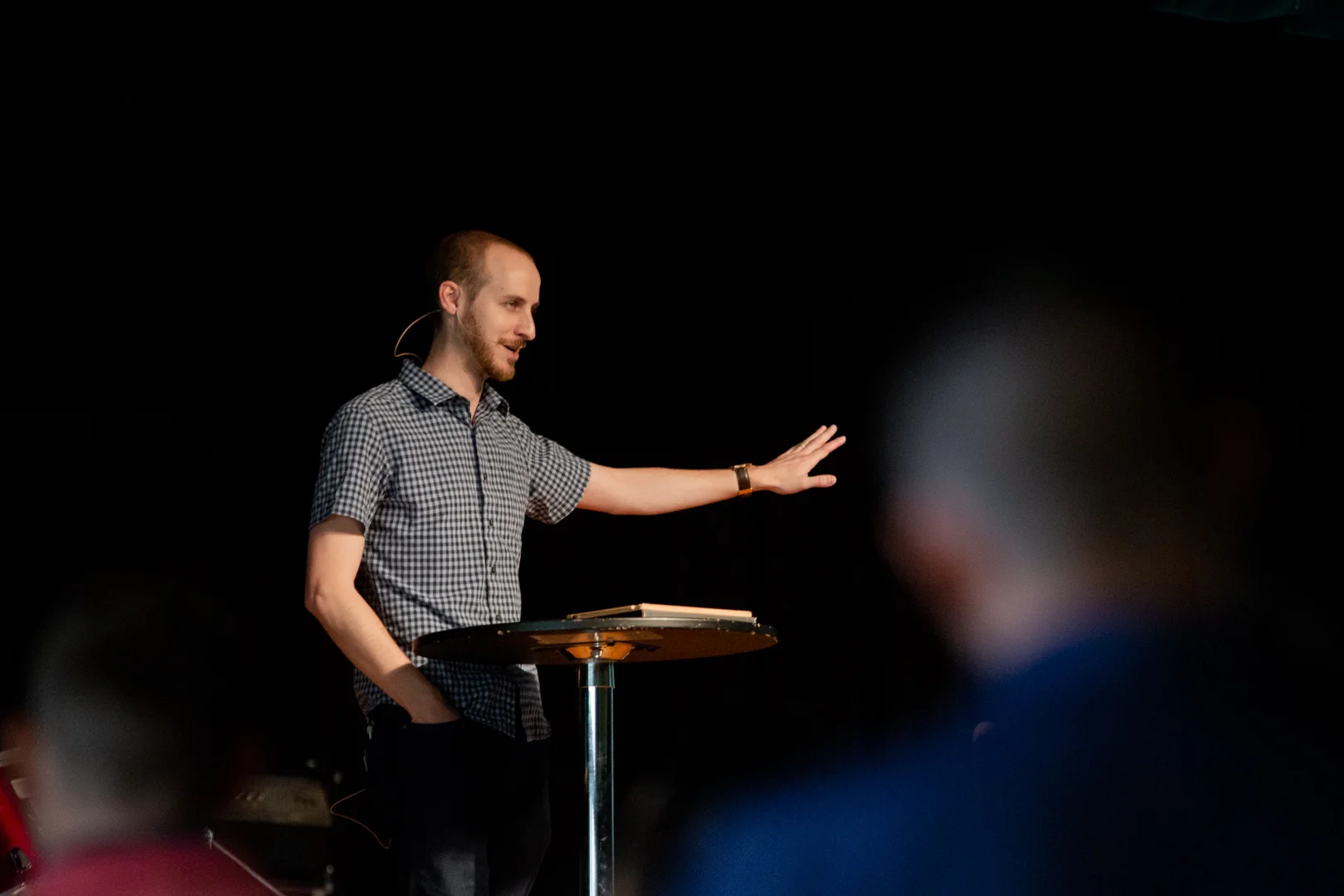

Beautiful Marriages in Exile
1 Peter 3:1-7
Beautiful Marriages in Exile
1 peter 3:1-7
“Marriage is the best training ground to let us explore the terrain of heaven and hell… Marriage gives us a taste of the goodness of God, the wonder of intimacy, and the startling naked holiness of what it means to be forgiven and found to be delightful. The goodness of marriage is almost more than we can comprehend. On the other hand, the bitter emptiness, the incomprehensible, confusing, alienating distance that comes with the hurt and failure that comes in marriage, is almost more than a human being can bear… marriage can be a taste of heaven or a taste of hell.”
~ Dan Allender
Main Idea: In the crucible of marriage, husbands and wives should hope in God and honor one another.
I. The Fearless Wife (3:1-6)
Peter continues his exhortation of how to “keep your conduct honorable” (2:12) by addressing wives. Peter’s acknowledgement and exhortation of both bondservants and wives would have been dignifying and uplifting in the 1st c. Roman Empire. He gives three broad exhortations:
A. Beautiful Submission (3:1-2)
Peter takes a general principle for all Christians (free submission) and applies it specifically to wives. This “shape” of the marriage relationship is consistently affirmed as God’s good design and not rooted in tradition or culture (cf. Gen. 2:18; Eph. 5:22-25; Col. 3:18; Rev. 19:7).
Because this gospel principle and posture has been abused, we need to note what submission is not:
It does not mean inferiority (cf. 3:7; Phil. 2:3-7)
It does not mean putting the will of your husband above the will of Christ (cf. 2:13; Eph. 5:22)
It does not mean there is no Biblical recourse in abusive or adulterous marriages
It does not mean agreeing with everything your husband says or does
Peter says this principle applies even in the very difficult circumstance where a believing wife has an unbelieving husband. “A wife should not acquire her own friends, but should make her husband’s friends her own. The gods are the first and most significant friends. For this reason, it is proper for a wife to recognize only those gods whom her husband worships and to shut the door to superstitious cults and strange superstitions” ~ Plutarch (1st Century Greek Philosopher)
B. Internal Adorning (3:3-4)
Rather than a legalistic ban on any external beauty or adorning, Peter here warns of an inordinate preoccupation or setting hope in these things; wives should treasure and pursue the “imperishable” (cf. 1:4) inward beauty of a “gentle and quiet spirit” (cf. Mt. 11:29; Gal. 5:23).
Proverbs 31:25, 30: Strength and dignity are her clothing,
and she laughs at the time to come.
Charm is deceitful, and beauty is vain,
but a woman who fears the Lord is to be praised.
C. Steadfast Hope (3:5-6)
Peter cites the example of Sarah from Genesis 18:12: So Sarah laughed to herself, saying, “After I am worn out, and my lord is old, shall I have pleasure?” Her statement was made “to herself,” revealing the posture of her heart toward her husband in what was a difficult marriage.
“The delicate relational pattern of head with helper, the head taking responsibility and providing initiative, the helper supporting, encouraging, comforting –is too beautiful to be regimented. There is no one-size-fits-all way to follow through. But a wife’s submissive heart toward her faithful husband is a pattern, a design, clearly taught in the New Testament. It is filled with potential for displaying the gospel before family, friends, neighbors, and colleagues, some of whom might never come into a church to hear the gospel.”
~ Ray Ortlund, Marriage and the Mystery of the Gospel
II. The Honorable Husband (3:7)
Peter gives two overarching exhortations to husbands:
1. Live with your wives in an understanding way (Lit. ‘according to knowledge’)
“The New Testament never tells a husband to subjugate his wife. An imperious (domineering, arrogant) husband knows nothing of the mind of Christ. Instead, the New Testament calls a Christian husband to enter into his wife’s hardships with sympathetic understanding, because she is his equal, a helper fit for him, and a fellow heir of the grace of life (1 Pet. 3:7).” ~ Ray Ortlund, Marriage and the Mystery of the Gospel
2. Show honor to your wives
‘As the weaker vessel’ (cf. 1 Thess. 4:4) speaks to the general physical realities of manhood vs. womanhood, or the social status of a wife in the 1st century. Husbands are to protect and honor this vulnerability rather than exploiting and abusing this reality.
Though they may be ‘weaker’ in this sense, they are certainly not lesser. Peter says they are to show honor to their wives “since they are heirs with you of the grace of life.” (cf. Gal. 3:28). The consequences for either the domineering or the passive husband are severe: “that your prayers may not be hindered.”
Because the mystery of marriage is a signpost to the gospel of Jesus Christ (Eph. 5:32), as husbands and wives hope in God and honor one another, they will declare and display the good news of Jesus Christ to one another and to the watching world.
“Christians are invited to ‘cut out’ small niches of hope, reconciliation, forgiveness, beauty, and health in the world. Rather than using the language of business and project management… perhaps mission is rather like marking art. We are not to expect that a beautiful sculpture will change the world into a paradise, but it will give the world something to think and talk about by just being there. ... So, this may be our task: a mission of small things – things that will be redeemed when Jesus returns.”
~ Stephen Paas, Pilgrims and Priests
Submission, Suffering, & Grace
1 Peter 2:13-25
Submission, Suffering, & Grace
1 peter 2:13-25
Main Idea: We honor the Lord by freely submitting to authority and faithfully enduring suffering.
I. Free Submission (2:13-17)
Specifying how Christians are to live “honorable” lives among unbelievers (2:12) in a variety of ordinary vocations and relationships, Peter begins by addressing authorities, urging us to “be subject to every human institution” [lit. ‘creature’].
Peter gives three reasons for this general posture of submission:
Authorities have been sovereignly put in place by God to promote justice, so we submit to them “for the Lord’s sake” (cf. Dan. 2:21; Acts 5:29)
Free submission will silence ignorant slander and accusations (cf. 2:12)
We are ultimately servants and slaves of God (cf. 1 Cor. 7:22; Rom. 6:20, 22), embracing not merely a freedom from (negative freedom), but also a freedom for (positive freedom)
“Freedom is perhaps the most resonant, deeply held American value. Yet freedom turns out to mean being left alone by others, not having other people’s values, ideas, or styles of life forced upon one, being free of arbitrary authority in work, family, and political life. What it is that one might do with that freedom is much more difficult for Americans to define.”
~ Robert Bellah, Habits of the Heart
As a summary, we are to “Honor everyone. Love the brotherhood. Fear God. Honor the emperor” (2:17). Christians ought to have a general posture of honor and respect toward others, empowered by the love we have for the “household of faith” and our worship of God, the only one we are commanded to “fear.”
II. Faithful Endurance (2:18-20)
Peter then addresses ‘servants’ or ‘slaves’ in indentured servanthood in the Roman Empire (an estimated ¼ of the population), urging them to be subject with all respect to masters who are both ‘good’ and ‘unjust’ (lit. ‘crooked’).
Peter uses this relationship as a greater paradigm of the godly response in the face of mistreatment: to endure suffering unjustly, while being “mindful of God” is actually a “gracious thing” that will be rewarded by Him (cf. Eph. 6:5-8).
Luke 6:32–35: If you love those who love you, what benefit is that to you? For even sinners love those who love them. And if you do good to those who do good to you, what benefit is that to you? For even sinners do the same. And if you lend to those from whom you expect to receive, what credit is that to you? Even sinners lend to sinners, to get back the same amount. But love your enemies, and do good, and lend, expecting nothing in return, and your reward will be great, and you will be sons of the Most High, for he is kind to the ungrateful and the evil.
III. Following Christ (2:21-25)
As we suffer for righteousness’ sake while doing good, we are stepping into our “calling” in Christ, following his example. Peter emphasizes a number of ways that Christ suffered as an example for us (cf. Isa. 53):
He did not sin or speak deceitfully
He did not revile or threaten in retaliation
He entrusted himself to God as a just Judge
Romans 12:19: Beloved, never avenge yourselves, but leave it to the wrath of God, for it is written, “Vengeance is mine, I will repay, says the Lord.”
While these exhortations are a difficult calling, Peter reminds us that Christ not only suffered with us, but he also suffered for us, in our place, on the cross. Christ’s sufferings are an invitation to a different posture and response to the sufferings we inevitably face in this life.
“If we ask the question: ‘Why does God allow evil and suffering to continue?’ and we look at the cross of Jesus, we still do not know what the answer is. However, we know what the answer isn’t. It can’t be that he doesn’t love us. It can’t be that he is indifferent or detached from our condition. God takes our misery and suffering so seriously that he was willing to take it on himself. … At the cross we have deep consolation and strength to face the brutal realities of life on earth.”
~ Tim Keller, The Reason for God
The outcome of Christ’s death on the ‘tree’(Deut. 21:32) on our behalf was not only for the forgiveness of our sins, but also that we might “die to sin and live to righteousness.” Christ’s crucifixion empowers us to live faithfully despite great opposition from within and without, having returned to our ultimate authority: The Shepherd and Overseer of our souls.
Pilgrims and Priests
1 Peter 2:9-12
Pilgrims & Priests
1 peter 2:9-12
Main Idea: As pilgrims and priests, we have been commissioned by God to declare and display the gospel.
I. Declaring the Gospel as Priests (2:9-10)
Peter reminds these “elect exiles” (1:1) of their status, name, and identity in Christ. They are:
A chosen race (Isa. 43:20-21; cf. Deut. 7:6-8; 1 Cor. 1:27-29)
A royal priesthood, a holy nation, a people for his own possession (Ex. 19:5-6)
God’s people who have received mercy (Hos. 2:23)
Three important realities can be seen in these identity markers:
They are rooted in Scripture, the place where our identity is given and formed
They emphasize God’s gracious, initiating love toward us
They are a corporate identity given to the church collectively, not merely scattered individuals
“Peter’s declaration of our ‘peoplehood’ in Christ has vast consequences for the life of the church of Christ. The church is not just a religious association formed by saved individuals to give united expression to their faith. Rather, the church is more a people than Israel was under the old covenant. Scattered in the world, indeed, as Israel was in dispersion, but a people nonetheless, bound together in the community of those who are united to one another as surely as they are united to their Lord. Church fellowship is not an optional advantage, to be chosen or ignored, like membership in a social club. It is the calling of every Christian. There is a spiritual ‘ethnicity’ to the church of Christ; Christians are blood relatives, joined by the blood of Jesus Christ”
~ Ed Clowney, The Message of 1 Peter: The Way of the Cross
As a “royal priesthood,” the church is set apart for a particular purpose: “that we may proclaim the excellencies of him who called you out of darkness into his marvelous light” (cf. 2 Cor. 4:6). “Priests” are ‘mediators’ who represent the people to God (through worship and praise) and God to the people (through teaching and blessing); our greatest ‘priestly’ service to the world is our sharing of the gospel (Rom. 15:16).
“I think we delight to praise what we enjoy because the praise not merely expresses but completes the enjoyment; it is its appointed consummation. It is not out of compliment that lovers keep on telling one another how beautiful they are; the delight is incomplete till it is expressed. It is frustrating to have discovered a new author and not to be able to tell anyone how good he is; to come suddenly, at the turn of the road, upon some mountain valley of unexpected grandeur and then to have to keep silent because the people with you care for it no more than for a tin can in the ditch; to hear a good joke and find no one to share it with.”
~ C.S. Lewis, Reflections on the Psalms
II. Displaying the Gospel as Pilgrims (2:11-12)
Peter reminds the church that our privileged and “beloved” status in Christ makes us “sojourners and exile” on the earth. He urges us as we wait for our true home to:
Abstain from the passions of our flesh which wage war against our soul; any “battles” that we might wage in this life must start first and foremost internally rather than externally (cf. Matt. 16:24; Col. 3:5; Jas. 4:1-3)
Keep our conduct among the Gentiles ‘honorable’ (good; beautiful), despite opposition, pressure, and false accusations (cf. Phil. 2:14-15)
“Inhabiting Greek as well as barbarian cities and following the customs of the natives in respect to clothing, food, and the rest of their ordinary conduct, they display to us their wonderful and confessedly striking method of life. They dwell in their own countries, but simply as sojourners. As citizens, they share in all things with others, and yet endure all things as if foreigners... They marry, as do all others; they beget children; but they do not destroy their offspring. They have a common table, but not a common bed. They are in the flesh, but they do not live after the flesh. They pass their days on earth, but they are citizens of heaven. They obey the prescribed laws, and at the same time surpass the laws by their lives. They love all men, and are persecuted by all... They are poor, yet make many rich; they are in lack of all things, and yet abound in all; they are dishonored, and yet in their very dishonor are glorified. They are evil spoken of, and yet are justified; they are reviled, and bless; they are insulted, and repay the insult with honor.”
~ The Epistle to Diognetus (2nd century AD)
As the church displays the gospel through ordinary, everyday faithfulness among unbelievers, they do not only have the “eye” of God (cf. 1:17) but also of the watching world. Peter fully expects that some will come to Christ as they “see your good deeds and glorify God on the day of visitation.”
Matthew 5:16: “… let your light shine before others, so that they may see your good works and give glory to your Father who is in heaven.”
“If you read history, you will find that the Christians who did most for the present world were just those who thought most of the next… It is since Christians have largely ceased to think of the other world that they have become so ineffective in this [one]… I must keep alive in myself the desire for my true country… I must never let it get snowed under or turned aside; I must make it the main object of life to press on to that other country and to help others to do the same.”
~ C.S. Lewis, Mere Christianity
A Living Hope in the Living Stone
1 Peter 1:22-2:8
A Living Hope in the Living Stone
1 peter 1:22-2:8
Main Idea: A living hope in the living stone produces longing hearts and loving siblings.
I. Loving Siblings (1:22-25)
“The love Peter has in view is neither a warm, fuzzy feeling nor friendships around a coffeepot after worship, though love as Peter defines it may involve both. Rather, it refers to righteous relationships with each other that are based on God’s character, which Christian behavior reflects.”
~ Karen Jobes
II. Longing Hearts (2:1-3)
“The word preached to Peter’s readers mediated their experience of God (1:25) and gave them their initial taste of the Lord. But when Peter exhorts them to crave spiritual milk, he is not telling them to crave the word of God, as if commanding them to listen to more sermons or to read more Scripture, as good and even necessary as those activities may be. He is saying that God in Christ alone both conceives and sustains the life of the new birth. They are to crave the Lord God for spiritual nourishment. They have tasted the goodness of the Lord in their conversion, but there is more to be had.”
~ Karen Jobes
III. The Living Stone (2:4-8)
2:4a Christ as Living Stone
2:4b believers as living stones
2:5 believers as spiritual house
2:6a Christ as cornerstone of the house
2:6b believers never to be shamed
2:7a the Cornerstone is honor to believers
2:7b–8a the downfall of those who reject the Living Stone
2:8b stumbling as the destiny of unbelievers
“Christ is laid across the path of humanity on its course into the future. In the encounter with him each person is changed: one for salvation, another for destruction. … One cannot simply step over Jesus to go on about the daily routine and pass him by to build a future. Whoever encounters him is inescapably changed through the encounter: Either one sees and becomes “a living stone,” or one stumbles as a blind person over Christ and comes to ruin, falling short, i.e., of one’s Creator and Redeemer and thereby of one’s destiny.”
~ Leonhard Goppelt, A Commentary on 1 Peter
Set Your Hope Fully on Grace
1 Peter 1:10-21
Set Your Hope Fully on Grace
1 peter 1:10-21
Main Idea: As the privileged recipients of grace through Christ, we are to set our hope fully on him.
I. Heavenly Curiosity (1:10-12)
Peter offers several truths about “this salvation” (cf. 1:3-9) that was to be ours:
1. The prophets predicted grace through the Christ (1:10, 12a)
2. The Spirit testified to the sufferings and glory of Christ (1:11)
“Jesus is therefore not simply the one of whom the prophets speak; he is the one who speaks through the prophets… Not only does prophecy bear witness to Jesus, but Jesus bears witness through prophecy.”
~ Edmund Clowney, The Message of 1 Peter: The Way of the Cross
3. The angels long to look at this salvation (1:12b; cf. 3:19-20; Heb. 2:16)
II. Healthy Thinking (1:13)
Peter transitions from these incredible truths of the gospel to the first command of his letter: “Therefore… set your hope fully on the grace that will be brought to you at the revelation of Jesus Christ.” To set our hope ‘fully’ in this way requires the intentional engagement of our whole being toward the Lord.
Matthew 22:35–38: And one of them, a lawyer, asked him a question to test him. “Teacher, which is the great commandment in the Law?” And he said to him, “You shall love the Lord your God with all your heart and with all your soul and with all your mind. This is the great and first commandment.
“People do not drift toward holiness. Apart from grace-driven effort, people do not gravitate toward godliness, prayer, and obedience to Scripture, faith, and delight in the Lord. We drift toward compromise and call it tolerance; we drift toward disobedience and call it freedom; we drift toward superstition and call it faith. We cherish the indiscipline of lost self-control and call it relaxation; we slouch toward prayerlessness and delude ourselves into thinking we have escaped legalism; we slide toward godlessness and convince ourselves we have been liberated.”
~ D.A. Carson, For the Love of God
Peter gives two directives related to our “thinking” as Christians:
1. Prepare your minds for action (lit. ‘gird up the loins of your mind’) (1:13a)
2 Corinthians 10:5: We destroy arguments and every lofty opinion raised against the knowledge of God, and take every thought captive to obey Christ…
2. Be sober-minded (1:13b; cf. Phil. 4:8)
III. Holy Living (1:14-16)
In addition to “healthy thinking,” Peter urges us to pursue “holy living” in response to salvation. This ‘holiness’ is framed as a proper response to the good news of the gospel:
Repentance (turning from): “do not be conformed to the passions of your former ignorance”
Faith (turning toward): “be holy in all your conduct”
To be “holy” is to be set aside to and belong “wholly” to the Lord in all that we are and in all that we do. The root of any ‘holiness’ in our lives must come from the holiness of God himself: “You shall be holy, for I am holy” (Lev. 11:44; 19:2; 20:7-8; 20:26; cf. Isa. 6:3; Rev. 4:8)
IV. Humble Fearing (1:17-21)
Peter exhorts these suffering Christians to “conduct yourselves with fear throughout the time of your exile.” This respectful, reverent, ‘fear of the Lord’ is rooted in two realities:
God is a Father who judges impartially (1:17; cf. Matt. 16:27; 2 Cor. 5:10)
We have been ‘ransomed’ (cf. Mk. 10:45) from the futile ways of our old life by “the precious blood of Christ, like a lamb without blemish or spot” (1:19)
1 Corinthians 6:19–20: Or do you not know that your body is a temple of the Holy Spirit within you, whom you have from God? You are not your own, for you were bought with a price. So glorify God in your body.
2 Corinthians 3:18: And we all, with unveiled face, beholding the glory of the Lord, are being transformed into the same image from one degree of glory to another. For this comes from the Lord who is the Spirit.
Living Hope & Inexpressible Joy
1 Peter 1:1-9
Living Hope & Inexpressible Joy
1 peter 1:1-9
Main Idea: We have living hope and inexpressible joy through suffering because of our secure inheritance in Christ.
I. A Divine Identity (1:1-2)
Peter addresses his letter to ‘elect exiles of the Dispersion,’ primarily Gentile Christians scattered across Asia Minor. Their status as ‘elect exiles’ is theological rather than socio-political; because they are loved and chosen by God, this makes them exiles (1:1; 17), strangers, and sojourners (2:11) on the earth as they await their true home.
This ‘electing’ love of God toward us is thoroughly Triune. It is…
According to the foreknowledge of God the Father (1:2a)
In the sanctification of the Spirit (1:2b)
For obedience to the Son, by the sprinkling of his blood (1:2c; cf. Ex. 24:3-8)
Philippians 3:20: But our citizenship is in heaven, and from it we await a Savior, the Lord Jesus Christ
Hebrews 11:13–16: These all died in faith, not having received the things promised, but having seen them and greeted them from afar, and having acknowledged that they were strangers and exiles on the earth. For people who speak thus make it clear that they are seeking a homeland… they desire a better country, that is, a heavenly one. Therefore, God is not ashamed to be called their God, for he has prepared for them a city.
“So much of our restlessness and disappointment is the result of trying to convince ourselves that we’re already home. [But we are called] to a refugee spirituality – unsettled yet hopeful, tenuous but searching, eager to find the hometown we’ve never been to… The disciple finds himself or herself between, on the way, fatigued yet hopeful. Baptism isn’t a capsule that transports us to the end of the road. Conversion is not an arrival at our final destination; it’s the acquisition of a compass.”
~ James K.A. Smith, On the Road with Saint Augustine
II. A Hopeful Inheritance (1:3-5)
Peter begins with a blessing and doxology to God, who in his great mercy has caused us to be born again (cf. Jn. 3) to a living hope through the resurrection of Jesus Christ. The resurrection of Christ is the key to a hope that is certain and alive, not mere “optimism” or “wishful desire” (cf. 1 Cor. 15:19).
“The means of our new birth is not first the message of the resurrection; it is the fact of the resurrection. When Christ rose he secured our salvation. He entered that new day of which the prophets spoke, and he brought us with him. Peter is saying what Paul also declared: when Christ rose, we rose. In giving life to Christ, God gave life to all those who are united to Christ. God’s elect have a hope that is as sure as Christ’s resurrection. Christ has not just made their salvation possible; he has made it sure.”
~ Edmund Clowney, The Message of 1 Peter: The Way of the Cross
This living hope is stored up for us in an ‘inheritance’ in heaven that is:
Imperishable
Undefiled
Unfading
Matthew 6:19–20: “Do not lay up for yourselves treasures on earth, where moth and rust destroy and where thieves break in and steal, but lay up for yourselves treasures in heaven, where neither moth nor rust destroys and where thieves do not break in and steal.”
This inheritance is being kept for us while we are being kept for it (cf. Ps. 121), “guarded by God’s power through faith.” Faith and hope are intrinsically connected until our salvation is “ready to be revealed in the last time.” Our salvation is past, present, and future in Christ Jesus.
III. A Joy Inexpressible (1:6-9)
Because of the good news of this salvation, we can rejoice even though we face "various trials.” Peter draws our attention to 3 realities in our suffering as Christians, that invite us to joy (cf. Jas. 1:2-4)
1. Suffering is temporary (1:6). Compared to the glories that await us in the future, all of our suffering is but “a little while.”
2 Corinthians 4:16–18a: So we do not lose heart. Though our outer self is wasting away, our inner self is being renewed day by day. For this light momentary affliction is preparing for us an eternal weight of glory beyond all comparison, as we look not to the things that are seen but to the things that are unseen.
"Suffering brings discouragements, because of our impatience. 'Alas!' We lament, 'I shall never get through such a trial.' But if God brings us into the trial he will be with us in the trial and at length bring us out, more refined. We shall lose nothing but dross (Zech. 13:9). From our own strength we cannot bear the least trouble, but by the Spirit's assistance we can bear the greatest.”
~ Richard Sibbes, The Bruised Reed
2. Suffering strengthens and refines our faith (1:7a).“Men will never become great in divinity until they become great in suffering.” ~ Charles Spurgeon, “The Christian’s Heaviness and Rejoicing”
3. Suffering results in praise, glory, and honor (1:7b).
While we await the ‘revelation’ of Jesus Christ, though we do not see him (cf. Jn. 20:29), we believe in him, love him, and “rejoice with joy that is inexpressible and filled with glory.” Joy in God in the midst of suffering results in great glory, as we endure as elect exiles until the day we see Christ face to face.
Hebrews 12:1b–2: “… let us run with endurance the race that is set before us, looking to Jesus, the founder and perfecter of our faith, who for the joy that was set before him endured the cross, despising the shame, and is seated at the right hand of the throne of God.”

Jesus is King
Psalm 72
Jesus is King
Psalm 72
Main Idea: Jesus is the king we long to follow.
I. The Dominion of Jesus’ Rule and Reign (72:1-11)
Isaiah 9:6-7: For to us a child is born, to us a son is given, and the government will be on his shoulders. And he will be called Wonderful Counselor, Mighty God, Everlasting Father, Prince of Peace. Of the greatness of his government and peace there will be no end. He will reign on David’s throne and over his kingdom, establishing and upholding it with justice and righteousness from that time on and forever. The zeal of the Lord Almighty will accomplish this.
Ephesians 1:20-23: …that he worked in Christ when he raised him from the dead and seated him at his right hand in the heavenly places, far above all rule and authority and power and dominion, and above every name that is named, not only in this age but also in the one to come. And he put all things under his feet and gave him as head over all things to the church, which is his body, the fullness of him who fills all in all.
II. The Deliverance of Jesus’ Rule and Reign (72:12-14)
Isaiah 53:5: But he was pierced for our transgressions; he was crushed for our iniquities; upon him was the chastisement that brought us peace, and with his wounds we are healed.
Romans 8:1-2: There is therefore now no condemnation for those who are in Christ Jesus. For the law of the Spirit of life has set you free in Christ Jesus from the law of sin and death.
III. The Destination of Jesus’ Rule and Reign (72:15-20)
Genesis 12:1–3: Now the Lord said to Abram, “Go from your country and your kindred and your father's house to the land that I will show you. And I will make of you a great nation, and I will bless you and make your name great, so that you will be a blessing. I will bless those who bless you, and him who dishonors you I will curse, and in you all the families of the earth shall be blessed.”
Revelation 11:15: Then the seventh angel blew his trumpet, and there were loud voices in heaven, saying, “The kingdom of the world has become the kingdom of our Lord and of his Christ, and he shall reign forever and ever.”
“It properly applies to the kingdom of Christ; and although that kingdom often totters upon the earth when assailed with the furious hatred of the whole world, and battered by the most formidable engines of Satan, it is yet wonderfully upheld and sustained by God, that it may not altogether fail.”
-John Calvin
I Sing, You Sing, We All Sing to Our King
Psalm 68
I Sing, You Sing, We All Sing to Our King
Psalm 68
Main Idea: Our God is great. Our God is good. Let us rejoice and sing.
I. Our God Descends (68:1-10)
Psalm 68:1–2: God shall arise, his enemies shall be scattered;
and those who hate him shall flee before him!
As smoke is driven away, so you shall drive them away;
as wax melts before fire,
so the wicked shall perish before God!
Numbers 10:35: And whenever the ark set out, Moses said, “Arise, O Lord, and let your enemies be scattered, and let those who hate you flee before you.”
Psalm 68:5-10: Father of the fatherless and protector of widows
is God in his holy habitation.
God settles the solitary in a home;
he leads out the prisoners to prosperity,
but the rebellious dwell in a parched land.
O God, when you went out before your people,
when you marched through the wilderness, Selah
the earth quaked, the heavens poured down rain,
before God, the One of Sinai,
before God, the God of Israel.
Rain in abundance, O God, you shed abroad;
you restored your inheritance as it languished;
your flock found a dwelling in it;
in your goodness, O God, you provided for the needy.
Psalm 68:3-4:But the righteous shall be glad;
they shall exult before God;
they shall be jubilant with joy!
Sing to God, sing praises to his name;
lift up a song to him who rides through the deserts;
his name is the Lord;
exult before him!
John 1:14: And the Word became flesh and dwelt among us, and we have seen his glory, glory as of the only Son from the Father, full of grace and truth.
The God who descended in fire at Sinai descended in flesh in Bethlehem.
Let us rejoice and sing!
II. Our God Ascends (68:11-27)
Psalm 68:11-17: The Lord gives the word;
the women who announce the news are a great host:
“The kings of the armies—they flee, they flee!”
The women at home divide the spoil—
though you men lie among the sheepfolds—
the wings of a dove covered with silver,
its pinions with shimmering gold.
When the Almighty scatters kings there,
let snow fall on Zalmon.
O mountain of God, mountain of Bashan;
O many-peaked mountain, mountain of Bashan!
Why do you look with hatred, O many-peaked mountain,
at the mount that God desired for his abode,
yes, where the Lord will dwell forever?
The chariots of God are twice ten thousand,
thousands upon thousands;
the Lord is among them; Sinai is now in the sanctuary.
Psalm 68:18-23: You ascended on high,
leading a host of captives in your train
and receiving gifts among men,
even among the rebellious, that the Lord God may dwell there.
Blessed be the Lord,
who daily bears us up;
God is our salvation. Selah
Our God is a God of salvation,
and to God, the Lord, belong deliverances from death.
But God will strike the heads of his enemies,
the hairy crown of him who walks in his guilty ways.
The Lord said,
“I will bring them back from Bashan,
I will bring them back from the depths of the sea,
that you may strike your feet in their blood,
that the tongues of your dogs may have their portion from the foe.”
Psalm 110:1: The Lord says to my Lord:
“Sit at my right hand,
until I make your enemies your footstool.”
Ephesians 4:7-8: But grace was given to each one of us according to the measure of Christ's gift. Therefore it says, “When he ascended on high he led a host of captives,
and he gave gifts to men.”
Psalm 68:24-27: Your procession is seen, O God,
the procession of my God, my King, into the sanctuary—
the singers in front, the musicians last,
between them virgins playing tambourines:
“Bless God in the great congregation,
the Lord, O you who are of Israel's fountain!”
There is Benjamin, the least of them, in the lead,
the princes of Judah in their throng,
the princes of Zebulun, the princes of Naphtali.
Colossians 3:16: Let the word of Christ dwell in you richly, teaching and admonishing one another in all wisdom, singing psalms and hymns and spiritual songs, with thankfulness in your hearts to God.
2 Corinthians 2:14-16: But thanks be to God, who in Christ always leads us in triumphal procession, and through us spreads the fragrance of the knowledge of him everywhere. For we are the aroma of Christ to God among those who are being saved and among those who are perishing, to one a fragrance from death to death, to the other a fragrance from life to life. Who is sufficient for these things?
The God who ascended to Zion ascended to the right hand of the Father.
Let all his people rejoice and sing!
III. Our God Reigns (68:28-35)
Psalm 68:28-30: Summon your power, O God,
the power, O God, by which you have worked for us.
Because of your temple at Jerusalem
kings shall bear gifts to you.
Rebuke the beasts that dwell among the reeds,
the herd of bulls with the calves of the peoples.
Trample underfoot those who lust after tribute;
scatter the peoples who delight in war.
Psalm 68:31: Nobles shall come from Egypt;
Cush shall hasten to stretch out her hands to God.
Psalm 68:32-35: O kingdoms of the earth, sing to God;
sing praises to the Lord, Selah
to him who rides in the heavens, the ancient heavens;
behold, he sends out his voice, his mighty voice.
Ascribe power to God,
whose majesty is over Israel,
and whose power is in the skies.
Awesome is God from his sanctuary;
the God of Israel—he is the one who gives power and strength to his people.
Blessed be God!
Revelation 5:9-10: And they sang a new song, saying,
“Worthy are you to take the scroll
and to open its seals,
for you were slain, and by your blood you ransomed people for God
from every tribe and language and people and nation,
and you have made them a kingdom and priests to our God,
and they shall reign on the earth.”
The God who reigns from Zion’s throne reigns the world with truth and grace.
Let the whole world rejoice and sing!
Satisfied in God
Psalm 63
Satisfied in God
Psalm 63
“These poets knew far less reason than we for loving God. They did not know that he offered them eternal joy; still less that he would die to win it for them. Yet they express a longing for him, for his mere presence, which comes only to the best Christians or to Christians in their best moments. They long to live all their days in the temple so that they may constantly see “the fair beauty of the Lord” (Ps. 27:1). Their longing to go up to Jerusalem and “appear before the presence of God” is like a physical thirst (Ps. 42)… Lacking that encounter with him, their souls are parched like a waterless countryside (Ps. 63:2).”
~ C.S. Lewis, Reflections on the Psalms
Main Idea: Our souls' deepest longings and greatest needs are satisfied by God alone.
I. Longing for the Lord (63:1-2)
“Think how powerful are the desires in human hearts. One person covets gold, another silver, another possessions, another ancestral lands, another plenty of ready money, another vast herds, another a spacious house, another a wife, another high rank, and another children. You are familiar with these desires, and you know how powerful they can be in the hearts of men and women. Everyone burns with desire, but there are precious few who can say to God: ‘My soul thirsts for you.’ People thirst for the world … where their souls are meant to be thirsting for God.”
~ Augustine, Psalms
II. Satisfied in the Lord (63:3-8)
Mark 8:36: For what does it profit a man to gain the whole world and forfeit his soul?
Matthew 5:6: “Blessed are those who hunger and thirst for righteousness, for they shall be satisfied.”
Revelation 22:17: The Spirit and the Bride say, “Come.” And let the one who hears say, “Come.” And let the one who is thirsty come; let the one who desires take the water of life without price.
III. Safe in the Lord (63:9-11)
Isaiah 25:6-8: On this mountain the Lord of hosts will make for all peoples
a feast of rich food, a feast of well-aged wine,
of rich food full of marrow, of aged wine well refined.
And he will swallow up on this mountain
the covering that is cast over all peoples,
the veil that is spread over all nations.
He will swallow up death forever;
and the Lord God will wipe away tears from all faces,
and the reproach of his people he will take away from all the earth,
for the Lord has spoken.
“Miktam” Moments: When I am Afraid
Psalm 56
Faithful Justice
Psalm 55
Main Idea: When I am afraid, I put my trust in God.
I. The Storm Before the Calm
This psalm commemorates a defining moment that re-oriented David’s response to a recurring problem - specifically “when I am afraid.” “Miktam” moments generally include two equally important components:
The Calamity that Reveals the Problem - in this case fear
The “Solution” that Magnifies the Problem - in this case panic
1. The Calamity that Reveals the Problem: Fear
David summarizes the longer story that landed him in Gath in the opening phrases of our psalm:
Psalm 56:1-2, 5-6: Be gracious to me, O God, for man tramples on me;
all day long an attacker oppresses me;
my enemies trample on me all day long,
for many attack me proudly.
All day long they injure my cause;
all their thoughts are against me for evil.
They stir up strife, they lurk;
they watch my steps,
as they have waited for my life.
2. The “Solution” that Magnifies the Problem: Panic
When David left Jonathan, fear took the driver’s seat in his decision-making. Scripture gives us no explanation of what David was thinking here, but this could not have been a smart move. David shows up in Gath, home of the giant he killed and beheaded in front of everybody, carrying the giant’s sword.
It’s after this traumatic string of events that David has his “miktam” moment: His fear-driven panic had put the word of God at risk. David was facing Saul’s opposition and his resulting ordeal because God had anointed him king instead of Saul. In the aftermath of this chaotic, traumatic episode, David realized that he had responded improperly to fear and, consequently, through his panic, had put God’s promise at risk. This was not the posture of a person who trusts in the LORD.
This psalm is written to be sung out loud as a reminder of what to do when fear threatens to drive you to panic. David’s “miktam” moment broke the hold of fear and panic and re-oriented him to the bigger story of what was happening in his life.
Psalm 56:3-4: When I am afraid,
I put my trust in you.
In God, whose word I praise,
in God I trust; I shall not be afraid.
What can flesh do to me?
II. The God Who Tracks our Tears
David found his way out of fear and into trust by remembering God’s awareness, God’s character, and God’s management.
Psalm 56:7-8: For their crime will they escape?
In wrath cast down the peoples, O God!
You have kept count of my tossings;
put my tears in your bottle.
Are they not in your book?
God’s Awareness: He Never Overlooks Anything
People’s sins against us are not overlooked by God any more than the tears those crimes cause go unnoticed before God.
God’s Character: He Always Is Who He Is
When David begs God at the beginning of this psalm to be gracious to him, he is asking God to be who He is on David’s behalf. This gracious God - the great I AM - whose word he trusted, had chosen David. David remembered the character of God and made the conscious decision to trust Him to be who He is.
God’s Management: He Always Does What He Says He Will
The story of God’s management is this: His enemies face His wrath. His chosen will know His salvation. No wonder David repeats our main point! For all of the nasty stuff that David endured “all day long” from enemies who wished to “trample on” him, he came to the conviction that he would outlast them because “God is for me!”
III. The Vows that Shall be Kept
God, whose word I trust, will keep His promises to me:
He will be gracious to me, though man seek to trample on me (56:1)
He will keep count of my tossings, put my tears in his bottle, writing them all in his book, though criminals commit their crimes against me
He will deliver my soul from death and my feet from falling, while my enemies turn back.
I will walk before God in the light of life - now and forever!
We know how the story ends. David is delivered from and through many trials into the kingship God chose him for.
Psalm 56:12-13: I must perform my vows to you, O God;
I will render thank offerings to you.
For you have delivered my soul from death,
yes, my feet from falling,
that I may walk before God
in the light of life.